
Secure Access Service Edge Market Outlook: Size, Share, Trends, Growth Analysis, Competitive Landscape & Forecast, 2026-2033

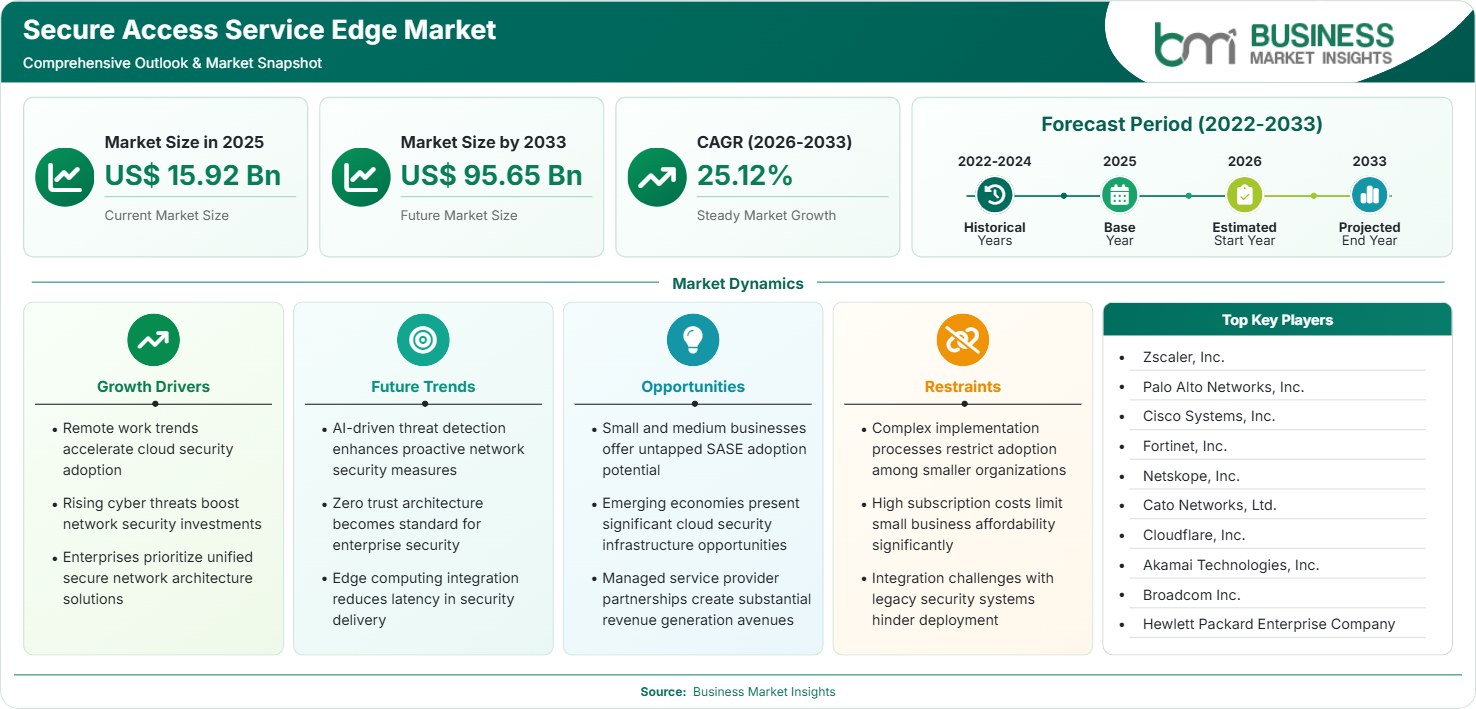
The Secure Access Service Edge market size was valued at US$ 15.92 Billion in 2025 and is projected to reach US$ 95.65 Billion by 2033, growing at a CAGR of 25.12% during 2026–2033, driven by cloud migration, zero-trust adoption, distributed workforces, and demand for unified network-security architectures.

Report Coverage
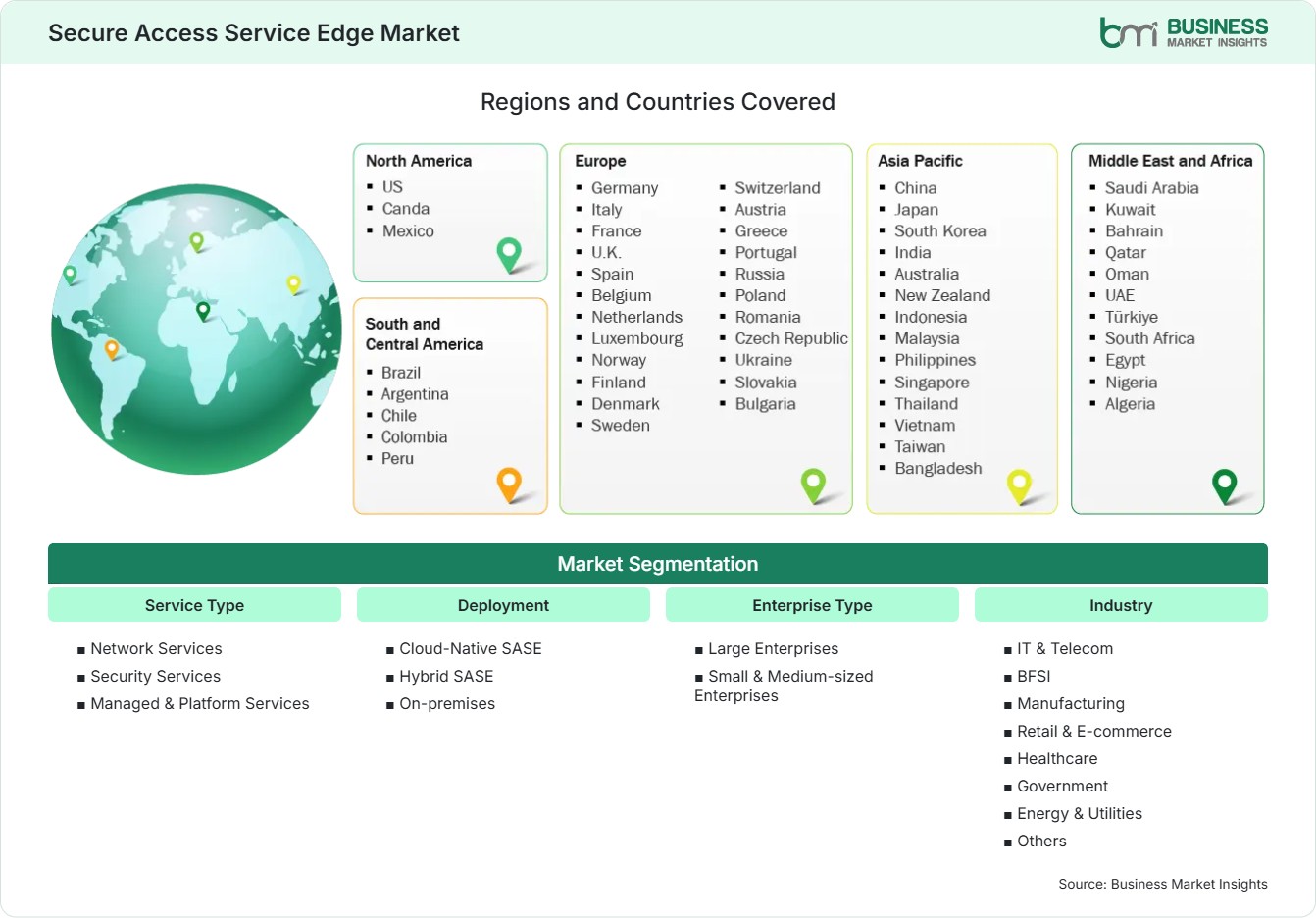
  • Service Type: Network Services, Security Services, Managed & Platform Services
  • Deployment: Cloud-Native SASE, Hybrid SASE, On-premises
  • Enterprise Type: Large Enterprises, Small & Medium-sized Enterprises
  • Industry: IT & Telecom, BFSI, Manufacturing, Retail & E-commerce, Healthcare, Government, Energy & Utilities, Others
US$ 15.92 Bn Market size in 2025
US$ 95.65 Bn Market Size by 2033
25.12% CAGR, 2026 - 2033
2026-2033 Forecast Period

AI Overview

Secure Access Service Edge Market Summary

  • North America Region: holds a Secure Access Service Edge Market share of 39%–43% in 2025, growing with a CAGR of 23%–25%, influenced by zero-trust programs, cloud migration, cyber resilience investments, and managed security demand. US enterprises accelerate SASE adoption through hybrid-cloud modernization, remote access controls, and integrated security procurement.
  • Fastest Growing Region: Asia Pacific holds a market share of 20%–24% in 2025, growing with a CAGR of 27%–29%, supported by rapid cloud adoption, expanding digital enterprises, cybersecurity modernization, and investments in distributed connectivity.
  • Leading Segment: Security Services holds a market share of 42%–46% in 2025, growing with a CAGR of 24%–26%, supported by zero-trust access, secure web gateways, cloud security, identity controls, and increasingly consolidated enterprise security architectures.
  • High Growth Segment: Cloud-Native SASE holds a Secure Access Service Edge Market share of 48%–52% in 2025, growing with a CAGR of 27%–29%, driven by scalable cloud delivery, distributed users, multi-cloud workloads, simplified administration, and integrated security enforcement.
  • Key Market Opportunity: Enterprises are shifting from fragmented security appliances toward unified cloud-delivered architectures, creating opportunities for vendors offering integrated networking, identity, security analytics, automation, managed services, and policy orchestration.
  • Major Market Players: Zscaler, Inc.; Palo Alto Networks, Inc.; Cisco Systems, Inc.; Fortinet, Inc.; Netskope, Inc.; Cato Networks, Ltd.; Cloudflare, Inc.; Akamai Technologies, Inc.; Broadcom Inc.; Hewlett Packard Enterprise Company.
Strategic Insights

Secure Access Service Edge Market: Strategic Insights

Secure Access Service Edge Market Strategic Framework
FREE PDF
Request your free sample
Request free sample
Stakeholder View

Key Takeaways

  • The ecosystem is moving toward integrated platforms that combine SD-WAN, secure access, threat prevention, identity, cloud security, and analytics. This changes value capture from individual appliances toward recurring software, subscriptions, managed services, and lifecycle support.
  • Cloud-native delivery represents the strongest structural opportunity because enterprises increasingly need consistent policies for employees, contractors, branches, SaaS applications, private applications, and multi-cloud workloads without deploying security infrastructure at every location.
  • Artificial intelligence is becoming an important differentiator in policy analysis, anomaly detection, threat prioritization, configuration assistance, and security operations. Vendors able to connect AI capabilities with trusted telemetry can reduce administrative complexity.
  • Asia Pacific provides an attractive investment case because cloud adoption, digital commerce, distributed workforces, and cybersecurity modernization are progressing simultaneously across India, China, Japan, Southeast Asia, and Australia.
  • Investment activity is increasingly focused on platform breadth and integration. Partnerships between network operators and security vendors are strengthening managed SASE propositions, while vendors are expanding zero-trust, SD-WAN, cloud-security, and AI capabilities.
  • Enterprise buyers increasingly evaluate SASE according to operational outcomes rather than isolated feature counts. Lower policy complexity, faster deployment, consistent user experience, and measurable security effectiveness are becoming central purchasing criteria.
Geographic Outlook

Secure Access Service Edge Market Regional Highlights

North America Secure Access Service Edge Market

North America accounted for a 39%–43% share in 2025 and is projected to record a 23%–25% CAGR through 2033. Mature cloud adoption, distributed enterprise architectures, zero-trust programs, and cybersecurity budgets support leadership. The Secure Access Service Edge Market share remains strongest in the United States, where large enterprises increasingly consolidate networking and security procurement. Canada contributes through cloud modernization and regulated-industry digitization, while Mexico provides additional demand from manufacturing, nearshoring, and multinational supply chains. External market studies also identify North America as the leading regional market, supporting the modeled range used here.

  • Enterprise modernization is shifting spending toward integrated networking-security platforms that can replace multiple legacy appliances and simplify policy administration across branches and cloud environments.
  • Zero-trust programs are increasing demand for identity-aware access, secure web gateways, cloud access controls, and continuous inspection across employees, contractors, applications, and unmanaged endpoints.
  • The United States remains the principal demand center, with financial services, technology, healthcare, government, and large distributed enterprises prioritizing resilient access architectures.
  • Managed service providers and telecommunications operators are expanding SASE bundles, creating recurring-revenue opportunities and lowering deployment barriers for organizations lacking specialized security operations teams.

US Secure Access Service Edge Market

The US represented approximately 72%–76% of North American demand in 2025 and is projected to grow at 23%–25% CAGR through 2033. Large technology companies, financial institutions, healthcare organizations, retailers, and federal agencies are replacing fragmented remote-access architectures with identity-centric controls. Regulatory scrutiny around sensitive information strengthens investment in secure access and monitoring. The US also benefits from a dense ecosystem of cybersecurity vendors, cloud providers, telecommunications companies, and managed security providers. Vendor innovation in AI-assisted security, zero-trust access, and secure networking should sustain adoption across distributed enterprise environments.

  • Federal cybersecurity modernization and zero-trust initiatives reinforce demand for continuous verification, least-privilege access, identity controls, and centralized policy enforcement across distributed environments.
  • Financial institutions and healthcare providers prioritize secure connectivity because sensitive data, third-party access, remote operations, and compliance requirements increase the cost of fragmented security architectures.
  • Large US enterprises increasingly evaluate SASE platforms through operational efficiency, deployment speed, and policy consistency rather than individual security feature availability.

Europe Secure Access Service Edge Market

Europe held a modeled 24%–28% share in 2025 and is projected to register a 24%–26% CAGR of the Secure Access Service Edge Market during 2026–2033. Germany, the UK, and France represent leading demand centers, while Ireland, the Netherlands, and Nordic markets provide strong technology adoption. European enterprises face complex data-governance requirements and increasingly distributed application environments, making centralized policy enforcement valuable. Germany is expected to maintain strong adoption through industrial digitization, while the UK remains a significant cybersecurity services market. France benefits from cloud modernization and public-sector digitization. Sovereignty requirements also encourage localized SASE architectures and controlled service delivery.

  • Germany combines industrial connectivity requirements with stringent cybersecurity priorities, supporting demand for secure access architectures across manufacturing, logistics, automotive, and enterprise technology environments.
  • The UK benefits from mature cloud adoption and a large managed-security ecosystem, supporting integration between secure networking, identity, cloud access, and threat prevention.
  • France is strengthening cyber resilience across public and private organizations, creating opportunities for vendors offering policy centralization and managed security capabilities.
  • Nordic economies provide attractive adoption conditions because digitally intensive enterprises require scalable security controls across cloud applications, remote users, and distributed operational environments.

Asia Pacific Secure Access Service Edge Market

Asia Pacific is projected to account for 4% share in expected to register the highest 27%–29% CAGR in the Secure Access Service Edge Market until 2033. The leading countries in this region include China, Japan, India, Australia, and South Korea. In addition, Southeast Asia provides high growth demand. Growth in India is driven by digital and cloud services, as well as distributed technologies. The growth in Japan is driven by robust enterprise infrastructure, and in Australia by high cybersecurity needs. In China, enterprise network and cloud technologies are under development. External research indicates that the Asia-Pacific region is the fastest-growing region.

  • India provides substantial upside as enterprises expand cloud workloads, digital services, remote operations, and security modernization, making the country an important long-term demand center.
  • Japan's mature enterprise technology base supports migration from traditional perimeter security toward identity-aware, cloud-delivered access and centralized policy management.
  • Australia combines strong cloud penetration with cybersecurity priorities across government, financial services, healthcare, mining, and critical infrastructure.
  • Southeast Asian enterprises increasingly adopt cloud services and distributed applications, creating demand for scalable architectures that reduce branch-level infrastructure and operational complexity.

Rest of World Secure Access Service Edge Market

South and Central America are expected to contribute about 5%-7% to the global Secure Access Service Edge market in 2025. Brazil, Mexico, Chile, and Colombia present the most promising commercial potential. The growth in the region is driven by cloud migration, financial digitalization, and the adoption of managed security services. The Middle East is witnessing considerable investment in digital government, smart infrastructure, cloud computing, and cyber resilience, while South Africa remains an important African market for technology. Managed SASE will help address the dearth of skilled security professionals.

The RoW segment is projected to grow at approximately 21%–23% CAGR through 2033. The UAE and Saudi Arabia benefit from national digital transformation programs, while Brazil's large enterprise base supports adoption across financial services, retail, telecommunications, and industrial sectors.

  • Brazil's financial and telecommunications ecosystems provide a strong use case for integrated security because distributed users and digital transactions require continuous access protection.
  • Gulf markets are developing sophisticated cloud and digital-government infrastructures, increasing demand for secure connectivity across public services, enterprises, and critical infrastructure.
  • South Africa provides an important African demand center as financial institutions and large enterprises modernize remote access and cloud security capabilities.
  • Managed service models can accelerate adoption where organizations require advanced security without building large internal cybersecurity operations teams.
Global Market Geography
FREE PDF
Request your free sample
Request free sample
Segment Analysis

Secure Access Service Edge Market Segmentation

Service Type

Service Type is crucial to buying decisions, as organizations are increasingly concerned with integrating connectivity, security, and operational services. The category Security Services has emerged as the dominant one, capturing a market share of 42%–46% and registering a CAGR of 24%–26% in 2025. The Secure Access Service Edge Market trends support service integration and service delivery as organizations seek fewer consoles and consistent policies.

  • Network Services: Network Services connect branches, users, applications, and cloud resources through software-defined connectivity. Adoption is supported by SD-WAN modernization, traffic optimization, branch simplification, and demand for application-aware routing.
  • Security Services: Security Services address zero-trust access, secure web traffic, cloud applications, data protection, and threat prevention. Demand increases as enterprises consolidate perimeter controls and require continuous inspection across distributed environments.
  • Managed & Platform Services: Managed & Platform Services provide centralized orchestration, monitoring, policy management, and operational support. They appeal to organizations seeking predictable subscription costs and reduced dependence on specialized internal security teams.

Deployment

Deployment Architecture drives scalability, control, integration, and operational cost. Cloud-Native SASE is the clear front-runner, with a 48%-52% market share by 2025 and a 27%-29% compound annual growth rate in the Secure Access Service Edge Market, driven by the distributed workforce and cloud workloads.

  • Cloud-Native SASE: Cloud-Native SASE provides scalable security and networking through distributed cloud infrastructure. Enterprises favor it for rapid deployment, centralized policy management, flexible capacity, and consistent protection across remote users and cloud applications.
  • Hybrid SASE: Hybrid SASE combines cloud-delivered functions with selected on-premises controls. It supports organizations balancing modernization with legacy systems, data-localization requirements, operational technology constraints, or specialized network architectures.
  • On-premises: On-premises deployments remain relevant where enterprises require local processing, infrastructure control, or specialized compliance. Adoption is concentrated in environments where latency, sovereignty, or existing security investments limit immediate cloud migration.

Enterprise Type

The Enterprise Type factor impacts the procurement, deployment complexity, and managed service dependency. Large Enterprises will account for an estimated market share of 64% - 68% of the Secure Access Service Edge Market in 2025 and experience a 23%- 25% CAGR, owing to complex networks and higher cybersecurity budgets.

  • Large Enterprises: Large Enterprises require unified policy enforcement across branches, employees, contractors, applications, and cloud workloads. SASE supports consolidation, security operations efficiency, global access control, and modernization of complex enterprise networks.
  • Small & Medium-sized Enterprises (SMEs): SMEs increasingly adopt cloud-delivered SASE because subscription models reduce upfront infrastructure requirements. Managed services provide access to advanced security capabilities without requiring extensive specialist teams or dedicated security operations centers.

Industry

The industry’s demand will be a function of regulatory risk, distribution, information sensitivity, and cloud dependency. BFSI and IT & Telecom are key centers for adoption. Healthcare, government, manufacturing, and retail are increasingly concerned about identity-centric access. The scope of the industry-specific Secure Access Service Edge Market is expanding as business operations become more interconnected.

  • IT & Telecom: IT & Telecom organizations require scalable access across cloud platforms, distributed infrastructure, software development environments, and remote users. SASE supports network modernization while improving security policy consistency.
  • BFSI: BFSI organizations prioritize secure access because transaction systems, customer information, third-party ecosystems, and regulatory controls demand continuous authentication, monitoring, and granular authorization.
  • Manufacturing: Manufacturing enterprises increasingly connect plants, suppliers, remote engineers, and industrial applications. Secure access architectures can reduce exposure while supporting distributed production and hybrid IT environments.
  • Retail & E-commerce: Retailers require secure connectivity across stores, warehouses, payment environments, corporate systems, and digital platforms. SASE helps standardize security controls while supporting seasonal traffic and distributed operations.
  • Healthcare: Healthcare organizations need controlled access to clinical applications, patient information, connected devices, and cloud systems. Identity-aware security supports compliance and reduces exposure from distributed access points.
  • Government: Government agencies require resilient access architectures across departments, contractors, applications, and remote users. Zero-trust principles and centralized controls support modernization while improving visibility over access decisions.
  • Energy & Utilities: Energy and utility organizations connect operational assets, field teams, control environments, and corporate systems. SASE adoption supports secure remote connectivity while helping segment access to sensitive infrastructure.
Market Forces

Secure Access Service Edge Market Dynamics

Key Market Drivers

Cloud Migration and Distributed Enterprise Architectures

With increased cloud adoption, enterprise traffic is transitioning from centralized data centers to distributed applications, SaaS platforms, and multi-cloud systems. This architectural transformation is one of the major drivers of the Secure Access Service Edge Market growth due to the inability of the traditional perimeter approach to offer consistent control for users and applications that function beyond corporate offices. Enterprises now need identity-based access, secure web inspection, cloud application control, and efficient routing from multiple geographical locations. This results in less dependency on the backhaul of traffic by centralized security appliances. Leading tech vendors have hence been combining their networking and security services onto a subscription platform. Zscaler said its expanded 2026 architecture was designed to ensure secure communication among unmanaged devices, B2B partners, and multi-cloud workloads.

Zero-Trust Security Adoption

The concepts of zero trust are changing security policy to be based not on network location but on identity, device health, application context, and policy enforcement. This change is in line with Secure Access Service Edge Market trends since SASE solutions allow merging identity-based access with secure connectivity and threat detection capabilities. More and more organizations, including financial services, health care institutions, government agencies, and tech firms, need fine-grained controls for their workers, contractors, partners, and third-party applications. Network segmentation does not have to rely solely on traditional VPN approaches. Fortinet's 2025 SASE strategy uses secure SD-WAN, universal ZTNA, and AI-powered threat detection.

Security and Networking Consolidation

Enterprise IT departments face challenges in reducing operational complexity due to the presence of firewalls, virtual private networks, SD-WAN systems, web gateway security, cloud access security brokers, and identity management. Thus, consolidation will become a structural force, as consolidated architectures will reduce policy management duplication and simplify monitoring. In terms of economics, consolidation will be beneficial not only through reduced licensing costs but also through reduced deployment complexity and faster troubleshooting. In Q4 2025, Fortinet noted a 40% increase in billings for the Unified SASE solution, providing a current vendor-level indicator of strong enterprise demand for converged networking and security solutions.

Key Market Opportunities

Managed SASE for Resource-Constrained Enterprises

Managed SASE provides an opportunity to extend advanced security capabilities to enterprises that cannot justify large internal security operations teams. Telecommunications companies, managed service providers, and cybersecurity specialists can offer such services on a recurrent basis. This is especially important for SMEs, regional companies, healthcare organizations, retailing companies, and industrial companies spread over a larger area. The business case makes it easier to grow geographically, as the customers do not have to build up their local security capabilities. There will be room for differentiation in service-level agreements, industry-specific compliance controls, local data processing, and security operations. Secure Access Service Edge Market Forecasts need to account for this recurring managed-service revenue model as well as enterprise platform usage.

Sovereign and Industry-Specific SASE Architectures

The issues of data sovereignty, sector regulation, and national cybersecurity policies offer opportunities for localized SASE solutions. Banks, healthcare organizations, government entities, and critical infrastructure providers may need greater control over inspection sites, logging, policy management, and data placement. These needs could be met by vendors via sovereign cloud offerings, dedicated service infrastructure, localized PoPs, and specialized policy management. The sovereign SASE offering from Fortinet is expected to become available in 2025 as a dedicated private SASE solution for the financial, healthcare, and government industries. This represents an opportunity to differentiate from other vendors beyond just features.

AI-Assisted Security Operations and Policy Automation

AI may add value by reducing the overhead of managing complex access policies, conducting threat investigations, configuring systems, and detecting anomalies. SASE solutions collect large volumes of telemetry from users, applications, devices, network traffic, and security events, providing a valuable basis for automation-based prioritization. With the help of AI, vendors may suggest policies, detect anomalies in access patterns, correlate events, and even assist security specialists. The evolution of Zscaler towards agentic administration until 2026 proves the product development path, while the wider adoption of AI brings opportunities to integrate decision-making assistance for vendors without undermining governance.

Market Restraints and Challenges

Integration Complexity Across Legacy Infrastructure

Factor: Many businesses operate in heterogeneous environments, with legacy firewalls, virtual private networks (VPNs), wide-area network (WAN) technologies, identity systems, operating systems, and specific applications that cannot be migrated all at once. Impact: Migrating to SASE requires a phased approach, interoperability testing, policy translation, and considerable change management. This may prolong the deployment process and undermine the cost savings associated with consolidation. Hybrid SASE models will decrease transition risks but will still retain some complexity as businesses transition from legacy controls. This means that SASE vendors should offer migration tools, powerful APIs, policy portability, and professional services. The ability to coexist is becoming increasingly important for businesses considering SASE adoption.

Data Sovereignty, Compliance, and Vendor Dependence

Factor: Providing security in the cloud requires firms to analyze factors such as data processing location, logging, regulatory requirements, service availability, and dependencies on external systems. Impact: Firms that are highly regulated may require additional analysis and approval before adopting cloud platforms. Divergent regulatory requirements may hamper the standardization of the deployment process worldwide. Service failures or the absence of points of presence in specific regions may affect the solution's performance. Solution vendors are responding to the challenge with sovereign architectures, regional infrastructure, better contract management, and regional services. But still, enterprises need to consider portability, exit strategy, and pricing.

Company Analysis

Competitive Landscape

The competitive environment combines cloud-native security specialists, networking companies, firewall vendors, and broader cybersecurity platforms. Secure Access Service Edge Market analysis indicates that competitive differentiation is increasingly based on platform integration, cloud scale, zero-trust depth, SD-WAN capabilities, threat intelligence, managed services, and AI-assisted operations. Major vendors are expanding beyond individual product categories to capture larger portions of enterprise security and connectivity spending.

Company Name

Overview

Products and Services relevant to this market

Zscaler, Inc.

Cloud-native security specialist focused on zero-trust access and secure connectivity for distributed enterprises.

Zero Trust SASE, ZTNA, secure web gateway, cloud firewall, CASB, digital experience monitoring, and AI-enabled administration.

Palo Alto Networks, Inc.

Cybersecurity provider combining network security, cloud security, security operations, and secure access capabilities.

Prisma Access, SD-WAN, ZTNA, secure web gateway, cloud-delivered firewall, CASB, and integrated SASE controls.

Cisco Systems, Inc.

Global networking and cybersecurity provider integrating connectivity, identity, observability, and security technologies.

Cisco Secure Access, SD-WAN, security gateways, zero-trust access, cloud security, and network management capabilities.

Fortinet, Inc.

Cybersecurity company focused on converged networking and security across branches, enterprises, and service providers.

FortiSASE, Secure SD-WAN, ZTNA, secure web gateway, firewall, cloud security, and FortiOS-based security controls.

Netskope, Inc.

Cloud and data security specialist providing security controls for users, applications, data, and network traffic.

Netskope One SASE, SSE, SD-WAN integration, ZTNA, CASB, SWG, DLP, and cloud security analytics.

Cato Networks, Ltd.

Cloud networking company delivering converged secure connectivity through a globally distributed platform.

Cato SASE Cloud, SD-WAN, ZTNA, SWG, CASB, firewall, WAN optimization, and managed security capabilities.

Cloudflare, Inc.

Connectivity and security platform with extensive global edge infrastructure for enterprise traffic and applications.

Cloudflare One, Zero Trust, secure web gateway, network firewall, CASB, ZTNA, and connectivity services.

Akamai Technologies, Inc.

Edge technology provider combining application delivery, network security, and distributed infrastructure.

Enterprise Application Access, secure access, cloud security, ZTNA, web security, and edge connectivity capabilities.

Broadcom Inc.

Technology company with enterprise infrastructure and VMware networking assets supporting hybrid-cloud environments.

VMware SD-WAN, secure access capabilities, network virtualization, hybrid-cloud networking, and enterprise infrastructure management.

Hewlett Packard Enterprise Company

Enterprise technology provider supporting secure networking and edge transformation through HPE Aruba networking solutions.

Aruba EdgeConnect, SD-WAN, SSE capabilities, secure access, WAN optimization, network management, and edge connectivity.

Trust & Transparency

Research Methodology

The market analysis combines proprietary research with secondary data from government agencies, company disclosures, regulatory filings, industry databases and expert interviews. Market estimates are validated through data triangulation, cross-market benchmarking and analyst review.

View Full Research Methodology

Questions Answered

Frequently Asked Questions

How will AI influence SASE platforms through 2033?

AI is likely to improve threat prioritization, policy recommendations, anomaly detection, configuration assistance, and security operations. The strongest platforms will combine AI automation with identity, network, endpoint, cloud, and threat telemetry while retaining governance over automated decisions.

What should buyers evaluate before selecting a Secure Access Service Edge market report?

Buyers should examine segmentation methodology, regional coverage, deployment models, vendor positioning, historical assumptions, forecast methodology, and whether market estimates distinguish networking, security, platform, and managed-service revenues.

Which industries offer the strongest long-term SASE opportunities?

BFSI, IT and telecom, healthcare, government, manufacturing, and retail offer strong opportunities because they combine distributed operations with sensitive data, regulatory obligations, and increasing cloud dependence.

How does cloud-native deployment change enterprise security architecture?

Cloud-native deployment moves security inspection and policy enforcement closer to users and applications. This can reduce traffic backhauling, improve scalability, and simplify policy management while supporting remote workforces and multi-cloud environments.

What factors are accelerating enterprise adoption of SASE platforms?

Cloud migration, distributed workforces, zero-trust programs, application decentralization, and pressure to simplify security operations are accelerating adoption. Enterprises increasingly want common access policies across users, branches, applications, and cloud workloads rather than separate controls for each environment.

Access the Full Secure Access Service Edge Market Report

Get segment-level forecasts, regional estimates, competitive benchmarking, company profiles and downloadable Excel datasets.

Access the full Secure Access Service Edge Market Report
350 pages PDF & Excel | 2026-09-23
Similar Research

Related Market Reports