
Fixed Wireless Access Market Outlook: Size, Share, Trends, Growth Analysis, Competitive Landscape & Forecast, 2026-2033

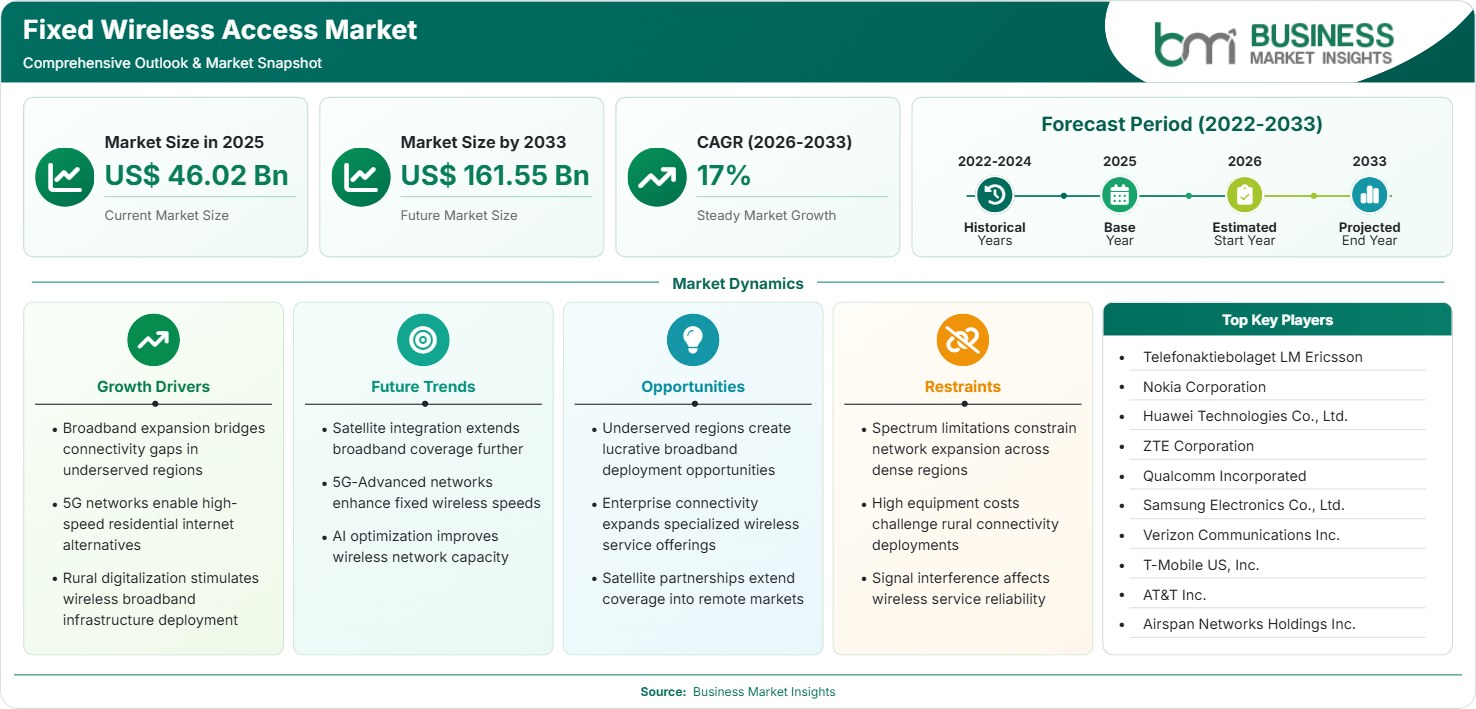
The Fixed Wireless Access Market size was valued at US$ 46.02 Billion in 2025 and is projected to reach US$ 161.55 Billion by 2033, growing at a CAGR of 17% during 2026–2033. Rising 5G deployments, expanding broadband access initiatives, increasing demand for last-mile connectivity, and rural digitization programs are creating substantial commercial opportunities across residential, enterprise, and industrial applications.

Report Coverage
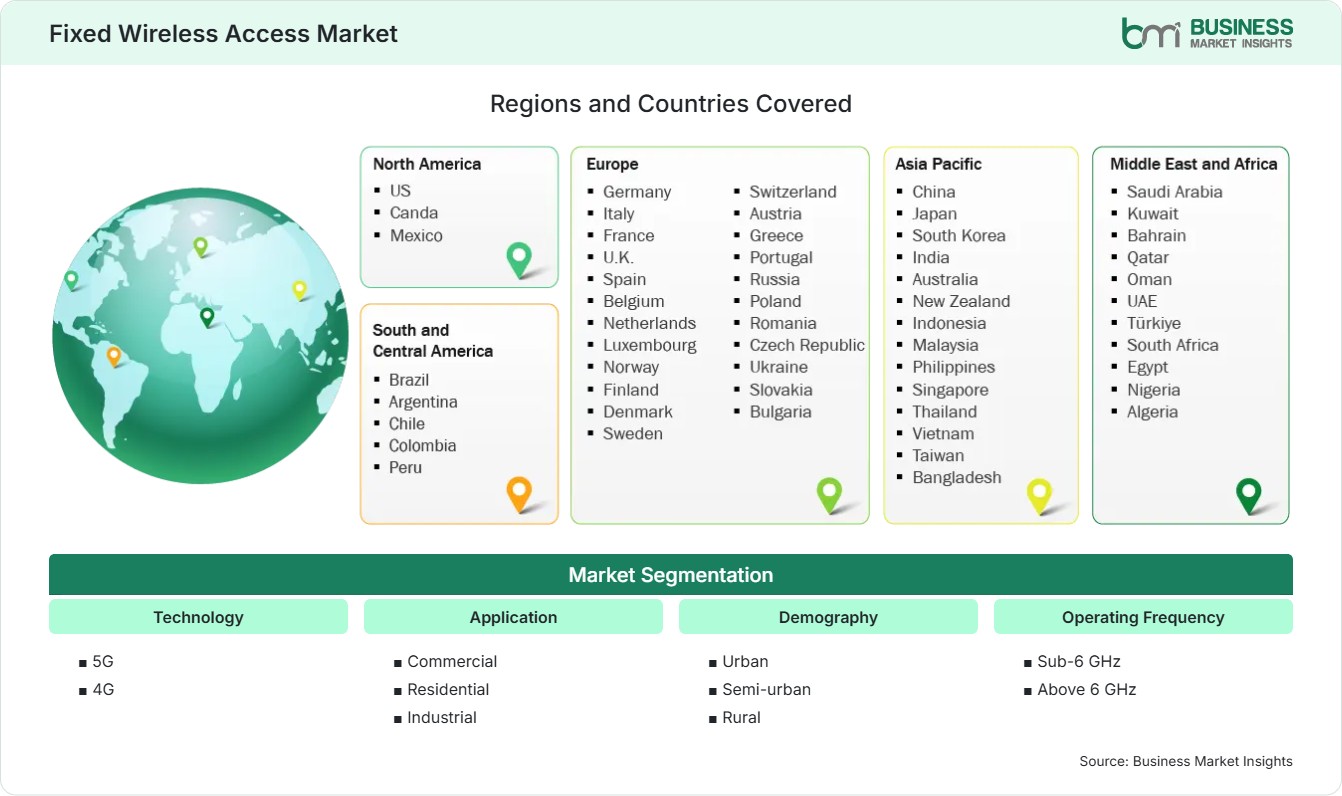
  • Technology: 5G, 4G
  • Application: Commercial, Residential, Industrial
  • Demography: Urban, Semi-urban, Rural
  • Operating Frequency: Sub-6 GHz, Above 6 GHz
US$ 46.02 Bn Market size in 2025
US$ 161.55 Bn Market Size by 2033
17% CAGR, 2026 - 2033
2026-2033 Forecast Period

AI Overview

Fixed Wireless Access Market Summary

  • North America Region: North America holds market share of 34%–37% in 2025, growing with a CAGR of 15.5%–17.0% during 2026–2033, supported by strong 5G infrastructure investments, broadband expansion programs, enterprise digitalization, spectrum availability, and increasing demand for cost-effective connectivity solutions in underserved communities. The U.S. market benefits from extensive carrier investments and expanding rural broadband initiatives, advancing at approximately 16.0%–17.5% CAGR through 2033.
  • Fastest Growing Region: Asia Pacific holds market share of 26%–29% in 2025, growing with a CAGR of 19.0%–21.0% during 2026–2033, driven by rapid urbanization, accelerating 5G deployments, government-backed digital inclusion programs, expanding industrial connectivity requirements, rising broadband demand, and increasing telecommunications infrastructure spending across developing economies.
  • Leading Segment: 5G technology accounts for 58%–62% share in 2025 and advances at a CAGR of 18.0%–20.0%, supported by superior network capacity, enhanced spectral efficiency, low latency performance, enterprise adoption, broadband substitution demand, and expanding operator investments in next-generation wireless infrastructure.
  • High Growth Segment: Industrial applications represent 18%–22% share in 2025 while growing at 19.0%–21.0% CAGR, fueled by Industry 4.0 deployment, private network requirements, remote asset monitoring, smart manufacturing initiatives, operational efficiency demands, and adoption of connected industrial automation technologies.
  • Key Market Opportunity: Expanding wireless broadband coverage in underserved and rural regions offers significant opportunity through public funding programs, spectrum optimization, affordable customer premises equipment, and enhanced service quality supporting digital inclusion objectives.
  • Major Market Players: Telefonaktiebolaget LM Ericsson, Nokia Corporation, Huawei Technologies Co., Ltd., ZTE Corporation, Qualcomm Incorporated, Samsung Electronics Co., Ltd., Verizon Communications Inc., T-Mobile US, Inc., AT&T Inc., and Airspan Networks Holdings Inc.
Strategic Insights

Fixed Wireless Access Market: Strategic Insights

Fixed Wireless Access Market Strategic Framework
FREE PDF
Request your free sample
Request free sample
Stakeholder View

Key Takeaways

  • The ecosystem is evolving from a traditional telecommunications model toward an integrated broadband delivery framework where chipset providers, network equipment vendors, operators, spectrum owners, and customer premises equipment manufacturers collectively shape value creation and service differentiation.
  • Residential broadband replacement remains the largest revenue contributor, while industrial connectivity applications present the highest long-term upside due to increasing adoption of smart manufacturing, predictive maintenance, connected logistics, and private wireless networking solutions.
  • Innovation is shifting toward standalone 5G architectures, AI-driven network optimization, cloud-native core infrastructure, advanced beamforming technologies, and energy-efficient radio systems that enhance coverage, capacity, and service reliability.
  • Asia Pacific presents a compelling expansion opportunity as governments accelerate broadband accessibility targets, telecom operators expand 5G footprints, and enterprises invest in digital transformation initiatives across manufacturing, transportation, and public services sectors.
  • Strategic partnerships between telecommunications operators and equipment suppliers are accelerating deployment timelines. Industry participants are increasingly pursuing infrastructure-sharing agreements, spectrum collaborations, and fixed-mobile convergence strategies to improve market penetration and profitability.
  • The growing availability of mid-band and millimeter-wave spectrum resources is improving service economics, enabling operators to serve underserved locations where fiber deployment remains financially challenging or operationally impractical.
Geographic Outlook

Fixed Wireless Access Market Regional Highlights

North America Fixed Wireless Access Market

North America accounted for approximately 34%–37% of global revenue in 2025 and is projected to expand at a 15.5%–17.0% CAGR through 2033. The region is aided by substantial investment in 5G, good spectrum access, and government-backed broadband initiatives. The region is advantaged by its well-developed telecoms infrastructure and high demand for digital services. The Fixed Wireless Access Market share remains highest in North America due to carrier-led network expansion strategies targeting suburban and rural households where fiber deployment economics remain less attractive.

  • Major telecommunications operators continue expanding mid-band spectrum utilization, improving network capacity while enabling broadband-grade connectivity solutions for residential and small-business users across underserved communities.
  • Federal broadband initiatives and infrastructure funding programs encourage deployment in rural areas, strengthening broadband accessibility and accelerating customer acquisition opportunities for wireless service providers.
  • Enterprise demand for secure, scalable connectivity solutions is increasing adoption across healthcare, education, retail, and logistics sectors, supporting diversified revenue generation beyond residential applications.
  • Advancements in customer premises equipment, beamforming technologies, and network management software improve service quality, helping operators compete effectively against cable and fiber broadband alternatives.

US Fixed Wireless Access Market

The United States represents approximately 78%–82% Fixed Wireless Access Market share within North America in 2025 and is forecast to grow at a 16.0%–17.5% CAGR during the forecast period. Competitive carriers, rapid 5G rollouts, and investments in broadband for rural areas keep pushing adoption. The demand for alternative broadband services continues to be high in both suburbs and other underserved areas. Positive regulatory programs as well as spectrum deployment plans are adding to this effort.

  • Large national carriers continue investing in standalone network architectures to improve broadband performance, lower latency, and support expanding residential subscriber bases across diverse geographic markets.
  • Rural broadband funding initiatives support connectivity deployment in underserved communities, creating long-term opportunities for service providers seeking sustainable subscriber growth.
  • Fixed-mobile convergence strategies are becoming increasingly common, enabling operators to bundle connectivity services and improve customer retention while enhancing revenue realization.
  • Enterprises increasingly utilize wireless broadband as primary or backup connectivity infrastructure, improving business continuity and network resilience across distributed operations.

Europe Fixed Wireless Access Market

Europe held approximately 24%–27% of the global Fixed Wireless Access Market revenue in 2025 and is anticipated to register a 16.0%–18.0% CAGR through 2033. The digital transformation, 5G network building, and broadband access targets drive regional expansion. There are several regions that use wireless broadband in addition to fiber rollouts, especially in geographically spread out areas. Germany is still the top region market, whereas Eastern European regions show more dynamism due to their network modernization and connectivity efforts.

  • Germany maintains regional leadership with advanced telecommunications infrastructure and enterprise digitization programs supporting large-scale broadband service adoption.
  • Poland and Romania are among the fastest-growing national markets, benefiting from expanding 5G deployments and increasing broadband accessibility initiatives.
  • Governments continue supporting digital inclusion programs designed to reduce connectivity disparities between urban and remote populations throughout the region.
  • Industrial digitization strategies across manufacturing and logistics sectors strengthen demand for reliable, scalable wireless broadband infrastructure.
  • Operators increasingly adopt open network architectures and virtualization technologies to improve deployment flexibility and operating efficiency.

Asia Pacific Fixed Wireless Access Market

Asia Pacific accounted for approximately 26%–29% of global revenue in 2025 and records the fastest expansion rate at 19.0%–21.0% CAGR through 2033. The process of urbanization, digitalization economy, and huge 5G investment program is currently reshaping the region’s connectivity infrastructure. The leader of regional 5G implementation is China, which invests much money in telecommunications. The best accelerator of 5G in the region is India, where broadband development projects are implemented. The region contributes significantly to overall Fixed Wireless Access Market growth due to its vast addressable population base.

  • China maintains regional leadership through extensive network infrastructure deployment and large-scale broadband penetration initiatives supporting households and enterprises.
  • India represents the fastest-growing major market, supported by aggressive 5G rollout programs, favorable policy initiatives, and increasing demand for affordable broadband services.
  • Southeast Asian economies continue investing heavily in digital infrastructure to support economic modernization and enhanced internet accessibility.
  • Manufacturing digitization and smart city projects generate additional demand for reliable wireless connectivity platforms.
  • Telecommunications providers increasingly target underserved communities where wireless deployment offers superior economic viability compared with extensive fiber installations.

Rest of World Fixed Wireless Access Market

The Rest of World region accounts for approximately 10%–13% of global revenue in 2025 and is projected to grow at a 17.0%–19.0% CAGR through 2033. There is an improvement in broadband accessibility programs in South and Central America, and there are more mobile network infrastructures being invested in. In contrast, the Middle East and Africa use wireless technologies to fill their connectivity gaps. Brazil leads Latin America, and Saudi Arabia has been making great strides due to its digital economy investments.

  • Brazil benefits from growing telecommunications investments and increasing demand for broadband expansion across underserved urban and rural communities.
  • Saudi Arabia continues accelerating digital infrastructure development through national transformation strategies and advanced telecommunications modernization programs.
  • Wireless broadband solutions provide cost-effective connectivity alternatives for geographically dispersed populations where fixed-line infrastructure remains limited.
  • Government-led smart city projects support network deployment opportunities across transportation, healthcare, and public administration sectors.
  • International infrastructure investments and public-private partnerships continue improving broadband accessibility throughout emerging economies.
Global Market Geography
FREE PDF
Request your free sample
Request free sample
Segment Analysis

Fixed Wireless Access Market Segmentation

Technology

Technology remains the defining competitive factor influencing network performance, deployment economics, and service scalability. This segment accounted for approximately 58%–62% share of total revenue in 2025, led by accelerating adoption of next-generation wireless infrastructure. The Fixed Wireless Access Market scope continues expanding as operators deploy advanced radio technologies to support higher broadband speeds, lower latency, and broader coverage. The segment is projected to grow at 17.5%–20.0% CAGR through 2033.

  • 5G: 5G technology delivers enhanced spectral efficiency, lower latency, and higher network throughput, enabling operators to provide fiber-like broadband experiences while supporting enterprise, residential, and industrial connectivity requirements.
  • 4G: 4G technology remains essential in regions where standalone 5G deployment is still emerging, offering cost-effective broadband coverage and facilitating connectivity expansion across underserved communities and developing markets.

Application

Application diversity continues expanding as wireless broadband becomes a practical solution across residential, commercial, and industrial environments. This segment benefits from increasing internet consumption, enterprise digitization, and growing demand for reliable remote connectivity. Residential adoption currently represents the largest revenue contributor, while industrial deployments demonstrate the strongest growth trajectory. The segment is expected to maintain robust momentum through 2033 as broadband accessibility becomes a national priority across numerous countries.

  • Commercial: Commercial adoption is increasing among retail stores, branch offices, educational institutions, and healthcare facilities seeking rapid deployment, operational flexibility, and resilient connectivity without extensive infrastructure investment.
  • Residential: Residential usage remains the primary revenue generator due to rising bandwidth requirements from streaming platforms, online education, hybrid work arrangements, and connected home ecosystems.
  • Industrial: Industrial applications benefit from smart manufacturing initiatives, remote monitoring systems, connected equipment, and digital transformation projects requiring scalable, secure, and reliable broadband connectivity platforms.

Demography

The patterns of deployment of different demographics greatly differ depending on the presence of infrastructure, density of population, and economic state. At the moment, urban regions are the biggest sources of demand because of high consumption of digital services. Nevertheless, investments into the deployment of networks are now made in semi-urban and rural regions as well because of existing network gaps.

  • Urban: Urban deployments focus on meeting growing bandwidth requirements from densely populated environments, supporting households, enterprises, and public institutions requiring high-quality wireless broadband services.
  • Semi-urban: Semi-urban markets offer substantial growth opportunities through infrastructure modernization, expanding business activities, and rising demand for affordable broadband alternatives in developing locations.
  • Rural: Rural deployments are supported by broadband inclusion initiatives, government subsidies, and operator investments aimed at reducing connectivity disparities while improving digital accessibility.

Operating Frequency

Frequency choice plays a significant role in affecting the coverage area, capacity, and effectiveness of deployment. The sub-6 GHz frequency choice is still prevalent owing to the greater coverage area and economic benefits of deployment. Higher frequencies have become more relevant in areas that demand improved data transmission. Efforts related to frequency allocations and technology innovations will continue favoring balanced adoption of frequencies in both categories.

  • Sub-6 GHz: Sub-6 GHz deployments provide extensive coverage, improved indoor penetration, and efficient spectrum utilization, making them suitable for large-scale residential and rural broadband implementation.
  • Above 6 GHz: Above 6 GHz frequencies support ultra-high capacity communications, dense urban connectivity requirements, and advanced enterprise applications requiring enhanced throughput and performance characteristics.
Market Forces

Fixed Wireless Access Market Dynamics

Key Market Drivers

Expansion of 5G Infrastructure Worldwide

The growth of 5G technology around the world is increasing access to broadband services, making it easier for Fixed Wireless Access to be deployed. According to Ericsson, FWA connections will increase from about 185 million at the end of 2025 to 350 million in 2031. There is great confidence among operators in the profitability of wireless broadband. There has been growth in investments in the network to make it better in terms of capacity and speed. Growth in mid-band coverage has increased the availability of higher-speed wireless broadband. Enhanced radio performance, declining equipment costs, and rising digital service consumption are further strengthening Fixed Wireless Access Market growth and creating opportunities for sustained subscriber acquisition.

Rural Broadband and Digital Inclusion Initiatives

Wireless broadband is increasingly being looked upon by governments as an alternative to bridge the digital divide, especially in rural and under-served areas. Broadband subsidy programs have been instrumental in helping networks roll out to regions where fiber installation may still pose economic challenges or require considerable time. The telecoms will find that they need less time to install the infrastructure and reduced capital investment in comparison with the installation of wired infrastructure. Meanwhile, the demand for the internet remains high since people are increasingly using the internet for education, health care, finance, and even governance purposes. The new requirements provide the basis for the FWA industry's success.

Growing Demand for Flexible Enterprise Connectivity

Increasingly, business customers need robust connectivity solutions that can help facilitate their distributed operations, cloud computing processes, and changing business needs. Fixed Wireless Access offers businesses the ability to establish connections quickly without the need to install fixed-line connections, making it a viable choice for places where it is not easy to deploy conventional broadband solutions. Enterprises have been utilizing wireless broadband connectivity for purposes such as setting up branch networks, ensuring business continuity, establishing temporary work sites, and as a backup connection solution. There is more demand as organizations focus on the process of digital transformation and the use of hybrid work environments.

Key Market Opportunities

Broadband Expansion Across Underserved Markets

Large areas within developing countries are inadequately serviced by broadband connections, thus presenting a large opportunity for wireless network service providers. Fixed Wireless Access Market Forecast suggests growing investment efforts, which would help expand broadband coverage not only into urban areas but also into those communities where there is limited fixed-line network coverage. In this regard, telecom companies would be able to use their mobile networks to venture into new areas by avoiding the costs involved in constructing a completely new network infrastructure. The government, on its part, is offering help in these types of ventures through funding, spectrum, and policies. There are many customers who need good internet services.

Industrial and Private Network Deployments

Manufacturing, energy, mining, and logistics industries are adopting new connectivity solutions that will make it possible to digitize and increase visibility into their businesses. Monitoring, automation, intelligent connected devices, and applications can all be easily achieved through wireless broadband, which eliminates the requirement of wired networks. With an increasing use of wireless private networks, telecommunications companies and device manufacturers have the opportunity to create new revenue streams through enterprise connectivity solutions. This means that they will be able to expand their services from residential broadband to industrial uses. Current Fixed Wireless Access Market Trends highlight that growing interest in connected operations and digital workflows is therefore creating opportunities for Fixed Wireless Access providers to participate in industrial connectivity projects and strengthen their enterprise offerings.

Fixed-Mobile Convergence Business Models

Telecom operators are becoming ever more adept at bundling both mobile and broadband services together to create better service propositions for their customers. This may be helpful in terms of enhancing customer loyalty, generating more income per individual customer, as well as making the best use of their existing spectrum and network resources. Another advantage of fixed-mobile convergence is that the telecom operator is better able to compete against fixed line broadband competitors. The current Fixed Wireless Access Market Trends indicate that the extended capabilities of 5G technology continue to support this trend by allowing operators to offer faster wireless broadband along with their mobile services. Customers prefer simpler connectivity solutions, offering convergence-oriented businesses another opportunity to differentiate themselves and gain more subscribers.

Market Restraints and Challenges

Spectrum Availability Constraints

Factor: Incompatibilities between spectrum assignment methodologies across different countries lead to additional problems in the application of FWA technology. Licensing terms, availability of spectrum, and regulations could pose additional hurdles in trying to apply standardized methodologies for deployment.

Impact: Delays, additional costs in the form of licensing fees, and inflexibility are among other things that operators can face in attempting to scale their operations. Regulatory variations could be another hurdle towards making operations consistent. In some instances, competing spectrum requirements for other mobile operations would limit the amount of bandwidth needed for wireless broadband services.

Network Capacity and Performance Management

Factor: The higher subscription density and usage of bandwidth-heavy applications, especially video streaming, are putting extra strain on the resources of the wireless networks. As more customers adopt Fixed Wireless Access, ensuring reliable service across various locations will become even more difficult.

Impact: Possible challenges for the service providers may include congestion, poor quality, and higher costs because of higher network traffic. Service providers will be required to invest continually in improving their infrastructure, antennas, spectrum management, and other measures to provide sufficient quality of service. Capacity planning is crucial for increasing the subscriber base and providing quality FWA service deployment from a commercial point of view.

Company Analysis

Competitive Landscape

Fixed Wireless Access Market analysis indicates competition across telecom operators, infrastructure vendors, semiconductor providers, and wireless equipment manufacturers.

Company Name

Overview

Products and Services relevant to this market

Ericsson AB

Global telecommunications infrastructure leader focused on 5G networks and connectivity solutions.

5G radio access solutions, network software, FWA platforms, broadband infrastructure.

Nokia Corporation

Telecommunications technology provider with strong wireless broadband portfolio.

FWA customer premises equipment, 5G infrastructure, network management platforms.

Huawei Technologies Co., Ltd.

Large-scale ICT and telecom infrastructure company operating globally.

5G networks, wireless broadband equipment, antennas, FWA devices.

Qualcomm Technologies, Inc.

Semiconductor innovator enabling advanced wireless connectivity.

5G chipsets, modem platforms, wireless broadband technologies.

Samsung Electronics Co., Ltd.

Major technology company with expanding network equipment business.

5G infrastructure, radio systems, broadband solutions.

Verizon Communications Inc.

Leading telecom operator and broadband service provider.

5G home internet, FWA connectivity services.

AT&T Inc.

Telecommunications provider serving consumer and enterprise customers.

Wireless broadband, enterprise connectivity, network services.

T-Mobile US, Inc.

Rapidly growing wireless operator leveraging 5G assets.

Fixed wireless internet, broadband services, 5G connectivity.

Vodafone Group Plc

Global operator with extensive European and international presence.

Broadband connectivity, FWA solutions, enterprise networks.

ZTE Corporation

Telecommunications infrastructure and equipment manufacturer.

Wireless access equipment, 5G systems, broadband terminals.

Trust & Transparency

Research Methodology

The market analysis combines proprietary research with secondary data from government agencies, company disclosures, regulatory filings, industry databases and expert interviews. Market estimates are validated through data triangulation, cross-market benchmarking and analyst review.

View Full Research Methodology

Questions Answered

Frequently Asked Questions

Why is a Fixed Wireless Access Market Report valuable for stakeholders?

A Fixed Wireless Access Market Report helps evaluate technology adoption patterns, competitive positioning, investment opportunities, regulatory developments, and long-term growth potential across regions and applications.

What factors influence deployment decisions?

Spectrum availability, population density, fiber economics, regulatory policies, customer demand, and expected return on investment are among the key deployment considerations.

Which application category generates the highest demand?

Residential broadband remains the largest demand center due to streaming, remote work, online learning, and increasing household connectivity requirements.

How important is 5G to future industry development?

5G enables higher capacity, lower latency, improved reliability, and differentiated service tiers, making it the primary technology platform for next-generation wireless broadband offerings.

What differentiates fixed wireless access from fiber broadband?

Fixed wireless access delivers internet connectivity through wireless spectrum rather than physical cable infrastructure, enabling faster deployment and lower installation costs in many locations.

Access the Full Fixed Wireless Access Market Report

Get segment-level forecasts, regional estimates, competitive benchmarking, company profiles and downloadable Excel datasets.

Access the full Fixed Wireless Access Market Report
350 pages PDF & Excel | 2026-09-17
Similar Research

Related Market Reports