
Blockchain Market Outlook: Size, Share, Trends, Growth Analysis, Competitive Landscape & Forecast, 2026-2033

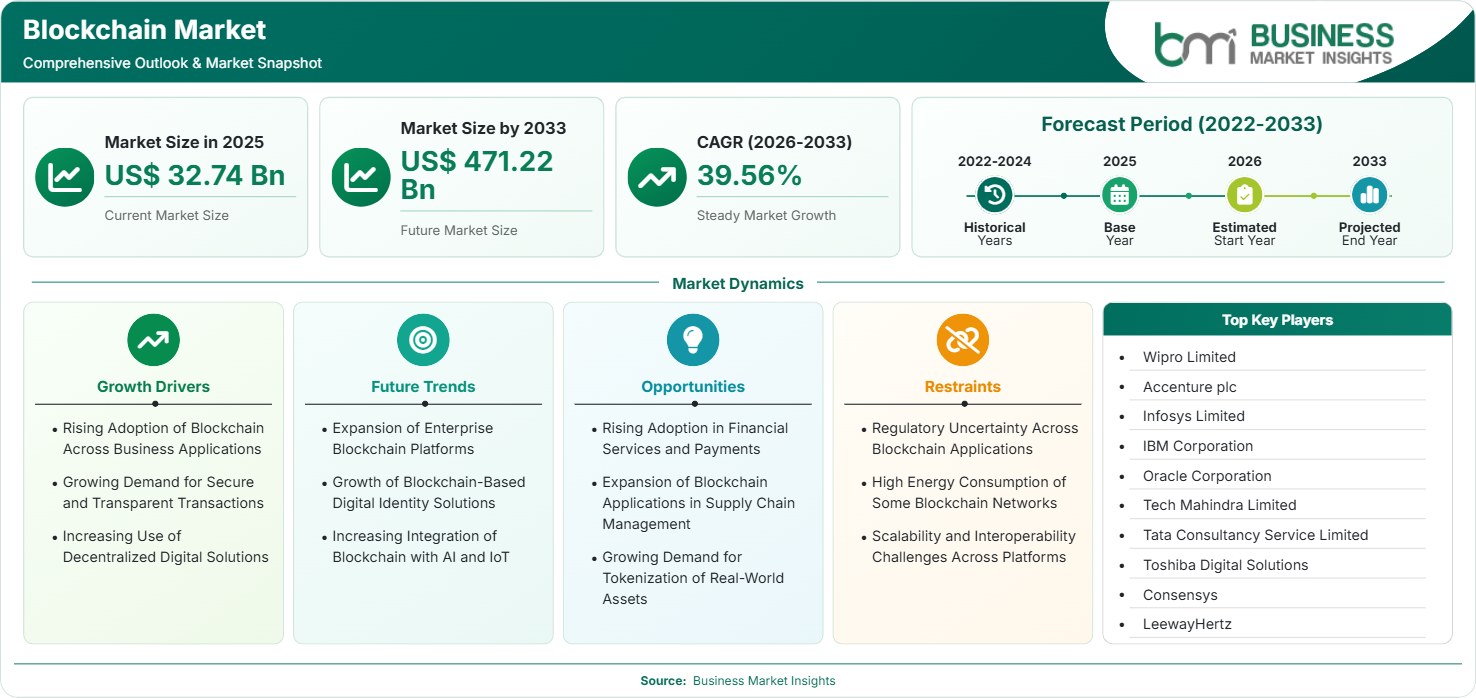
The Blockchain Market size was valued at US$ 32.74 Billion in 2025 and is projected to reach US$ 471.22 Billion by 2033, growing at a CAGR of 39.56% during 2026–2033. Growing adoption of decentralized technologies, increasing demand for secure digital transactions, and rising enterprise investments in distributed ledger solutions are supporting market growth globally. Organizations across industries are increasingly utilizing blockchain platforms to improve transparency, enhance data security, and streamline business processes.

Report Coverage
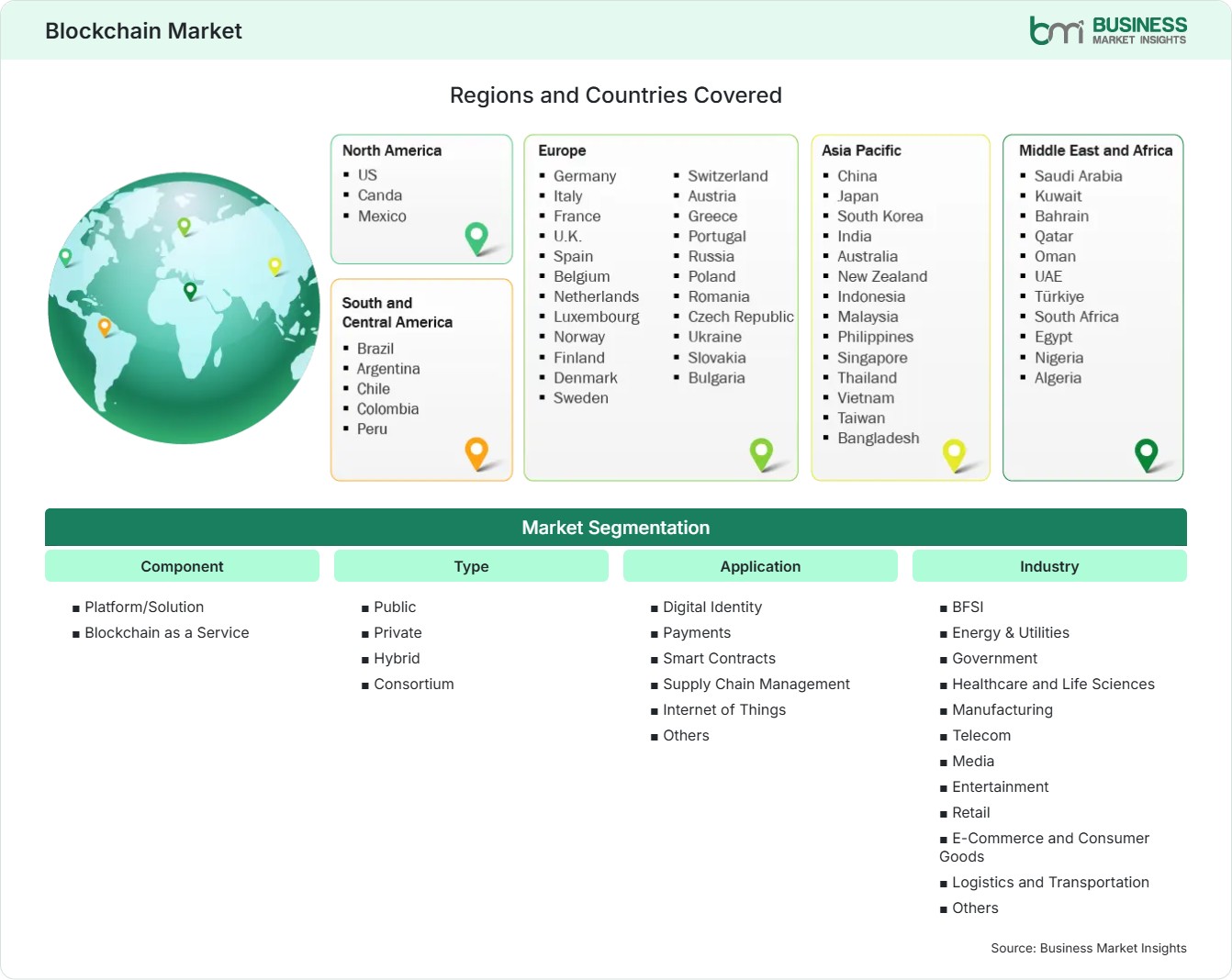
  • Component: Platform/Solution, Blockchain as a Service
  • Type: Public, Private, Hybrid, Consortium
  • Application: Digital Identity, Payments, Smart Contracts, Supply Chain Management, Internet of Things , Others
  • Industry: BFSI, Energy & Utilities, Government, Healthcare and Life Sciences, Manufacturing, Telecom, Media, Entertainment, Retail, E-Commerce and Consumer Goods, Logistics and Transportation, Others
US$ 32.74 Bn Market size in 2025
US$ 471.22 Bn Market Size by 2033
39.56% CAGR, 2026 - 2033
2026-2033 Forecast Period

AI Overview

Blockchain Market Summary

  • North America Region: North America holds a market share of 38%–41% in 2025, growing with a CAGR of 38.7%–39.4% during 2026–2033. Strong technology adoption, extensive enterprise digital transformation initiatives, and growing blockchain investments continue supporting regional leadership. The U.S. blockchain market is expected to register a CAGR of 39.0%–39.7%.
  • Fastest Growing Region: Asia Pacific accounts for 27%–30% share in 2025 and is projected to grow at a CAGR of 40.6%–41.3% through 2033. Increasing blockchain adoption across enterprises, government digitalization initiatives, and expanding fintech ecosystems continue driving regional growth.
  • Leading Segment: Platform/Solution represents 62%–65% share in 2025 and is expected to grow at a CAGR of 39.9%–40.6% through 2033. Growing deployment of enterprise blockchain platforms continues supporting segment dominance.
  • High Growth Segment: BFSI accounts for 28%–31% share in 2025 and is forecast to grow at a CAGR of 40.8%–41.5% during 2026–2033. Increasing adoption of blockchain for payments, settlements, and fraud prevention continues accelerating segment growth.
  • Key Market Opportunity: Expansion of smart contract applications, blockchain-enabled digital identity systems, decentralized finance platforms, and supply chain transparency solutions is creating substantial growth opportunities.
  • Major Market Players: Wipro Limited, Accenture plc, Infosys Limited, IBM Corporation, Oracle Corporation, Tech Mahindra Limited, Tata Consultancy Service Limited, Toshiba Digital Solutions, Consensys, and LeewayHertz.
Strategic Insights

Blockchain Market: Strategic Insights

Blockchain Market Strategic Framework
FREE PDF
Request your free sample
Request free sample
Stakeholder View

Key Takeaways

  • Blockchain technology is becoming a critical component of modern digital transformation strategies.
  • Platform and solution offerings remain the dominant segment within the market.
  • BFSI continues representing the largest industry segment for blockchain adoption.
  • Digital identity and smart contract applications are gaining significant traction.
  • Enterprises are increasingly utilizing blockchain to improve transparency and security.
  • North America remains the leading blockchain market due to strong technology investments.
  • Asia Pacific is projected to witness the fastest growth owing to expanding digital economies.
  • Supply chain management and decentralized applications are expected to create substantial future opportunities.
Geographic Outlook

Blockchain Market Regional Highlights

North America Blockchain Market

North America accounts for 38%–41% Blockchain Market share in 2025 and is projected to grow at a CAGR of 38.7%–39.4% through 2033. The region benefits from strong technology ecosystems, extensive enterprise digitization initiatives, and increasing investments in blockchain innovation.

  • Enterprises continue investing in blockchain platforms to strengthen transparency and improve operational efficiency. Adoption is particularly strong among financial institutions and technology companies.
  • Businesses are increasingly exploring decentralized applications to streamline digital workflows. These initiatives are creating demand for scalable blockchain infrastructure.
  • Financial institutions continue evaluating blockchain-based solutions for payments and transaction processing. The technology is helping improve speed and reduce operational friction.
  • Growing investment activity is supporting development of enterprise-grade blockchain solutions. Venture capital and corporate funding continue encouraging innovation.
  • Organizations are increasingly focusing on secure data sharing capabilities. Blockchain platforms are being utilized to improve trust across digital ecosystems.
  • Strong technology partnerships continue accelerating commercialization of blockchain applications. Collaboration among software providers and enterprises remains an important growth factor.

US Blockchain Market

The United States contributes approximately 90%–94% of North American revenue and is expected to register a CAGR of 39.0%–39.7% through 2033. The country remains the largest blockchain market due to advanced technology infrastructure and strong enterprise adoption.

  • Major enterprises are implementing blockchain solutions to improve data integrity and transaction transparency. Adoption continues expanding across multiple industries.
  • Technology companies are developing enterprise-focused blockchain platforms and services. Product innovation remains a key area of investment.
  • Financial institutions continue exploring distributed ledger technologies for settlements and payment applications. This trend is supporting market expansion.
  • Organizations are increasingly adopting blockchain-enabled digital identity systems. These solutions help improve authentication and security.
  • Research and development activities continue driving innovation across blockchain ecosystems. New use cases are emerging across both public and private sectors.
  • Corporate investment in digital transformation remains supportive of blockchain adoption. Many enterprises view distributed ledger technologies as a strategic capability.

Europe Blockchain Market

Europe represents 22%–25% of global revenue in 2025 and is anticipated to expand at a CAGR of 39.2%–39.9% through 2033. Increasing focus on digital innovation and data transparency continues supporting regional growth.

  • Germany continues leading regional demand through enterprise technology adoption and industrial innovation initiatives. Blockchain is increasingly being integrated into digital transformation programs.
  • Poland is among the fastest-growing markets and is estimated to register a CAGR of 40.1%–40.8% during the forecast period. Expanding technology investments continue supporting growth.
  • Enterprises are exploring blockchain solutions for supply chain visibility and document management. These applications are creating new adoption opportunities.
  • Governments are evaluating blockchain-enabled services to improve efficiency and transparency. Public sector interest continues increasing.
  • Financial institutions are implementing blockchain-based solutions to enhance operational processes. Adoption remains particularly strong within banking environments.
  • Growing interest in digital identity and secure record management continues supporting market development. Organizations are prioritizing trusted data-sharing solutions.

Asia Pacific Blockchain Market

Asia Pacific accounts for 27%–30% of global revenue in 2025 and is expected to achieve the fastest CAGR of 40.6%–41.3% through 2033. Rapid digitalization, expanding fintech ecosystems, and increasing enterprise technology adoption continue supporting strong market growth.

  • China remains the largest regional blockchain market due to significant investments in digital technologies and enterprise innovation. Organizations continue expanding blockchain deployment initiatives.
  • India is projected to achieve approximately 41.5%–42.2% CAGR, supported by growing technology adoption and digital transformation programs. Enterprises are increasingly evaluating blockchain applications.
  • Financial technology companies continue exploring blockchain platforms for transaction processing and security improvements. This trend is contributing to market growth.
  • Businesses are implementing blockchain solutions to improve supply chain visibility and traceability. Adoption is expanding across multiple industries.
  • Governments continue supporting digital innovation initiatives that encourage blockchain development. Public sector involvement remains an important growth factor.
  • Increasing awareness regarding data security and transparency continues supporting enterprise adoption. Organizations are seeking technologies that improve trust and accountability.

Rest of World Blockchain Market

Rest of World accounts for 8%–11% of global revenue in 2025 and is projected to expand at a CAGR of 37.2%–37.9% through 2033. Growing digital transformation initiatives and increasing enterprise technology investments continue supporting market development across Latin America, the Middle East, and Africa.

  • Brazil continues generating demand through expanding adoption of digital technology solutions. Organizations are increasingly evaluating blockchain use cases.
  • The UAE is witnessing increased investment in blockchain innovation and digital infrastructure development. Technology modernization efforts continue supporting market growth.
  • Saudi Arabia is expected to achieve approximately 38.1%–38.8% CAGR through 2033, supported by digital economy initiatives and enterprise modernization programs.
  • Financial institutions are increasingly exploring blockchain applications for secure transactions. Interest in distributed ledger technologies continues expanding.
  • Organizations are seeking solutions that improve transparency and data integrity. Blockchain platforms are gaining attention as part of broader digital transformation efforts.
  • Technology adoption initiatives across both public and private sectors continue creating favorable conditions for market expansion.
Global Market Geography
FREE PDF
Request your free sample
Request free sample
Segment Analysis

Blockchain Market Segmentation

Component

The component segment represents the primary offerings through which organizations deploy and manage blockchain technologies. This segment accounts for approximately 62%–65% share in 2025 and is projected to grow at a CAGR of 39.9%–40.6% through 2033. The expanding Blockchain Market Scope is supported by growing enterprise adoption, increasing demand for digital trust frameworks, and rising investments in decentralized infrastructure solutions.

  • Platform/Solution: Platform and solution offerings dominate the market due to their role in enabling blockchain application development, network management, smart contract deployment, and transaction processing.
  • Blockchain as a Service: Blockchain as a Service continues gaining traction as organizations seek cost-effective deployment models that reduce infrastructure complexity and accelerate implementation timelines.

Type

The type segment highlights the major blockchain architectures adopted across industries. This segment accounts for approximately 36%–39% share in 2025 and is expected to register a CAGR of 40.1%–40.8% through 2033. Current Blockchain Market Trends indicate increasing adoption of both permissioned and permissionless blockchain networks depending on security, compliance, and operational requirements.

  • Public: Public blockchain networks remain important for decentralized applications that require transparency, openness, and broad participation.
  • Private: Private blockchain platforms are widely adopted by enterprises that require greater control, governance, and data privacy.
  • Hybrid: Hybrid blockchains continue growing as organizations seek to combine the benefits of public and private network architectures.
  • Consortium: Consortium blockchains are increasingly used where multiple organizations need to share trusted information while maintaining collaborative governance structures.

Application

The application segment highlights the key business functions utilizing blockchain technology. This segment accounts for approximately 30%–33% share in 2025 and is projected to grow at a CAGR of 40.4%–41.1% through 2033. Organizations are increasingly exploring blockchain applications beyond financial services to improve efficiency, transparency, and security.

  • Digital Identity: Digital identity solutions are gaining traction as organizations seek secure and verifiable identity management capabilities.
  • Payments: Blockchain-based payment systems continue experiencing strong adoption due to their ability to improve transaction speed and transparency.
  • Smart Contracts: Smart contracts are expanding rapidly because they automate agreements and reduce manual intervention.
  • Supply Chain Management: Supply chain applications help improve traceability, accountability, and information sharing across business networks.
  • Internet of Things (IoT): Blockchain is increasingly supporting secure device communication and data integrity within connected ecosystems.
  • Others: Other applications include document management, digital asset management, record keeping, and decentralized applications.

Industry

The industry segment highlights the major sectors adopting blockchain technologies to enhance operational efficiency and trust. This segment accounts for approximately 28%–31% share in 2025 and is projected to grow at a CAGR of 40.8%–41.5% through 2033.

  • BFSI: BFSI remains the largest industry segment due to growing use of blockchain for payments, settlements, compliance, and fraud prevention.
  • Energy & Utilities: Energy companies are evaluating blockchain solutions for energy trading and transaction transparency.
  • Government: Government agencies are exploring blockchain for identity management, record keeping, and public service modernization.
  • Healthcare and Life Sciences: Healthcare organizations are adopting blockchain to improve data integrity and information sharing.
  • Manufacturing: Manufacturers utilize blockchain to strengthen traceability and supply chain visibility.
  • Telecom, Media, and Entertainment: Companies are leveraging blockchain to improve content management and digital transactions.
  • Retail, E-Commerce and Consumer Goods: Retailers are exploring blockchain for product authentication and customer engagement initiatives.
  • Logistics and Transportation: Logistics providers continue adopting blockchain to improve shipment tracking and operational transparency.
  • Others: Other industries include education, real estate, agriculture, and professional services.
Market Forces

Blockchain Market Dynamics

Key Market Drivers

Rising Adoption of Blockchain Across Business Applications

Blockchain technology is being widely adopted by organizations for multiple business purposes in order to achieve higher efficiency levels and build trust in digital processes. Companies are stepping away from pilot projects and beginning to apply blockchain-based solutions to process transactions, monitor assets, manage compliance, and share information. Blockchain technology helps companies reduce reliance on manual verification and increase the transparency of transactions between parties. With the rising number of organizations that see the value of blockchain technology for their operations, blockchain adoption is continuously growing.

Growing Demand for Secure and Transparent Transactions

Both security and transparency are becoming key considerations for businesses working in the digital era. Blockchain technology allows for maintaining a record of transactions, which can enhance accountability and prevent unauthorized modifications to the data. This feature is attracting the attention of banks, government bodies, supply chain managers, and companies dealing with sensitive information. Business entities are looking for technologies that will increase the level of trust but also allow processing transactions quickly and efficiently. Due to this reason, the rising concerns about cybersecurity and data integrity are likely to drive market growth.

Increasing Use of Decentralized Digital Solutions

There have been many discussions about the use of decentralized technology because businesses are looking for alternatives to centralized technology systems. Blockchain enables distributed systems that improve data exchange, reduce reliance on intermediaries, and increase system reliability. Decentralized applications have become part of operations for organizations seeking more flexible ways of working and implementing innovations. The interest in decentralized finance, decentralized identity systems, and distributed data management systems contributes to the development of this market area.

Key Market Opportunities

Rising Adoption in Financial Services and Payments

Financial institutions continue representing one of the strongest growth opportunities within the blockchain market. Banks, payment providers, and financial technology companies are investing in blockchain solutions to improve transaction efficiency and reduce processing times. The technology is also helping organizations strengthen transparency and improve compliance capabilities. Growing demand for digital financial services is encouraging further experimentation with blockchain-based payment systems. As the financial sector continues modernizing transaction infrastructure, opportunities for blockchain vendors and service providers are expected to expand significantly.

Expansion of Blockchain Applications in Supply Chain Management

Supply chain management is emerging as an important opportunity area for blockchain adoption. Organizations are utilizing distributed ledger technologies to improve product traceability and strengthen visibility across supply networks. Blockchain solutions help create transparent records that improve accountability and support informed decision-making. Businesses are increasingly seeking technologies that simplify information sharing among suppliers, distributors, and customers. As supply chains become more global and interconnected, demand for blockchain-enabled transparency solutions is expected to grow steadily.

Growing Demand for Tokenization of Real-World Assets

The tokenization of physical and financial assets is creating new opportunities across the blockchain ecosystem. Organizations are exploring methods to represent ownership of assets through digital tokens that can be managed and transferred efficiently. This approach has potential applications across real estate, financial instruments, commodities, and other asset classes. Tokenization can improve accessibility, liquidity, and administrative efficiency within asset markets. Long-term Blockchain Market Forecast projections remain favorable as businesses continue assessing blockchain-enabled asset management models.

Market Restraints and Challenges

Regulatory Uncertainty Across Blockchain Applications

Factor: Regulatory frameworks governing blockchain technologies continue evolving across countries and jurisdictions. Differences in compliance requirements, legal interpretations, taxation policies, and digital asset regulations create uncertainty for organizations seeking to deploy blockchain solutions.

Impact: Regulatory ambiguity can delay investment decisions and slow large-scale implementation initiatives. Organizations may adopt a cautious approach while waiting for clearer guidance, which can affect the pace of market expansion and long-term project development.

High Energy Consumption of Some Blockchain Networks

Factor: Certain blockchain networks require substantial computing resources to validate transactions and maintain network integrity. Concerns regarding energy consumption and environmental sustainability have become important considerations for stakeholders evaluating blockchain deployments.

Impact: Energy-related concerns may influence adoption decisions and encourage organizations to evaluate alternative consensus mechanisms. Companies may increasingly prioritize energy-efficient blockchain platforms to align with sustainability objectives and operational cost requirements.

Company Analysis

Competitive Landscape

The Blockchain Market Analysis is characterized by competition among technology consulting firms, enterprise software providers, cloud service companies, blockchain platform developers, and digital transformation specialists. Market participants are focusing on enterprise blockchain deployment, smart contract development, digital identity solutions, and decentralized application ecosystems to strengthen their market positions. Growing demand for secure digital transactions, increasing enterprise adoption of distributed ledger technologies, and expanding interest in blockchain-based business models continue driving innovation across the market. Companies are investing in platform development, blockchain integration services, industry-specific solutions, and consulting capabilities to address evolving customer requirements and accelerate enterprise adoption of blockchain technologies.

Company Name

Overview

Products and Services Relevant to this Market

Wipro Limited

Global technology services and consulting company with blockchain implementation capabilities.

Enterprise blockchain solutions, digital transformation services, smart contract development, and blockchain consulting services.

Accenture plc

Professional services company focused on technology and business transformation.

Blockchain strategy, enterprise blockchain deployment, supply chain blockchain solutions, and digital identity services.

Infosys Limited

Technology services company supporting enterprise blockchain adoption.

Blockchain platforms, consulting services, distributed ledger implementations, and business process transformation solutions.

IBM Corporation

Technology company offering enterprise blockchain infrastructure and services.

Blockchain platforms, supply chain blockchain solutions, digital asset management, and enterprise integration services.

Oracle Corporation

Enterprise software and cloud computing company.

Blockchain cloud services, enterprise ledger solutions, smart contract management, and decentralized application support.

Tech Mahindra Limited

IT services company focused on digital transformation and emerging technologies.

Blockchain consulting, distributed ledger solutions, digital identity applications, and enterprise integration services.

Tata Consultancy Service Limited

Global technology consulting and software services provider.

Enterprise blockchain platforms, business process automation, blockchain development, and implementation services.

Toshiba Digital Solutions

Technology company providing digital innovation and enterprise solutions.

Blockchain-based applications, digital transaction platforms, data management solutions, and enterprise technology services.

Consensys

Blockchain technology company focused on decentralized applications and infrastructure.

Blockchain development tools, smart contract platforms, decentralized finance solutions, and enterprise blockchain services.

LeewayHertz

Blockchain development and consulting company.

Custom blockchain solutions, tokenization platforms, smart contract development, and decentralized application services.

Trust & Transparency

Research Methodology

The market analysis combines proprietary research with secondary data from government agencies, company disclosures, regulatory filings, industry databases and expert interviews. Market estimates are validated through data triangulation, cross-market benchmarking and analyst review.

View Full Research Methodology

Questions Answered

Frequently Asked Questions

How are smart contracts influencing the blockchain industry?

Smart contracts are enabling automated execution of agreements without requiring manual intervention. These digital contracts help improve efficiency, reduce transaction delays, and enhance transparency across business processes. Growing adoption of smart contracts continues expanding blockchain use cases across multiple industries.

What does this Blockchain Market Report cover?

This report covers component analysis, type assessment, application evaluation, industry analysis, regional trends, competitive landscape analysis, market drivers, opportunities, restraints, challenges, and future growth prospects through 2033.

Why does BFSI represent the high-growth industry segment?

BFSI continues experiencing strong growth because financial institutions are actively adopting blockchain technologies for payments, settlements, compliance management, digital identity verification, and fraud prevention. The need for secure and transparent transaction processing remains a key adoption driver.

Which component segment dominates the market?

Platform/Solution dominates the market due to growing enterprise demand for blockchain infrastructure, application development capabilities, smart contract deployment, and network management solutions. Organizations prefer comprehensive platforms that support scalable blockchain implementation across multiple business functions.

What is driving growth in the market?

Rising adoption of blockchain across business applications, growing demand for secure and transparent transactions, and increasing use of decentralized digital solutions are major factors driving market growth. Organizations are increasingly implementing distributed ledger technologies to improve transparency, strengthen trust, and streamline digital operations.

Access the Full Blockchain Market Report

Get segment-level forecasts, regional estimates, competitive benchmarking, company profiles and downloadable Excel datasets.

Access the full Blockchain Market Report
350 pages PDF & Excel | 2026-08-20
Similar Research

Related Market Reports