
Blockchain Gaming Market Outlook: Size, Share, Trends, Growth Analysis, Competitive Landscape & Forecast, 2026-2033

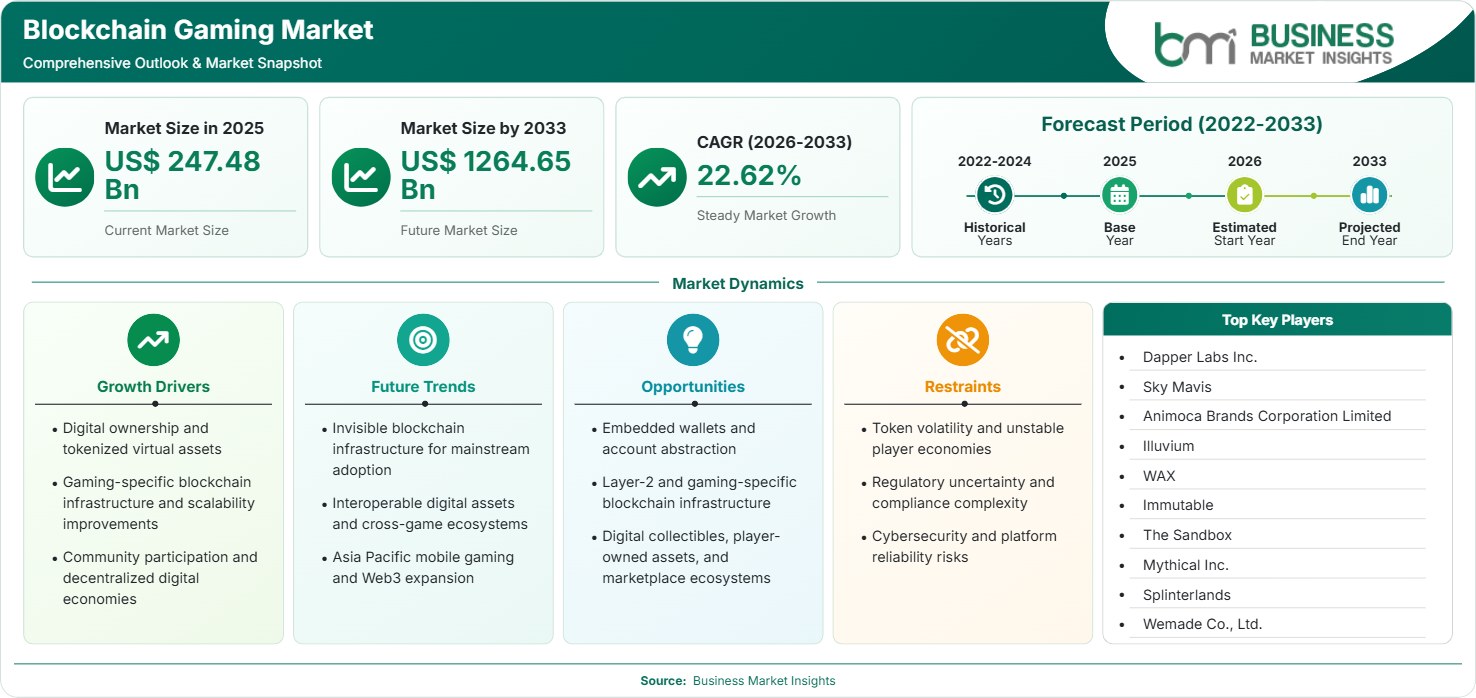
The Blockchain Gaming Market size was valued at US$ 247.48 Billion in 2025 and is projected to reach US$ 1264.65 Billion by 2033, growing at a CAGR of 22.62% during 2026–2033, supported by digital ownership, blockchain infrastructure, mobile gaming, Web3 investment, tokenized assets, decentralized economies, and player-focused monetization.

Report Coverage
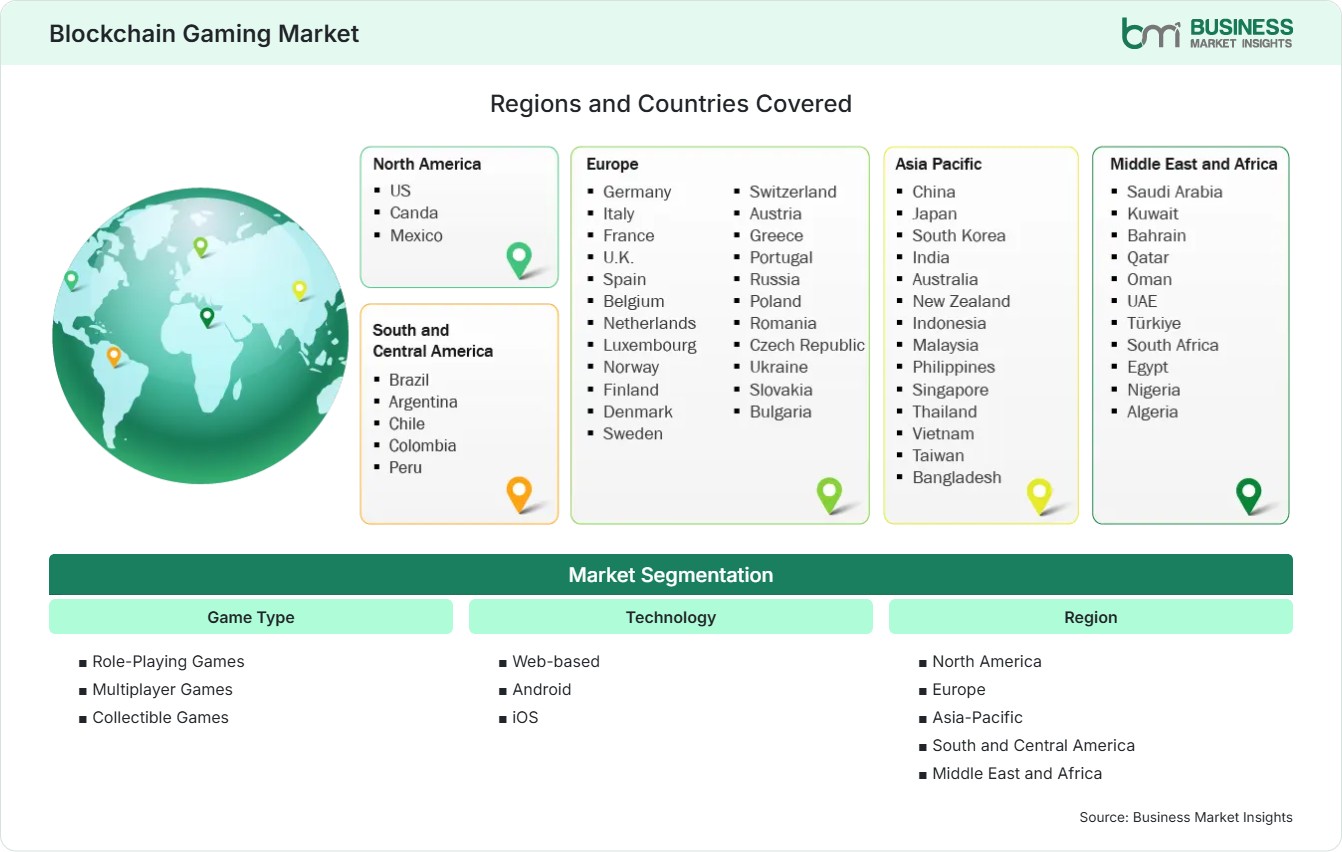
  • Game Type: Role-Playing Games, Multiplayer Games, Collectible Games
  • Technology: Web-based, Android, iOS
  • Region: North America, Europe, Asia-Pacific, South and Central America, Middle East and Africa
US$ 247.48 Bn Market size in 2025
US$ 1264.65 Bn Market Size by 2033
22.62% CAGR, 2026 - 2033
2026-2033 Forecast Period

AI Overview

Blockchain Gaming Market Summary

  • North America Region: North America held a 26%–29% share in 2025 and is projected to grow at a 20.5%–22.5% CAGR, supported by venture investment, established gaming companies, blockchain infrastructure, NFT adoption, digital wallets, developer ecosystems, and increasing institutional interest in Web3 entertainment. The US represents 82%–87% of North American demand, with a 20.8%–22.8% CAGR through 2033, supported by technology investment, established game studios, blockchain developers, and digital-asset infrastructure.
  • Fastest Growing Region: Asia Pacific held a 27%–30% share of the Blockchain Gaming Market in 2025 and is projected to expand at a 24.0%–26.5% CAGR, driven by mobile-first gaming, large player populations, esports, Web3 development, digital wallets, blockchain investment, creator communities, and growing adoption across South Korea, Japan, India, China, and Southeast Asia.
  • Leading Segment: Role Playing Games (RPG) held a 33%–35% share in 2025 and is projected to grow at a 23.0%–25.0% CAGR, supported by persistent virtual worlds, character ownership, tokenized equipment, player progression, multiplayer interaction, collectibles, guild economies, and increasingly sophisticated digital marketplaces.
  • High Growth Segment: Collectible Games held a 31%–34% share of the Blockchain Gaming Market in 2025 and is projected to grow at a 24.5%–27.0% CAGR, supported by digital collectibles, trading-card mechanics, scarce virtual assets, licensed intellectual property, secondary marketplaces, community participation, and blockchain-based ownership records.
  • Key Market Opportunity: The strongest opportunity lies in invisible blockchain infrastructure that simplifies wallets, ownership, payments, rewards, identity, interoperability, and transactions while allowing mainstream players to focus primarily on gameplay.
  • Major Market Players: Dapper Labs Inc., Sky Mavis, Animoca Brands Corporation Limited, Illuvium, WAX, Immutable, The Sandbox, Mythical Inc., Splinterlands, and Wemade Co., Ltd.
Strategic Insights

Blockchain Gaming Market: Strategic Insights

Blockchain Gaming Market Strategic Framework
FREE PDF
Request your free sample
Request free sample
Stakeholder View

Key Takeaways

  • Value-chain evolution: The ecosystem extends beyond game developers to blockchain infrastructure providers, wallets, marketplaces, payment platforms, token issuers, communities, creators, esports operators, and digital-asset service providers.
  • Application upside: RPGs and collectible games have strong structural compatibility with blockchain because persistent characters, scarce items, cards, equipment, and digital assets can support ownership and secondary-market functionality.
  • Technology direction: Layer-2 networks, gaming-specific chains, embedded wallets, account abstraction, gas sponsorship, smart-contract automation, and interoperability are reducing technical friction between blockchain infrastructure and conventional gaming.
  • Regional opportunity: Asia Pacific offers an attractive expansion environment because of its large gaming population, mobile-first consumption, esports culture, developer talent, and active Web3 ecosystem.
  • Investment direction: Capital is increasingly focused on scalable infrastructure, established communities, game studios, digital economies, and technologies that simplify onboarding rather than purely speculative token launches.
  • Competitive differentiation: Gameplay quality, intellectual property, player retention, community strength, marketplace liquidity, security, transaction reliability, and sustainable economic design are becoming stronger competitive factors.
Geographic Outlook

Blockchain Gaming Market Regional Highlights

North America Blockchain Gaming Market

North America held a 26%–29% share in 2025 and is projected to grow at a 20.5%–22.5% CAGR through 2033. External industry research places the region among the largest markets, supported by venture funding, established game developers, NFT participation, and blockchain infrastructure. The regional Blockchain Gaming Market share benefits from technology investment, sophisticated digital entertainment ecosystems, strong developer capabilities, and large consumer spending.

  • Established US and Canadian gaming ecosystems support blockchain development through experienced studios, publishers, technology providers, investors, and established intellectual-property portfolios.
  • Venture investment supports blockchain infrastructure, gaming studios, wallet providers, marketplaces, analytics platforms, and developer tools designed to reduce Web3 adoption barriers.
  • Digital ownership applications are expanding across collectibles, rewards, loyalty programs, player assets, community participation, and marketplace-based monetization.
  • Regulatory developments remain important because token structures, NFT marketplaces, consumer protection, taxation, and digital-asset transactions affect product design.

US Blockchain Gaming Market

The US represented 82%–87% of North American demand in 2025 and is projected to grow at a 20.8%–22.8% CAGR through 2033. The country combines major gaming publishers, technology companies, venture investors, blockchain developers, esports organizations, and digital-asset infrastructure. Developers increasingly emphasize gameplay quality and seamless user experiences rather than making blockchain functionality the central proposition. This supports applications involving ownership, collectibles, rewards, identity, marketplaces, and community participation.

  • US developers benefit from mature game engines, publishing networks, venture capital, intellectual property, and large gaming communities capable of accelerating successful blockchain-enabled titles.
  • Embedded wallets and simplified authentication can reduce onboarding friction for players unfamiliar with cryptocurrency, blockchain networks, or digital-asset transactions.
  • Digital collectibles, player-owned assets, loyalty systems, and creator economies provide blockchain use cases that can complement conventional game monetization.

Europe Blockchain Gaming Market

Europe held a 23%–26% share in 2025 and is projected to grow at a 19.5%–22.0% CAGR of the Blockchain Gaming Market through 2033. The region benefits from established game-development clusters, creative industries, technology startups, esports, and digital-asset infrastructure. The UK, Germany, France, Sweden, Finland, and Poland provide important development ecosystems. MiCA and related digital-asset rules are creating a more structured regulatory environment while increasing compliance requirements. Germany and the UK remain leading markets, while France and Nordic countries provide high-growth development opportunities.

  • The UK combines established publishers, independent studios, technology companies, investors, esports organizations, and a large international gaming audience.
  • Germany provides opportunities through game development, technology startups, blockchain communities, and increasing interest in digital ownership and virtual economies.
  • France benefits from strong creative industries, established game development, publisher relationships, and expanding Web3 experimentation.
  • Nordic countries contribute technical talent, established gaming studios, digital payment infrastructure, and expertise in free-to-play and mobile experiences.

Asia Pacific Blockchain Gaming Market

Asia Pacific held a 27%–30% share in 2025 and is projected to grow at a 24.0%–26.5% CAGR, making it the fastest-growing regional market. Independent industry research identifies Asia Pacific as the fastest-growing geography, supported by mobile gaming, large gaming populations, Web3 infrastructure, and cryptocurrency familiarity. South Korea, Japan, India, China, Singapore, and Southeast Asia provide differentiated growth opportunities. The regional Blockchain Gaming Market growth is increasingly supported by mobile-first distribution and developer ecosystems.

  • South Korea provides opportunities through established publishers, esports, advanced mobile infrastructure, and active blockchain gaming development.
  • Japan offers strong potential around entertainment intellectual property, collectible games, characters, digital merchandise, and premium gaming ecosystems.
  • India combines a large mobile gaming population, expanding developer talent, and growing interest in Web3 technologies and digital ownership.
  • Southeast Asia provides substantial opportunities because of mobile gaming adoption, blockchain communities, digital wallets, guilds, collectibles, and player-driven economies.
  • China remains strategically important for gaming technology and digital entertainment, although blockchain-related products require careful consideration of regulatory requirements.

Rest of World Blockchain Gaming Market

Rest of World accounted for about 18%–21% market share of the Blockchain Gaming Market in 2025 and is expected to register a CAGR of 19.0%–22.5% during 2025-2033. Latin America region takes advantage of mobile games, a young digital population, knowledge of cryptocurrencies, and growing tech communities. Brazil and Mexico are key markets, while Argentina, Colombia, and Chile are also providing business opportunities. Developers can tap into local payment solutions, low-cost mobile options, social gaming, and community-based digital economies.

The Middle East and Africa offer potential due to young demographics, smartphone adoption, growth of esports, digital payments, and increased technology investment. A gaming ecosystem is being built in the UAE and Saudi Arabia, whereas South Africa already offers an existing technology infrastructure. Localization, competitive play, digital collectibles, and the accessibility of blockchain infrastructure may aid regional efforts.

  • Brazil offers a large gaming audience, strong mobile adoption, technology communities, and opportunities for localized digital economies and competitive gaming.
  • Mexico benefits from connections with North American technology ecosystems, expanding gaming communities, and increasing adoption of mobile entertainment and digital payments.
  • The UAE is developing gaming and technology infrastructure capable of attracting studios, investors, platforms, and regional distribution activities.
  • Saudi Arabia is investing in gaming and entertainment, creating opportunities across esports, digital content, game development, and blockchain infrastructure.
Global Market Geography
FREE PDF
Request your free sample
Request free sample
Segment Analysis

Blockchain Gaming Market Segmentation

Game Type

Role-playing games emerged as the top segment with a market share of 33% to 35% of the Blockchain Gaming Market in 2025 and a CAGR of 23.0% to 25.0% from 2021 to 2033. Role-playing games include characters, weapons, advancement, societies, guilds, collectibles, and virtual economies, and thus align with blockchain-based property ownership models. Collectible and multiplayer formats present complementary opportunities with scarce items, rewards, social interaction, and digital exchanges. External studies have identified role-playing games as the top blockchain game genre.

  • Role-Playing Games (RPG): Persistent characters, equipment, progression, guilds, collectibles, and virtual economies provide natural applications for verifiable blockchain ownership.
  • Multiplayer Games: Multiplayer titles can integrate blockchain for competitive rewards, digital identities, transferable assets, esports participation, community incentives, and player-driven marketplaces.
  • Collectible Games: Collectible games use tokenized cards, characters, items, and digital assets to create transparent ownership, scarcity, trading, and secondary-market opportunities.

Technology

Technology accessible through web browsers remains one of the most prevalent due to its ease of distribution, updates, wallet connectivity, and player onboarding. Platforms like Android and iOS make blockchain technologies more accessible to mobile-first game communities and give players the chance to earn and exchange rewards and collectibles. The technological environment now includes such factors as built-in wallets, account abstraction, low transaction fees, blockchain interoperability, cloud solutions, and developer APIs. These tools enable studios to incorporate blockchain functionality while limiting the technical burden placed on players.

  • Web-based: Browser games provide accessible distribution, rapid updates, simple wallet connectivity, and lower installation barriers for blockchain-enabled experiences.
  • Android: Android provides extensive geographic reach, particularly across emerging economies, supporting mobile blockchain games, digital wallets, rewards, and community participation.
  • iOS: iOS provides access to premium mobile audiences and supports opportunities for streamlined blockchain-enabled gaming, ownership, rewards, and digital economies.
Market Forces

Blockchain Gaming Market Dynamics

Key Market Drivers

Digital ownership is reshaping virtual asset economics

Blockchain technology enables the creation of verified ownership histories for certain kinds of digital assets, such as characters, collectibles, equipment, cards, and land in virtual worlds. Unlike traditional game economies, where the publisher controls all player assets, this applies only to selected assets. The effect is most prominent when players value scarcity, provenance, transferability, and collecting. The external study cites the integration of NFT technology and decentralized economies as key drivers of the market. Thus, Blockchain Gaming Market trends are moving towards utility-based ownership rather than speculative assets. More developers are implementing blockchain technology in their games selectively to build loyalty and participation.

Gaming-specific infrastructure is improving scalability and usability

For blockchain gaming, it is important that transactions are quick, predictable, and cost-effective, and that wallets and interfaces are tailored to the average user's needs. Several challenges from the past have been tackled by layer-two solutions, game-specific blockchains, account abstraction, gas sponsorship, and built-in wallets. Immutable, for instance, bases its ecosystem on blockchain technology, developer tools, wallets, and transaction services aimed at games. Public information highlights that the company’s infrastructure supports hundreds of games and millions of transactions. Such infrastructure helps developers accommodate frequent low-value transactions without having users deal with the complexities of blockchain.

Community participation is expanding beyond conventional gameplay

The technology may be able to link players, creators, developers, guilds, collectors, marketplaces, and digital communities via programmable economies. They will be able to engage in asset creation, tournaments, collectibles, rewards, community governance, and creator payments. The model can provide additional ways to engage with the product beyond traditional playing sessions, earning some money along the way. But sustainable adoption is possible only by striking the right balance between financial motivation and entertainment. Modern trends in the gaming industry favor gameplay-focused models that use blockchain technologies as an optional feature. Thus, it is possible to limit reliance on speculation about token value and keep players engaged. Intellectual property, social elements, community, and the practicality of assets are therefore gaining importance as competitive factors in blockchain-based gaming environments.

Key Market Opportunities

Invisible blockchain infrastructure can accelerate mainstream adoption

Traditional gamers tend to prioritize gameplay, speed, graphics, socialization, advancement, and ease of use over the underlying blockchain technology. The challenge is to keep the blockchain infrastructure hidden through embedded wallets, automatic transactions, paid fees, easy identification, and familiar interfaces. This would broaden the user base beyond the crypto-native community. Service providers have begun developing technologies that could facilitate the easier integration of blockchain into games. The business opportunity, hence, is not confined to games but extends to wallet technology, identity technology, payment systems, developer APIs, analytics, marketplaces, and transaction services. Companies that reduce technical complexity can enable blockchain functionality without requiring players to understand wallets, tokens, gas fees, networks, or smart contracts in the Blockchain Gaming Market forecasts.

Interoperable assets can expand digital entertainment ecosystems

Interoperability presents an opportunity to link up games, marketplaces, communities, identities, and digital assets within similar environments. Some use cases could be cross-game rewards, common identities, franchise collectibles, creator assets, and restricted portability. Interoperability requires compatibility of standards, security of contracts, intellectual property rights, sustainability of incentives, and robust infrastructure. The strongest entertainment brands are likely to take advantage of blockchain in this case as well, since it can help build engagement around characters, merchandise, collectibles, and communities. But absolute portability will not be universal due to variations in gaming mechanics, intellectual property, standardization, and economics across different games. Controlled interoperability for selected assets and rewards would be a commercially viable approach for game designers and publishers.

Asia Pacific offers scalable mobile gaming opportunities

Asia Pacific is home to massive gaming audiences, mobile-first attitudes, esports, digital payments, and blockchain development. Studies show that the region is the leading region for blockchain gaming growth, whereas role-playing games continue to dominate. There is potential in South Korea for publishing and esports, in Japan for entertainment intellectual property, in India for game development, and in Southeast Asia for mobile communities. Games may be made to fit localization, lightweight wallets, marketplace apps, competitive apps, and community apps. Collaboration with local publishers, payment providers, game developers, esports organizations, and communities may facilitate distribution and market access.

Market Restraints and Challenges

Factor: Token volatility, Impact: unstable player economies

The factor is exposure to cryptocurrency and token price fluctuations within game economies. The impact can include unpredictable asset values, unstable rewards, speculative behavior, reduced player confidence, and difficulty forecasting developer revenues. Economies designed around financial incentives may become vulnerable when token prices decline or marketplace liquidity falls. Developers therefore need sustainable issuance models, meaningful asset utility, effective economic sinks, and gameplay-led engagement. Stable payment mechanisms can reduce exposure but may increase technical and regulatory complexity. Long-term adoption depends on ensuring that a game's entertainment value remains compelling even when asset prices fluctuate. This makes economic design, treasury management, marketplace liquidity, and player retention important elements of blockchain gaming strategy.

Factor: Regulatory uncertainty, Impact: higher compliance complexity

The factor is evolving regulation covering cryptocurrencies, NFTs, digital ownership, consumer protection, taxation, financial transactions, privacy, and potentially gambling-related mechanics. The impact can include higher legal expenses, regional product restrictions, marketplace limitations, delayed launches, and different token structures between jurisdictions. Global game companies must monitor changing requirements while maintaining consistent player experiences. Clearer regulatory frameworks can encourage institutional participation, but compliance remains complex for smaller studios. Companies may need specialized legal, tax, security, and risk-management capabilities when launching blockchain games internationally. Regulatory design therefore remains an important consideration in token architecture, marketplace operations, wallet integration, customer disclosures, and regional commercialization strategies.

Company Analysis

Competitive Landscape

The Blockchain Gaming Market analysis indicates competition across game developers, blockchain infrastructure providers, digital-asset ecosystems, metaverse platforms, NFT marketplaces, and Web3 technology companies. Differentiation increasingly depends on intellectual property, gameplay quality, player communities, infrastructure scalability, marketplace liquidity, developer tools, security, and onboarding. Public industry research consistently identifies several supplied companies among the principal participants in the global blockchain gaming ecosystem.

Company Name

Overview

Products and Services relevant to this market

Dapper Labs Inc.

Canadian Web3 entertainment company focused on blockchain applications, digital collectibles, and consumer gaming experiences.

Blockchain games, digital collectibles, NFT platforms, marketplaces, player-owned assets, and blockchain infrastructure.

Sky Mavis

Singapore-based Web3 gaming company best known for developing the Axie Infinity ecosystem.

Axie Infinity, Ronin blockchain, digital assets, gaming infrastructure, marketplaces, and player economies.

Animoca Brands Corporation Limited

Global Web3 company with extensive investments across gaming, digital property, and virtual worlds.

Web3 gaming investments, digital ownership, blockchain ecosystems, metaverse platforms, and gaming infrastructure.

Illuvium

Blockchain gaming developer creating an interconnected gaming universe with collectible and role-playing elements.

RPG experiences, collectible creatures, tokenized items, digital assets, marketplaces, and game economies.

WAX

Blockchain ecosystem focused on gaming, NFTs, digital collectibles, and consumer-facing digital assets.

Gaming NFTs, digital collectibles, marketplaces, blockchain infrastructure, wallets, and asset services.

Immutable

Gaming-focused Web3 infrastructure company developing blockchain technology and developer tools.

Immutable Chain, developer SDKs, gaming infrastructure, wallets, marketplaces, transactions, and digital ownership solutions.

The Sandbox

Virtual-world platform enabling creators and communities to develop, own, and monetize digital experiences.

Virtual land, creator tools, digital assets, metaverse experiences, marketplaces, and community economies.

Mythical Inc.

US-based Web3 gaming company focused on player-owned economies and digital asset experiences.

Blockchain games, digital collectibles, marketplaces, player economies, and gaming infrastructure.

Splinterlands

Blockchain gaming company focused on competitive collectible digital card experiences.

Collectible cards, tokenized assets, competitive gameplay, marketplaces, rewards, and player economies.

Wemade Co., Ltd.

South Korean game company with an established blockchain gaming and digital-asset ecosystem.

Blockchain games, WEMIX ecosystem, digital assets, gaming platforms, token economies, and blockchain infrastructure.

Trust & Transparency

Research Methodology

The market analysis combines proprietary research with secondary data from government agencies, company disclosures, regulatory filings, industry databases and expert interviews. Market estimates are validated through data triangulation, cross-market benchmarking and analyst review.

View Full Research Methodology

Questions Answered

Frequently Asked Questions

What is the Blockchain Gaming Market Report useful for?

The Market Report can support strategic planning around regional expansion, game formats, technology adoption, competitive positioning, investment opportunities, digital-asset infrastructure, partnerships, and emerging blockchain-enabled gaming business models.

Can blockchain games succeed without play-to-earn mechanics?

Yes. Blockchain can provide ownership, collectibles, identity, rewards, and marketplace functionality without requiring cryptocurrency earnings to be the primary reason for participation. Gameplay quality can remain the central value proposition.

What role does layer-2 infrastructure play in blockchain games?

Layer-2 infrastructure can improve transaction speed and reduce costs while maintaining blockchain settlement. For gaming, this makes frequent asset interactions more practical and supports wallets, marketplaces, rewards, and other on-chain functions.

Why are RPGs well suited to blockchain gaming?

RPGs involve persistent characters, equipment, progression, communities, and long engagement cycles. These characteristics create natural applications for digital ownership, collectibles, tokenized equipment, guild systems, and player-driven economies.

How does blockchain change traditional game ownership?

Blockchain can provide verifiable ownership records for selected digital assets such as characters, equipment, cards, collectibles, and virtual land. Depending on the game architecture, players can potentially transfer or trade these assets through compatible marketplaces.

Access the Full Blockchain Gaming Market Report

Get segment-level forecasts, regional estimates, competitive benchmarking, company profiles and downloadable Excel datasets.

Access the full Blockchain Gaming Market Report
350 pages PDF & Excel | 2026-08-31