
Online Gaming Market Outlook: Size, Share, Trends, Growth Analysis, Competitive Landscape & Forecast, 2022-2033

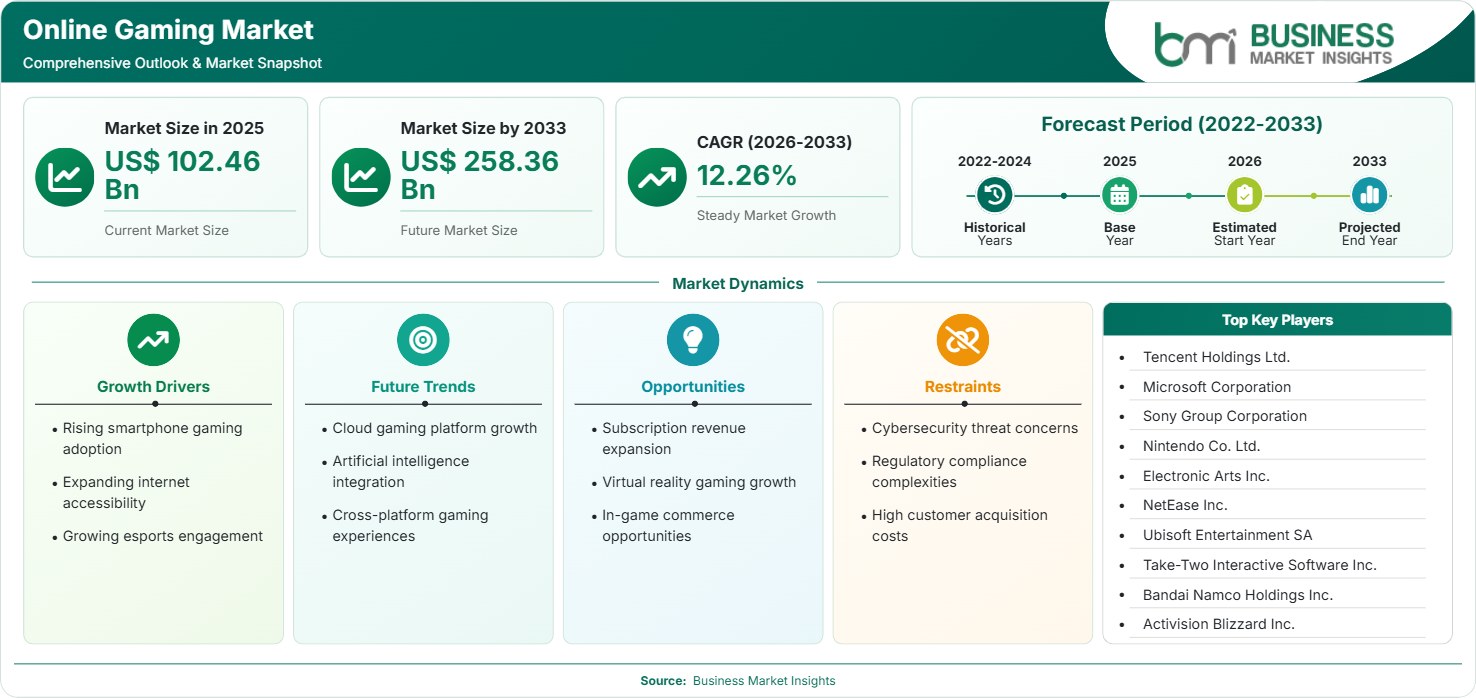
The Online Gaming Market size was valued at US$ 102.46 billion in 2025 and is projected to reach US$ 258.36 billion by 2033, growing at a CAGR of 12.26% during 2026–2033. Rising smartphone gaming adoption, expanding internet accessibility, and growing esports engagement are driving market expansion. Subscription-based gaming services, virtual reality gaming innovations, and expanding in-game commerce continue creating significant growth opportunities across the global gaming ecosystem.

Report Coverage
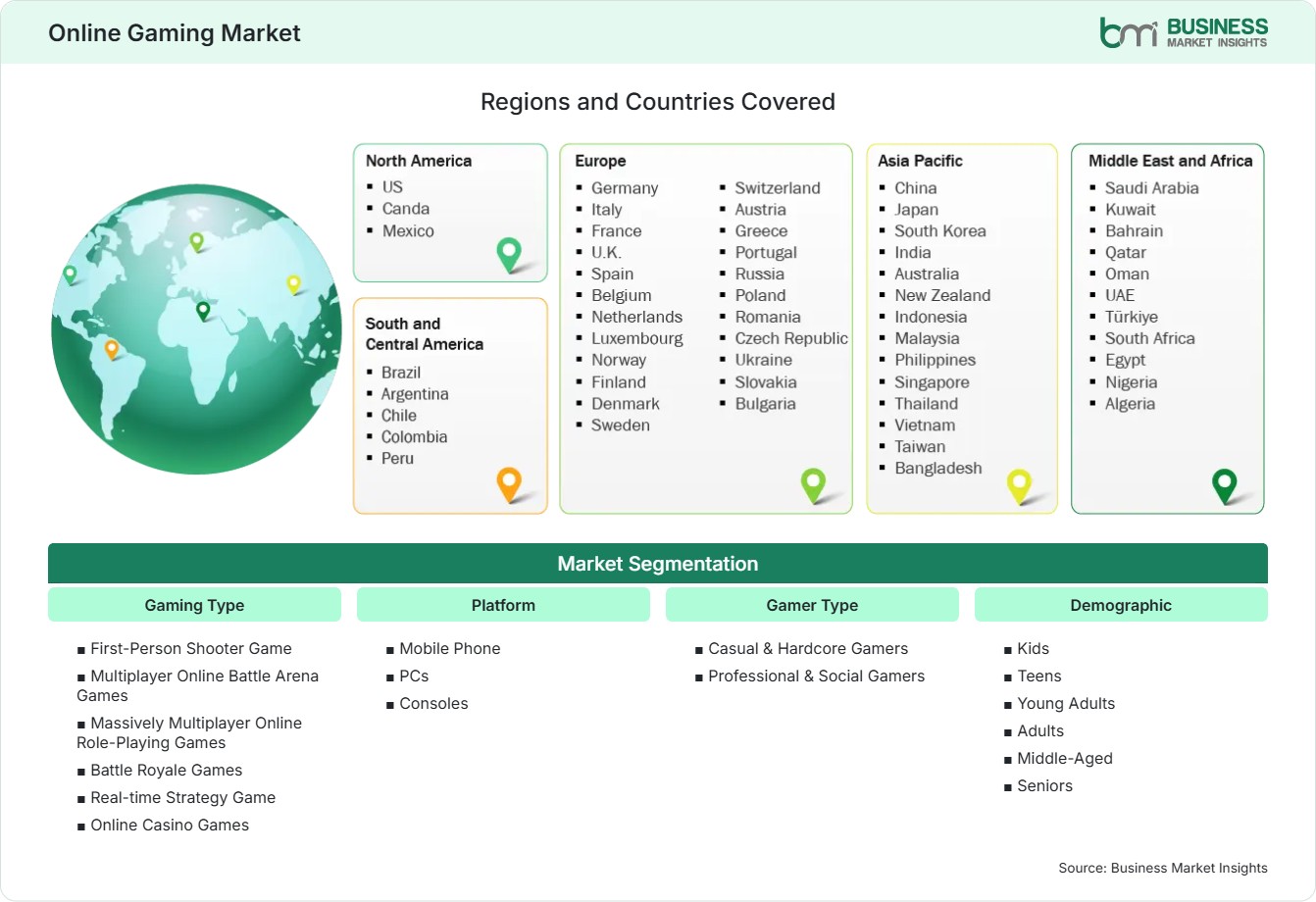
  • Gaming Type: First-Person Shooter Game, Multiplayer Online Battle Arena Games, Massively Multiplayer Online Role-Playing Games, Battle Royale Games, Real-time Strategy Game, Online Casino Games
  • Platform: Mobile Phone, PCs, Consoles
  • Gamer Type: Casual & Hardcore Gamers, Professional & Social Gamers
  • Demographic: Kids, Teens, Young Adults, Adults, Middle-Aged, Seniors
US$ 102.46 Bn Market size in 2025
US$ 258.36 Bn Market Size by 2033
12.26% CAGR, 2026 - 2033
2026-2033 Forecast Period

01 AI Overview

Online Gaming Market Summary

  • North America Region: North America holds 31%–34% of the market share in 2025 and is projected to grow at a CAGR of 11.8%–12.4% during 2026–2033. High digital connectivity, widespread gaming console adoption, robust esports infrastructure, and increasing consumer spending on digital entertainment continue supporting regional market leadership.
  • U.S. Market: The United States represents the largest contributor within North America, supported by a mature gaming industry, strong esports ecosystem, and high adoption of cloud gaming and subscription services, with a projected CAGR of 12.0%–12.6% through 2033.
  • Fastest Growing Region: Asia Pacific accounts for 38%–41% of the global market in 2025 and is expected to register the fastest CAGR of 13.0%–13.6% during 2026–2033. Rapid smartphone penetration, expanding internet infrastructure, growing esports popularity, and increasing investments in gaming content continue accelerating regional market growth.
  • Leading Segment: Mobile Phone accounts for 52%–55% of the market share in 2025 and is anticipated to expand at a CAGR of 12.8%–13.4% through 2033. Affordable smartphones, high-speed mobile internet, and free-to-play monetization models continue supporting segment dominance.
  • High Growth Segment: Battle Royale Games represent 16%–19% of the market in 2025 while growing at a CAGR of 13.8%–14.5% during the Online Gaming Market forecast period. Increasing multiplayer engagement, competitive gaming culture, and continuous content updates continue driving strong player participation worldwide.
  • Key Market Opportunity: Expanding cloud gaming platforms, virtual reality experiences, subscription-based gaming ecosystems, and in-game digital commerce present significant opportunities for developers and publishers to strengthen user engagement and diversify revenue streams.
  • Major Market Players: Tencent Holdings Ltd., Microsoft Corporation, Sony Group Corporation, Nintendo Co. Ltd., Electronic Arts Inc., NetEase Inc., Ubisoft Entertainment SA, Take-Two Interactive Software Inc., Bandai Namco Holdings Inc., Activision Blizzard Inc.
02 Strategic Insights

Online Gaming Market: Strategic Insights

online-gaming-market-market-strategic-framework
FREE PDF
Request your free sample
Request free sample
03 Stakeholder View

Key Takeaways

  • Mobile gaming continues to dominate global online gaming revenues. Affordable smartphones, expanding mobile internet coverage, and free-to-play business models continue attracting millions of new gamers across both developed and emerging markets.
  • Esports is becoming a major revenue and engagement driver. Professional gaming tournaments, sponsorships, streaming platforms, and competitive gaming communities continue expanding audience participation and commercial investment worldwide.
  • Subscription and cloud gaming services are reshaping game distribution. Consumers increasingly prefer subscription-based access to extensive game libraries while cloud gaming reduces hardware dependency and improves accessibility.
  • Asia Pacific offers the strongest long-term investment opportunity. Rapid digitalization, expanding gaming populations, rising disposable incomes, and continuous investments in gaming infrastructure continue supporting exceptional regional growth.
  • In-game commerce is becoming increasingly important for revenue generation. Digital skins, battle passes, downloadable content, virtual currencies, and personalized gaming experiences continue strengthening player engagement while generating recurring revenues.
04 Geographic Outlook

Online Gaming Market Regional Highlights

North America Online Gaming Market

North America accounted for approximately 31%–34% of the Online Gaming Market share in 2025 and is projected to expand at a CAGR of 11.8%–12.4% during 2026–2033. The region benefits from high internet penetration, widespread console and PC gaming adoption, advanced cloud gaming infrastructure, and strong consumer spending on digital entertainment. Continuous innovation in multiplayer gaming, esports, and subscription services continues supporting regional market leadership.

  • Growing adoption of cloud gaming services enables gamers to access high-quality titles across multiple devices without requiring expensive gaming hardware.
  • Increasing participation in esports tournaments and live-streaming platforms continues driving user engagement and revenue generation for publishers.
  • Strong investments in gaming studios, artificial intelligence integration, and immersive gameplay technologies encourage continuous product innovation.
  • Expansion of subscription-based gaming platforms provides consumers with affordable access to extensive digital game libraries.
  • Growing demand for cross-platform gaming experiences strengthens player retention while encouraging broader multiplayer participation.

US Online Gaming Market

The United States represents the largest national market within North America, accounting for approximately 26%–29% of global demand in 2025 and registering a CAGR of 12.0%–12.6% through 2033. High disposable incomes, a mature gaming ecosystem, expanding esports investments, and increasing digital content consumption continue supporting sustained market growth.

  • Increasing adoption of cloud gaming and subscription platforms continues transforming game distribution models.
  • Strong presence of leading game publishers and technology companies accelerates innovation across console, PC, and mobile gaming.
  • Rising popularity of esports competitions and content creators expands audience engagement and advertising opportunities.
  • Increasing consumer spending on downloadable content, virtual currencies, and in-game purchases strengthens recurring revenue generation.

Europe Online Gaming Market

Europe captured approximately 24%–27% of the global market in 2025 and is projected to expand at a CAGR of 11.2%–11.8% during the forecast period. Digital technology advancement, esports players, smartphone games, and good digital entertainment environments keep fueling regional growth. Germany consumes the most in the region, whereas Poland shows great growth potential due to its gaming development activities.

  • Germany remains the leading market with a projected CAGR of 11.3%–11.9%, supported by a strong gaming industry, established esports ecosystem, and high digital entertainment spending.
  • Poland is anticipated to register a CAGR of 12.3%–12.9%, driven by rapid expansion of game development studios, increasing gaming populations, and growing investments in digital entertainment.
  • European publishers continue investing in cloud gaming infrastructure and cross-platform multiplayer experiences.
  • Increasing popularity of indie games and digital distribution platforms strengthens market diversity across the region.
  • Rising consumer demand for subscription gaming services continues expanding recurring revenue opportunities.

Asia Pacific Online Gaming Market

Asia Pacific represented approximately 38%–41% of global revenue in 2025 and is expected to register the fastest CAGR of 13.0%–13.6% during 2026–2033. Expanding smartphone ownership, affordable internet services, rising esports popularity, and increasing investments in gaming technology continue supporting Online Gaming Market growth across the region.

  • China leads regional demand with a projected CAGR of 13.1%–13.7%, supported by a massive gamer population, advanced mobile gaming ecosystem, and continuous investments in gaming content.
  • India is forecast to grow at a CAGR of 13.6%–14.2%, driven by affordable smartphones, expanding 5G deployment, increasing digital payment adoption, and rapid growth of mobile gaming communities.
  • Japan continues introducing innovative online gaming experiences through advanced console, mobile, and multiplayer game development.
  • Rapid expansion of esports tournaments and live-streaming platforms strengthens player engagement across regional markets.
  • International publishers continue expanding partnerships and localized gaming content to capitalize on growing regional demand.

Rest of World Online Gaming Market

The Rest of World region accounted for approximately 7%–9% of global market revenue in 2025 and is projected to expand at a CAGR of 10.5%–11.1% through 2033. Market expansion is supported by improving internet infrastructure, rising smartphone penetration, increasing youth populations, and growing accessibility of digital gaming platforms across Latin America, the Middle East, and Africa.

  • Brazil remains the leading South American market, while the United Arab Emirates demonstrates strong growth through expanding esports investments, increasing digital connectivity, and rising consumer spending on online entertainment.
  • Brazil is projected to register a CAGR of 10.7%–11.3%, supported by expanding mobile gaming adoption, increasing esports participation, and improving digital payment infrastructure.
  • The United Arab Emirates is anticipated to grow at a CAGR of 11.2%–11.8%, driven by government support for digital entertainment, premium gaming events, and expanding gaming communities.
  • Expansion of broadband and 5G infrastructure continues improving accessibility to multiplayer and cloud gaming services.
  • Increasing localization of gaming content encourages broader adoption across culturally diverse consumer groups.
  • Rising investments in gaming events, esports venues, and digital entertainment ecosystems continue strengthening long-term regional market growth.
global-market-geography
FREE PDF
Request your free sample
Request free sample
05 Segment Analysis

Online Gaming Market Segmentation

Gaming Type

The Gaming Type segment accounted for approximately 22%–25% of the market share in 2025 and is projected to expand at a CAGR of 12.5%–13.1% during 2026–2033. Increasing engagement in multi-player games, constant game content updates, development of more e-sports tournaments, and improving cross-platform compatibility keep motivating gamers to participate in different types of games. The Online Gaming Market scope keeps widening due to constant investments in developing an immersive gaming experience.

  • First-Person Shooter Game: First-person shooter games continue attracting a large player base owing to competitive multiplayer gameplay, realistic graphics, and frequent esports tournaments that enhance long-term user engagement.
  • Multiplayer Online Battle Arena Games: MOBA games maintain strong popularity through team-based gameplay, strategic competition, and active esports leagues supported by continuous content updates.
  • Massively Multiplayer Online Role-Playing Games: MMORPGs continue expanding through immersive virtual worlds, character progression systems, and social interaction features that encourage long-term player retention.
  • Battle Royale Games: Battle royale games remain among the fastest-growing categories owing to dynamic gameplay, seasonal updates, live events, and increasing participation in competitive gaming communities.
  • Real-time Strategy Game: Real-time strategy games continue appealing to players seeking tactical decision-making, multiplayer competition, and strategic gameplay across PC and mobile platforms.

Online Casino Games: Online casino games continue witnessing growing adoption through secure digital payment systems, mobile accessibility, and expanding legalization in regulated gaming markets.

Platform

The Platform segment represented nearly 52%–55% of total market revenue in 2025 and is expected to register a CAGR of 12.7%–13.3% during the forecast period. The fast-paced adoption of smartphones, better internet connectivity, and advancing cloud gaming platforms have resulted in further diversification of the gaming platforms. The Online Gaming Market trends point to an increasing number of investments in cross-platform games.

  • Mobile Phone: Mobile phones remain the dominant gaming platform due to affordable smartphones, free-to-play business models, widespread mobile internet availability, and increasing adoption of cloud gaming services.
  • PCs: PC gaming continues maintaining a strong user base through advanced graphics performance, esports participation, customizable hardware, and access to competitive multiplayer titles.
  • Consoles: Console gaming continues expanding through exclusive game releases, subscription gaming services, enhanced graphics capabilities, and next-generation gaming hardware innovations.

Gamer Type

The Gamer Type segment accounted for approximately 63%–66% of the global Online Gaming Market in 2025 and is forecast to expand at a CAGR of 12.2%–12.8% during 2026–2033. Increasing accessibility of online games, rising digital entertainment consumption, and expanding gaming communities continue driving participation across diverse gamer profiles.

  • Casual & Hardcore Gamers: This segment dominates the market owing to its large player base, frequent gameplay activity, growing mobile gaming adoption, and increasing spending on downloadable content and in-game purchases.
  • Professional & Social Gamers: Professional esports players and socially connected gamers continue registering strong growth through competitive tournaments, live streaming platforms, sponsorships, and creator-driven gaming communities.

Demographic

The Demographic segment represented approximately 34%–37% of market revenue in 2025 and is projected to register a CAGR of 12.3%–12.9% through 2033. Growing digital literacy, broader smartphone accessibility, and expanding availability of age-specific gaming content continue supporting Online Gaming Market growth across multiple demographic groups.

  • Kids: Educational games, interactive entertainment, and parental control features continue supporting growth in children's online gaming experiences.
  • Teens: Teen gamers represent one of the most active user groups owing to strong engagement in multiplayer games, esports, social gaming platforms, and live-streaming communities.
  • Young Adults: Young adults constitute the largest demographic segment due to high digital adoption, disposable income, competitive gaming participation, and frequent spending on premium gaming content.
  • Adults: Adult gamers increasingly participate in online gaming for entertainment, social interaction, and stress relief through mobile, PC, and console platforms.
  • Middle-Aged: Growing familiarity with digital technologies and casual mobile gaming applications continue driving participation among middle-aged consumers.
  • Seniors: Seniors are gradually adopting online games focused on cognitive development, entertainment, puzzle-solving, and social interaction through user-friendly digital platforms.
06 Market Forces

Online Gaming Market Dynamics

Key Market Drivers

Rising smartphone gaming adoption

Fast-paced smartphone adoption, as well as low-cost mobile Internet, remains an essential force behind global participation in online gaming. Mobile games gain popularity among consumers thanks to ease of access and the freemium business model adopted by game developers. Constant improvements in terms of processing speed and cloud gaming make gamers’ experience even better. All the above is expected to boost the Online Gaming Market.

Expanding internet accessibility

The increasing use of high-speed internet, fiber-optic technology, and 5G connections ensures the smooth operation of multiplayer games, cloud games, and online interactions. Enhanced internet access gives developers the ability to provide large updates to games, engaging multiplayer games, and live service games, thereby increasing the number of gamers worldwide.

Growing esports engagement

The growing prominence of eSports tournaments, professional gaming leagues, and live streaming services only increases engagement among players and business interest in the industry. With sponsorships, media rights, advertising dollars, and creator economy systems, publishers are incentivized to build competitive gaming ecosystems capable of sustained growth.

Key Market Opportunities

Subscription revenue expansion

Gaming platforms that rely on subscription continue offering consistent sources of recurring revenue for publishers through giving users access to vast game libraries, exclusive content, and even cloud gaming. Such platforms boost customer retention while lowering the entry point into premium gaming experiences.

Virtual reality gaming growth

The constant improvement in VR technology equipment, immersive gameplay features, and motion tracking systems opens up great potential for the developers of highly engaging games. More investment in VR-based content is likely to boost the premium gaming segment during the forecast period.

In-game commerce opportunities

The increasing consumer expenditure on virtual currency, cosmetic products, battle passes, downloadables, and personalized digital assets is providing new opportunities for earning money for game designers. The in-game transactions improve player experience, resulting in steady revenue generation in different gaming environments.

Market Restraints and Challenges

Cybersecurity threat concerns

Factor: Online gaming platforms increasingly face cybersecurity threats including hacking, account theft, data breaches, cheating software, and distributed denial-of-service (DDoS) attacks that compromise user experiences. Impact: Security risks increase operational costs, reduce consumer trust, and require continuous investments in advanced cybersecurity infrastructure, fraud prevention technologies, and regulatory compliance measures.

Regulatory compliance complexities

Factor: Online gaming companies operate across multiple jurisdictions with varying regulations governing digital payments, data privacy, age restrictions, gambling laws, and consumer protection. Impact: Regulatory complexity increases compliance costs, delays market expansion strategies, and requires publishers to continuously adapt products and operations to satisfy evolving legal requirements across global markets.

07 Company Analysis

Competitive Landscape

The competitive environment includes constant investments in cloud gaming, artificial intelligence, immersive gaming techniques, ecosystems for esports, and cross-platform gaming solutions. The report on the Online Gaming Market analysis that major gaming companies are trying to improve their position on the market via mergers and acquisitions, game releases, subscription models, live service games, and next-gen gaming solutions due to the increasing global demand for digital entertainment.

Company Name

Overview

Products and Services Relevant to this Market

Tencent Holdings Ltd.

Global technology and gaming company with one of the world's largest online gaming portfolios.

Mobile games, PC games, online multiplayer games, esports platforms, gaming publishing services.

Microsoft Corporation

Global technology company offering gaming hardware, cloud gaming, and digital entertainment platforms.

Xbox consoles, Xbox Game Pass, cloud gaming services, online multiplayer gaming, game publishing.

Sony Group Corporation

Leading entertainment and gaming company recognized for its PlayStation ecosystem.

PlayStation consoles, PlayStation Network, online multiplayer services, exclusive games, subscription gaming.

Nintendo Co. Ltd.

Global video game developer and hardware manufacturer with iconic gaming franchises.

Nintendo Switch, online gaming services, multiplayer games, digital game distribution.

Electronic Arts Inc.

International game publisher specializing in sports, action, and multiplayer gaming franchises.

Online sports games, multiplayer titles, live-service games, digital gaming platforms.

NetEase Inc.

Chinese internet technology company focused on online gaming development and publishing.

Mobile games, PC online games, MMORPGs, cloud gaming services, esports titles.

Ubisoft Entertainment SA

International video game developer and publisher known for open-world and multiplayer games.

Online action games, multiplayer shooters, live-service games, digital game platforms.

Take-Two Interactive Software Inc.

Global publisher of interactive entertainment software and online gaming franchises.

Multiplayer games, online open-world games, sports games, digital entertainment services.

Bandai Namco Holdings Inc.

Japanese entertainment company specializing in gaming, anime, and digital content.

Online multiplayer games, action games, fighting games, mobile gaming applications.

Activision Blizzard Inc.

Leading interactive entertainment company with globally recognized online gaming franchises.

First-person shooter games, MMORPGs, esports titles, online multiplayer games, digital gaming services.

08 Industry Activity

Recent Developments

March 2026

Nintendo Co., Ltd. launched the Nintendo Switch 2, introducing enhanced online multiplayer capabilities, GameChat, improved digital services, and expanded support for online gaming experiences across first- and third-party titles.

June 2025

Microsoft Corporation introduced the ROG Xbox Ally and ROG Xbox Ally X handheld gaming devices in partnership with ASUS, integrating Xbox Cloud Gaming, Game Pass, and Windows gaming into a unified portable online gaming platform.

March 2025

Ubisoft Entertainment SA and Tencent Holdings Ltd. announced the creation of a new gaming subsidiary backed by Tencent, bringing together major franchises including Assassin's Creed, Far Cry, and Tom Clancy's Rainbow Six to accelerate live-service and online gaming growth.

February 2025

NetEase Games launched Marvel Rivals Season 1 globally, expanding its hero-based online multiplayer game with new playable characters, maps, and competitive content, strengthening its position in the online gaming market.

10 Trust & Transparency

Research Methodology

The market analysis combines proprietary research with secondary data from government agencies, company disclosures, regulatory filings, industry databases and expert interviews. Market estimates are validated through data triangulation, cross-market benchmarking and analyst review.

View Full Research Methodology

11 Questions Answered

Frequently Asked Questions

What does the Market Report cover?

The Online Gaming Market Report provides comprehensive analysis of market size, segmentation, regional performance, competitive landscape, growth drivers, opportunities, restraints, technological advancements, recent industry developments, and market forecasts through 2033.

Why are Battle Royale games witnessing rapid growth?

Battle Royale games continue expanding due to competitive multiplayer gameplay, frequent content updates, esports tournaments, social interaction, and live in-game events that encourage long-term player engagement.

Which platform holds the largest market share?

Mobile Phone represents the leading platform owing to affordable smartphones, high-speed mobile internet availability, free-to-play monetization models, and increasing consumer preference for mobile gaming.

Which region dominates the global market?

Asia Pacific currently leads the global market due to its large gamer population, widespread smartphone adoption, expanding internet infrastructure, growing esports industry, and increasing investments in gaming development.

What factors are driving the Online Gaming Market?

The market is mostly driven by increased adoption of smartphone gaming, increased internet penetration, increased involvement in e-sports, constant technological innovation, and increased demand for immersive multiplayer gaming.

Access the Full Online Gaming Market Report

Get segment-level forecasts, regional estimates, competitive benchmarking, company profiles and downloadable Excel datasets.

Access the full Online Gaming Market Report
350 pages PDF & Excel | 2026-07-30