
Wireless Testing Market Outlook: Size, Share, Trends, Growth Analysis, Competitive Landscape & Forecast, 2026-2033

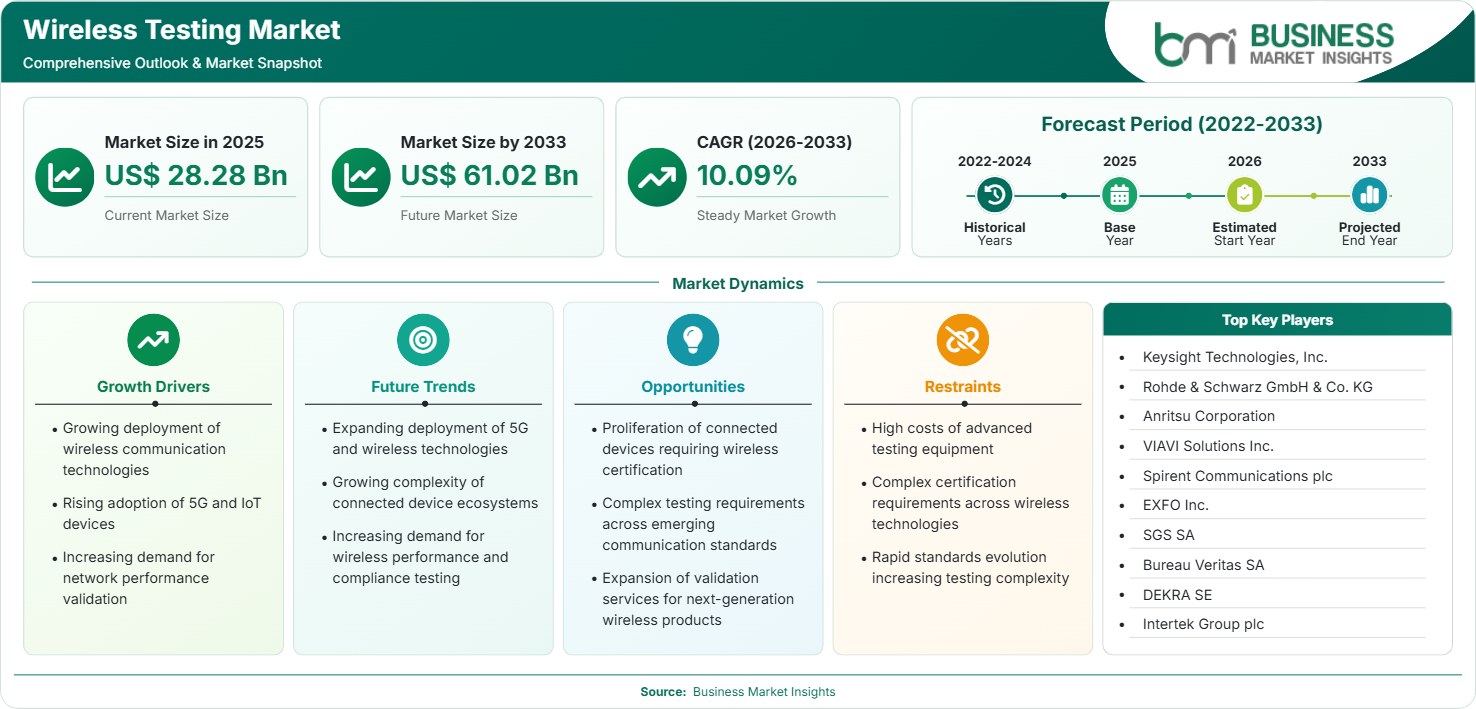
The Wireless Testing Market size was valued at US$ 28.28 billion in 2025 and is projected to reach US$ 61.02 billion by 2033, growing at a CAGR of 10.09% during 2026–2033. Key drivers include accelerating 5G deployments, increasing IoT device certifications, growing automotive connectivity requirements, rising demand for OTA validation, expanding Wi-Fi ecosystems, and stronger regulatory compliance requirements worldwide.

Report Coverage
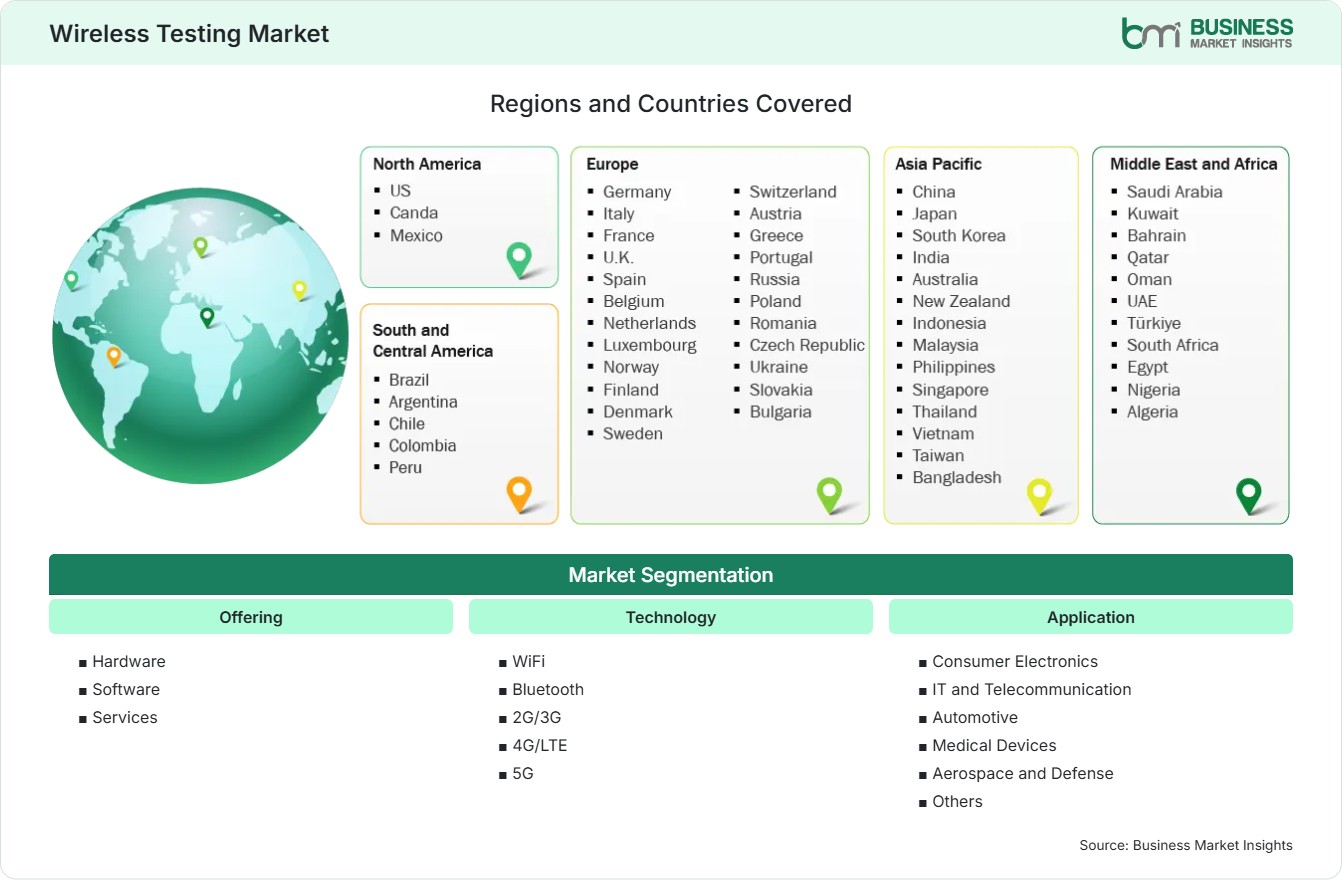
  • Offering: Hardware, Software, Services
  • Technology: WiFi, Bluetooth, 2G/3G, 4G/LTE, 5G
  • Application: Consumer Electronics, IT and Telecommunication, Automotive, Medical Devices, Aerospace and Defense, Others
US$ 28.28 Bn Market size in 2025
US$ 61.02 Bn Market Size by 2033
10.09% CAGR, 2026 - 2033
2026-2033 Forecast Period

AI Overview

Wireless Testing Market Summary

  • North America Region: North America holds a market share of 34%–37% in 2025, growing with a CAGR of 8.8%–9.4% through 2033. Growth stems from 5G densification, defense communication modernization, connected vehicle testing demand, AI-driven network validation adoption, and certification investments. The U.S. market benefits from advanced telecom infrastructure, strong R&D spending, and an estimated CAGR of 8.9%–9.5%.
  • Fastest Growing Region: Asia Pacific holds a market share of 29%–32% in 2025, growing with a CAGR of 11.8%–12.6% through 2033. Drivers include semiconductor investments, large-scale telecom deployments, industrial IoT expansion, smart manufacturing programs, and accelerating wireless device production across key economies.
  • Leading Segment: IT and Telecommunication accounts for 30%–34% share in 2025 and expands at 10.2%–10.8% CAGR. Demand is supported by network modernization, private wireless deployments, Open RAN validation requirements, dense small-cell installations, and escalating performance assurance needs.
  • High Growth Segment: 5G technology represents 18%–22% share in 2025 and advances at 13.0%–14.2% CAGR. Expansion is fueled by standalone network rollouts, enterprise connectivity initiatives, spectrum optimization requirements, advanced antenna testing, and growing certification workloads.
  • Key Market Opportunity: Growing adoption of private 5G, industrial automation systems, connected healthcare infrastructure, autonomous mobility platforms, and mission-critical communications creates substantial opportunities for advanced interoperability, performance, and cybersecurity testing solutions.
  • Major Market Players: Keysight Technologies, Inc.; Rohde & Schwarz GmbH & Co. KG; Anritsu Corporation; VIAVI Solutions Inc.; Spirent Communications plc; EXFO Inc.; SGS SA; Bureau Veritas SA; DEKRA SE; Intertek Group plc.
Strategic Insights

Wireless Testing Market: Strategic Insights

Wireless Testing Market Strategic Framework
FREE PDF
Request your free sample
Request free sample
Stakeholder View

Key Takeaways

  • The industry value chain is expanding beyond laboratory certification toward continuous network assurance, field validation, cybersecurity assessment, and cloud-based analytics services.
  • The greatest potential benefits can be found in applications relating to the automotive sector, medical devices, and industrial IoT, since there is increasing dependence on reliable wireless performance for critical tasks.
  • Innovation is now moving in the direction of AI-powered automation, digital twins, OTA testing chambers, and virtualized network validation platforms.
  • The investment opportunity in the Asia Pacific is the most attractive one, due to the concentration of electronics manufacturing and the rapid expansion of wireless infrastructure.
  • Strategic acquisitions are now focusing on certification laboratories, experts in RF engineering, and software-based testing capabilities in order to expand their range of services.
  • There is growing demand for enterprise-grade validation frameworks as a result of private 5G networks, the demand covering latency, coverage, interoperability, and security performance metrics.
Geographic Outlook

Wireless Testing Market Regional Highlights

North America Wireless Testing Market

North America accounts for 34%–37% Wireless Testing Market share in 2025 and is projected to expand at 8.8%–9.4% CAGR through 2033. Strong operator investments, defense modernization programs, and extensive device certification requirements sustain regional demand. The region has a significant concentration of testing laboratories, network equipment suppliers, and wireless technology innovators. Continued adoption of private networks, industrial connectivity solutions, and advanced broadband architectures supports long-term expansion.

  • The volume of radio, interoperability, and performance testing is continually increasing with large-scale deployments of 5G standalone networks.
  • The demand for specialized validation services is growing as a result of modernization programs in defense and aerospace, as well as in wireless technology.
  • For the ecosystems involving connected vehicles it is necessary to have comprehensive frameworks that cover V2X testing and certification.
  • Enterprise private networks provide ongoing opportunities for commissioning and optimization.

US Wireless Testing Market

The United States represents 73%–78% of North American Wireless Testing Market share and advances at 8.9%–9.5% CAGR. Strong telecom investments, leading technology vendors, and advanced research ecosystems reinforce market leadership. Adoption of Open RAN architectures, industrial automation platforms, and connected healthcare applications is generating sustained demand across compliance and performance testing activities.

  • Open RAN use increases the need for interoperability testing.
  • The federal broadband programs lead to increased investment in network validation.
  • The increasing adoption of private 5G is driving demand for enterprise-oriented testing services.
  • The rate of innovation in semiconductor technology is accelerating wireless product certification cycles.

Europe Wireless Testing Market

Europe captures 24%–27% Wireless Testing Market share in 2025 and is expected to grow at 9.1%–9.8% CAGR. Germany leads regional demand, while Poland and Spain are among higher-growth markets. Regulatory compliance requirements under regional frameworks strengthen testing adoption. Automotive connectivity development and industrial digitalization projects create sustained demand for advanced RF validation services.

  • Germany is still the main market in the region, due to its leadership in industrial automation.
  • Spain and Poland have gained as a result of the telecommunications modernization projects.
  • The complexity involved in certifying automotive wireless integration rises.
  • The high standards for EMC compliance help to meet the demand for laboratory services.

Asia Pacific Wireless Testing Market

Asia Pacific holds 29%–32% share in 2025 while registering the fastest expansion of 11.8%–12.6% CAGR. China leads the region in terms of electronics manufacturing scale, while India records one of the strongest growth trajectories. Expanding semiconductor production, telecom investments, and smart manufacturing initiatives accelerate testing demand. The region continues benefiting from significant wireless device production volumes.

  • China is responsible for certification and validation for device manufacturing.
  • India benefits from telecom expansion and production-linked incentive programs.
  • Japan is enhancing its innovation in the area of high-frequency and advanced wireless testing.
  • Growing IoT ecosystems increase the need for interoperability assessment.
  • The combination of Wi-Fi and 5G leads to an increase in laboratory workloads.

Rest of World Wireless Testing Market

The Rest of World region accounts for 10%–13% share in 2025 and grows at 9.8%–10.6% CAGR. The Middle East benefits from smart-city investments and advanced telecom programs, while Brazil leads South and Central America. Digital transformation initiatives, industrial modernization, and growing mobile broadband adoption support testing service demand across diverse industry verticals.

  • The UAE and Saudi Arabia are speeding up their investments in wireless infrastructure.
  • Brazil is leading the way with regard to certification activities in Latin America.
  • The mining, energy, and utilities sectors are supporting the adoption of industrial wireless technology.
  • The greater the expansion of smart-city projects, the higher the requirements become for connectivity performance.
Global Market Geography
FREE PDF
Request your free sample
Request free sample
Segment Analysis

Wireless Testing Market Segmentation

Offering

Offering is a critical industry category, with hardware contributing the largest revenue. The segment accounts for approximately 42%–46% share in 2025 and expands at 9.3%–10.0% CAGR. Continuous demand for spectrum analyzers, network emulators, and OTA systems supports growth. The Wireless Testing Market scope continues to broaden as software automation and managed testing services gain strategic importance.

  • Hardware: Essential for RF measurement, protocol verification, and performance validation across telecom, industrial, and consumer applications.
  • Software: Enables automation, analytics, virtualization, and continuous validation throughout product development lifecycles.
  • Services: Includes certification, compliance, consulting, interoperability, and managed testing activities addressing increasingly complex wireless ecosystems.

Technology

Technology segmentation reflects evolving connectivity standards. The category benefits from increasing multi-standard device deployments and stronger certification requirements. The segment demonstrates healthy expansion with 10.0%–11.0% CAGR supported by the rising adoption of advanced communications technologies.

  • WiFi: Demand increases as Wi-Fi 6E and Wi-Fi 7 deployments require higher-performance validation methodologies.
  • Bluetooth: Continues benefiting from wearable devices, consumer electronics, and healthcare monitoring applications.
  • 2G/3G: Maintains relevance through legacy infrastructure support and migration-related testing requirements.
  • 4G/LTE: Supports extensive validation needs across existing networks and private connectivity environments.
  • 5G: Fastest-growing technology area driven by standalone deployments, network slicing, and advanced antenna architectures.

Application

Application demand is led by IT and telecommunications, which contribute 30%–34% of the market share in 2025 and expand at a 10.2%–10.8% CAGR. Wireless Testing Market trends increasingly reflect growing adoption among automotive, healthcare, and industrial sectors seeking dependable wireless performance and regulatory compliance.

  • Consumer Electronics: Product innovation cycles require recurring certification and interoperability validation.
  • IT and Telecommunication: Largest application area supported by network modernization and infrastructure investments.
  • Automotive: Connected vehicle platforms increase RF, V2X, and OTA testing requirements.
  • Medical Devices: Regulatory standards drive extensive performance and safety validation processes.
  • Aerospace and Defense: Critical communications systems demand rigorous testing under challenging operating conditions.
Market Forces

Wireless Testing Market Dynamics

Key Market Drivers

Expansion of Global 5G Standalone Infrastructure

The rapid rollout of standalone 5G networks is still the main driver of growth. Telecom operators around the world continue to invest in high-capacity networks that demand extensive interoperability, conformance, and performance testing. The introduction of network slicing, massive MIMO systems, and improved spectrum usage greatly raises the level of complexity involved in validation. Since operators are moving towards cloud-native network environments, their testing needs now go beyond hardware to include software assurance and automation. The increasing uptake of private 5G by enterprises is driving up laboratory workload, and at the same time, device manufacturers must ensure their products are compatible with a variety of frequency bands and deployment scenarios.

Rapid Growth in Connected Devices and IoT Ecosystems

Billions of connected endpoints are creating substantial certification and validation demand. Smart manufacturing, healthcare monitoring, logistics tracking, utilities management, and consumer electronics all require reliable wireless communications. Multi-radio environments that combine Wi-Fi, Bluetooth, cellular, and satellite connectivity require coexistence testing to prevent performance degradation. As organizations deploy increasingly complex IoT networks, the need for continuous monitoring and validation expands, driving demand for both equipment and service offerings.

Stringent Regulatory and Compliance Requirements

National and international regulators are still working to strengthen the rules relating to spectrum management, electromagnetic compatibility, and wireless performance. Before a device can be put on the market, manufacturers have to go through lengthy certification processes. Since requirements set by the FCC, CE, and other regulatory bodies demand thorough testing, there is an additional layer of validation driven by growing expectations regarding the cybersecurity of connected products, which in turn promotes greater investment in advanced testing facilities and professional services.

Key Market Opportunities

Private 5G Networks Across Industrial Verticals

Private wireless infrastructure adoption presents a major expansion opportunity. Manufacturing facilities, ports, airports, mining operations, and utilities are deploying dedicated networks requiring specialized commissioning and validation services. Wireless Testing Market Forecasts increasingly benefit from enterprise digital transformation initiatives that seek low-latency, highly reliable connectivity. Vendors offering end-to-end testing, optimization, security validation, and lifecycle management capabilities are positioned to capture significant value as deployments scale globally.

Wi-Fi 7 Commercialization and Enterprise Upgrades

The commercial introduction of Wi-Fi 7 is currently transforming enterprise connectivity by delivering much higher throughput, lower latency, and improved spectrum efficiency. These improvements enable support for bandwidth-heavy applications, real-time communications, and large-scale IoT implementations. Yet acceptance will depend on the development of new testing and validation methods that address multi-link operations, advanced modulation techniques, and performance in dense-network scenarios. Since enterprises are modernizing infrastructure, there is a growing demand for certification, interoperability testing, and performance benchmarking services. Vendor companies with specialized expertise in high-frequency validation, automated testing, and cloud-based analytics are well-positioned to benefit from the growing number of Wi-Fi 7 deployments.

Automotive Connectivity and Autonomous Systems

Because connected vehicles require seamless integration among cellular networks, sensors, navigation systems, cloud services, and roadside equipment to operate safely and efficiently, the increasing use of Vehicle-to-Everything (V2X) communication and software-defined vehicle architectures significantly increases system complexity and the need for testing. Nowadays, car manufacturers require thorough validation at all stages of development, pre-production, and production. This trend offers significant long-term prospects for specialized radio-frequency testing, cybersecurity evaluations, checks to ensure regulatory compliance, performance optimization, and the ongoing validation of software to support reliable and secure vehicle connectivity.

Market Restraints and Challenges

High Capital Costs of Advanced Test Infrastructure

To carry out modern testing, it is necessary to make a large investment in sophisticated equipment, such as OTA chambers, network emulators, spectrum analyzers,s and automated testing systems. The high cost of such equipment poses major challenges for smaller laboratories and regional service providers seeking to expand their capabilities and remain competitive. Because of the rapid pace of technological development, the financial burden grows, as the intervals between equipment replacements become shorter and more frequent upgrades are required. Moreover, companies have to provide support for both new and older technologies, which in turn leads to higher operating expenses, longer return-on-investment periods, and greater pressure on long-term budget planning.

Fragmented Standards and Technology Complexity

The situation regarding telecommunications and connectivity testing is becoming more complicated due to the presence of multiple wireless standards, differing frequency allocations across regions, and constantly changing regulatory requirements. This degree of fragmentation leads to operational difficulties and complicates the processes of certification and validation. Consequently, testing cycles become longer, more resource-intensive, and more expensive for manufacturers and service providers. Since modern devices usually include cellular, Wi-Fi, Bluetooth, satellite communication, and new wireless protocols, there is a need for advanced testing frameworks and for specialized knowledge. Moreover, the shortage of skilled workers in RF engineering and protocol analysis impedes efficient service delivery and delays the introduction of new technologies.

Company Analysis

Competitive Landscape

The competitive environment remains characterized by technology leadership, certification expertise, and global laboratory networks. This Wireless Testing Market analysis highlights leading companies operating across equipment, software, and services.

Company Name

Overview

Products and Services relevant to this market

Keysight Technologies, Inc.

Leading electronic measurement company with extensive wireless R&D capabilities.

RF test systems, network emulation, 5G validation, protocol testing software.

Rohde & Schwarz GmbH & Co. KG

Global provider of test and measurement technologies.

Spectrum analyzers, OTA systems, wireless compliance testing platforms.

Anritsu Corporation

Major telecommunications testing specialist.

Network analyzers, 5G testing solutions, protocol and RF validation tools.

VIAVI Solutions Inc.

Focused on network performance and assurance solutions.

Wireless monitoring, optimization, certification, and performance analytics.

Spirent Communications plc

Specialized in automated test and assurance solutions.

Network emulation, performance validation, cybersecurity and assurance tools.

EXFO Inc.

Communications testing and analytics provider.

Network testing, service assurance, fiber and wireless validation solutions.

SGS SA

Global inspection, testing, and certification leader.

Wireless compliance, certification, EMC testing, regulatory assessment.

Bureau Veritas SA

International testing and certification organization.

Device validation, compliance services, wireless certification programs.

DEKRA SE

Independent testing and inspection specialist.

Connectivity assessment, EMC testing, automotive wireless validation.

Intertek Group plc

Global quality assurance and certification provider.

Wireless certification, interoperability testing, regulatory compliance services.

Trust & Transparency

Research Methodology

The market analysis combines proprietary research with secondary data from government agencies, company disclosures, regulatory filings, industry databases and expert interviews. Market estimates are validated through data triangulation, cross-market benchmarking and analyst review.

View Full Research Methodology

Questions Answered

Frequently Asked Questions

What does a Wireless Testing Market Report help stakeholders evaluate?

It helps assess competitive positioning, investment opportunities, technology trends, regional demand patterns, regulatory impacts, and strategic growth prospects across major industry segments.

How do testing services differ from testing equipment?

Equipment provides measurement and validation capabilities, while services encompass certification, compliance assessments, interoperability testing, consulting, optimization, and managed assurance activities.

Which region offers the best future expansion prospects?

Asia Pacific presents the strongest growth outlook owing to large-scale electronics production, telecom investments, semiconductor manufacturing expansion, and government-backed digital transformation initiatives.

Which application generates the highest revenue contribution?

IT and telecommunication remains the largest application area due to ongoing network modernization, infrastructure expansion, and extensive validation requirements across wireless ecosystems.

What factors are creating long-term demand for wireless testing solutions?

Demand is driven by multi-standard devices, private 5G deployments, connected vehicles, industrial IoT expansion, and increasingly strict certification requirements across global regulatory jurisdictions.

Access the Full Wireless Testing Market Report

Get segment-level forecasts, regional estimates, competitive benchmarking, company profiles and downloadable Excel datasets.

Access the full Wireless Testing Market Report
350 pages PDF & Excel | 2026-09-15
Similar Research

Related Market Reports