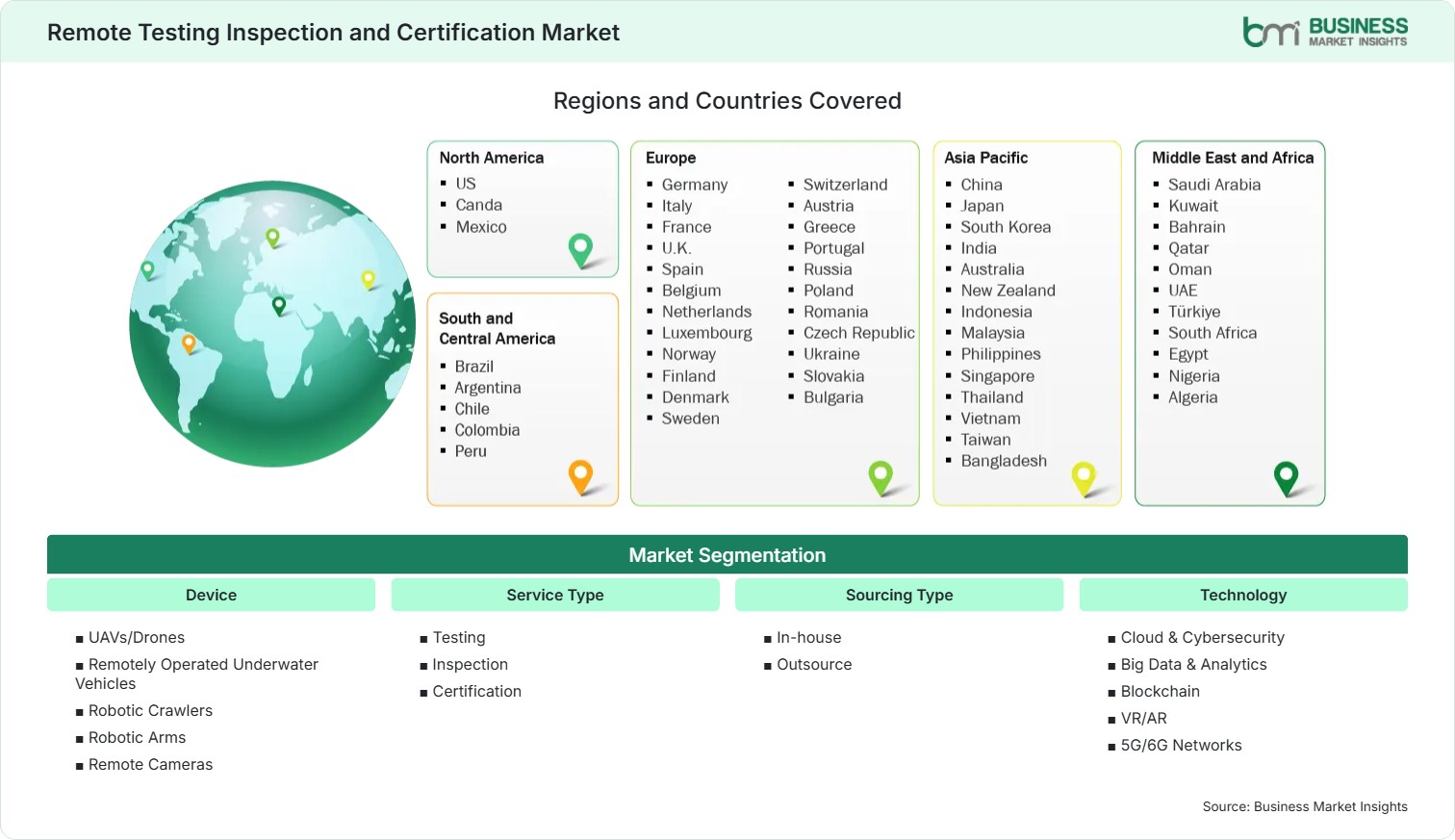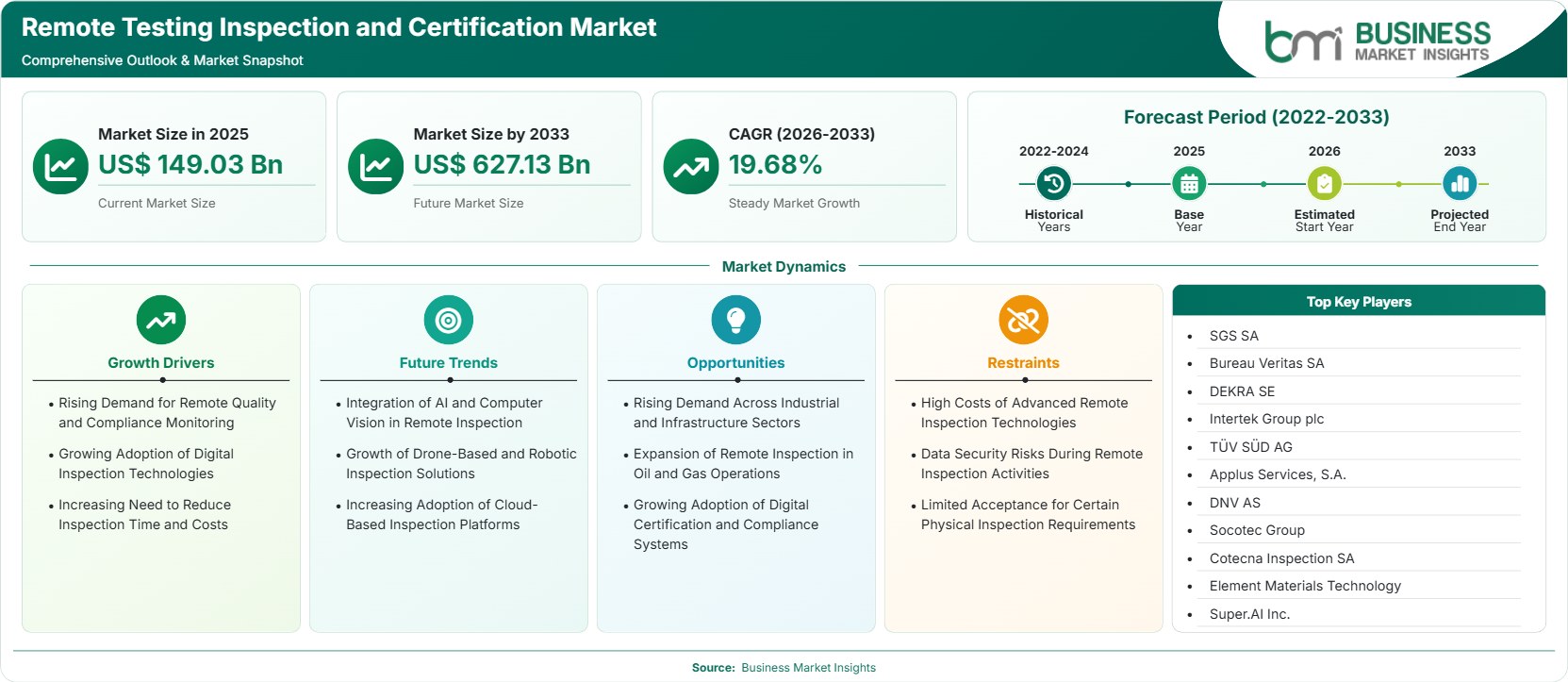
Remote Testing Inspection and Certification Market Regional Highlights
North America Remote Testing Inspection and Certification Market
North America represents 29%–32% Remote Testing Inspection and Certification Market share in 2025 and is projected to expand at 18%–20% CAGR through 2033. The region benefits from mature certification ecosystems, advanced aerospace production, aging energy assets, and high adoption of industrial automation. Remote inspection is increasingly linked with cybersecurity, digital evidence, and predictive maintenance. The United States remains the principal demand center, while Canada supports opportunities across energy, mining, infrastructure, and transportation. Regulatory acceptance of remotely operated systems should progressively expand addressable applications.
- Aerospace operators require repeatable inspection evidence for aircraft structures, engines, components, and production quality, increasing demand for remote imaging, non-destructive testing, robotics, and digitally managed certification records.
- Energy companies increasingly use drones, crawlers, and remote cameras to inspect pipelines, storage assets, power infrastructure, and renewable installations while limiting shutdowns and personnel exposure.
- Cybersecurity is becoming integral to remote assurance because connected inspection devices transmit operational images, asset information, sensor outputs, and certification records across distributed networks.
- US procurement increasingly favors scalable inspection workflows that combine field robotics with cloud analytics, supporting recurring monitoring rather than isolated compliance events.
US Remote Testing Inspection and Certification Market
The US accounts for 72%–78% of North American Remote Testing Inspection and Certification Market demand in 2025 and is projected to grow at 18%–21% CAGR. Its market structure combines sophisticated TIC providers with aerospace, defense, energy, infrastructure, healthcare, and technology customers. Demand is supported by aging industrial assets, stringent quality requirements, digital transformation, and investment in autonomous systems. The US also provides a strong commercialization base for AI-powered inspection platforms and robotic systems serving multiple regulated industries.
- Aerospace and defense applications support high-value testing because component integrity, traceability, and qualification requirements make automated evidence collection commercially attractive.
- Energy infrastructure creates opportunities for drones and robotic crawlers where inspection teams must examine elevated, remote, submerged, or hazardous assets without extensive physical access.
- Digital assurance providers can monetize cybersecurity, AI governance, and data integrity alongside conventional testing, inspection, and certification services.
Europe Remote Testing Inspection and Certification Market
Europe holds 23%–26% Remote Testing Inspection and Certification Market share in 2025 and is forecast to grow at 17%–20% CAGR. Germany leads regional industrial demand, while France and the UK remain important certification and infrastructure centers. Spain is a high-growth market for drone-enabled inspection, supported by renewable energy and industrial assets. European buyers emphasize safety, sustainability, traceability, and regulatory conformity, encouraging TIC providers to integrate remote technologies into established assurance programs rather than treat robotics as standalone equipment.
- Germany is positioned around 17%–20% CAGR through industrial automation, machinery assurance, automotive production, and sophisticated engineering inspection requirements.
- France benefits from aerospace, nuclear, infrastructure, and industrial certification demand, with digital evidence supporting more efficient conformity workflows.
- Spain can record 21%–24% CAGR as renewable infrastructure and remote inspection deployments expand across wind, utilities, and industrial facilities.
- The UK maintains strong opportunities in offshore energy, aerospace, maritime assets, and advanced materials testing.
Asia Pacific Remote Testing Inspection and Certification Market
Asia Pacific represents 29%–33% Remote Testing Inspection and Certification Market share in 2025 and is forecast to expand at 21%–24% CAGR, making it the fastest-growing regional market. China, Japan, South Korea, India, Singapore, and Australia create diverse demand across manufacturing, energy, infrastructure, mining, electronics, food, and transportation. Rapid industrialization, automation investment, labor constraints, and expanding digital infrastructure support remote inspection adoption. India and Southeast Asia offer particularly strong incremental opportunities as industrial capacity and infrastructure projects increase.
- China is positioned at 22%–25% CAGR because large-scale manufacturing, electronics, infrastructure, renewable energy, and automation create substantial inspection workloads.
- India can achieve 23%–26% CAGR as industrial digitization, infrastructure development, renewable assets, and drone adoption broaden remote inspection applications.
- Japan and South Korea maintain strong demand from electronics, automotive, robotics, shipbuilding, and advanced manufacturing quality systems.
- Australia provides specialized opportunities across mining, energy, remote infrastructure, and underwater inspection where physical access is costly.
Rest of World Remote Testing Inspection and Certification Market
South and Central America account for a growing portion of Remote Testing Inspection and Certification Market demand through mining, energy, food processing, agriculture, and infrastructure modernization. Brazil leads regional adoption, while Chile and Mexico provide attractive opportunities for remote asset inspection. The regional market is estimated at 12%–15% share in 2025 and 17%–21% CAGR through 2033.
Middle Eastern and African markets are increasingly adopting remote inspection across oil and gas, utilities, ports, construction, and renewable infrastructure. Saudi Arabia and the UAE represent leading regional markets, while South Africa provides opportunities in mining and industrial asset integrity.
- Brazil is positioned at 20%–23% CAGR, supported by energy infrastructure, agriculture, mining, ports, and industrial quality requirements.
- Saudi Arabia and the UAE can achieve 22%–25% CAGR as large infrastructure and energy projects incorporate drones, digital twins, and remote monitoring.
- South Africa benefits from mining inspection requirements involving large, hazardous, and geographically dispersed assets.
- Mexico supports demand through automotive manufacturing, electronics, energy, and cross-border supply-chain compliance.