
Cargo Container X-Ray Inspection Systems Market Outlook: Size, Share, Trends, Growth Analysis, Competitive Landscape & Forecast, 2026–2033

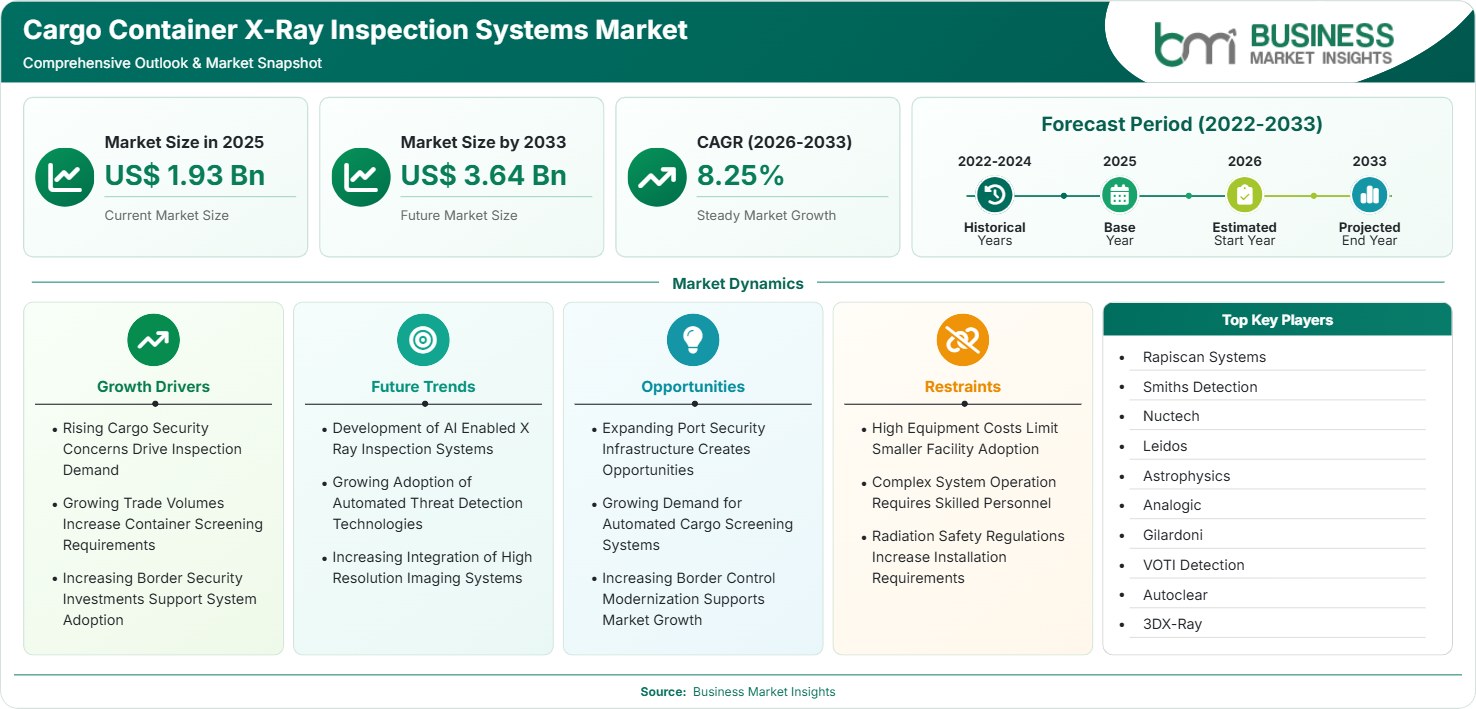
The Cargo Container X-Ray Inspection Systems Market size was valued at US$ 1.93 billion in 2025 and is projected to reach US$ 3.64 billion by 2033, growing at a CAGR of 8.25% during 2026–2033, driven by cargo security, trade expansion, border modernization, automated screening, and port infrastructure investment.

Report Coverage
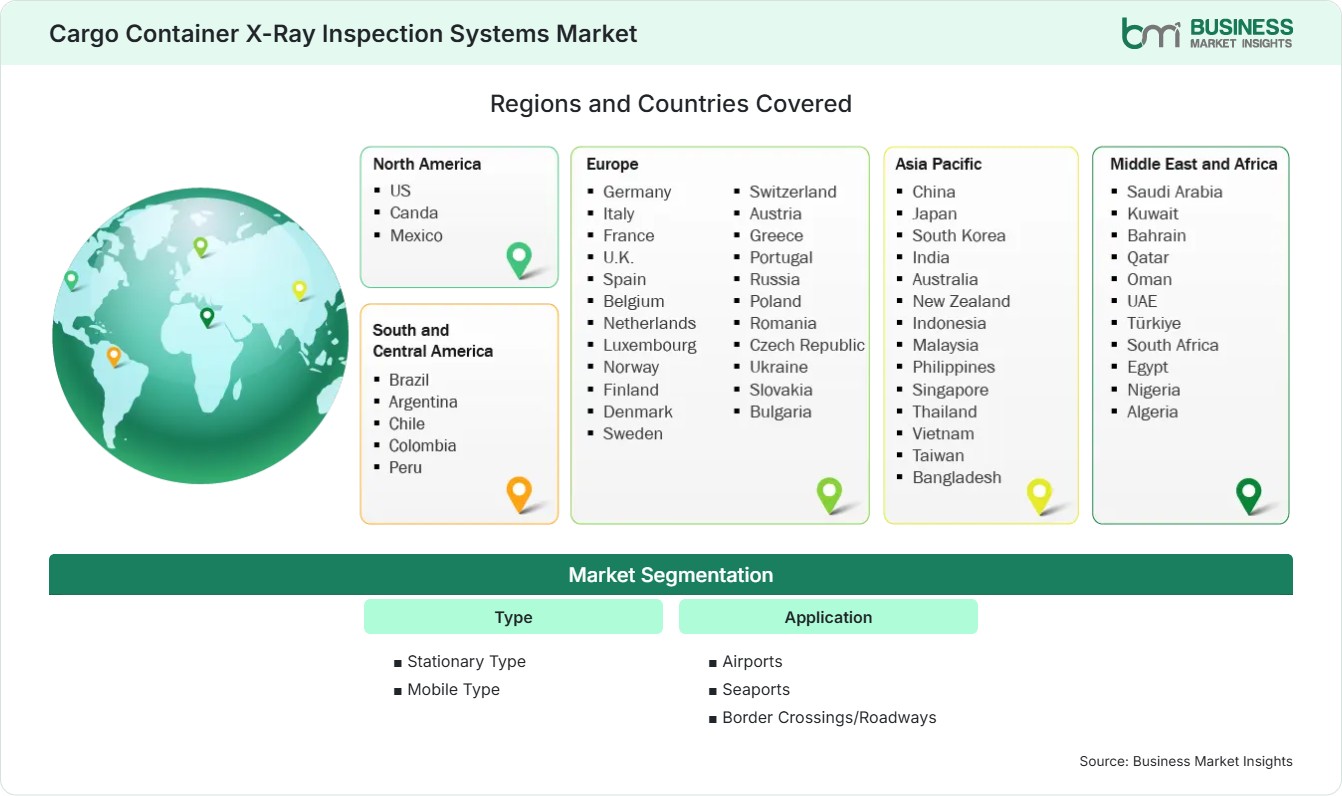
  • Type: Stationary Type, Mobile Type
  • Application: Airports, Seaports, Border Crossings/Roadways
US$ 1.93 Bn Market size in 2025
US$ 3.64 Bn Market Size by 2033
8.25% CAGR, 2026 - 2033
2026-2033 Forecast Period

AI Overview

Cargo Container X-Ray Inspection Systems Market Summary

  • North America: North America holds a 35%-39% share in 2025, growing at a CAGR of 7.5%-8.5%, supported by cargo security requirements, border modernization, major ports, customs automation, and demand for non-intrusive inspection technologies. The US represents 78%-82% of regional demand, growing at a CAGR of 7.7%-8.7%.
  • Fastest Growing Region: Asia Pacific holds a 23%-27% share in 2025 and grows at a CAGR of 9.0%-10.0%, driven by maritime trade expansion, port modernization, border security programs, logistics investment, and increasing deployment of automated cargo screening technologies.
  • Leading Segment: Stationary Type holds a 65%-70% share in 2025 and grows at a CAGR of 7.8%-8.8%, supported by permanent customs infrastructure, high-throughput seaport operations, integrated inspection lanes, automated imaging, and continuous cargo processing requirements.
  • High Growth Segment: Mobile Type holds a 10%-15% Cargo Container X-Ray Inspection Systems Market share in 2025 and grows at a CAGR of 9.5%-10.5%, supported by flexible deployment, temporary checkpoints, remote border operations, mobile inspection requirements, and changing infrastructure needs.
  • Key Market Opportunity: Automated image analysis, risk-based inspection, mobile deployment, integrated radiation detection, and networked customs platforms can strengthen cargo screening while reducing disruption to legitimate trade.
  • Major Market Players: Rapiscan Systems, Smiths Detection, Nuctech, Leidos, Astrophysics, Analogic, Gilardoni, VOTI Detection, Autoclear, 3DX-Ray.
Strategic Insights

Cargo Container X-Ray Inspection Systems Market: Strategic Insights

Cargo Container X-Ray Inspection Systems Market Strategic Framework
FREE PDF
Request your free sample
Request free sample
Stakeholder View

Key Takeaways

  • The value chain is moving from standalone scanners toward integrated inspection ecosystems combining imaging hardware, image analysis, radiation detection, networking, training, and lifecycle support.
  • Mobile inspection platforms offer strong upside where authorities require flexible screening capacity across temporary checkpoints, secondary inspection areas, remote borders, and changing freight routes.
  • Automated image analysis is becoming a key product differentiator because dense and complex cargo can make manual interpretation demanding, particularly at busy inspection facilities.
  • Port and border modernization programs provide attractive investment opportunities because advanced inspection infrastructure can strengthen security while supporting efficient clearance procedures.
  • Procurement decisions increasingly emphasize lifecycle value, including maintenance, software upgrades, operator training, system availability, integration, and technical support.
  • Competitive differentiation will increasingly depend on imaging quality, throughput, deployment flexibility, automation, threat detection, interoperability, and adaptability to different cargo environments.
Geographic Outlook

Cargo Container X-Ray Inspection Systems Market Regional Highlights

North America Cargo Container X-Ray Inspection Systems Market

North America holds a 35%-39% share in 2025 and grows at a CAGR of 7.5%-8.5%. The region benefits from established customs infrastructure, major seaports, extensive trade corridors, and demand for advanced non-intrusive cargo inspection technologies.

  • Border modernization supports high-energy inspection systems capable of screening containers and vehicles without extensive unloading or manual examination.
  • Major seaports require high-throughput systems that process cargo efficiently while supporting customs risk assessment and security enforcement.
  • Canada provides opportunities through port security, cross-border freight corridors, logistics infrastructure, and inspection modernization.
  • Automated image analysis and networked inspection workflows are increasing the operational value of advanced screening systems.

US Cargo Container X-Ray Inspection Systems Market

The US represents 78%-82% of North American demand in 2025 and grows at a CAGR of 7.7%-8.7%. Demand is supported by extensive maritime and land-border trade, customs enforcement, critical infrastructure protection, and non-intrusive inspection requirements.

  • Land-border checkpoints require reliable systems capable of screening commercial vehicles and identifying concealed threats without unnecessarily disrupting freight movement.
  • Mobile platforms provide flexibility at checkpoints where inspection capacity must be repositioned according to traffic patterns and security requirements.
  • Automated image interpretation is increasingly relevant as agencies seek faster review and more consistent identification of suspicious cargo.

Europe Cargo Container X-Ray Inspection Systems Market

Europe holds a 24%-28% share in 2025 and grows at a CAGR of 7.5%-8.5%. Germany, France, the United Kingdom, Italy, Spain, and the Netherlands represent important markets because of dense logistics networks and extensive cross-border trade.

  • Germany benefits from industrial freight corridors and demand for sophisticated customs and cargo-security infrastructure.
  • The Netherlands provides opportunities through major maritime gateways where high cargo throughput requires efficient non-intrusive inspection.
  • France and Italy are supported by seaport activity, border controls, aviation logistics, and customs modernization.
  • The United Kingdom continues to require advanced inspection capabilities across ports, freight terminals, and border locations.

Asia Pacific Cargo Container X-Ray Inspection Systems Market

Asia Pacific holds a 23%-27% share in 2025 and grows at a CAGR of 9.0%-10.0%. China, Japan, India, South Korea, Singapore, and Australia support regional demand through port expansion, trade activity, border management, and security modernization.

  • China supports extensive deployment opportunities across major seaports, logistics hubs, customs facilities, and border checkpoints.
  • India offers opportunities through port modernization, expanding trade infrastructure, border security, and technology-enabled customs operations.
  • Singapore benefits from its position as a major maritime and logistics hub requiring efficient cargo screening.
  • Japan, South Korea, and Australia provide opportunities through advanced customs operations, maritime security, and sophisticated logistics infrastructure.

Rest of World Cargo Container X-Ray Inspection Systems Market

Rest of World holds a 10%-14% share in 2025 and grows at a CAGR of 7.0%-8.0%. Latin America, the Middle East, and Africa provide opportunities through port expansion, border control modernization, customs digitization, and infrastructure security.

Latin American demand is supported by maritime trade corridors and customs enforcement. Middle Eastern Cargo Container X-Ray Inspection Systems Markets emphasize strategic ports and border security, while African markets increasingly require inspection capabilities at developing logistics gateways and regional trade routes.

  • Brazil provides opportunities through major ports, border crossings, agricultural exports, and customs modernization requirements.
  • The United Arab Emirates and Saudi Arabia offer opportunities through logistics hubs, strategic ports, and sophisticated border-security infrastructure.
  • South Africa supports demand through ports, regional freight corridors, customs operations, and cargo-security requirements.
  • Emerging markets can benefit from mobile systems where flexible inspection infrastructure is more practical than permanent installations.
Global Market Geography
FREE PDF
Request your free sample
Request free sample
Segment Analysis

Cargo Container X-Ray Inspection Systems Market Segmentation

Type

Stationary Type holds a 65%-70% share in 2025 and grows at a CAGR of 7.8%-8.8% through 2033, supported by permanent high-throughput facilities. The Cargo Container X-Ray Inspection Systems Market scope also encompasses mobile platforms serving flexible checkpoints and border requirements.

  • Stationary Type: Permanent systems support high-volume screening at seaports and major border facilities, integrating with fixed lanes, customs workflows, automated controls, and centralized security infrastructure.
  • Mobile Type: Mobile platforms provide flexible screening capacity for temporary checkpoints, secondary inspection locations, remote borders, emergency security requirements, and changing logistics patterns.

Application

Seaports hold a 52%-57% share in 2025 and grow at a CAGR of 8.0%-9.0% through 2033, reflecting concentrated container flows and security requirements. Airports and border crossings provide complementary demand through specialized cargo screening and customs operations.

  • Airports: Airport cargo screening requires compact, reliable imaging systems capable of processing freight efficiently while supporting aviation security procedures and controlled logistics environments.
  • Seaports: Seaports require high-throughput inspection systems capable of screening dense containers while minimizing disruption to vessel, terminal, and customs operations.
  • Border Crossings/Roadways: Road and border checkpoints benefit from mobile and fixed systems that inspect trucks and cargo while supporting rapid customs decision-making and security enforcement.
Market Forces

Cargo Container X-Ray Inspection Systems Market Dynamics

Key Market Drivers

Rising Cargo Security Concerns Drive Inspection Demand

Security issues related to cargo are increasing the need for non-invasive inspection at ports, airports, and border crossings. The Cargo Container X-Ray Inspection Systems Market growth can be attributed to the availability of technology that can detect hidden threats without unloading the container. Technologies such as high-energy X-rays, dual-energy inspection, material discrimination, and image enhancement can be used to increase the detection efficiency of threats in dense cargo environments. Modern security programs are more concerned with systems that provide good penetration, high-quality images, high throughput, and operational versatility. Issues relating to drugs, weapons, and other dangerous cargo are driving risk-based inspections of cargo.

Growing Trade Volumes Increase Container Screening Requirements

Expanding the cargo trade business is posing greater challenges for customs and security organizations, requiring more inspections without causing delays in clearing goods. An increased cargo volume necessitates an inspection system that can operate nonstop and perform efficient container screening. Technologies such as high-throughput imaging, automated trucking positioning, remote imaging, and better interfaces can enhance productivity. This technology is also gaining significance as logistics operations become more complex and varied. Providers of inspection solutions that offer both faster scanning and better image analysis are helping authorities implement additional security measures without hindering the flow of cargo. In other words, the Cargo Container X-Ray Inspection Systems Market Trend is getting increasingly related to inspection automation and technologies.

Increasing Border Security Investments Support System Adoption

Customs agencies are investing in inspection infrastructure to improve detection efficiency without hampering legitimate cargo transport. Current technologies in cargo inspection include combining X-ray imaging with radiation detection, automatic threat detection, cargo information, and monitoring. The integration of such systems allows specific inspection processes to be carried out without having to inspect everything manually. Mobile systems are useful when infrastructure changes due to traffic, security ,conditions, or checkpoint settings. Stationary systems remain necessary at high-traffic gateway locations that require consistent throughput. In general, the increasing trend towards the application of technology in customs operations is driving the procurement of systems that support interoperability, remote diagnostics, image storage, and software upgrades.

Key Market Opportunities

Expanding Port Security Infrastructure Creates Opportunities

Opportunities in the Cargo Container X-Ray Inspection Systems Market forecast include new investments in inspection and security technology at ports, especially to integrate inspection, customs, and terminal operations. High-energy X-ray systems would be able to inspect dense containers without the need for unloading or manual inspection. There are also modern solutions with built-in image analysis, radiation detectors, control rooms, and data networking. Expansions at ports would create new greenfield opportunities to build lane solutions around modern inspection systems. The suppliers would also have the opportunity to offer systems to major gateways and regional ports in various sizes.

Growing Demand for Automated Cargo Screening Systems

These advances are providing ways to optimize image interpretation, inspection uniformity, and operator efficiency. For example, artificial intelligence could assist with anomaly detection and prioritization of areas of interest in X-ray images, and automation could help standardize the placement of vehicles for inspection and inspection protocols. This would be useful in situations involving a high volume of cargo and shortages of image analysts. Automation could be used to facilitate remote viewing, centralized monitoring, and integration with customs risk management software. Differentiation could be achieved through proprietary algorithms, open architecture, and interfaces for additional analytics software. The installed system can be upgraded through software and detection advances.

Increasing Border Control Modernization Supports Market Growth

Modernization programs at the borders have generated a need for inspection technology that is both secure and faster. Mobile and fixed X-ray machines can be installed based on traffic, checkpoint setup, and risk management. Integration of inspection systems will ensure that image analysis can be performed alongside cargo documents, radiation inspection, vehicle recognition, and decision-making. Modernization programs also offer opportunities in developing countries where customs are transitioning from physical inspection to technological screening. Adaptation of technology to the environment is very important for vendors, as the availability of the inspection process plays a key role in determining traffic flow at the borders.

Market Restraints and Challenges

High Equipment Costs Limit Smaller Facility Adoption

Factor: The use of high-energy X-ray systems entails significant capital expenditure for imaging equipment, shielding, electricity, installation, integration, and servicing. Impact: Smaller ports, regional airports, and lower-throughput border crossings may delay purchases or opt for less advanced inspection solutions due to capital constraints. These restrictions may also increase the time intervals between replacements, keeping such facilities stuck with outdated systems. Suppliers can respond to this problem by designing modular systems, offering leasing options, maintenance packages, and scalable inspection packages. Mobile inspection systems can be another solution, as a single system can cover several locations without each point having dedicated equipment.

Complex System Operation Requires Skilled Personnel

Factor: cargo X-ray systems generate complex images and require trained personnel to interpret dense, overlapping, and unfamiliar materials accurately. Impact: limited availability of skilled operators can reduce inspection effectiveness, increase training expenses, and constrain system utilization. Automated image analysis can prioritize suspicious regions, but operators still require knowledge of imaging principles, threat characteristics, material discrimination, and system procedures. Training therefore remains an important component of successful deployment. Remote assistance, standardized interfaces, simulation tools, and automated quality controls can reduce operational burdens. Suppliers that combine intuitive software with comprehensive training and technical support can improve customer outcomes. Workforce capability will remain a practical constraint as authorities expand screening coverage and introduce increasingly sophisticated imaging technologies.

Company Analysis

Competitive Landscape

The Cargo Container X-Ray Inspection Systems Market analysis focuses on imaging performance, penetration capability, throughput, automated image analysis, mobility, integration, maintenance, and lifecycle support. Competitive differentiation increasingly depends on combining hardware with intelligent software and deployment services. Suppliers with broad inspection portfolios can address varied requirements across ports, airports, and border crossings.

Company Name

Overview

Products and Services relevant to this market

Rapiscan Systems

Security inspection technology provider serving cargo, vehicle, border, aviation, and critical infrastructure applications.

Cargo and vehicle X-ray inspection systems, mobile scanners, high-energy imaging, threat detection, installation, and support.

Smiths Detection

Security technology provider focused on threat detection and inspection across ports, borders, aviation, and logistics.

X-ray inspection systems, image analysis, automated threat detection, cargo screening, software, and service solutions.

Nuctech

Security inspection technology company providing screening systems for customs, ports, airports, and border environments.

Cargo and vehicle scanners, X-ray imaging, inspection platforms, image analysis, security systems, and support services.

Leidos

Technology and engineering company with non-intrusive inspection capabilities for government and commercial customers.

Cargo scanners, mobile X-ray systems, radiation detection, material discrimination, installation, training, and maintenance.

Astrophysics

Security screening equipment provider specializing in X-ray imaging and inspection technologies.

X-ray inspection systems, cargo screening equipment, imaging software, security scanners, and technical support.

Analogic

Technology company developing advanced imaging and detection systems for security and transportation applications.

X-ray imaging technologies, detection systems, security inspection equipment, imaging components, and related solutions.

Gilardoni

Industrial technology company with expertise in X-ray inspection and imaging systems.

X-ray inspection equipment, security screening systems, imaging technologies, detectors, and specialized inspection solutions.

VOTI Detection

Security technology company focused on advanced X-ray imaging and automated threat detection.

X-ray screening platforms, automated detection technologies, cargo inspection systems, imaging software, and security solutions.

Autoclear

Security screening provider offering inspection technologies for cargo, baggage, and security applications.

X-ray inspection systems, cargo screening, explosives detection, imaging technologies, and technical support services.

3DX-Ray

Security technology company specializing in X-ray inspection equipment for cargo and threat detection.

X-ray screening systems, portable and mobile inspection equipment, cargo scanners, imaging technologies, and support.

Trust & Transparency

Research Methodology

The market analysis combines proprietary research with secondary data from government agencies, company disclosures, regulatory filings, industry databases and expert interviews. Market estimates are validated through data triangulation, cross-market benchmarking and analyst review.

View Full Research Methodology

Questions Answered

Frequently Asked Questions

What does the Cargo Container X-Ray Inspection Systems Market report indicate about future competition?

The report indicates that competition will increasingly focus on detection quality, throughput, automated image analysis, interoperability, mobility, lifecycle support, and system integration. Providers capable of combining advanced imaging with software and long-term service capabilities can strengthen their market position.

Why are mobile inspection systems creating new opportunities?

Mobile systems allow authorities to relocate inspection capacity according to traffic patterns, security priorities, temporary checkpoints, or infrastructure limitations. This flexibility can be particularly valuable for regional borders and facilities where permanent high-capacity scanning infrastructure is not economically practical.

How are automated technologies influencing cargo inspection adoption?

Automated technologies can assist operators by highlighting suspicious areas, improving image interpretation, standardizing scanning workflows, and supporting remote review. These functions can improve consistency and reduce the workload associated with manually reviewing complex cargo images.

Which applications present the strongest opportunity in the market?

Seaports, international border crossings, major airports, logistics hubs, and high-volume freight corridors present strong opportunities. These environments require reliable screening systems that can inspect dense cargo while maintaining efficient movement of legitimate shipments.

What factors are improving Cargo Container X-Ray Inspection Systems Market return on investment?

Improved image quality, automated analysis, higher inspection throughput, flexible deployment, and integration with customs workflows can improve return on investment. These capabilities help facilities strengthen cargo security while reducing unnecessary physical examinations and improving operational efficiency.

Access the Full Cargo Container X-Ray Inspection Systems Market Report

Get segment-level forecasts, regional estimates, competitive benchmarking, company profiles and downloadable Excel datasets.

Access the full Cargo Container X-Ray Inspection Systems Market Report
350 pages PDF & Excel | 2026-08-19