Market Summary
Executive Summary and Global Market Analysis
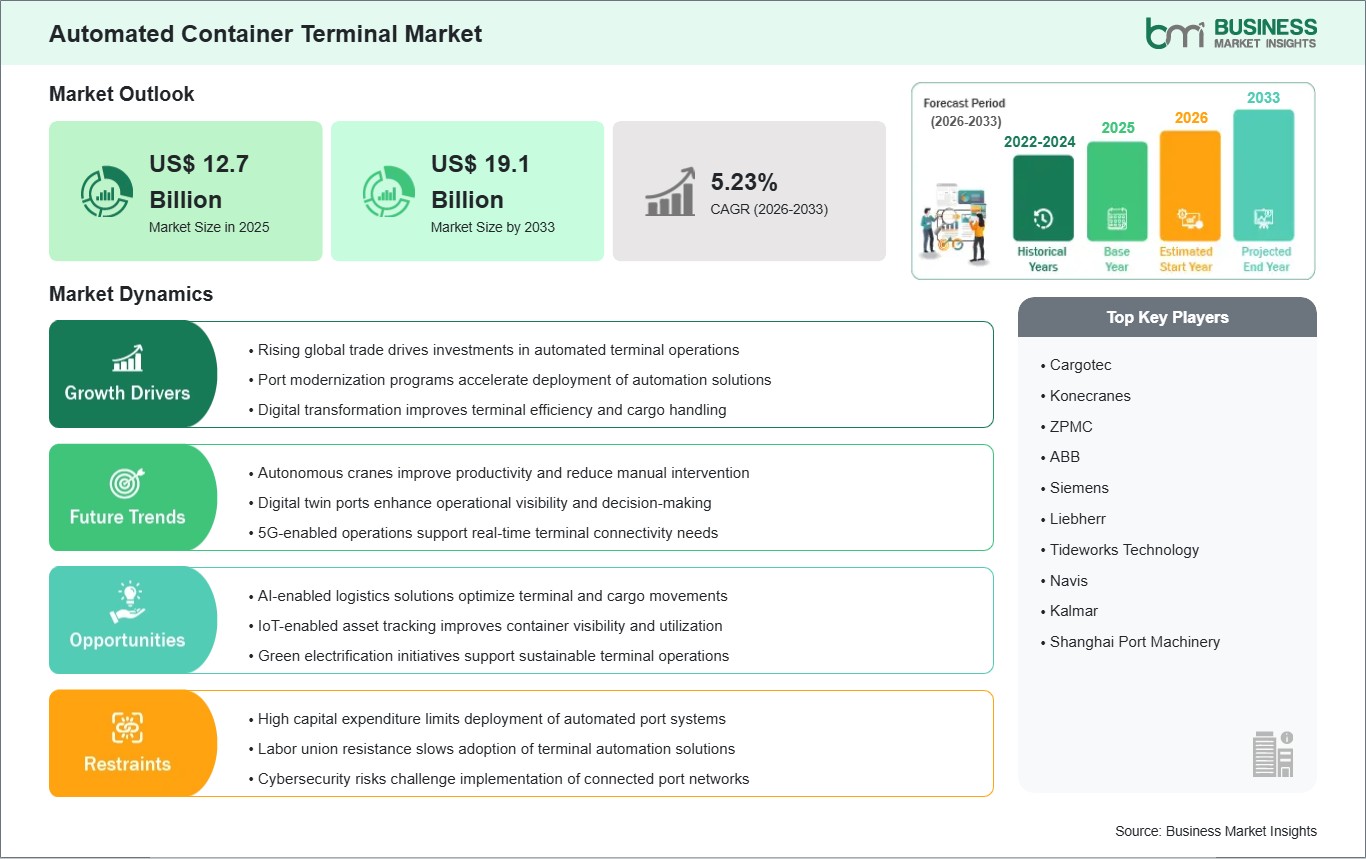
Automated container terminals use advanced equipment and digital technologies to automate cargo handling, container movement, and terminal operations. These terminals commonly include automated cranes, automated guided vehicles, terminal tractors, and intelligent software systems. They allow ports to increase efficiency, minimize delays, and cope with increasing traffic. The demand for this equipment is on the rise owing to the development of international trade and increased requirements for the rapid processing of containers at ports. Increased funding of smart port projects and digitalization of port infrastructure also drive the implementation of automated container terminal systems.
There are several challenges that may affect market growth. The installation of automated terminal infrastructure requires significant capital investment, which can be difficult for smaller ports and developing regions. The integration of automation systems into terminal operations could prove difficult, especially when a lot of planning and training is involved. In addition, cybersecurity threats keep rising as ports are becoming increasingly connected using cloud computing services and digital platforms. There may be some operational interruptions and difficulties in implementing technology within the terminals.
Despite these challenges, the market is expected to benefit from continued advancements in artificial intelligence, robotics, cloud computing, and IoT technologies. Smart port concepts are opening up possibilities of automation, real-time tracking, and predictive maintenance. The advancement of digital twins and autonomous cargo-handling solutions will help to improve the efficiency of terminal operations. Increased attention to sustainability in ports and energy efficiency in equipment is leading to an improvement in terminal infrastructure. As global supply chains become more connected and data-driven, automated container terminals are expected to play an increasingly important role in future logistics networks.
Segment Analysis
Automated Container Terminal Market Segmentation
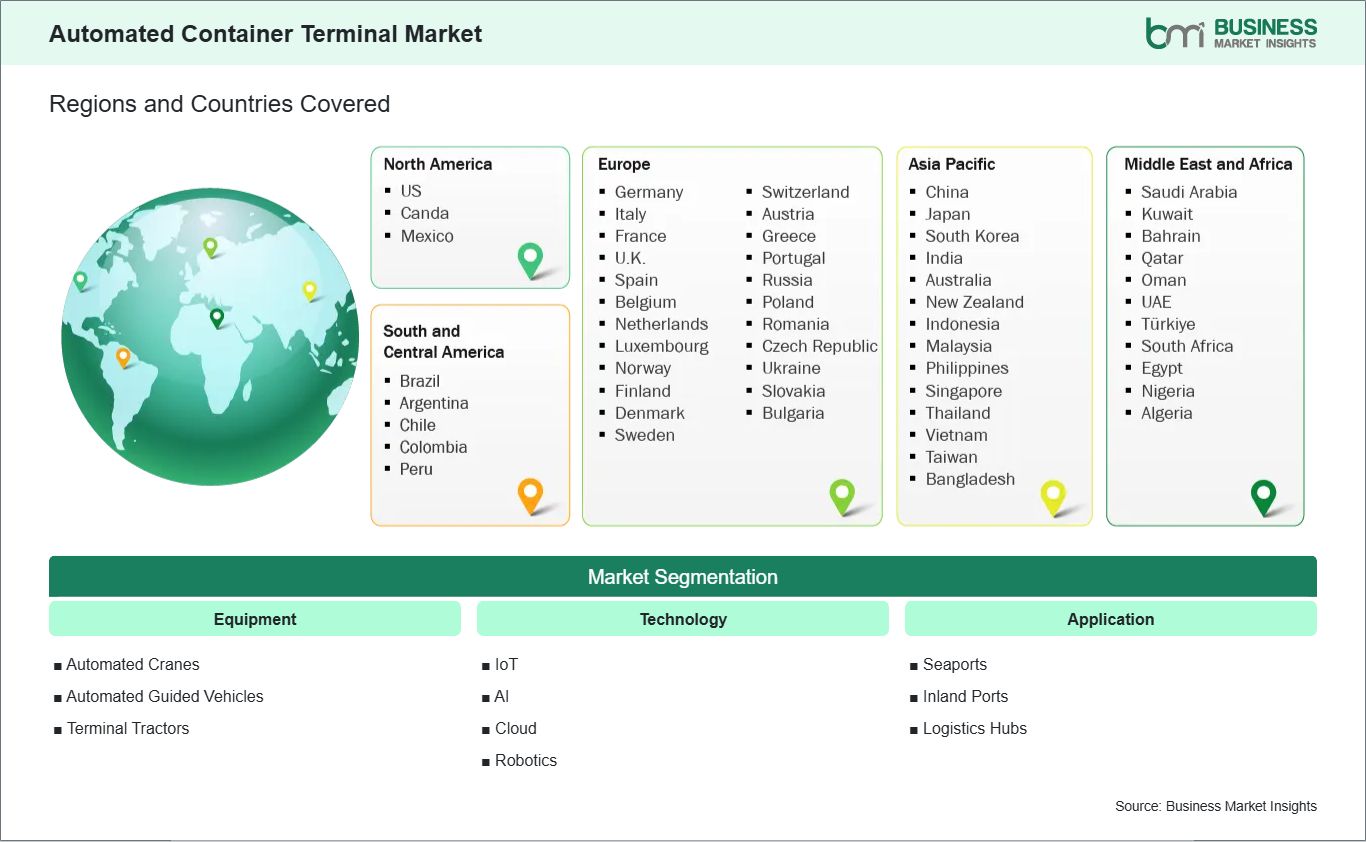
The Automated Container Terminal market is segmented based on equipment, technology, and application. These segments play an important role in shaping operational efficiency and digital transformation across port infrastructure.
By Equipment
- Automated Cranes: Widely used for efficient container loading, unloading, and stacking operations within terminals.
- Automated Guided Vehicles: Support autonomous transportation of containers across terminal yards and operational zones.
- Terminal Tractors: Assist in container movement and logistics coordination within automated terminal environments.
By Technology
- IoT: Enables real-time monitoring, equipment tracking, and operational visibility across terminal activities.
- AI: Supports predictive analytics, intelligent scheduling, and automated decision-making processes.
- Cloud: Facilitates centralized data management, remote monitoring, and system integration capabilities.
- Robotics: Enhances automated cargo handling, equipment operations, and terminal productivity.
By Application
- Seaports: Major deployment area due to high cargo traffic and international trade requirements.
- Inland Ports: Utilize automation technologies to improve cargo transfer and logistics efficiency.
- Logistics Hubs: Adopt automated systems to streamline container handling and supply chain operations.
Market Forces
Automated Container Terminal Market Drivers and Opportunities
Rising Global Trade and Port Modernization Initiatives
The increasing volume of international trade and containerized cargo movement is driving investments in automated container terminal infrastructure. Ports across developed and developing economies are under pressure to improve operational efficiency, reduce vessel turnaround times, and handle growing cargo volumes without significantly expanding physical infrastructure. Automation technologies provide an effective solution by enabling faster container handling, minimizing operational bottlenecks, and improving asset utilization.
Governments and port authorities are concentrating their efforts on modernization initiatives aimed at smart port creation, digitalization, and infrastructure improvement. Increased attention to resilient supply chains and sustainable logistics operations by the regulators favors the adoption of automation solutions that can operate using minimal energy and are managed through intelligent systems. Automation of cranes, guiding vehicles, and digital management systems ensures greater safety and reliability. As global trade networks continue to evolve, automated container terminals are becoming essential for maintaining competitiveness and operational performance. The combination of increasing cargo demand, technological advancements, and infrastructure modernization efforts is expected to remain a major growth driver for the market during the forecast period.
Expansion of AI-Driven Smart Port Ecosystems
The development of smart ports presents significant opportunities for the Automated Container Terminal market. Emerging technologies such as artificial intelligence, robotics, cloud computing, and digital twins are enabling terminals to create highly connected and intelligent operational environments. These innovations support real-time decision-making, predictive maintenance, resource optimization, and enhanced cargo visibility across the supply chain.
Future terminal developments are expected to focus on integrated digital ecosystems that connect port operations, shipping companies, customs authorities, and logistics providers. AI-powered analytics can improve berth allocation, container scheduling, and equipment utilization, while cloud-based platforms facilitate seamless data exchange among stakeholders. Robotics and autonomous vehicles are also expanding beyond container transportation to support more advanced terminal functions. Growing investments in sustainability initiatives create additional opportunities for automated terminal technologies. Electrified equipment, intelligent energy management systems, and environmentally optimized operations are becoming increasingly important for modern ports. As countries continue investing in smart infrastructure and digital logistics networks, the adoption of advanced automated container terminal solutions is expected to accelerate significantly.
Size and Share Analysis
Automated Container Terminal Market Size and Share Analysis
The Automated Container Terminal market size is expected to reach US$ 19.1 billion by 2033 from US$ 12.7 billion in 2025. The market is estimated to record a CAGR of 5.23% from 2026 to 2033.
By equipment, automated cranes account for a significant share of the market due to their essential role in container loading, unloading, and stacking operations. Automated guided vehicles are witnessing increasing adoption as ports seek greater efficiency in container transportation within terminal yards. Terminal tractors continue to support operational flexibility and cargo movement across large port facilities.
By technology, IoT and AI represent major contributors to market growth as terminal operators increasingly adopt intelligent monitoring, predictive analytics, and operational optimization tools. Cloud-based platforms are gaining importance for centralized management and data integration, while robotics technologies continue to expand across container handling applications.
By application, seaports dominate the market owing to high cargo throughput requirements and ongoing investments in automation infrastructure. Inland ports are increasingly implementing automated systems to improve logistics efficiency, while logistics hubs are adopting digital technologies to enhance supply chain connectivity and operational performance.
Report Coverage
Automated Container Terminal Market Report Coverage and Deliverables
The "Automated Container Terminal Market Size and Forecast (2022-2033)" report provides a detailed analysis of the market covering below areas:
- Market size and forecast at global, regional, and country levels for all the key market segments covered under the scope
- Market trends, as well as market dynamics such as drivers, restraints, and key opportunities
- Market analysis covering key market trends, global and regional framework, major players, regulations, and recent market developments
- Industry landscape and competition analysis covering market concentration, heat map analysis, prominent players, and recent developments for the market
- Detailed company profiles, including SWOT analysis
Geographic Insights
Automated Container Terminal Market Geographic Insights
The Automated Container Terminal Market shows diverse regional adoption patterns influenced by increasing global trade volumes, port modernization programs, and growing investments in digital logistics infrastructure.
North America, being a technologically advanced region, has a strong focus on port automation and supply chain optimization. The region comprises the United States and Canada, where port operators are investing in intelligent cargo handling systems, automated cranes, and digital terminal management platforms. Growing demand for operational efficiency and reduced vessel turnaround times is supporting the adoption of automation technologies. The region benefits from established logistics infrastructure, advanced connectivity networks, and strong investment capabilities, enabling the deployment of sophisticated automated container terminal solutions across major seaports and logistics centers.
Asia Pacific is experiencing substantial growth due to rapid expansion in maritime trade, container traffic, and port infrastructure development. The region includes countries such as China, India, Singapore, Japan, and South Korea, which are actively investing in smart port initiatives and terminal modernization projects. Ports across the region are adopting automated guided vehicles, robotics, and AI-driven operational systems to improve productivity and handle increasing cargo volumes efficiently. Strong government support for digital infrastructure and logistics modernization further contributes to market expansion.
Both regions are contributing significantly to the growth of the Automated Container Terminal Market, focusing on automation-driven operational efficiency, infrastructure modernization, and the development of intelligent logistics ecosystems that support global trade and supply chain performance.
Industry Activity
Recent Developments
The Automated Container Terminal Market is analyzed using a mix of primary and secondary research sources, including corporate publications, industry associations, and verified databases. This approach ensures accurate tracking of innovation trends and strategic developments influencing the market.
- In June 2026, Tianjin Port finalized massive infrastructure upgrades utilizing deep artificial intelligence and intelligent logistics systems to handle its multi-million annual container load. The fully automated ecosystem combines AI-driven crane management and predictive analytics to eliminate bottleneck delays across its expansive trade route network. The development aims to transform conventional, high-labor shipping docks into a fully digitalized global trade gateway.
- In March 2025, Colombo West International Terminal (CWIT) in Sri Lanka officially commenced operations as the country's first fully automated container terminal. The facility utilizes automated rail-mounted gantry cranes, intelligent guided vehicles, and advanced terminal automation systems to enhance operational efficiency and strengthen regional maritime logistics capabilities. The project reflects growing investment in automated terminal infrastructure across Asia.
Trust & Transparency
Research Methodology
The market analysis combines proprietary research with secondary data from government agencies, company disclosures, regulatory filings, industry databases and expert interviews. Market estimates are validated through data triangulation, cross-market benchmarking and analyst
review.
View Full Research Methodology
Key Sources Referred:
World Bank - Global Trade IndicatorsWorld Trade Organization (WTO)International Monetary Fund (IMF)International Trade Administration (ITA)Company WebsitesCompany Annual ReportsCompany Investor Presentations