
Wireless Power Transmission Market Outlook: Size, Share, Trends, Growth Analysis, Competitive Landscape & Forecast, 2026–2033

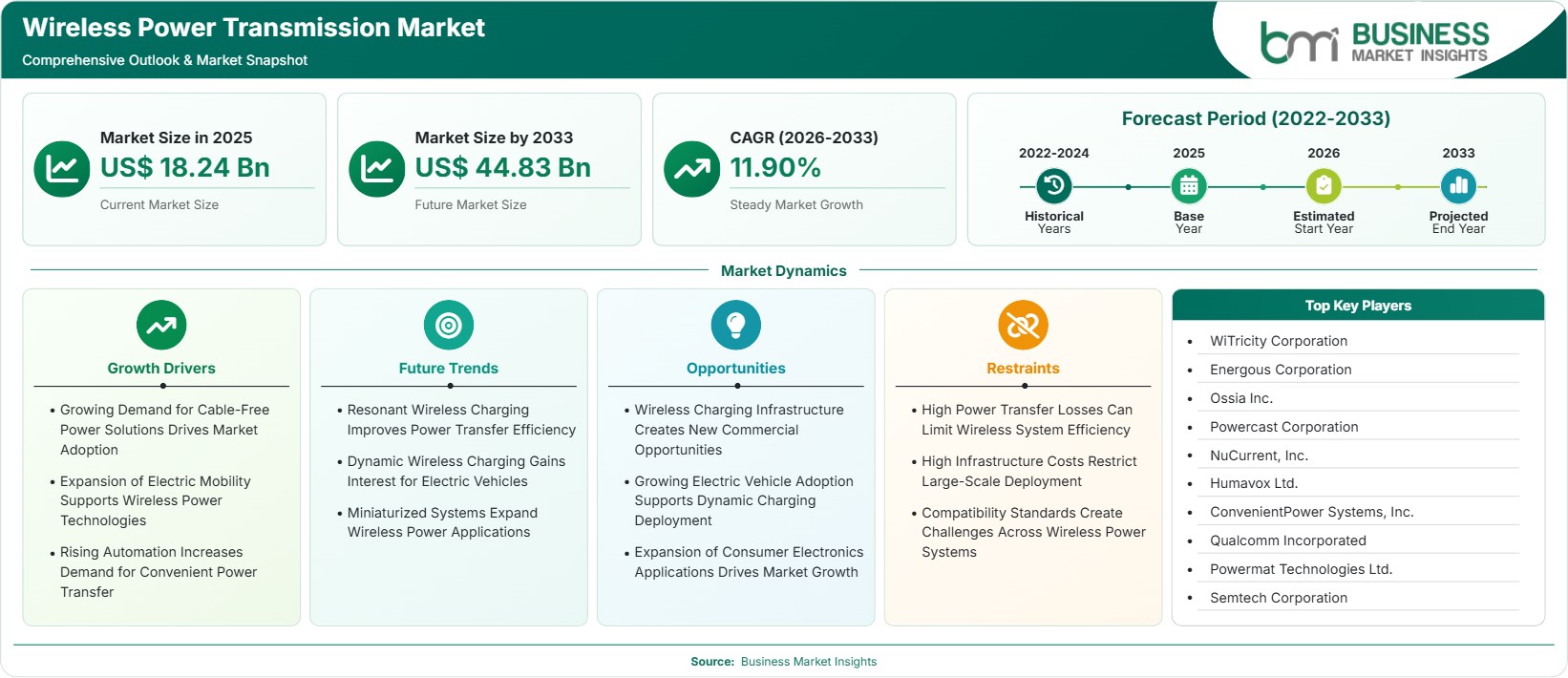
The Wireless Power Transmission Market size was valued at US$ 18.24 Billion in 2025 and is projected to reach US$ 44.83 Billion by 2033, growing at a CAGR of 11.90% during 2026–2033, driven by cable-free charging, charging infrastructure, and higher demand for flexible power delivery.

Report Coverage
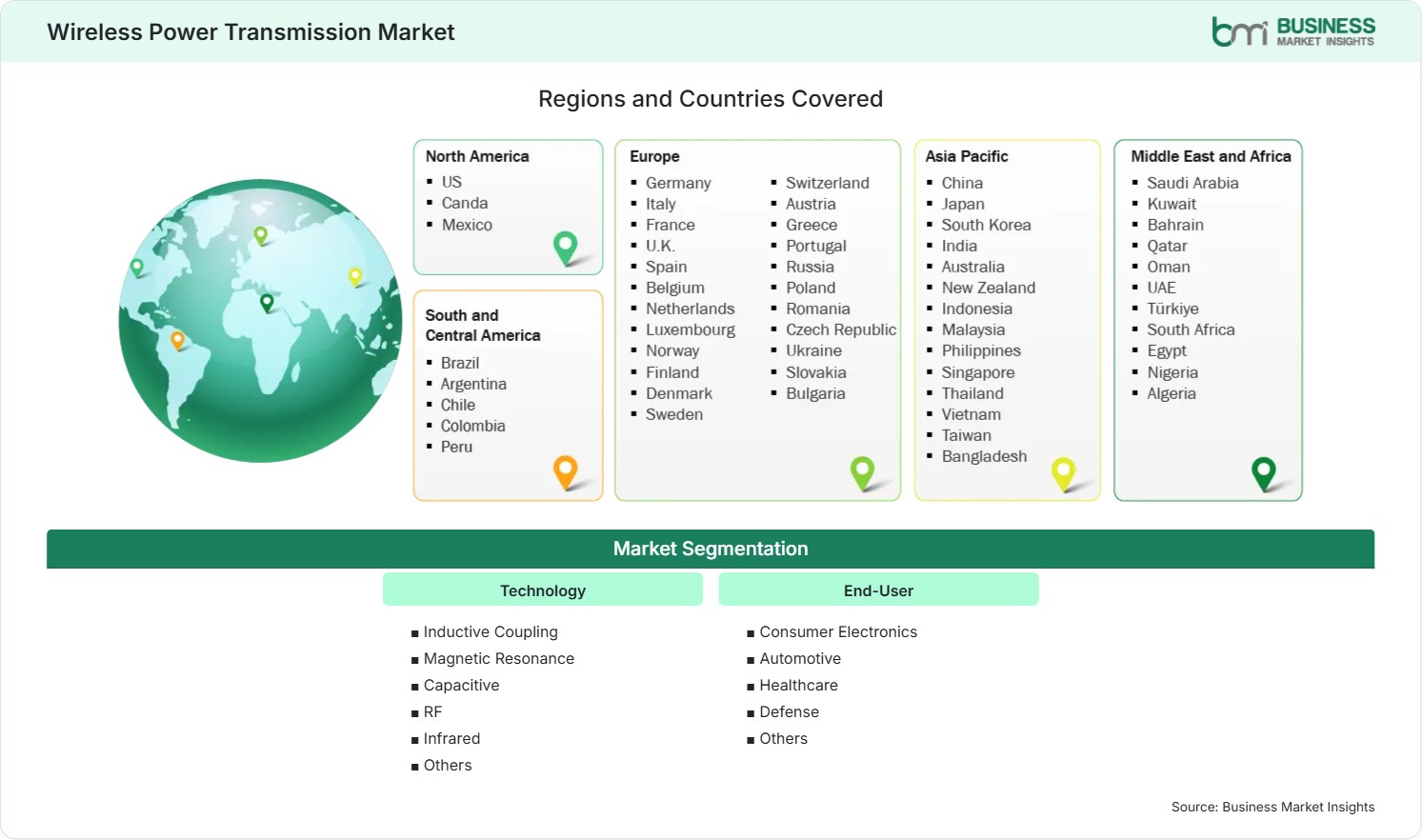
  • Technology: Inductive Coupling, Magnetic Resonance, Capacitive, RF, Infrared, Others
  • End-User: Consumer Electronics, Automotive, Healthcare, Defense, Others
US$ 18.24 Bn Market size in 2025
US$ 44.83 Bn Market Size by 2033
11.90% CAGR, 2026 - 2033
2026-2033 Forecast Period

01 AI Overview

Wireless Power Transmission Market Summary

  • North America: held 28%–31% Wireless Power Transmission Market share in 2025 and is projected to grow at 10.8%–11.5% CAGR through 2033, supported by electric mobility, and investment in charging infrastructure. The US accounts for 80%–84% of regional demand, expanding at 10.9%–11.6% CAGR through 2033, supported by EV charging, electronics, and automation.
  • Fastest Growing Region: Asia Pacific held 34%–37% share in 2025 and is projected to expand at 12.5%–13.3% CAGR through 2033, supported by electronics manufacturing, electric mobility, industrial automation, connected devices, and rapid deployment of wireless charging infrastructure.
  • Leading Segment: Inductive Coupling held 48%–52% share in 2025 and is projected to grow at 11.2%–11.9% CAGR through 2033, supported by mature component availability, established charging standards, compact designs, efficient short-range transfer, and broad device compatibility.
  • High Growth Segment: Magnetic Resonance held 18%–22% share in 2025 and is projected to grow at 13.0%–13.8% CAGR through 2033, supported by greater spatial tolerance, multi-device charging potential, electric mobility applications, and demand for flexible power transfer.
  • Key Market Opportunity: Wireless charging infrastructure creates commercial opportunities across automotive, consumer, industrial, healthcare, and automated environments as interoperability, charging convenience, alignment, and power-transfer efficiency improve across deployment settings.
  • Major Market Players: WiTricity Corporation, Energous Corporation; Ossia Inc., Powercast Corporation, NuCurrent, Inc., Humavox Ltd., ConvenientPower Systems, Inc., Qualcomm Incorporated, Powermat Technologies Ltd., Semtech Corporation.
02 Strategic Insights

Wireless Power Transmission Market: Strategic Insights

Wireless Power Transmission Market Strategic Framework
FREE PDF
Request your free sample
Request free sample
03 Stakeholder View

Key Takeaways

  • The industry value chain is shifting toward integrated systems combining power electronics, coils, control software, communication, alignment technologies, thermal management, and certification.
  • Automotive wireless charging offers the strongest medium-term upside because EV growth increases the addressable base for stationary and eventually dynamic power-transfer infrastructure.
  • Technology development is focused on improving alignment tolerance, transfer efficiency, charging speed, foreign-object detection, thermal management, interoperability, and multi-device operation.
  • Asia Pacific provides the strongest investment case because electronics production, EV manufacturing, connected-device penetration, and industrial automation are expanding simultaneously.
  • Standardization is becoming a commercial differentiator because interoperable systems can reduce customer qualification barriers and improve confidence in cross-platform charging deployment.
  • Infrastructure economics will increasingly determine adoption, particularly for automotive and industrial applications where installation, power electronics, alignment systems, and site integration materially influence total ownership cost.
04 Geographic Outlook

Wireless Power Transmission Market Regional Highlights

North America Wireless Power Transmission Market

North America held 28%–31% share in 2025 and North America Wireless Power Transmission Market forecast to expand at 10.8%–11.5% CAGR through 2033. The region benefits from strong consumer-electronics adoption, established automotive manufacturing, healthcare technology deployment, and industrial automation. The US represents most regional demand, while Canada contributes through automotive, healthcare, and industrial applications.

  • EV charging is becoming a major demand pathway as manufacturers and infrastructure providers seek automated charging methods that reduce connector handling and improve charging convenience.
  • Consumer electronics demand supports compact wireless charging systems, particularly where device design, charging convenience, and interoperability influence purchasing decisions.
  • Industrial automation creates demand for connector-free power delivery where repeated mechanical connections can create maintenance requirements, downtime, or contamination concerns.
  • Standards development is improving market confidence by defining requirements for safety, electromagnetic compatibility, positioning, interoperability, and performance across wireless power systems.

US Wireless Power Transmission Market

The US Wireless Power Transmission Market represented 80%–84% of North American demand in 2025 and is forecast to grow at 10.9%–11.6% CAGR through 2033. Demand is supported by electric mobility, consumer electronics, healthcare equipment, automation, and advanced charging infrastructure. The market has strong technical capabilities across power electronics, wireless communications, and automotive engineering.

  • Automotive applications are strengthening as EV penetration increases and charging systems evolve toward greater automation, convenience, and interoperability.
  • Industrial applications benefit from connector-free power transfer where equipment mobility, repeated charging cycles, or harsh operating conditions increase the value of automated energy delivery.
  • Consumer applications remain an important volume base, with higher charging power and improved magnetic alignment expanding the functionality of wireless charging systems.

Europe Wireless Power Transmission Market

Europe Wireless Power Transmission Market held 23%–26% share in 2025 and is projected to grow at 10.2%–10.9% CAGR through 2033. Germany, the UK, France, and Italy remain leading markets, while Spain and the Netherlands provide attractive growth opportunities. Germany is expected to expand at 10.4%–11.1% CAGR, while the Netherlands is positioned at 11.3%–12.0% CAGR as mobility electrification and charging infrastructure develop.

  • Germany benefits from its automotive manufacturing base, industrial automation capabilities, engineering expertise, and increasing demand for advanced charging technologies.
  • The Netherlands provides a strong growth environment because electrified mobility, connected infrastructure, and dense urban transport networks favor automated charging solutions.
  • European standardization is improving deployment conditions by defining safety, communication, positioning, electromagnetic compatibility, and interoperability requirements for wireless power systems.
  • Healthcare and industrial applications provide additional demand because connector-free power can improve equipment usability, charging convenience, and operational flexibility.

Asia Pacific Wireless Power Transmission Market

Asia Pacific Wireless Power Transmission Market represented 34%–37% share in 2025 and is projected to grow at 12.5%–13.3% CAGR through 2033, making it the largest and fastest-growing regional market. China, Japan, South Korea, and India are leading demand centers, while India and Southeast Asia provide stronger growth opportunities. China is expected to grow at 12.8%–13.5% CAGR, while India is positioned at 13.4%–14.2% CAGR through 2033.

  • China benefits from its electronics manufacturing scale, EV production base, charging infrastructure development, and widespread deployment of connected consumer devices.
  • India provides strong growth potential as electric mobility, electronics manufacturing, industrial automation, and digital infrastructure increase demand for convenient power-transfer technologies.
  • Japan and South Korea support advanced wireless power applications through established electronics industries, automotive capabilities, semiconductor ecosystems, and high levels of technology adoption.
  • Southeast Asia offers additional opportunities as manufacturing capacity, urbanization, consumer electronics penetration, and electric mobility develop across multiple national markets.

Rest of World Wireless Power Transmission Market

Rest of World held 10%–13% share in 2025 and is projected to grow at 9.8%–10.6% CAGR through 2033, supported by infrastructure modernization and increasing technology adoption. South and Central America are the developing regions for electric mobility, consumer electronics, healthcare technology, and industrial automation where there is a slow demand growth. Brazil and Mexico are the leading markets of South and Central America, and Mexico is profiting from manufacturing synergy while Brazil is enjoying its vast electronics and automobiles market. Middle East and Africa are emerging demand centers in the fields of healthcare, industrial automation, smart infrastructure, and electric mobility.

  • Brazil remains a leading South American market, supported by automotive production, consumer electronics, industrial applications, and gradual electrification of transport.
  • Mexico benefits from manufacturing integration with North American supply chains, creating demand for advanced automotive, electronics, and industrial power technologies.
  • Gulf markets provide opportunities through smart infrastructure, premium mobility, healthcare modernization, and automation investments that can support higher-value wireless power applications.
  • South Africa provides an important African technology market, while broader regional growth depends on infrastructure investment, affordability, technical support, and standards awareness.
Global Market Geography
FREE PDF
Request your free sample
Request free sample
05 Segment Analysis

Wireless Power Transmission Market Segmentation

Technology

Inductive Coupling held 48%–52% share in 2025 and is projected to grow at 11.2%–11.9% CAGR through 2033. Its established architecture, compact implementation, predictable short-range transfer, and broad component availability support continued adoption. Magnetic Resonance provides stronger growth potential where greater alignment tolerance and spatial freedom matter.

  • Inductive Coupling: Uses closely aligned electromagnetic fields for efficient short-range transfer, supporting mature charging architectures, compact hardware, standardized implementations, and broad compatibility across electronic devices.
  • Magnetic Resonance: Enables greater spatial tolerance between transmitter and receiver, supporting flexible positioning, multi-device charging, and higher-value automotive or industrial power-transfer configurations.
  • Capacitive: Transfers energy through electric-field coupling and can support compact implementations where controlled separation, lightweight structures, and integration flexibility are important.
  • RF: Enables power delivery over greater distances than tightly coupled systems, supporting low-power connected devices, sensors, and applications requiring reduced dependence on physical charging interfaces.
  • Infrared: Uses directed optical energy for wireless transfer where line-of-sight operation is acceptable, providing potential for specialized devices and controlled environments requiring contactless energy delivery.

End-User

Near-field applications held 86%–90% share in 2025 and are projected to grow at 11.4%–12.0% CAGR through 2033. Consumer electronics provide the largest installed application base, while automotive and healthcare are gaining strategic importance. Defense and other specialized applications contribute additional demand where connector-free energy transfer can improve equipment mobility, reliability, environmental protection, or operational convenience.

  • Consumer Electronics: Remains the largest application base, supported by smartphones, wearables, accessories, and connected devices requiring convenient charging, compact components, and improved interoperability.
  • Automotive: Gains importance as EV adoption expands and vehicle manufacturers pursue automated charging, connector reduction, improved user convenience, and compatibility with emerging wireless charging infrastructure.
  • Healthcare: Benefits from connector-free power delivery for equipment requiring easy cleaning, sealed designs, reduced cable clutter, and convenient charging within controlled operating environments.
  • Defense: Supports specialized applications where reliable contactless energy transfer can reduce exposed connectors, improve equipment mobility, and simplify power delivery under demanding operating conditions.
06 Market Forces

Wireless Power Transmission Market Dynamics

Key Market Drivers

Growing Demand for Cable-Free Power Solutions Drives Market Adoption

Wireless power has emerged as an attractive option for design engineers aiming at reducing the reliance on physical connectors. Consumer devices, industrial machinery, health care facilities, and mobility-related applications are now requiring smaller form factors with less mechanical interfaces. This could result in increased flexibility of enclosures, enhanced ease of use, and reduced wear due to frequent plugging/unplugging. Hence, the success of the Wireless Power Transmission Market is attributed to not just convenience but also the needs of the design of products.

Expansion of Electric Mobility Supports Wireless Power Technologies

Electric mobility is widening the addressable market for higher-power wireless energy transfer. As the installed EV base grows, charging convenience becomes increasingly important alongside charging speed and infrastructure availability. Wireless systems can support automated charging while reducing connector handling and enabling greater integration with parking, fleet, and smart-energy environments. SAE J2954 establishes criteria covering interoperability, electromagnetic compatibility, EMF, safety, performance, and testing for light-duty vehicle wireless power transfer, helping define technical requirements for broader deployment. This supports Wireless Power Transmission Market growth by reducing uncertainty around vehicle-side and infrastructure-side system design.

Rising Automation Increases Demand for Convenient Power Transfer

Automation is creating applications where equipment must operate with minimal manual intervention and limited reliance on physical power connections. Industrial robots, mobile equipment, automated guided systems, sensors, and connected machinery can benefit from charging architectures that fit into automated operating cycles. Wireless transfer can reduce mechanical connector wear and allow power delivery at designated operating points without requiring manual cable connection. The Wireless Power Transmission Market trends increasingly reflect this shift toward integrated energy management rather than standalone charging hardware.

Key Market Opportunities

Wireless Charging Infrastructure Creates New Commercial Opportunities

Wireless charging infrastructure provides a route for expanding wireless power beyond individual devices into shared mobility, automotive, industrial, and commercial environments. The opportunity is strongest where users value automated charging, reduced connector handling, and predictable energy availability. Standardization is improving the commercial foundation for infrastructure investment. Commercial opportunities also extend to installation, maintenance, power-management software, alignment systems, and monitoring.

Growing Electric Vehicle Adoption Supports Dynamic Charging Deployment

Dynamic wireless power transfer presents a longer-term opportunity because energy can be transferred while vehicles are moving. The commercial opportunity depends on infrastructure cost, roadway integration, vehicle compatibility, grid capacity, and demonstrated lifecycle economics. Nevertheless, dynamic systems could reduce charging downtime and potentially reduce the need for very large onboard energy-storage capacity in selected use cases. Continued standards development and improvements in transfer efficiency will determine the pace at which this opportunity moves from demonstration to commercial infrastructure.

Expansion of Consumer Electronics Applications Drives Market Growth

Consumer electronics remains a broad commercial opportunity because wireless charging can be integrated into increasingly diverse connected-device ecosystems. Higher power levels, improved magnetic alignment, multi-device support, and interoperability are expanding the functionality of wireless charging systems. Future opportunities extend into wearables, accessories, computing devices, connected equipment, and other battery-powered products. Suppliers can capture value through smaller receiver modules, improved thermal management, integrated power electronics, and designs that support multiple device types within common charging ecosystems.

Market Restraints and Challenges

High Power Transfer Losses Can Limit Wireless System Efficiency

Factor: Wireless transfer involves conversion, coupling, alignment, and electromagnetic losses that may lower efficiency compared to direct conductive transfer. Impact: Efficiency losses can lead to greater energy use, heat production, cooling needs, and operational costs, especially for more powerful systems. Efficiency is dependent on factors including distance between transmitter and receiver, alignment, other objects, coil design, frequency, and surrounding substances.

High Infrastructure Costs Restrict Large-Scale Deployment

Factor: Wireless charging infrastructure requires specialized transmitters, receivers, power electronics, alignment systems, communication functions, installation work, and site integration. Impact: Higher upfront expenditure can delay adoption where conductive charging or conventional power connections provide lower initial costs. Infrastructure economics become particularly challenging for automotive applications because deployment requires coordination between vehicles, charging sites, electrical systems, and standards compliance.

07 Company Analysis

Competitive Landscape

The Wireless Power Transmission Market analysis reflects competition across wireless charging technology specialists, semiconductor companies, RF power providers, automotive-oriented technology developers, and firms supplying system components. Competitive positioning depends on transfer efficiency, operating range, power density, alignment tolerance, receiver size, thermal performance, interoperability, electromagnetic compliance, and integration capability.

Company Name

Overview

Products and Services relevant to this market

WiTricity Corporation

Wireless power technology company focused on magnetic-resonance power transfer and automotive applications.

Wireless EV charging technology, magnetic-resonance systems, reference designs, licensing, and interoperability solutions.

Energous Corporation

Wireless power technology provider focused on RF-based over-the-air energy transfer.

RF wireless power transmitters, receivers, power management, and wireless charging solutions for connected devices.

Ossia Inc.

Wireless power technology company focused on long-distance RF power delivery.

RF wireless power systems, transmitters, receivers, control technology, and charging infrastructure solutions.

Powercast Corporation

Developer of RF-based wireless power technologies for connected and low-power applications.

RF transmitters, receivers, wireless power modules, development platforms, and charging systems.

NuCurrent, Inc.

Wireless power technology specialist focused on compact charging and power-transfer integration.

Wireless power coils, charging modules, antennas, reference designs, and system engineering services.

Humavox Ltd.

Wireless charging technology provider focused on integrated and embedded charging architectures.

Wireless charging systems, embedded power-transfer technology, charging modules, and design integration.

ConvenientPower Systems, Inc.

Wireless charging technology developer focused on charging platforms and power-transfer systems.

Wireless charging platforms, power-transfer modules, charging systems, and integration technologies.

Qualcomm Incorporated

Technology company with extensive semiconductor, connectivity, and wireless power capabilities.

Wireless charging technologies, power-management solutions, semiconductor components, and charging platforms.

Powermat Technologies Ltd.

Wireless charging technology company with expertise in inductive charging and power-transfer systems.

Wireless charging systems, inductive charging technology, charging infrastructure, and integration solutions.

Semtech Corporation

Semiconductor and connectivity technology provider with power-management and wireless technology capabilities.

Power-management ICs, wireless components, semiconductor solutions, and technologies supporting wireless power systems.

10 Trust & Transparency

Research Methodology

The market analysis combines proprietary research with secondary data from government agencies, company disclosures, regulatory filings, industry databases and expert interviews. Market estimates are validated through data triangulation, cross-market benchmarking and analyst review.

View Full Research Methodology

11 Questions Answered

Frequently Asked Questions

What does the Wireless Power Transmission Market Report cover?

The report evaluates technology and end-user segments, regional demand, market structure, growth drivers, opportunities, and technology trends influencing the industry through 2033.

How are wireless power standards affecting market adoption?

Standards improve interoperability, safety, electromagnetic compatibility, positioning, and testing requirements. Greater standardization reduces technical uncertainty for manufacturers and infrastructure developers, and specialized applications.

What determines the efficiency of wireless power transmission systems?

Efficiency depends on coupling, alignment, coil geometry, frequency, power electronics, transfer distance, thermal conditions, and control algorithms.

Why is electric mobility important for wireless power transmission?

Electric mobility expands demand for automated charging and creates opportunities for stationary and dynamic power-transfer systems. Wireless charging can reduce connector handling and support charging integration within parking, fleet, and transportation infrastructure.

What is the main technology used in wireless power transmission?

Inductive coupling currently represents the largest technology base because it offers established components, compact implementation, predictable short-range transfer, and broad compatibility.

Access the Full Wireless Power Transmission Market Report

Get segment-level forecasts, regional estimates, competitive benchmarking, company profiles and downloadable Excel datasets.

Access the full Wireless Power Transmission Market Report
350 pages PDF & Excel | 2026-08-24