
Telecom Power Systems Market Outlook: Size, Share, Trends, Growth Analysis, Competitive Landscape & Forecast, 2026-2033

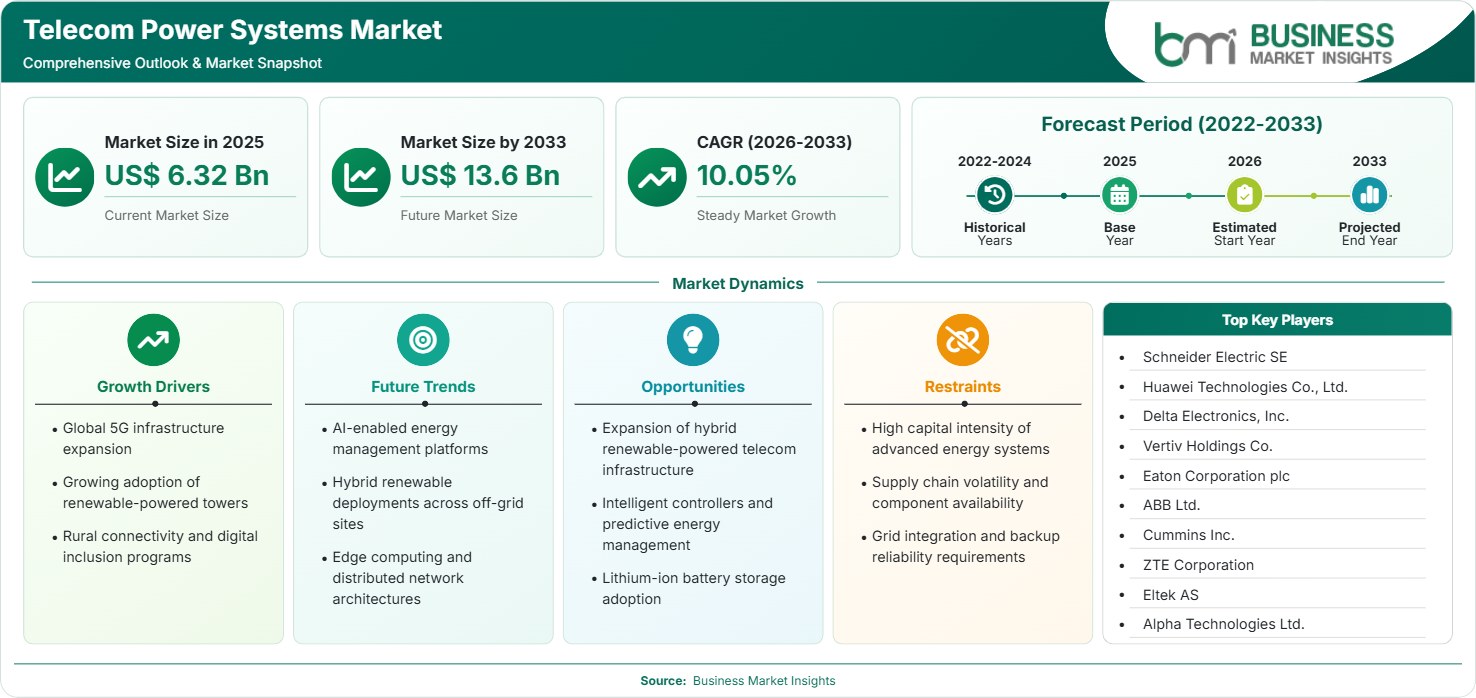
The Telecom Power Systems Market size was valued at US$ 6.32 Billion in 2025 and is projected to reach US$ 13.6 Billion by 2033, growing at a CAGR of 10.05% during 2026–2033, driven by 5G deployments, tower densification, hybrid energy adoption, remote connectivity initiatives, and increasing energy-efficiency investments.

Report Coverage
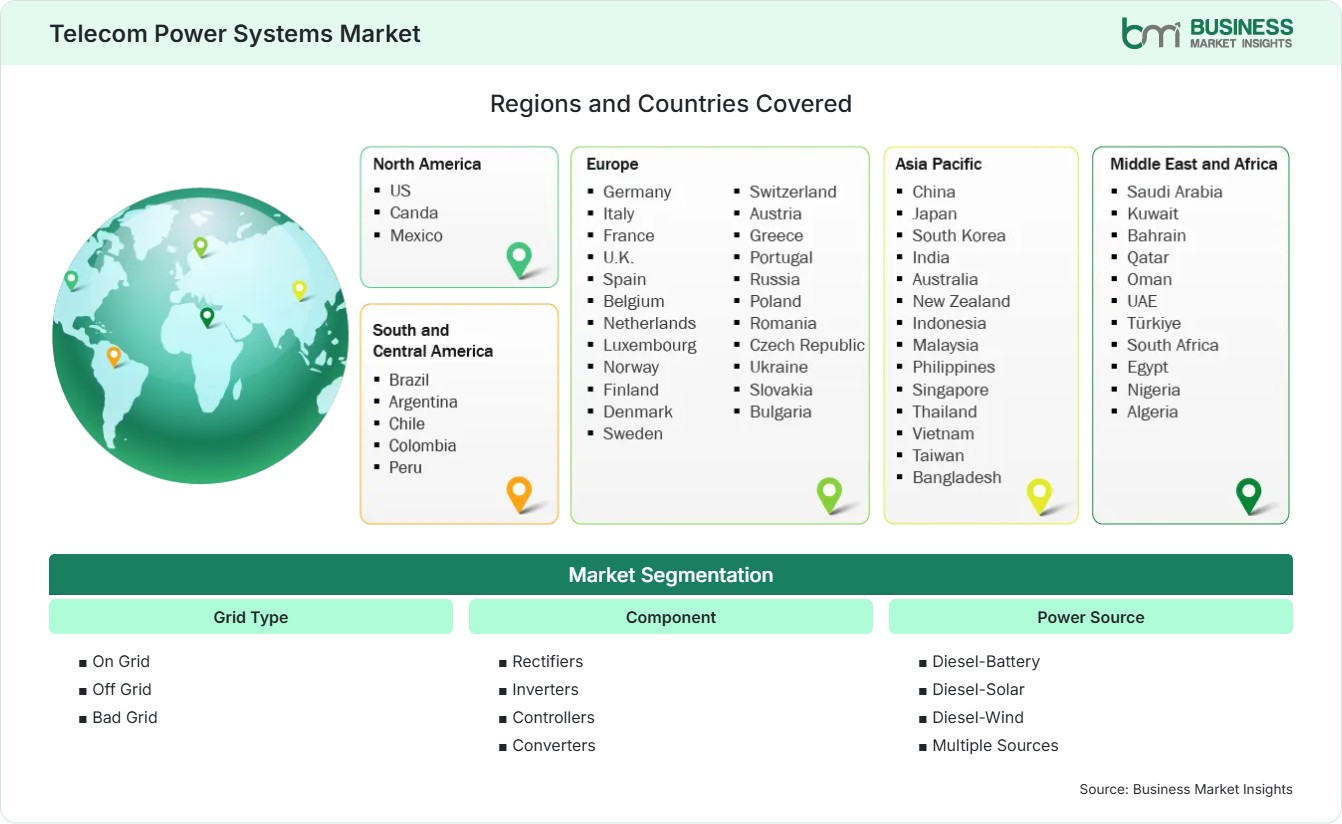
  • Grid Type: On Grid, Off Grid, Bad Grid
  • Component: Rectifiers, Inverters, Controllers, Converters
  • Power Source: Diesel-Battery, Diesel-Solar, Diesel-Wind, Multiple Sources
US$ 6.32 Bn Market size in 2025
US$ 13.6 Bn Market Size by 2033
10.05% CAGR, 2026 - 2033
2026-2033 Forecast Period

AI Overview

Telecom Power Systems Market Summary

  • North America Region: North America holds a market share of 34%–37% in 2025, growing at a CAGR of 8.5%–9.2% during 2026–2033. Growth is supported by 5G network expansion, data-intensive services, advanced backup systems, renewable integration, edge infrastructure investment, telecom modernization programs, operational resilience requirements, energy optimization initiatives, and grid reliability enhancements. US market benefits from large-scale 5G densification and network resilience spending, advancing at an estimated CAGR of 8.8%–9.4%.
  • Fastest Growing Region: Asia Pacific holds a market share of 28%–31% in 2025 and grows at a CAGR of 11.8%–12.6% during 2026–2033. Key drivers include tower expansion, rural broadband projects, increasing smartphone penetration, renewable deployments, telecom digitization programs, infrastructure investment, growing subscriber bases, network upgrades, and strong government-backed connectivity initiatives.
  • Leading Segment: On-grid accounts for 40%–43% share in 2025 and advances at 8.7%–9.4% CAGR through 2033. Demand stems from urban tower concentration, lower operating costs, reliable utility access, grid modernization, energy efficiency priorities, maintenance reduction objectives, digital monitoring implementation, and network availability requirements.
  • High Growth Segment: Diesel-Solar represents a 24%–27% share in 2025 and expands at a CAGR of 12.8%–13.6%. Adoption increases through carbon reduction targets, fuel cost optimization, remote tower deployment, renewable integration strategies, battery performance improvements, sustainability programs, operational savings, and energy security objectives.
  • Key Market Opportunity: Expansion of hybrid renewable-powered telecom infrastructure across off-grid and bad-grid locations creates opportunities for intelligent controllers, energy storage, predictive management software, and long-duration backup solutions.
  • Major Market Players: Schneider Electric SE, Huawei Technologies Co., Ltd., Delta Electronics, Inc., Vertiv Holdings Co., Eaton Corporation plc, ABB Ltd., Cummins Inc., ZTE Corporation, Eltek AS, Alpha Technologies Ltd.
Strategic Insights

Telecom Power Systems Market: Strategic Insights

Telecom Power Systems Market Strategic Framework
FREE PDF
Request your free sample
Request free sample
Stakeholder View

Key Takeaways

  • The value chain is evolving from equipment-centric procurement toward integrated energy-management ecosystems combining power electronics, batteries, remote monitoring, and lifecycle services.
  • Off-grid deployments and hybrid renewable configurations provide the strongest upside as operators target remote connectivity and lower operating expenditure.
  • Innovation is shifting toward lithium-ion storage, smart controllers, predictive maintenance software, and AI-enabled energy optimization platforms.
  • Asia Pacific presents the most compelling regional investment case because of tower additions, rural broadband programs, and rapid telecom subscriber growth.
  • Strategic partnerships between telecom operators, tower companies, and energy technology providers are increasing as network resilience becomes a critical performance metric.
  • Sustainability objectives are influencing procurement decisions, encouraging migration from diesel-dominant systems toward solar-assisted and multi-source architectures.
Geographic Outlook

Telecom Power Systems Market Regional Highlights

North America Telecom Power Systems Market

North America accounted for 34%–37% of global revenue in 2025 and is projected to expand at a CAGR of 8.5%–9.2% through 2033. The regional Telecom Power Systems Market share remains supported by mature telecom infrastructure, substantial 5G investments, and strong emphasis on network resiliency. Operators are modernizing legacy power architectures while integrating advanced monitoring systems. Increasing edge-network deployment and enterprise connectivity requirements further strengthen demand. Utility reliability standards and renewable integration programs continue influencing long-term procurement strategies.

  • 5G small-cell deployment requires highly reliable distributed power systems across dense urban environments.
  • Telecom operators increasingly adopt lithium-ion batteries to reduce maintenance and improve lifecycle economics.
  • Grid modernization initiatives encourage advanced power-management technologies and remote monitoring capabilities.
  • Data traffic growth from cloud applications increases demand for resilient backup infrastructure.
  • Sustainability commitments support gradual deployment of renewable-assisted telecom energy systems.

US Telecom Power Systems Market

The United States represents 78%–82% of regional demand and advances at a CAGR of 8.8%–9.4%. Growth is supported by extensive network densification, data-center connectivity, and increasing investment in infrastructure hardening. Federal broadband initiatives and private sector spending continue supporting resilient telecommunications networks. Advanced battery technologies are gaining adoption across macro towers and distributed network assets. Telecom operators remain focused on power-efficiency improvements and operational continuity.

  • Broadband expansion projects increase demand for reliable power in newly connected communities.
  • Edge computing infrastructure stimulates investment in distributed telecom energy assets.
  • Weather resilience planning expands deployment of backup and hybrid power configurations.
  • Energy-management software adoption improves operational visibility and cost control.

Europe Telecom Power Systems Market

Europe holds approximately 23%–26% market share in 2025 and is expected to grow at a CAGR of 8.9%–9.7%. Regional demand is shaped by decarbonization targets, advanced telecom networks, and renewable-energy integration policies. Germany remains the leading market supported by infrastructure modernization, while Eastern European countries demonstrate higher growth trajectories approaching 10%–11%. Investments in efficient power conversion technologies and battery storage continue strengthening regional competitiveness and operational sustainability.

  • Carbon-reduction frameworks accelerate solar-assisted telecom infrastructure deployment.
  • Germany leads regional installations through extensive network modernization activity.
  • Poland and Romania show faster growth supported by digital infrastructure investments.
  • Operators increasingly deploy intelligent controllers and remote energy-management systems.
  • Renewable integration supports lower operating costs and improved sustainability metrics.

Asia Pacific Telecom Power Systems Market

Asia Pacific captures 28%–31% of global revenue in 2025 and records the highest CAGR of 11.8%–12.6% between 2026 and 2033. Regional expansion is driven by tower rollouts, smartphone adoption, and large-scale connectivity programs. China and India remain dominant markets, while Southeast Asian economies exhibit strong investment momentum. Telecom Power Systems Market share gains are supported by rural broadband initiatives, growing mobile data demand, and increasing deployment of renewable-powered telecom infrastructure.

  • India continues extensive tower deployment supporting broadband coverage expansion.
  • China invests heavily in advanced network infrastructure and energy-efficient systems.
  • Indonesia and Vietnam show strong growth through rural connectivity initiatives.
  • Hybrid renewable solutions gain traction in remote and island-based deployments.
  • Governments support universal digital access through telecom infrastructure investment.

Rest of World Telecom Power Systems Market

Rest of World region holds a market share of 11%-14% during 2025 and grows at a CAGR of 9.8%-10.6%. Hybrid solutions are being used in South & Central America to provide remote telecoms coverage. Off-grid deployment and network expansion initiatives drive the market growth in the MEA region. Brazil and Saudi Arabia emerge as major regions for this market, while Kenya and Nigeria show rapid growth due to improved connectivity and energy access.

  • Remote-location towers drive sustained demand for renewable-assisted energy systems.
  • Brazil benefits from broad telecom coverage expansion and modernization projects.
  • Saudi Arabia supports advanced infrastructure through digital transformation initiatives.
  • African markets increasingly adopt solar-diesel hybrid configurations.
  • Reliability challenges encourage investment in energy storage and intelligent controls.
Global Market Geography
FREE PDF
Request your free sample
Request free sample
Segment Analysis

Telecom Power Systems Market Segmentation

Grid Type

Grid type was another vital category for the application. On-grid accounted for a 40%-43% share in 2025 and experienced a CAGR of 8.7%-9.4%. The scope of the Telecom Power Systems Market in this application segment is supported by dense urban infrastructure, reliable access to utilities, and lower cost of ownership. The trend of installing off-grid and bad-grid continues expanding as operators pursue broader network coverage.

  • On Grid: Widely adopted across urban telecom infrastructure where dependable utility access reduces fuel consumption, lowers operational expenses, and supports uninterrupted service continuity.
  • Off Grid: Essential for remote territories lacking reliable electricity, driving adoption of renewable energy integration, intelligent controllers, and long-duration battery storage systems.
  • Bad Grid: Supports regions affected by unstable power quality, requiring backup systems, advanced rectifiers, and energy management solutions for enhanced reliability.

Component

The components determine the efficiency, effectiveness, and reliability of the systems. The rectifier segment accounted for the largest market share in 2025 and is forecast to remain dominant during the forecast period. Telecom Power Systems Market dynamics reveal increasing adoption of power management solutions offering intelligent power conversion, remote monitoring, and energy management architecture across telecom infrastructure.

  • Rectifiers: Convert AC power to DC power for telecom equipment, supporting energy efficiency improvements and expanding deployment across modern communication networks.
  • Inverters: Enable reliable AC output from battery and renewable sources, supporting hybrid telecom power architectures in varied operating conditions.
  • Controllers: Increasingly integrated with analytics and remote monitoring features, enabling predictive maintenance and optimized energy utilization.
  • Converters: Improve compatibility among multiple energy sources and equipment configurations while supporting system flexibility and operational reliability.

Power Source

The selection of energy sources is now taking into account factors such as sustainability and resilience. Diesel Battery continues to be the largest revenue contributor, capturing 38%-41% of market value by 2025, with a CAGR of 8.4%-9.1%. Yet, the fastest-growing energy source is diesel-solar, due to reduced dependence on fuel and better environmental impact.

  • Diesel-Battery: Remains prevalent where uninterrupted backup capability is critical and renewable integration remains limited by deployment economics.
  • Diesel-Solar: Gains momentum through fuel savings, carbon reduction benefits, and improved economics of photovoltaic technologies and storage systems.
  • Diesel-Wind: Suitable for areas with strong wind resources, supporting reduced diesel consumption and enhanced energy diversification.
  • Multiple Sources: Combines several energy inputs to maximize resilience, flexibility, and operational continuity across challenging deployment environments.
Market Forces

Telecom Power Systems Market Dynamics

Key Market Drivers

Global 5G Infrastructure Expansion

The growing deployment of 5G infrastructure continues to be one of the main factors that drives demand. According to industry groups such as the GSMA, the number of 5G connections is growing globally; however, more networks and additional radio infrastructure will be required. This leads to increased demand for electricity on macro towers, DAS, and small cell sites. The telecommunication firms are employing highly efficient rectifiers, batteries, and monitoring mechanisms to ensure availability while maintaining cost efficiency. Telecom Power Systems Market growth will be positively influenced by power systems' role in ensuring network availability. As these operators seek to ensure lower latency and increased coverage, the acquisition of energy systems becomes part of their growth strategy.

Growing Adoption of Renewable-Powered Towers

Telecom service providers are increasingly incorporating solar energy and hybrid systems into their networks to reduce fuel costs and achieve their sustainability goals. Growing diesel prices and companies' carbon footprint reduction initiatives have spurred interest in developing renewable energy-assisted telecom networks. Smart power management, innovative storage options, and advanced monitoring tools allow for optimal use of various energy sources. Telecom Power Systems Market trends point to a clear move toward those solutions that integrate resilience with green credentials. It would be logical to opt for hybrid systems in the event of an unreliable power grid and expensive fuel transportation, as both factors may significantly affect the business case. Companies specializing in integrated renewable energy solutions will find many deployment opportunities.

Rural Connectivity and Digital Inclusion Programs

Global governments continue to support the expansion of broadband and mobile coverage to bridge the digital divide. Large-scale telecom networks in developing countries need a reliable energy infrastructure that can work despite changes in grid conditions. Telecom power solutions help ensure high service availability in difficult and underserved areas. The growing number of subscribers and increased mobile data consumption create new infrastructure needs that go beyond the usual backup options and include integrating energy generation, storage, and management. Public funding mechanisms and development finance initiatives create favorable conditions for suppliers to deliver resilient, scalable, and energy-efficient telecom power technologies.

Key Market Opportunities

AI-Enabled Energy Management Platforms

The application of artificial intelligence holds significant promise for improving the use and maintenance of network power. The ability of predictive analytics to anticipate component failures before downtime ensures efficiency and reduces expenses. Telecom companies are increasingly interested in solutions that combine monitoring, diagnostics, and network performance forecasting. Telecom Power Systems Market Forecasts now account for the contribution of software solutions in addition to hardware sales. Manufacturers of technology capable of intelligent analysis and control are likely to improve batteries, reduce fuel costs, and achieve sustainability goals. As telecom infrastructure becomes more distributed, centralized AI-based management solutions are expected to become an important competitive differentiator.

Hybrid Renewable Deployments Across Off-Grid Sites

A significant portion of telecom infrastructure in remote locations still lacks grid access. This is an area where solar-hybrid systems, wind-hybrid systems, and combinations thereof are highly applicable for reducing costs and increasing reliability. With better storage and control systems, the economics of such projects become much more favorable. Telecom providers are starting to consider hybrid approaches as a permanent solution rather than relying solely on diesel generators. Providers of turnkey hybrid energy solutions can become involved in infrastructure development in new telecom projects.

Edge Computing and Distributed Network Architectures

The expansion of edge computing increases demand for localized telecom infrastructure with highly reliable power systems. Edge facilities support latency-sensitive applications across industrial automation, cloud services, and digital platforms. These sites often require redundant energy systems and intelligent monitoring capabilities. Telecom energy vendors can capitalize on demand for compact, modular, and scalable solutions optimized for distributed environments. As operators expand network intelligence closer to end users, power-system requirements become increasingly sophisticated, creating opportunities across hardware, software, and services.

Market Restraints and Challenges

High Capital Intensity of Advanced Energy Systems

Factor: Installation of renewable energy systems, smart control technologies, and improved batteries often leads to higher initial costs than other methods. Impact: Financial constraints could hinder improvements, particularly in smaller organizations. Although the total cost of ownership becomes attractive in the long run, the initial cost is a significant barrier in the purchase process. Availability of finance, scale of project, and the financial situation play a role in decision-making. In emerging economies, alternatives to existing infrastructure pose a threat due to competition for funds. Companies need to demonstrate return-on-investment ratios and flexible financing strategies to facilitate the adoption and broader implementation across telecom networks.

Supply Chain Volatility and Component Availability

Factor: The shortage of semiconductors, limitations in battery materials, and supply chain disruptions can affect equipment availability and implementation schedules. Impact: This delay might increase installation costs and delay network expansion. Telecom operators need a consistent procurement process to meet their service delivery commitments. Besides, fluctuations in raw material costs can affect equipment costs. The vendors are working to resolve this factor through diversified procurement, regional plants, and inventory management processes. Nevertheless, the uncertainties in the supply chain remain a challenge to deployment programs.

Company Analysis

Competitive Landscape

Telecom Power Systems Market analysis indicates competition is centered on energy efficiency, hybrid-power expertise, digital monitoring capabilities, and global service networks.

Company Name

Overview

Products and Services relevant to this market

Schneider Electric SE

Global energy management specialist serving telecom operators and infrastructure providers.

Rectifiers, power distribution systems, energy management platforms, hybrid telecom energy solutions.

Huawei Technologies Co., Ltd.

Leading telecom technology company with extensive power-system portfolio.

Smart power solutions, site energy systems, controllers, hybrid renewable telecom platforms.

Delta Electronics, Inc.

Major provider of power electronics and energy infrastructure solutions.

Rectifiers, converters, telecom power cabinets, renewable integration technologies.

Vertiv Holdings Co.

Infrastructure provider focused on critical power and continuity solutions.

DC power systems, monitoring platforms, backup power equipment, energy management.

Eaton Corporation plc

Diversified power-management company serving telecom applications globally.

UPS systems, power conversion technologies, energy storage, network power solutions.

ABB Ltd.

Industrial technology company with power and automation expertise.

Controllers, converters, electrification products, energy-efficiency solutions.

Cummins Inc.

Global power-generation specialist supporting telecom infrastructure.

Backup generators, hybrid energy systems, integrated power solutions.

ZTE Corporation

Telecommunications equipment provider with telecom energy capabilities.

Telecom site power systems, monitoring software, rectification solutions.

Eltek AS

Specialist developer of power conversion technologies.

High-efficiency rectifiers, controllers, telecom DC power systems.

Alpha Technologies Ltd.

Provider of backup and network power infrastructure solutions.

Energy storage systems, telecom power platforms, hybrid power packages.

Trust & Transparency

Research Methodology

The market analysis combines proprietary research with secondary data from government agencies, company disclosures, regulatory filings, industry databases and expert interviews. Market estimates are validated through data triangulation, cross-market benchmarking and analyst review.

View Full Research Methodology

Questions Answered

Frequently Asked Questions

Why are intelligent controllers gaining importance?

They enable remote monitoring, predictive maintenance, energy optimization, and operational visibility, helping operators improve uptime while lowering operating costs.

What does the Telecom Power Systems Market Report typically evaluate?

It evaluates technology trends, regional demand patterns, competitive positioning, regulatory influences, investment activity, and future revenue opportunities across major segments.

How does battery technology affect telecom network operations?

Advanced batteries improve backup duration, reduce maintenance requirements, support renewable integration, and enhance network resilience during power interruptions.

Which region presents the strongest long-term investment potential?

Asia Pacific offers significant opportunities because of expanding telecom coverage, increasing data consumption, infrastructure investments, and supportive connectivity initiatives.

What is the primary factor influencing adoption of hybrid telecom power systems?

Hybrid systems reduce long-term fuel consumption, improve reliability in remote locations, and support sustainability objectives while maintaining continuous network operations.

Access the Full Telecom Power Systems Market Report

Get segment-level forecasts, regional estimates, competitive benchmarking, company profiles and downloadable Excel datasets.

Access the full Telecom Power Systems Market Report
350 pages PDF & Excel | 2026-09-02
Similar Research

Related Market Reports