
Telecom Generator Market Outlook: Size, Share, Trends, Growth Analysis, Competitive Landscape & Forecast, 2026–2033

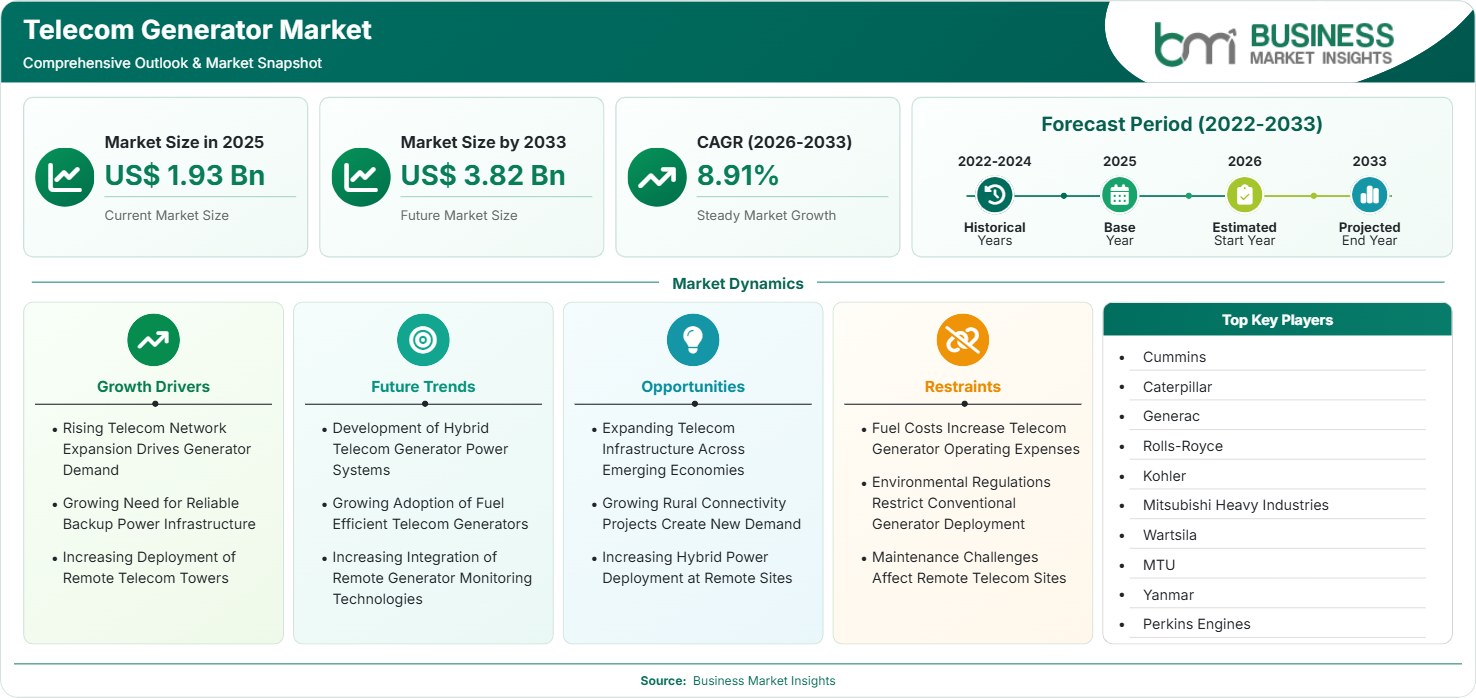
The Telecom Generator Market size was valued at US$ 1.93 billion in 2025 and is projected to reach US$ 3.82 billion by 2033, growing at a CAGR of 8.91% during 2026–2033, driven by network expansion, reliable backup power, remote towers, rural connectivity, and hybrid energy systems.

Report Coverage
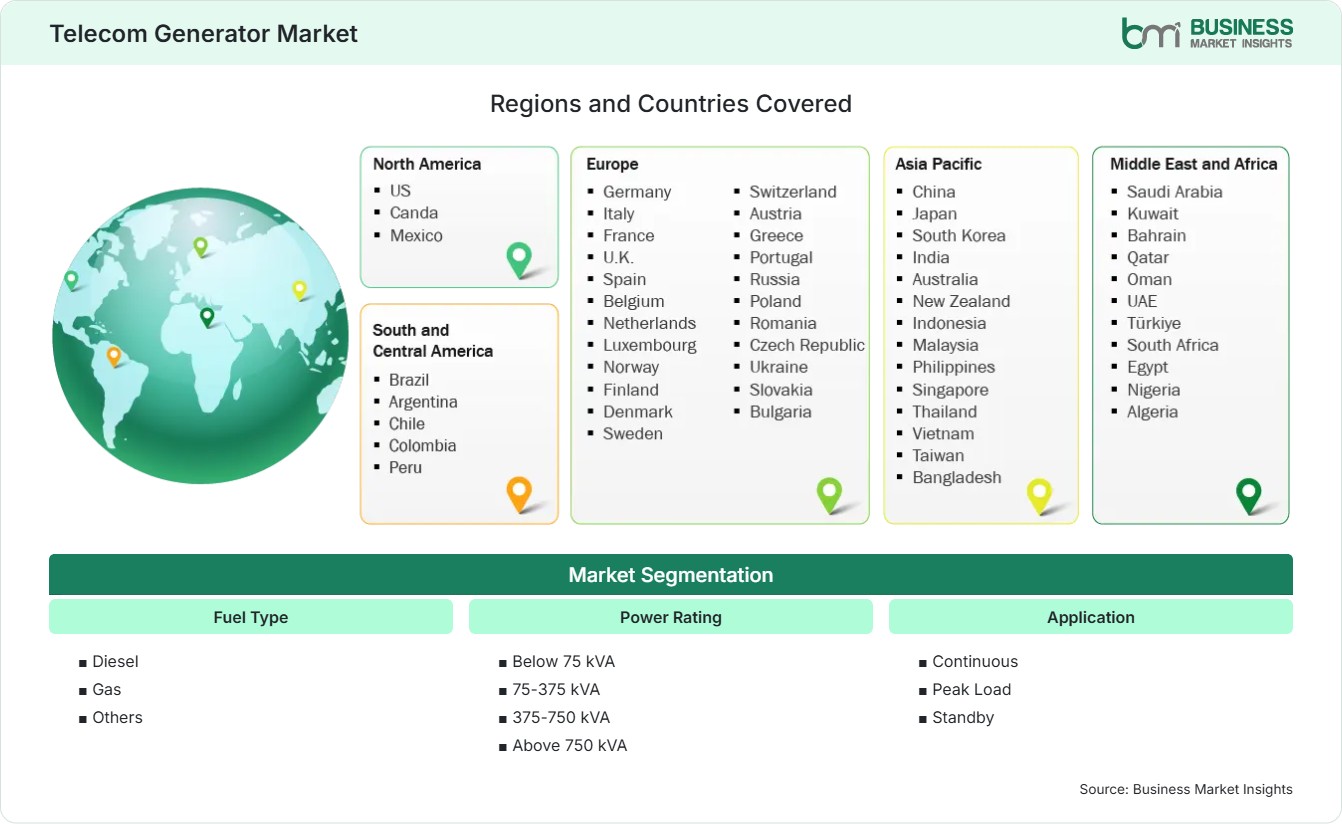
  • Fuel Type: Diesel, Gas, Others
  • Power Rating: Below 75 kVA, 75-375 kVA, 375-750 kVA, Above 750 kVA
  • Application: Continuous, Peak Load, Standby
US$ 1.93 Bn Market size in 2025
US$ 3.82 Bn Market Size by 2033
8.91% CAGR, 2026 - 2033
2026-2033 Forecast Period

AI Overview

Telecom Generator Market Summary

  • North America: North America holds a 25%-29% share in 2025, growing at a CAGR of 7.8%-8.8%, influenced by network modernization, infrastructure resilience, replacement demand, distributed communications assets, and dependable backup requirements. The US accounts for 78%-83% of regional demand, growing at a CAGR of 7.9%-8.9%.
  • Fastest Growing Region: Asia Pacific holds a 31%-35% share in 2025 and grows at a CAGR of 9.6%-10.6%, driven by rural network expansion, tower densification, mobile infrastructure development, uneven grid availability, and increasing requirements for autonomous telecom power.
  • Leading Segment: Diesel holds a 64%-69% share in 2025 and grows at a CAGR of 7.8%-8.7%, supported by established fuel infrastructure, high energy density, proven reliability, widespread servicing capabilities, and suitability for remote telecommunications sites.
  • High Growth Segment: Gas holds a 12%-16% Telecom Generator Market share in 2025 and grows at a CAGR of 10.0%-11.0%, supported by cleaner distributed generation requirements, emissions considerations, fuel diversification, and applications where dependable gas availability supports operation.
  • Key Market Opportunity: Telecom infrastructure expansion in emerging economies creates opportunities for efficient generators, remote monitoring, hybrid systems, modular power units, and lower-emission backup solutions designed for geographically dispersed network assets.
  • Major Market Players: Cummins, Caterpillar, Generac, Rolls-Royce, Kohler, Mitsubishi Heavy Industries, Wartsila, MTU, Yanmar, Perkins Engines.
Strategic Insights

Telecom Generator Market: Strategic Insights

Telecom Generator Market Strategic Framework
FREE PDF
Request your free sample
Request free sample
Stakeholder View

Key Takeaways

  • The value chain is shifting toward integrated telecom power ecosystems that combine generators, batteries, renewable sources, controllers, monitoring platforms, maintenance, and energy-management capabilities.
  • Remote towers and rural connectivity projects provide attractive demand pockets because operators require dependable autonomous power where grid availability is weak, intermittent, or difficult to extend.
  • Product development is increasingly focused on fuel efficiency, compact footprints, remote diagnostics, automated load management, lower emissions, longer service intervals, and compatibility with hybrid power architectures.
  • Emerging economies provide compelling investment environments where network expansion, rural coverage, tower densification, and inconsistent electricity infrastructure create recurring requirements for distributed backup generation.
  • Procurement strategies increasingly emphasize lifecycle economics rather than initial equipment prices, placing greater importance on fuel consumption, maintenance requirements, uptime, monitoring, and service availability.
  • Suppliers capable of integrating generators with renewable energy, battery storage, digital controls, and predictive maintenance can address operators seeking lower operating costs without compromising network resilience.
Geographic Outlook

Telecom Generator Market Regional Highlights

North America Telecom Generator Market

North America holds a 25%-29% share in 2025 and grows at a CAGR of 7.8%-8.8%. Demand is supported by network modernization, infrastructure resilience, replacement cycles, distributed communications assets, and increasing requirements for reliable power during grid disruptions.

  • Network modernization sustains demand for dependable standby systems as operators upgrade equipment, expand capacity, and maintain service continuity across increasingly distributed communications infrastructure.
  • The US remains the principal regional market, with telecommunications operators prioritizing resilience, remote monitoring, efficient maintenance, and backup capacity across network facilities and tower sites.
  • Canada offers opportunities through rural connectivity requirements, geographically dispersed infrastructure, harsh operating environments, and autonomous power needs at communications locations distant from reliable grid connections.
  • Hybrid generator systems can gain traction where operators seek to combine conventional backup generation with batteries and renewable sources to reduce fuel consumption and maintenance frequency.

US Telecom Generator Market

The US represents 78%-83% of North American demand in 2025 and grows at a CAGR of 7.9%-8.9%. Network resilience, infrastructure upgrades, replacement demand, and severe-weather preparedness support continued investment in dependable distributed power systems.

  • Communications infrastructure operators increasingly emphasize backup power reliability as network availability becomes essential for emergency response, business continuity, digital services, and connected devices.
  • Replacement demand is supported by aging generator fleets, improved emissions requirements, fuel-efficiency objectives, and increasing adoption of remote equipment monitoring.
  • Data-intensive mobile networks and edge infrastructure can create additional requirements for resilient power architectures combining generators with battery systems and intelligent energy controls.

Europe Telecom Generator Market

Europe holds a 21%-25% Telecom Generator Market share in 2025 and grows at a CAGR of 7.1%-8.1%. Germany, the United Kingdom, France, and Italy lead regional demand, while Spain and Eastern European markets offer stronger growth through network modernization.

  • Germany benefits from extensive telecommunications infrastructure, industrial connectivity requirements, and increasing emphasis on energy efficiency across distributed technical facilities.
  • The United Kingdom presents opportunities through network resilience initiatives, rural coverage requirements, infrastructure upgrades, and growing deployment of remote monitoring technologies.
  • France and Italy maintain demand through network expansion, replacement cycles, and the need to secure communications infrastructure against grid interruptions.
  • Spain and selected Eastern European markets can experience stronger growth as operators extend broadband and mobile infrastructure into underserved regions and modernize tower power systems.

Asia Pacific Telecom Generator Market

Asia Pacific holds a 31%-35% share in 2025 and grows at a CAGR of 9.6%-10.6%. China, India, Japan, and South Korea lead regional demand, while India and Southeast Asian economies provide stronger growth through rural network expansion.

  • India benefits from mobile infrastructure development, rural connectivity initiatives, tower densification, and uneven grid reliability across geographically diverse service areas.
  • China maintains substantial demand through communications infrastructure development, network modernization, industrial connectivity, and deployment of resilient power systems across distributed sites.
  • Southeast Asia offers opportunities because island geographies, rural communities, weak grid infrastructure, and expanding mobile services increase the need for autonomous telecom power.
  • Japan and South Korea emphasize network reliability, energy efficiency, advanced monitoring, and resilient infrastructure, supporting replacement and technology-upgrade opportunities.

Rest of World Telecom Generator Market

Rest of World holds a 17%-21% share in 2025 and grows at a CAGR of 8.6%-9.6%. Latin America, the Middle East, and Africa provide opportunities through rural coverage, remote towers, infrastructure modernization, and unreliable grid conditions.

Latin America benefits from mobile network expansion across geographically dispersed communities, while the Middle East emphasizes resilient infrastructure for expanding digital services. Africa remains relevant for off-grid and weak-grid telecom installations requiring autonomous power.

  • Brazil offers opportunities through extensive mobile networks, rural connectivity requirements, replacement demand, and dependable power requirements at communications sites exposed to grid instability.
  • Saudi Arabia and the United Arab Emirates support advanced communications infrastructure, where reliable backup generation can complement increasingly digitalized commercial and public-sector networks.
  • South Africa presents demand for resilient telecom power because operators manage distributed infrastructure alongside grid reliability challenges and geographically dispersed service requirements.
  • Nigeria and other Sub-Saharan African markets offer high-growth opportunities as mobile coverage expands into rural areas where grid-connected power remains economically or technically challenging.
Global Market Geography
FREE PDF
Request your free sample
Request free sample
Segment Analysis

Telecom Generator Market Segmentation

Fuel Type

Diesel holds a 64%-69% share in 2025 and grows at a CAGR of 7.8%-8.7% through 2033, supported by mature supply chains, high energy density, established servicing, and suitability for remote sites. Gas offers faster expansion where cleaner generation and fuel availability support deployment. The Telecom Generator Market scope increasingly includes hybrid configurations alongside conventional generation.

  • Diesel: Diesel generators remain preferred for remote telecom sites because of proven reliability, fuel accessibility, high-load capability, established maintenance networks, and suitability for prolonged backup operation.
  • Gas: Gas generators benefit from lower-emission objectives and cleaner distributed generation requirements, particularly where natural gas infrastructure supports dependable fuel availability.

Power Rating

The 75-375 kVA category holds a 31%-36% share in 2025 and grows at a CAGR of 8.4%-9.4% through 2033, serving medium-scale tower clusters and network facilities. Smaller systems support individual sites, while larger ratings address major telecom hubs and high-load infrastructure.

  • Below 75 kVA: Compact generators suit individual towers and lower-load communications sites, emphasizing portability, fuel efficiency, compact installation, and simplified maintenance.
  • 75-375 kVA: Mid-range systems serve larger tower clusters and communications facilities requiring dependable standby capacity, scalable loading, and extended operating capability.
  • 375-750 kVA: Higher-capacity systems address network hubs and facilities with multiple equipment loads, requiring stronger thermal performance, robust controls, and reliable continuous operation.
  • Above 750 kVA: Large generators support major communications facilities and infrastructure complexes where high power requirements demand sophisticated synchronization, load management, and redundant generation capabilities.

Application

Standby applications hold a 58%-63% share in 2025 and grow at a CAGR of 8.2%-9.2% through 2033, reflecting the central role of generators in maintaining communications during grid interruptions. Continuous systems support off-grid sites, while peak-load units address temporary capacity requirements.

  • Continuous: Continuous systems serve remote locations without dependable grid access, requiring durable engines, efficient fuel utilization, and maintenance strategies suited to extended operation.
  • Peak Load: Peak-load generators support periods of elevated electricity demand, helping communications facilities manage temporary capacity requirements without excessive permanent grid upgrades.
  • Standby: Standby generators provide emergency backup during grid failures, protecting network availability and supporting uninterrupted telecommunications services across critical infrastructure.
Market Forces

Telecom Generator Market Dynamics

Key Market Drivers

Rising Telecom Network Expansion Drives Generator Demand

The Telecom Generator Market growth has a strong association with the proliferation of mobile broadband, fiber, tower, and edge networks. The deployment of network infrastructure to areas that were previously unconnected enhances the quantity of sites that need reliable power sources. Back-up generators are still relevant in regions where power infrastructure is either poor or non-existent. In addition to expanding network coverage, telecom companies are improving their existing network infrastructure due to high equipment loads and traffic volumes. Generators have been designed to be more fuel-efficient and able to conduct diagnostics remotely and install compactly while integrating with batteries and renewable power sources.

Growing Need for Reliable Backup Power Infrastructure

The Telecom Generator Market trend is getting influenced by the growing significance of uninterrupted communication in the business world, as well as in emergencies, health care, finance, and government administrations. The mobile network needs an assured supply of electricity whenever there is any disruption caused by storms, electricity failure, fuel issues, or other infrastructural problems impacting the power supply at the local level. The backup generator system will act as an independent electricity source that can sustain the network activities until the main electricity is restored. Generators are being used in conjunction with batteries to optimize the switching process. The remote monitoring facility will detect the levels of fuel, engine, and battery condition and maintenance issues even before the failure occurs.

Increasing Deployment of Remote Telecom Towers

Deployment of remote towers increases the need for independent power solutions since a significant number of the new communication facilities will be deployed outside the reach of a reliable power grid. The Telecom Generator Market outlook is affected by the increasing demand for efficient, fuel-saving, and maintenance-friendly devices that can function without much human interaction on site. A hybrid system using generators, batteries, solar solutions, and intelligent controllers can help save fuel and reduce maintenance needs. Remote monitoring becomes relevant in situations when there are long distances between the service person and the site in question. A manufacturer can distinguish itself through devices capable of functioning under challenging conditions related to temperature, dust, humidity, altitude, and logistics.

Key Market Opportunities

Expanding Telecom Infrastructure Across Emerging Economies

The Telecom Generator Market forecast is backed up by investment in infrastructure in emerging markets, where telecom companies are expanding their networks into rural and peri-urban regions. The building of new towers, small cells, network installations, and broadband infrastructure generates a need for power sources. These needs can be addressed using modular generators, ease of maintenance, remote management, and hybrid power setups. Partnership arrangements with local service providers may increase access to the equipment and minimize the cost of maintenance over time. Financing schemes involving equipment, maintenance, fuel management, and remote management could help telecoms struggling with budgetary constraints get better access to the product.

Growing Rural Connectivity Projects Create New Demand

Rural connectivity initiatives offer prospects since communication towers in rural regions may have increased power expenditure and maintenance challenges. Power solutions that can be used in either intermittent or continuous operation can deliver stable energy in areas where extending the grid is not feasible. Solar-hybrid power solutions may cut down on the need for fuel while keeping the generator running during cloudy days or when there are high loads. Remote monitoring allows operators to manage geographically spread-out assets as well as schedule maintenance according to the performance of these assets. Equipment providers can thus differentiate themselves not only by the power of the engine but also in terms of total cost of ownership. Collaboration with tower firms, network operators, energy service companies, and infrastructure developers is one way to achieve this.

Increasing Hybrid Power Deployment at Remote Sites

A hybrid power generation approach can help minimize the use of diesel generators through coordination with generators, solar PV power, batteries, intelligent control, and energy management software. This will help reduce the amount of time that generators run and also increase fuel economy while maintaining reliable backup power availability. This is especially true for remote locations where renewable sources of energy are available and have high fuel transport costs. The other benefit of hybrid systems is that the generators will run more efficiently and in the load ranges for which they are designed instead of working at lower loads most of the time. Controllers can decide on how much power from the renewable source, stored energy, or the generator is to serve the load.

Market Restraints and Challenges

Fuel Costs Increase Telecom Generator Operating Expenses

Factor: Generators operating for extended periods under weak grid or off-grid conditions require large amounts of fuel, in addition to higher logistics expenses incurred from traveling to remote locations. Impact: The increased use of fuel can raise the overall cost of ownership, making the economy of traditional generator-only systems less attractive. It is possible that operators will mitigate this restraint by curtailing running hours using battery storage, renewable energy sources, intelligent controls, and better load management. Fuel tracking and remote diagnostics can help detect any leaks, inefficiencies in usage, and improper operation.

Environmental Regulations Restrict Conventional Generator Deployment

Factor: Increased environmental standards could lead to stricter emission standards from stationary diesel equipment, especially in cities and environmentally sensitive areas. Impact: Compliance with these regulations could raise the cost of equipment and limit its flexibility, leading to an increased need for less polluting machines. Improved engine designs, after-treatment systems, cleaner fuel, or hybrid designs might be required to comply with relevant regulations. The regulation could also affect permitting and installation schedules if generators are located near population centers. While diesel is very useful in remote and emergency situations, there is regulatory pressure to develop other types of generators.

Company Analysis

Competitive Landscape

The Telecom Generator Market analysis centers on engine efficiency, power density, remote monitoring, lifecycle economics, emissions compliance, hybrid integration, service networks, and reliability across geographically dispersed telecom sites. Competitive differentiation increasingly depends on dependable equipment combined with maintenance and intelligent power-management capabilities.

Company Name

Overview

Products and Services relevant to this market

Cummins

Global power technology provider with extensive engine and generator capabilities for distributed power applications.

Diesel and gas generator sets, standby systems, power controls, monitoring, maintenance, and distributed power solutions.

Caterpillar

Power equipment manufacturer serving infrastructure, industrial, and remote power applications worldwide.

Diesel generator sets, gas generators, controls, remote monitoring, rental solutions, and lifecycle support.

Generac

Power equipment company offering distributed generation and energy-management solutions for critical applications.

Generator sets, standby power systems, controllers, monitoring technologies, and energy-management solutions.

Rolls-Royce

Power systems provider with advanced engine and generator technologies for demanding applications.

MTU generator sets, diesel engines, gas systems, power controls, automation, and lifecycle services.

Kohler

Power equipment manufacturer supplying reliable generation systems across commercial and industrial applications.

Diesel and gas generators, automatic transfer systems, controls, monitoring, and service solutions.

Mitsubishi Heavy Industries

Diversified engineering company with large-scale power-generation and energy technology capabilities.

Gas and diesel generator systems, engines, power-generation equipment, controls, and integrated energy solutions.

Wartsila

Energy technology company specializing in flexible generation and lifecycle services for distributed power systems.

Gas and dual-fuel engines, generator sets, energy management, controls, and lifecycle optimization services.

MTU

Power systems brand focused on high-performance engines and generator solutions for critical infrastructure.

Diesel generator sets, engines, automation, monitoring, power controls, and service solutions for communications facilities.

Yanmar

Engine and power equipment manufacturer serving compact and distributed generation applications.

Diesel engines, generator sets, power systems, controls, maintenance, and remote-site generation solutions.

Perkins Engines

Engine manufacturer providing power solutions for distributed and standby generation applications.

Diesel engines, generator sets, power units, controls, service programs, and replacement engine solutions.

Trust & Transparency

Research Methodology

The market analysis combines proprietary research with secondary data from government agencies, company disclosures, regulatory filings, industry databases and expert interviews. Market estimates are validated through data triangulation, cross-market benchmarking and analyst review.

View Full Research Methodology

Questions Answered

Frequently Asked Questions

What does the Telecom Generator Market report indicate about future competition?

The report indicates that competition will increasingly focus on fuel efficiency, emissions performance, hybrid compatibility, remote monitoring, compact system design, lifecycle service, and reliability. Suppliers offering integrated power solutions can strengthen relationships with telecom operators and tower infrastructure providers.

Why are remote telecom towers creating new opportunities for generator suppliers?

Remote towers frequently operate where grid access is weak, intermittent, or unavailable. Reliable generators provide autonomous power, while compact designs, remote diagnostics, and hybrid systems can reduce maintenance visits and fuel logistics challenges across geographically dispersed infrastructure.

How are hybrid technologies influencing telecom generator adoption?

Hybrid technologies combine generators with batteries, renewable energy, intelligent controllers, and energy-management software. They can reduce generator runtime, lower fuel consumption, improve load management, and support more sustainable operation at remote communications sites.

Which applications present the strongest opportunity in the market?

Remote telecom towers, rural connectivity projects, network facilities, and critical communications infrastructure present strong opportunities. Sites with unreliable grid access or high outage exposure have particularly strong requirements for autonomous backup generation and hybrid power systems.

What factors are improving Telecom Generator Market return on investment?

Network expansion, remote tower deployment, increasing uptime requirements, hybrid power integration, remote monitoring, and replacement of aging equipment can improve investment returns. Lifecycle efficiency is becoming increasingly important as operators evaluate fuel consumption, maintenance requirements, service availability, and generator operating hours.

Access the Full Telecom Generator Market Report

Get segment-level forecasts, regional estimates, competitive benchmarking, company profiles and downloadable Excel datasets.

Access the full Telecom Generator Market Report
350 pages PDF & Excel | 2026-08-19