
Servers Market Outlook: Size, Share, Trends, Growth Analysis, Competitive Landscape & Forecast, 2026-2033

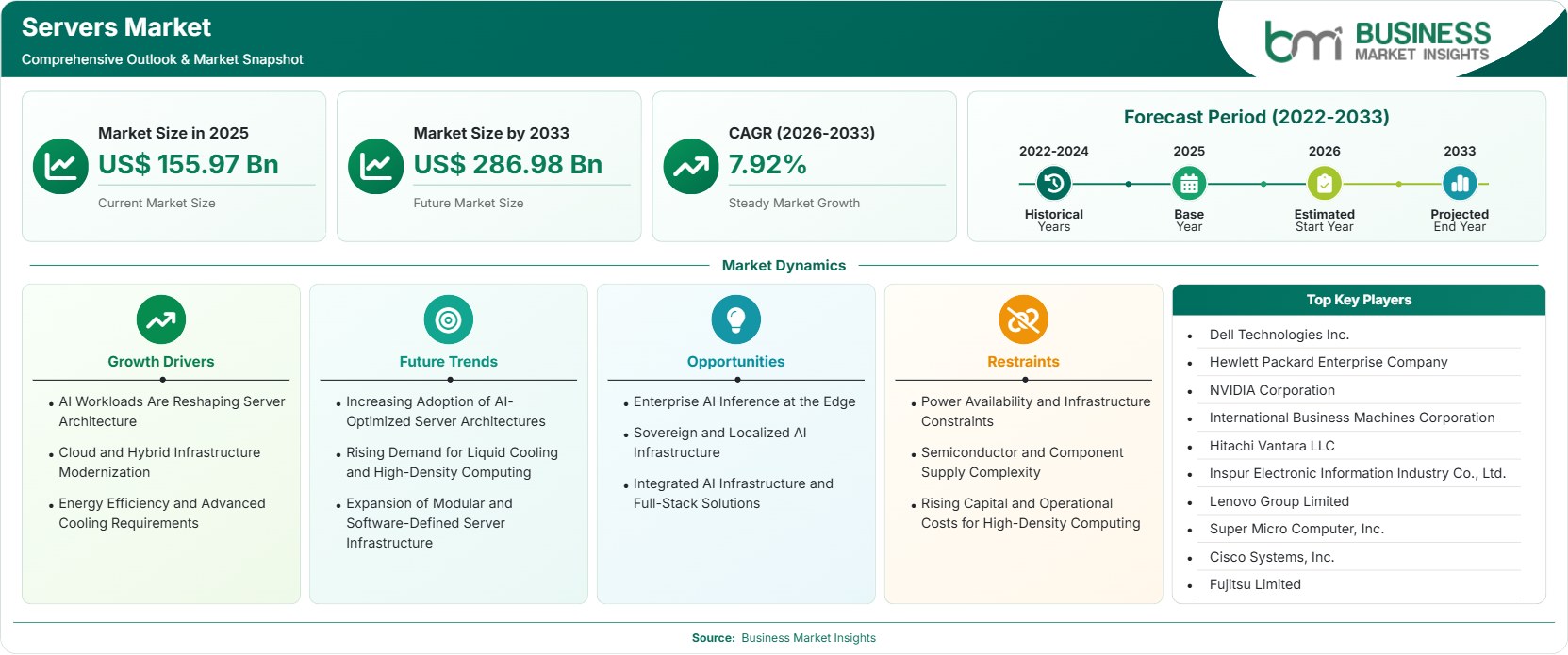
The Servers Market size was valued at US$ 155.97 Billion in 2025 and is projected to reach US$ 286.98 Billion by 2033, growing at a CAGR of 7.92% during 2026–2033.

AI infrastructure, hyperscale cloud expansion, edge computing, enterprise modernization, higher data volumes, and energy-efficient architectures are creating investment opportunities across compute, storage, networking, and managed infrastructure ecosystems.

Report Coverage
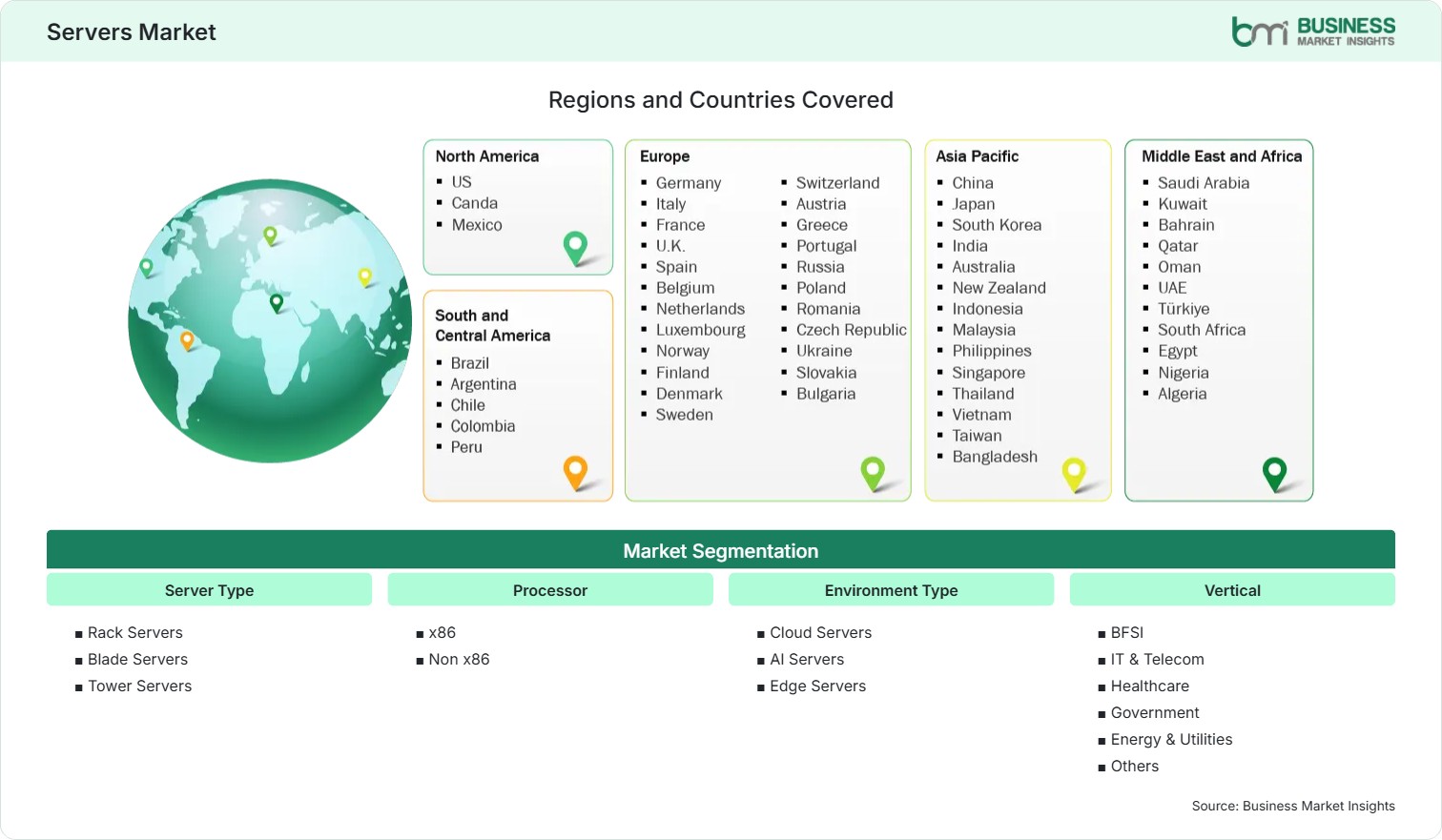
  • Server Type: Rack Servers, Blade Servers, Tower Servers
  • Processor: x86, Non x86
  • Environment Type: Cloud Servers, AI Servers, Edge Servers
  • Vertical: BFSI, IT & Telecom, Healthcare, Government, Energy & Utilities, Others
US$ 155.97 Bn Market size in 2025
US$ 286.98 Bn Market Size by 2033
7.92% CAGR, 2026 - 2033
2026-2033 Forecast Period

AI Overview

Servers Market Summary

  • North America Region: holds a modeled 31%–34% share in 2025, growing at a 7.2%–7.7% CAGR during 2026–2033, supported by hyperscale data centers, AI workloads, cloud migration, semiconductor ecosystems, enterprise modernization, sovereign infrastructure, and expanding edge deployments. The US represents the region’s dominant demand center, with server investment supported by AI data centers, cloud providers, government computing, and accelerated enterprise digitization, advancing at approximately 7.3%–7.8% CAGR through 2033.
  • Fastest Growing Region: Asia Pacific holds a modeled 30%–33% share in 2025 and is advancing at an 8.8%–9.5% CAGR, driven by hyperscale expansion, AI adoption, digital public infrastructure, manufacturing automation, cloud penetration, 5G deployment, and growing data localization requirements.
  • Leading Segment: Rack Servers account for a modeled 55%–59% share in 2025 and are advancing at a 7.5%–8.1% CAGR, supported by standardized deployment, scalable density, virtualization, cloud infrastructure, efficient maintenance, and strong hyperscale and enterprise data-center demand.
  • High Growth Segment: AI Servers represent a modeled 13%–17% share in 2025 and are projected to advance at a 13.5%–15.5% CAGR, supported by accelerated computing, generative AI, inference, model training, high-bandwidth networking, liquid cooling, and specialized processor architectures.
  • Key Market Opportunity: Increasing AI inference at enterprise edge locations creates demand for compact, energy-efficient compute platforms combining accelerators, high-speed networking, secure management, and localized processing while reducing latency and dependence on centralized cloud infrastructure.
  • Major Market Players: Dell Technologies Inc.; Hewlett Packard Enterprise Company; NVIDIA Corporation; International Business Machines Corporation; Hitachi Vantara LLC; Inspur Electronic Information Industry Co., Ltd.; Lenovo Group Limited; Super Micro Computer, Inc.; Cisco Systems, Inc.; Fujitsu Limited.
Strategic Insights

Servers Market: Strategic Insights

Servers Market Strategic Framework
FREE PDF
Request your free sample
Request free sample
Stakeholder View

Key Takeaways

  • Server value creation increasingly depends on coordinated access to processors, accelerators, memory, networking, storage, power systems, cooling technologies, operating platforms, and integration services rather than standalone hardware.
  • AI servers offer the strongest upside because training and inference workloads require accelerated computing, high memory bandwidth, high-speed interconnects, and increasingly sophisticated thermal management.
  • Product development is moving toward heterogeneous compute, liquid cooling, rack-scale architectures, confidential computing, AI-assisted infrastructure management, and processors optimized for specific workload classes.
  • Asia Pacific presents a compelling investment case because expanding cloud adoption, digital infrastructure programs, AI development, manufacturing automation, and data localization are increasing demand for localized compute capacity.
  • Strategic partnerships are increasingly focused on complete AI infrastructure stacks spanning servers, accelerators, networking, storage, software, and services, reducing deployment complexity and accelerating enterprise AI commercialization.
Geographic Outlook

Servers Market Regional Highlights

North America Servers Market

North America held a modeled 31%–34% share in 2025 and is projected to grow at a 7.2%–7.7% CAGR through 2033. The region benefits from hyperscale cloud investment, AI infrastructure spending, mature enterprise technology adoption, semiconductor ecosystems, and substantial data-center capacity. The US remains the principal demand engine, while Canada contributes through cloud, financial-services, public-sector, and AI infrastructure deployments. The regional Servers Market share remains supported by strong technology investment.

  • Hyperscalers are expanding high-density AI clusters, increasing demand for accelerated servers and advanced networking infrastructure.
  • Enterprise buyers are combining private cloud, hybrid cloud, and AI systems to retain control over sensitive workloads and improve governance.
  • Data-center power constraints are increasing attention toward liquid cooling, workload scheduling, processor efficiency, and rack-level optimization.
  • Government and defense computing requirements are supporting secure, resilient, domestically controlled infrastructure.

US Servers Market

The US Servers Market accounted for a modeled 72%–76% of North American demand in 2025 and is projected to expand at a 7.3%–7.8% CAGR during 2026–2033. Demand is anchored by hyperscalers, AI developers, financial institutions, healthcare organizations, federal agencies, and technology companies. Large-scale AI infrastructure programs are increasing requirements for GPU-enabled systems, high-speed fabrics, high-density racks, and liquid cooling. Enterprise modernization also sustains conventional compute demand as organizations refresh aging infrastructure and migrate applications toward hybrid architectures.

  • AI infrastructure investment is increasing demand for GPU-rich platforms, high-bandwidth memory, advanced interconnects, and power-dense rack designs.
  • Financial services and healthcare require secure, high-performance systems capable of supporting analytics, AI inference, and regulated workloads.
  • Public-sector modernization reinforces demand for resilient infrastructure, cybersecurity, sovereign computing, and mission-critical processing.

Europe Servers Market

Europe held a modeled 23%–26% share in 2025 and is expected to grow at a 6.8%–7.4% CAGR through 2033. Germany, the UK, France, and the Netherlands represent leading infrastructure markets, while Spain, Italy, and the Nordic economies provide attractive growth opportunities. European buyers increasingly prioritize energy efficiency, cybersecurity, data sovereignty, and sustainable data-center operations. The region’s Servers Market share is therefore shaped by both computational requirements and environmental performance considerations.

  • Germany and the UK remain leading demand centers because of established enterprise IT ecosystems, cloud adoption, and extensive colocation capacity.
  • France and the Nordic countries offer opportunities for energy-efficient facilities where renewable power availability can support sustainable computing expansion.
  • Sovereign cloud and data-residency requirements encourage localized infrastructure investment across regulated industries and public-sector organizations.
  • AI adoption is increasing demand for accelerated computing while intensifying scrutiny of energy consumption and cooling efficiency.

Asia Pacific Servers Market

Asia Pacific Servers Market represented a modeled 30%–33% share in 2025 and is projected to record an 8.8%–9.5% CAGR through 2033. China, Japan, South Korea, Australia, India, and Singapore form major infrastructure markets, while India and Southeast Asia provide particularly strong expansion opportunities. Japan is also emphasizing sovereign AI infrastructure, with Fujitsu announcing domestic manufacturing of sovereign AI servers beginning in 2026.

  • China maintains substantial domestic demand across cloud computing, AI, telecommunications, manufacturing, and public-sector digital infrastructure.
  • India is gaining momentum through hyperscale data-center investment, digital services expansion, AI adoption, and enterprise cloud migration.
  • Japan combines mature enterprise infrastructure with demand for sovereign and energy-efficient AI systems supporting mission-critical applications.
  • Singapore, South Korea, and Australia benefit from regional cloud hubs, advanced connectivity, enterprise digitization, and AI infrastructure investment.

Rest of World Servers Market

South and Central America are supported by cloud adoption, financial digitization, telecommunications modernization, and increasing demand for localized computing. Brazil and Mexico remain leading markets, while Chile and Colombia offer expanding opportunities as cloud and data-center ecosystems mature. In the Middle East and Africa, the UAE, Saudi Arabia, Israel, and South Africa are leading infrastructure markets, supported by digital transformation, sovereign cloud strategies, AI programs, and smart-city development. The Rest of World Servers Market is projected to expand at a 6.1%–6.8% CAGR during 2026–2033.

  • Brazil and Mexico benefit from enterprise digitization, financial technology adoption, telecommunications investment, and growing hyperscale data-center activity.
  • Gulf economies are deploying AI and sovereign digital infrastructure as part of national diversification and technology-development programs.
  • South Africa remains an important regional hub for cloud services and enterprise computing infrastructure across Southern Africa.
  • Israel’s advanced technology ecosystem supports specialized AI, cybersecurity, and high-performance computing requirements.
  • Data localization and national digital strategies are increasing demand for locally managed infrastructure across emerging economies.
Global Market Geography
FREE PDF
Request your free sample
Request free sample
Segment Analysis

Servers Market Segmentation

Server Type

Rack Servers represented a modeled 55%–59% share in 2025 and are projected to grow at a 7.5%–8.1% CAGR through 2033. Standardization, scalable density, easier servicing, and compatibility with hyperscale and enterprise facilities sustain adoption across data-center environments.

  • Rack Servers: Standardized form factors support scalable data centers, virtualization, AI workloads, and efficient maintenance, making rack architectures suitable for hyperscale, enterprise, and colocation deployments.
  • Blade Servers: Shared power, cooling, and management infrastructure supports dense deployments where floor space is constrained, although specialized chassis requirements can limit flexibility compared with rack-based systems.
  • Tower Servers: Standalone configurations remain relevant for small businesses, branch offices, laboratories, and organizations requiring straightforward installation without dedicated data-center rack infrastructure.

Processor

x86 processors maintained a modeled 78%–82% share in 2025 and are projected to expand at a 7.0%–7.6% CAGR through 2033. Broad software compatibility, established ecosystems, and enterprise familiarity support continued adoption, while non-x86 architectures gain targeted workloads.

  • x86: Broad operating-system compatibility, extensive enterprise software support, and mature vendor ecosystems maintain x86 dominance across cloud, enterprise, virtualization, database, and general-purpose computing workloads.
  • Non x86: ARM and specialized architectures gain adoption where energy efficiency, workload optimization, custom silicon, and performance-per-watt advantages support cloud-scale or purpose-built applications.

Environment Type

Cloud Servers held a modeled 48%–52% share in 2025 and are projected to grow at a 8.0%–8.6% CAGR through 2033. AI Servers are the fastest-growing environment, while Edge Servers gain importance where latency and localized processing determine application performance.

  • Cloud Servers: Elastic provisioning, shared infrastructure, virtualization, and managed services support cloud servers across enterprise applications, analytics, storage, software development, and scalable digital workloads.
  • AI Servers: GPU acceleration, high-bandwidth memory, advanced networking, and liquid cooling enable model training, inference, recommendation engines, computer vision, and increasingly autonomous enterprise workflows.
  • Edge Servers: Localized processing reduces latency and bandwidth requirements for manufacturing, retail, healthcare, telecommunications, transportation, and industrial applications requiring near-real-time decision-making.

Vertical

IT and Telecom represented a modeled 27%–31% share in 2025 and is projected to grow at a 7.8%–8.4% CAGR through 2033. AI, cloud, networking, and digital services sustain demand across major verticals.

  • BFSI: Banks and insurers deploy resilient servers for transaction processing, fraud analytics, risk modeling, customer platforms, regulatory workloads, and increasingly AI-enabled financial services.
  • IT & Telecom: Cloud platforms, network functions, AI services, software applications, and growing data volumes make compute infrastructure fundamental to service-provider modernization and digital operations.
  • Healthcare: Electronic health records, medical imaging, analytics, genomics, clinical AI, and data governance requirements support demand for secure, reliable, high-performance server infrastructure.
  • Government: Public-sector modernization, national security, digital services, sovereign infrastructure, and data-residency requirements support controlled and resilient computing environments.
  • Energy & Utilities: Grid modernization, predictive maintenance, operational analytics, renewable integration, and industrial IoT increase requirements for centralized and edge processing.
  • Others: Manufacturing, retail, transportation, education, and media increasingly deploy servers for automation, analytics, digital commerce, content processing, and connected operations.
Market Forces

Servers Market Dynamics

Key Market Drivers

AI Workloads Are Reshaping Server Architecture

AI workloads are shifting server requirements from conventional CPU-focused configurations toward heterogeneous architectures that integrate GPUs, accelerators, high-bandwidth memory, and advanced interconnects. The shift is changing the priorities for procurement as there is a need for infrastructure that will be conducive to model training and inference operations. Servers Market growth is now being driven more by architecture designed for specific workloads rather than the replacement cycle of enterprises. Applications of inference are increasing in both centralized and decentralized setups where there is a need for computing platforms that will provide low-latency processing, safe data handling, and predictable operational expenses. Server vendors are developing systems that have flexible options for different computing needs.

Cloud and Hybrid Infrastructure Modernization

Cloud and hybrid infrastructure modernization is reshaping server procurement as organizations balance public cloud resources with privately controlled computing environments. The hybrid systems require servers that could handle virtualization, container, Kubernetes system, database, analytics, and AI workloads under unified management models. The Servers Market trends show that infrastructure that allows for flexibility in terms of lifecycle management, automation, security, and portability of workloads has increasing demand. Companies consolidate applications and upgrade infrastructure to better utilize the resources and manage it easily. As workloads get more and more distributed between enterprise locations, private clouds, and public cloud infrastructure, vendors of servers with capabilities in computing, networking, storage, software, and services become more important for infrastructure modernization initiatives.

Energy Efficiency and Advanced Cooling Requirements

Increasing computational density is making thermal management and energy efficiency important considerations in server procurement. Advanced computing configurations create more heat which requires advanced infrastructures able to sustain stable conditions for operation. Such trends contribute to the increased attention paid to direct cooling, airflow optimization, power conversion efficiency, and workload-based resource allocation. The increasing focus by server purchasers on performance per watt, density of racks, cooling capability, efficiency of operation, and total lifecycle costs drives the development of advanced infrastructure in hyperscale, colocation, enterprise, and specific computing facilities. The manufacturers are designing new server architectures that allow for various cooling solutions and improve computational efficiency.

Key Market Opportunities

Enterprise AI Inference at the Edge

Enterprise AI inference at the edge creates opportunities for server suppliers to develop compact computing platforms optimized for localized processing. For manufacturing plants, healthcare settings, retail stores, telecoms infrastructure, logistics centers, and energy centers, the need for near real-time analytics has become critical. The Servers Market Forecast is underpinned by the rising need for local processing, which can ensure low-latency, security of confidential data, and better predictability of operational needs. Vendors can exploit this trend via small form-factor servers, accelerators, secure remote management systems, and networking technologies for edge networks. Vendors merging compute power with simple deployment and management can increase their competitiveness as distributed AI grows within enterprises.

Sovereign and Localized AI Infrastructure

Sovereign computing is creating opportunities in the Servers Market as governments and regulated organizations seek greater control over sensitive information, critical workloads, and artificial intelligence capabilities. Localized infrastructure can serve the needs of data governance, data security, compliance, and control. The server companies can leverage these opportunities by working in collaboration with the manufacturers, semiconductor companies, cloud computing providers, governments, and research organizations. The sovereign infrastructure programs would also provide procurement opportunities that are outside of the traditional enterprise purchases by generating demand for computing infrastructure that fits national requirements.

Integrated AI Infrastructure and Full-Stack Solutions

Customers increasingly prefer validated infrastructure stacks that combine servers, accelerators, networking, storage, software, and technical services rather than sourcing each component independently. Integrated solutions will be easier to implement, have less compatibility issues, and ensure clear accountability at each layer of the infrastructure. This creates opportunities for vendors offering reference architecture, implementation services, lifecycle management, financing, optimization, and support in addition to hardware. The full-stack approach is especially useful for companies that do not possess the expertise to design complicated AI infrastructure. As infrastructure demands become more interdependent, vendors who can manage hardware, software, networking, security, and services can build stronger client relationships.

Market Restraints and Challenges

Power Availability and Infrastructure Constraints

Factor: Increasing server density can raise electricity requirements, cooling needs, facility engineering complexity, and infrastructure planning demands. Impact: Limited power availability can delay deployments, increase facility requirements, and restrict high-density computing. The operators need to ensure that the procurement of the servers is compatible with the electrical capacity and the cooling system available. This will result in longer time frames and efficient use of energy in the process. The efficient cooling process helps in managing the heat but may entail additional resources in terms of infrastructure and expertise, especially when there is heavy computing involved.

Semiconductor and Component Supply Complexity

Factor: Advanced servers depend on specialized processors, accelerators, memory, networking components, power systems, and cooling technologies sourced through interconnected supply chains. Impact: Supply disruptions, allocation limits, geopolitical restrictions, and manufacturing challenges can increase procurement uncertainty, extend delivery timelines, and raise system costs. The rapid changes in technology will equally present challenges when it comes to inventory planning since the components specifications keep changing from one generation of the servers to the other. Flexibility in sourcing, components qualifications, wider supply base, and regional manufacturing will be essential.

Company Analysis

Competitive Landscape

The Servers Market analysis indicates that competition is moving toward complete infrastructure platforms rather than isolated server hardware. Leading suppliers are differentiating through AI acceleration, proprietary management software, cooling technologies, cloud integration, networking, security, and lifecycle services. Recent product announcements from Dell, HPE, Fujitsu, and Hitachi Vantara show increasing emphasis on AI-ready systems, sovereign infrastructure, and integrated architectures.

Company Name

Overview

Products and Services relevant to this market

Dell Technologies Inc.

Global infrastructure provider with extensive enterprise, cloud, and AI computing capabilities across major customer segments and geographies.

PowerEdge rack and AI servers, high-performance computing, infrastructure management, storage, networking, cooling, private cloud, and AI Factory solutions.

Hewlett Packard Enterprise Company

Enterprise technology provider combining compute, networking, hybrid cloud, edge, AI, and infrastructure services for complex workloads.

ProLiant Compute servers, AI systems, Cray supercomputers, edge servers, GreenLake, networking, storage, and AI infrastructure services.

NVIDIA Corporation

Accelerated computing leader supplying GPUs and platforms that increasingly define AI server architecture and high-performance infrastructure requirements.

Data-center GPUs, accelerated computing platforms, networking, AI software, reference architectures, NVLink technologies, and AI infrastructure ecosystems.

International Business Machines Corporation

Enterprise technology company serving mission-critical computing, hybrid cloud, AI, analytics, and regulated workloads across global industries.

IBM Power systems, enterprise infrastructure, hybrid cloud platforms, AI solutions, servers, storage, management, and infrastructure services.

Hitachi Vantara LLC

Data infrastructure specialist combining storage, hybrid cloud, operational technology, and AI-ready infrastructure for enterprise workloads.

Hitachi iQ AI infrastructure, storage platforms, hybrid cloud management, data orchestration, accelerated computing, and industry-specific infrastructure.

Inspur Electronic Information Industry Co., Ltd.

China-based computing infrastructure provider with capabilities spanning servers, AI systems, cloud infrastructure, and data-center technologies.

General-purpose servers, AI servers, high-performance computing, storage, cloud infrastructure, data-center systems, and integrated computing platforms.

Lenovo Group Limited

Global technology company with a broad infrastructure portfolio spanning enterprise servers, storage, AI, edge, and data-center solutions.

ThinkSystem servers, AI infrastructure, edge systems, storage, high-performance computing, management software, and Neptune cooling solutions.

Super Micro Computer, Inc.

Infrastructure manufacturer recognized for modular server architectures, high-density systems, accelerated computing, and rapid AI platform deployment.

GPU servers, rack servers, liquid-cooled systems, AI platforms, storage, networking, server management, and data-center optimization solutions.

Cisco Systems, Inc.

Networking and infrastructure technology provider extending its capabilities into AI-ready data-center architectures and integrated compute ecosystems.

UCS servers, networking, data-center switching, security, observability, AI infrastructure networking, and integrated infrastructure management.

Fujitsu Limited

Japanese technology provider with strong enterprise, government, high-performance computing, and sovereign infrastructure capabilities.

PRIMERGY servers, AI infrastructure, supercomputing, MONAKA processor platforms, data-center services, hybrid cloud, and sovereign AI systems.

Trust & Transparency

Research Methodology

The market analysis combines proprietary research with secondary data from government agencies, company disclosures, regulatory filings, industry databases and expert interviews. Market estimates are validated through data triangulation, cross-market benchmarking and analyst review.

View Full Research Methodology

Questions Answered

Frequently Asked Questions

What does the Servers Market Report help businesses evaluate?

The report helps businesses evaluate technology adoption, regional opportunities, competitive positioning, AI infrastructure, edge computing, cooling technologies, procurement priorities, and emerging investment opportunities.

Why are edge servers gaining strategic importance?

Edge servers process data closer to its source, reducing latency and bandwidth requirements. They support real-time analytics, localized AI inference, operational continuity, privacy, and distributed computing.

What role will liquid cooling play in future server infrastructure?

Liquid cooling is gaining importance as AI and HPC systems reach higher rack densities. It can improve thermal management, increase compute density, and provide more consistent performance than conventional air cooling.

How is AI infrastructure influencing server design?

AI workloads are increasing demand for accelerators, high-bandwidth memory, faster networking, advanced power delivery, and improved cooling. These features support training, inference, analytics, and other compute-intensive workloads.

What factors are changing Servers Market procurement decisions?

AI acceleration, power density, cooling, security, lifecycle management, and software compatibility increasingly influence server purchases. Buyers are focusing on total infrastructure costs, scalability, performance, and energy efficiency.

Access the Full Servers Market Report

Get segment-level forecasts, regional estimates, competitive benchmarking, company profiles and downloadable Excel datasets.

Access the full Servers Market Report
350 pages PDF & Excel | 2026-08-27