Market Summary
Executive Summary and Global Market Analysis
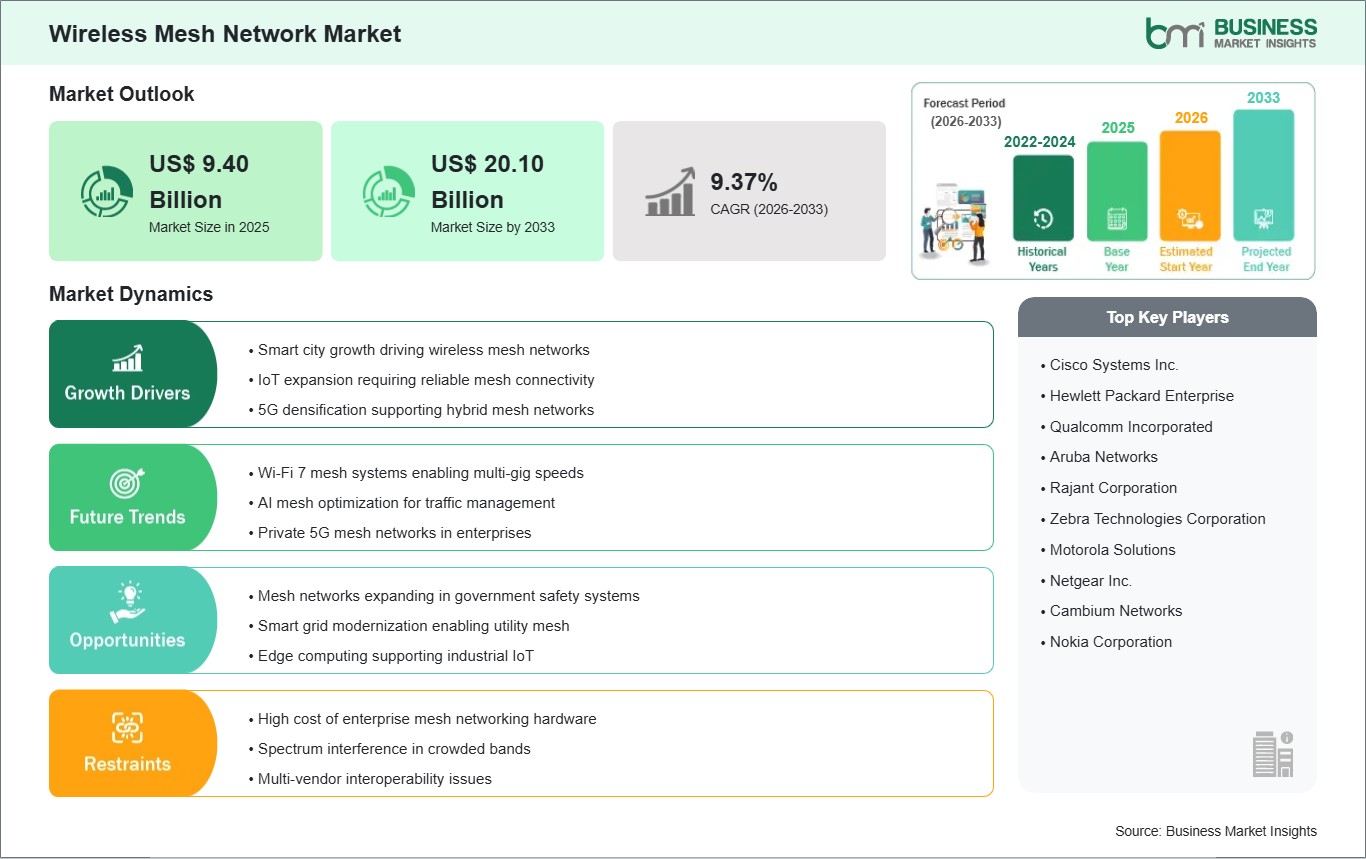
Wireless mesh network represents a pivotal shift in telecommunications, moving away from centralized hub-and-spoke models toward a decentralized, self-healing web of connectivity. This market encompasses a range of architectures, including infrastructure-class, ad-hoc, and hybrid deployments, which are essential for environments where traditional cabling is impractical or too expensive. These networks deliver immense value by ensuring constant uptime; if a single node fails, the system automatically reroutes data through the most efficient alternative path. Together, they form a critical portfolio supporting the digital transformation of smart cities, industrial IoT, and public safety communications. Market expansion is currently driven by the global surge in connected devices, the acceleration of Industry 4.0 automation, and the increasing need for high-bandwidth solutions that can handle dense data traffic in urban and industrial settings. Furthermore, the transition toward next-generation Wi-Fi and 5G integration is significantly improving the throughput and reliability of these networks.
However, several challenges can restrain market growth: security vulnerabilities inherent in multi-hop topologies remain a primary concern for sensitive data transmission. High procurement costs for ruggedized, outdoor-rated hardware can slow adoption in budget-sensitive municipalities. Additionally, the industry faces constraints due to a lack of cross-vendor interoperability standards, which often forces operators into closed ecosystems and complicates the expansion of heterogeneous networks.
Despite these hurdles, the market holds immense opportunities in the universal push for smart city digitalization and the deployment of battery-free, energy-harvesting sensors. The expansion of disaster management networks and the development of AI-driven, self-configuring protocols are expected to create significant opportunities for long-term market growth.
Segment Analysis
Wireless Mesh Network Market Segmentation
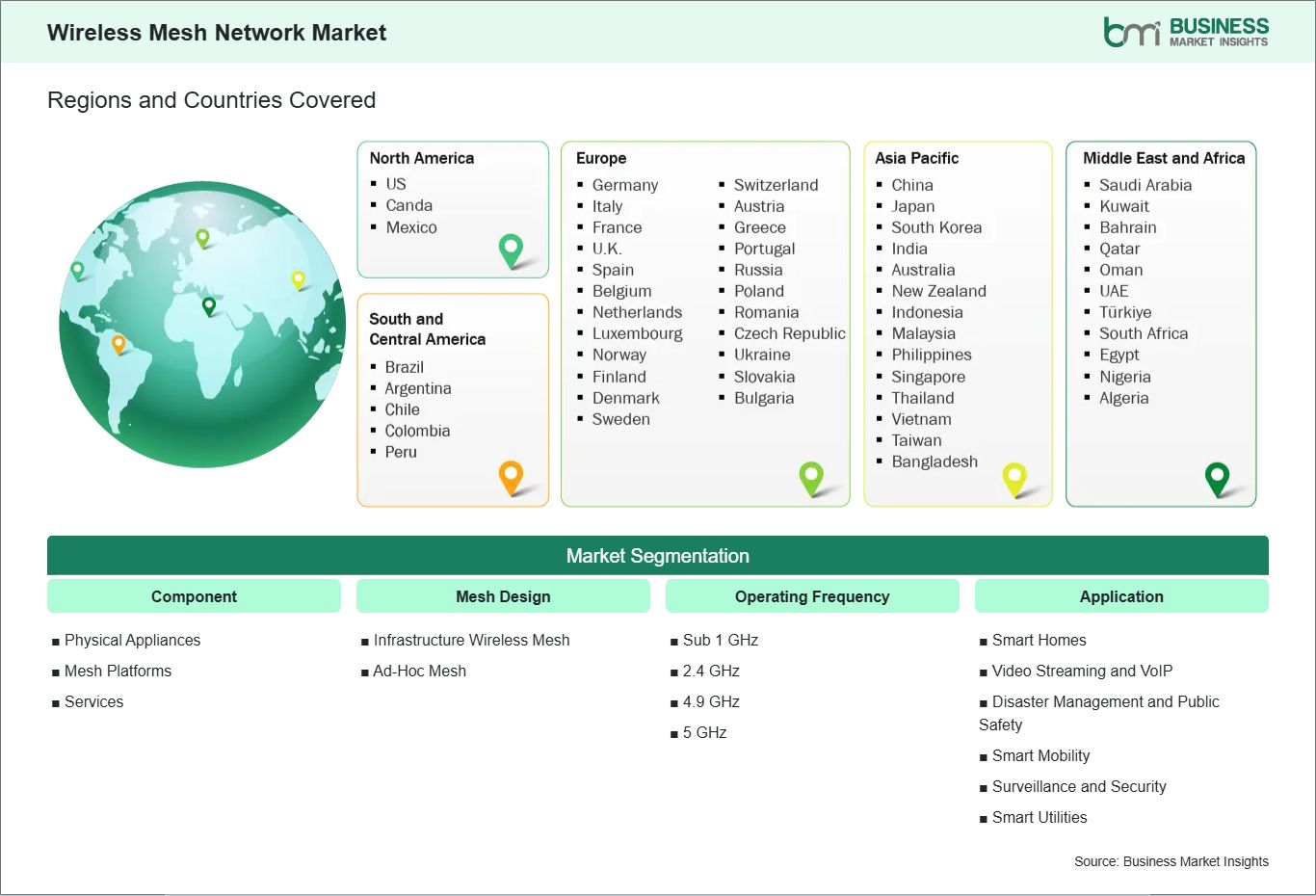
Key segments that contributed to the derivation of the Wireless Mesh Network market analysis are component, mesh design, operating frequency, and application.
- By Component, the market is segmented into Physical Appliances, Mesh Platforms, and Services.
- By Mesh Design, the market is divided into Infrastructure Wireless Mesh and Ad-Hoc Mesh.
- By Operating Frequency, the market is categorized into Sub 1 GHz, 2.4 GHz, 4.9 GHz, and 5 GHz.
- By Application, the market is segmented into Smart Homes, Video Streaming and VoIP, Disaster Management and Public Safety, Smart Mobility, Surveillance and Security, and Smart Utilities.
Market Forces
Wireless Mesh Network Market Drivers and Opportunities
Advancing Resilient Connectivity and Smart City Ecosystems
The primary driver for the Wireless Mesh Network (WMN) Market is the accelerating global demand for self-healing, decentralized communication infrastructures that can operate reliably within complex and high-density environments. As urban centers worldwide transition toward comprehensive "Smart City" frameworks, wireless mesh networks provide the essential backbone for interconnected services such as intelligent traffic management, public safety monitoring, and automated street lighting. Unlike traditional star or point-to-point architectures, mesh systems offer inherent redundancy; if a single node fails, the network autonomously reroutes data through neighboring nodes to maintain continuous uptime. This resilience makes them a non-discretionary choice for industrial sectors operating in challenging or remote terrains, such as underground mining and offshore energy, where physical cabling is often structurally impossible or prohibitively expensive. This momentum is further amplified by the shift toward Industry 4.0, where thousands of sensors, machines, and autonomous robots require constant, low-latency connectivity to ensure operational safety and high-velocity throughput in automated factories. Consequently, the ability of mesh networks to provide scalable, secure, and flexible coverage ensures they remain a foundational element of modern digital infrastructure.
AI-Driven Optimization and Emergency Response Agility
A significant high-value opportunity lies in the integration of Artificial Intelligence (AI) and Machine Learning (ML) into mesh network orchestration. Next-generation platforms can autonomously manage frequency interference and self-optimize data paths in real-time, drastically reducing the need for manual network administration. There is also a major growth frontier in the deployment of Rapidly Deployable Ad-Hoc Networks for Disaster Recovery. In scenarios where fixed infrastructure is destroyed by natural events, portable mesh kits can provide immediate, high-security communication hubs for first responders. Furthermore, the convergence of Mesh Topologies with Edge Computing presents a lucrative opportunity; by processing data at the node level rather than sending all traffic to a central cloud, these systems can support ultra-fast response times for autonomous vehicle coordination. Manufacturers who focus on "green" nodes powered by energy-harvesting technologies and those developing advanced encryption for "zero-trust" security environments are positioned to lead the most innovative segments of the global communications landscape.
Size and Share Analysis
Wireless Mesh Network Market Size and Share Analysis
The Wireless Mesh Network market demonstrates steady growth, with size and share analysis revealing evolving trends and competitive positioning among key players. The report further examines subsegments categorized within type, destination, and end user, offering insights into their contribution to overall market performance.
Based on component, Physical Appliances subsegment holds a significant market share, serving as the industry benchmark for ruggedized, high-performance edge connectivity. Physical Appliances, including mesh routers and gateways, are indispensable for the Industrial sector, where they provide the hardware durability required for extreme environments like open-pit mines and chemical plants. A notable trend is the surge in the Mesh Platforms subsegment, which is registering a higher CAGR as enterprises move toward software-defined networking (SDN). These platforms are becoming essential for Smart Utilities, allowing for the centralized management of millions of disparate meter nodes through a single virtualized interface, providing a data-driven path to optimizing grid load balancing.
Report Coverage
Wireless Mesh Network Market Report Coverage and Deliverables
The "Wireless Mesh Network Market Size and Forecast (2022 - 2033)" report provides a detailed analysis of the market covering below areas:
- Wireless Mesh Network market size and forecast at global, regional, and country levels for all the key market segments covered under the scope
- Wireless Mesh Network market trends, as well as market dynamics such as drivers, restraints, and key opportunities
- Wireless Mesh Network market analysis covering key market trends, global and regional framework, major players, regulations, and recent market developments
- Industry landscape and competition analysis covering market concentration, heat map analysis, prominent players, and recent developments for the Wireless Mesh Network market
- Detailed company profiles, including SWOT analysis
Geographic Insights
Wireless Mesh Network Market Geographic Insights
The geographical scope of the Wireless Mesh Network market report is divided into five regions: North America, Asia Pacific, Europe, Middle East & Africa, and South & Central America.
North America maintains a leading position, driven by extensive investments in research and development and the early adoption of advanced networking technologies in the public safety and military sectors. Asia Pacific acts as the primary engine for rapid expansion, fueled by large-scale digitalization and the massive rollout of connected infrastructure across emerging economies. Europe also represents a significant portion of the landscape, where the focus remains on smart grid modernization and strict data security protocols in industrial environments.
The Asia-Pacific Wireless Mesh Network Market is segmented into China, Japan, South Korea, India, Australia, and the Rest of Asia. This region is the fastest-growing market globally, characterized by a proactive approach to building high-density internet connectivity in urban centers. China and India are at the forefront, integrating mesh networks into vast smart city initiatives to manage traffic, public utilities, and environmental monitoring. Japan and South Korea continue to lead in technological innovation, focusing on ultra-low latency mesh applications for advanced manufacturing and robotics.
Industry Activity
Recent Developments
The Wireless Mesh Network market is evaluated by gathering qualitative and quantitative data post primary and secondary research, which includes important corporate publications, association data, and databases. A few of the key developments in the Wireless Mesh Network market are:
- In October 2025, Boundless Devices Inc. announced the launch of the Motorola Q15 Wi-Fi 7 Mesh Router in the U.S. and Canada. Engineered for modern homes, the Q15 delivers ultra-fast Wi-Fi 7 speeds, seamless mesh coverage, and robust parental controls through the MotoSync+ app. Each unit supports over 120 connected devices and can cover up to 2,000 sq. ft., with additional units expanding coverage seamlessly. The launch highlights the growing adoption of advanced mesh networking solutions that provide enhanced connectivity, IoT integration, and improved digital safety for residential and small office environments.
- In May 2025, Rajant launched LTE Enhance, a new device that integrates its Kinetic Mesh networks with LTE, enabling seamless, high-capacity connectivity for industrial applications. The solution enhances network adaptability, reduces latency, and supports bandwidth-heavy use cases like IoT and autonomous vehicles, reinforcing growth and innovation in the Wireless Mesh Network market.
Trust & Transparency
Research Methodology
The market analysis combines proprietary research with secondary data from government agencies, company disclosures, regulatory filings, industry databases and expert interviews. Market estimates are validated through data triangulation, cross-market benchmarking and analyst
review.
View Full Research Methodology
Key Sources Referred:
World Bank - Global Trade IndicatorsWorld Trade Organization (WTO)International Monetary Fund (IMF)International Trade Administration (ITA)Company WebsitesCompany Annual ReportsCompany Investor Presentations