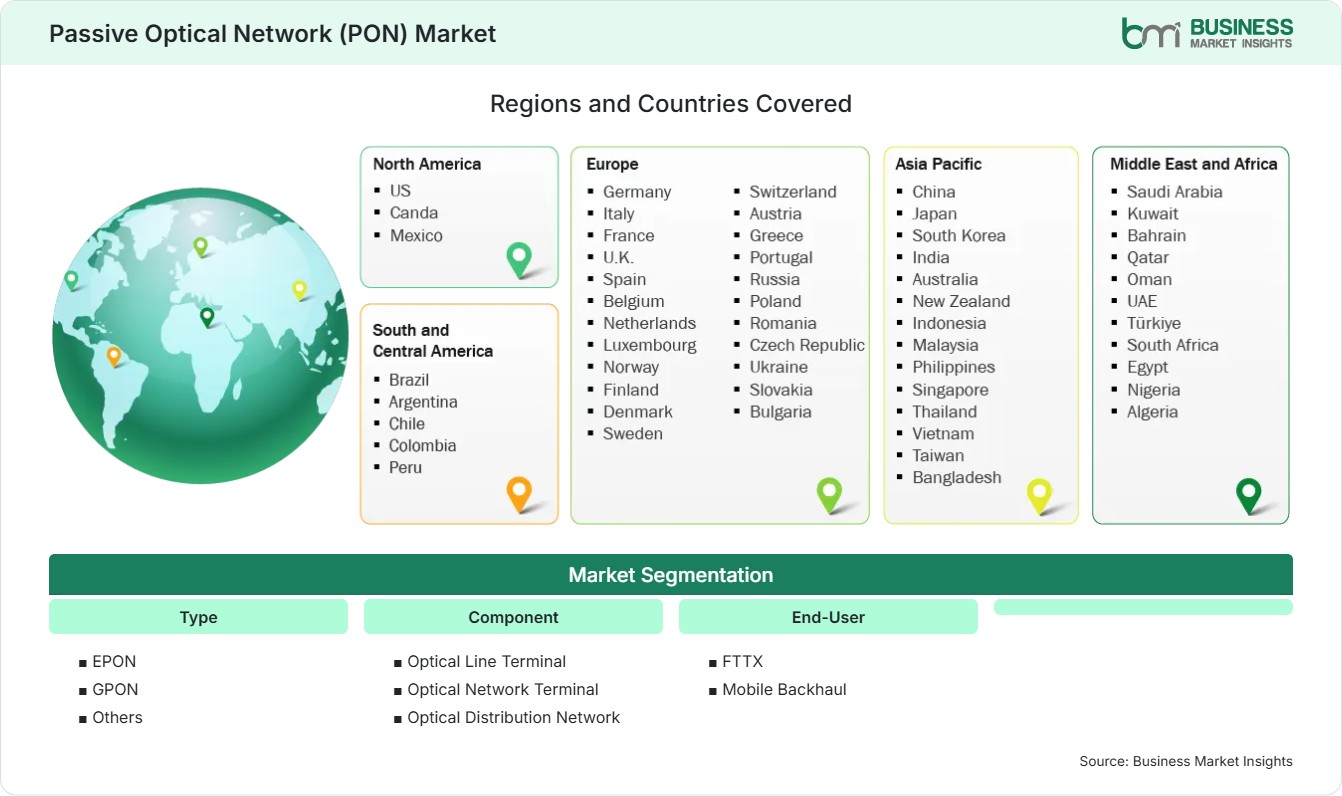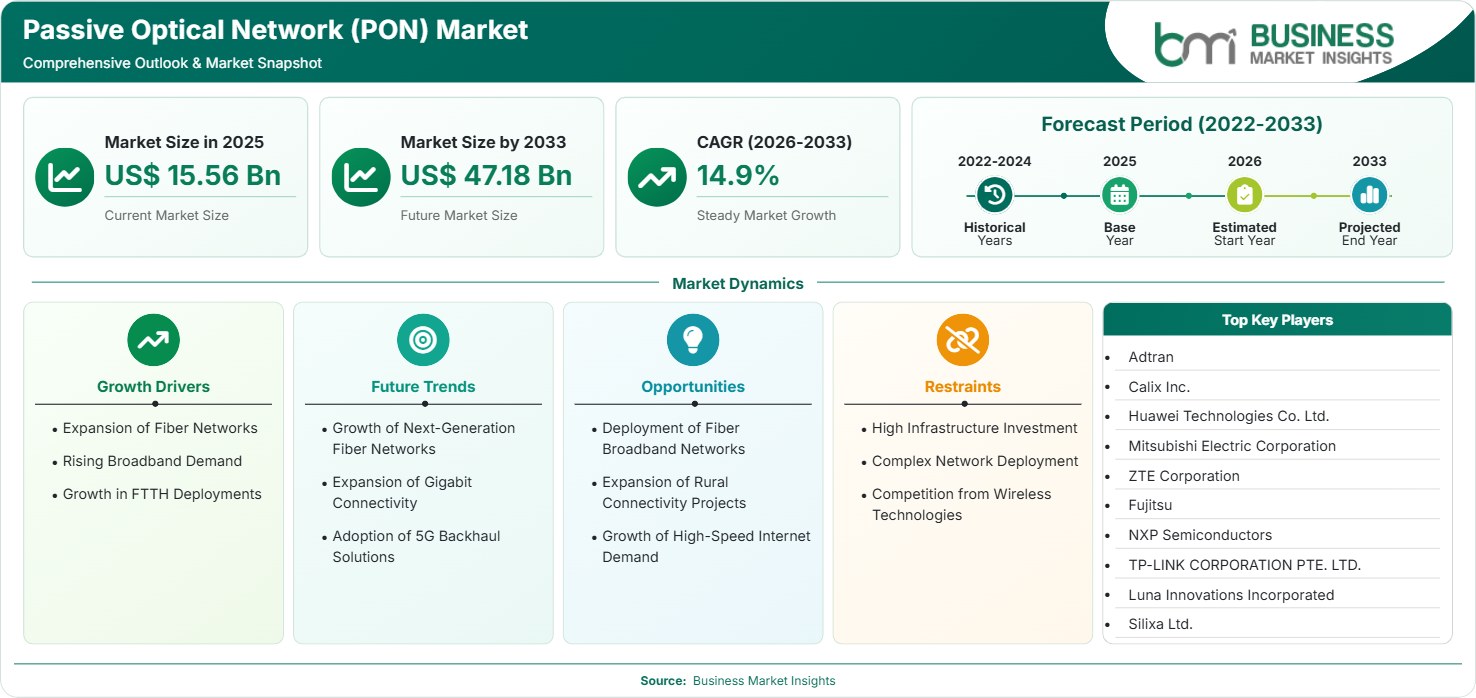
Passive Optical Network (PON) Market Regional Highlights
North America Passive Optical Network (PON) Market
North America accounted for approximately 32%–34% Passive Optical Network (PON) Market share in 2025 and is expected to expand at a 13.2%–13.8% CAGR from 2026–2033. The region benefits from accelerated fiber broadband upgrades, government-backed connectivity programs, and strong investment from telecom operators.
- Government broadband initiatives and infrastructure funding programs are accelerating fiber deployments across underserved areas, improving connectivity access while creating additional demand for optical network equipment and deployment services.
- Telecom operators are upgrading legacy broadband infrastructure with fiber-based solutions to support higher bandwidth applications, including cloud computing, remote work, streaming services, and connected enterprise platforms.
- Increasing 5G rollout requirements are strengthening demand for fiber backhaul solutions, enabling operators to improve network reliability, capacity, and performance across dense urban connectivity environments.
- Equipment manufacturers are focusing on next-generation PON platforms that improve scalability, energy efficiency, and operational flexibility for large-scale broadband infrastructure modernization projects.
US Passive Optical Network (PON) Market
The US represented approximately 27%–29% of the global market in 2025 and is projected to grow at a 13.5%–14.0% CAGR during 2026–2033. The country remains a major contributor due to extensive fiber investment, government broadband expansion initiatives, and increasing demand for high-speed internet services. The Passive Optical Network (PON) market share in the US continues benefiting from telecom modernization and enterprise connectivity requirements.
- Federal broadband expansion programs are supporting fiber infrastructure deployment across rural and underserved communities, increasing opportunities for network equipment providers and installation service companies.
- Leading telecommunications operators are increasing fiber coverage to support growing bandwidth consumption from video platforms, artificial intelligence applications, smart devices, and cloud-based services.
- Enterprise adoption of fiber connectivity is rising as businesses require secure, scalable, and high-capacity networks for digital transformation initiatives and distributed workforce models.
- Continuous investment in 5G networks is encouraging operators to integrate fiber-based backhaul solutions that improve performance, reduce latency, and support increasing mobile data traffic.
Europe Passive Optical Network (PON) Market
Europe accounted for an estimated 22%–24% market share in 2025 and is anticipated to register a 12.8%–13.4% CAGR through 2033. The region is progressing through widespread broadband modernization, supported by digital connectivity policies and increasing fiber penetration.
- Germany continues leading European adoption through strong telecom investments, industrial connectivity requirements, and increasing deployment of fiber networks supporting enterprise and residential broadband services.
- Spain is projected to achieve a 14.5%–15.0% CAGR, driven by advanced FTTH infrastructure, competitive telecom markets, and strong consumer demand for high-speed connectivity solutions.
- France and Italy are expanding fiber coverage through national broadband strategies, increasing demand for optical line terminals, network components, and deployment-related technologies.
- European sustainability objectives are encouraging adoption of energy-efficient optical networking equipment that reduces operational costs while supporting long-term digital infrastructure development.
- Telecom operators are increasingly deploying next-generation PON technologies to enhance network capacity and prepare infrastructure for future broadband requirements.
Asia Pacific Passive Optical Network (PON) Market
Asia Pacific held approximately 38%–40% market share in 2025 and is expected to achieve the highest growth rate at 16.2%–16.8% CAGR between 2026–2033. The region benefits from extensive fiber deployment programs, rapid urbanization, expanding internet penetration, and government-supported digital transformation initiatives.
- China maintains regional leadership through extensive FTTH deployment, large-scale telecom investments, advanced manufacturing capabilities, and widespread adoption of optical access technologies.
- India is forecast to achieve a 17.0%–17.5% CAGR, supported by digital connectivity initiatives, increasing broadband subscribers, expanding telecom networks, and growing demand for affordable high-speed internet services.
- Southeast Asian countries are accelerating fiber infrastructure investments to support smart cities, digital economies, cloud services, and expanding enterprise connectivity requirements.
- Government programs focused on rural connectivity and broadband inclusion are creating opportunities for optical equipment suppliers across developing Asian markets.
- Domestic manufacturing growth and strategic partnerships with global technology providers are strengthening the regional optical networking ecosystem and improving supply chain capabilities.
Rest of World Passive Optical Network (PON) Market
The Rest of World region accounted for approximately 8%–10% share in 2025 and is projected to grow at a 14.0%–14.6% CAGR during 2026–2033. South & Central America are experiencing gradual fiber expansion through telecom investments, while the Middle East and Africa are advancing digital infrastructure programs. The Passive Optical Network (PON) market growth outlook remains supported by broadband accessibility initiatives, urban connectivity projects, and rising data consumption.
Brazil represents the largest South & Central American market, while Saudi Arabia demonstrates strong growth momentum due to smart city programs and telecommunications modernization strategies.
- Brazil continues expanding fiber networks through telecom operator investments, increasing broadband adoption, and growing demand for reliable residential and enterprise connectivity services.
- Saudi Arabia is expected to record a 15.2%–15.7% CAGR, supported by digital transformation programs, smart city investments, and national initiatives improving telecommunications infrastructure.
- Middle Eastern countries are increasing fiber deployment to support government services, cloud adoption, industrial automation, and next-generation communication networks.
- African markets are gradually improving broadband availability through international connectivity projects, telecom partnerships, and investments in scalable optical access solutions.
- Regional operators are adopting flexible PON architectures to address connectivity gaps, improve network efficiency, and support future digital service expansion.