Market Summary
Executive Summary and Global Market Analysis
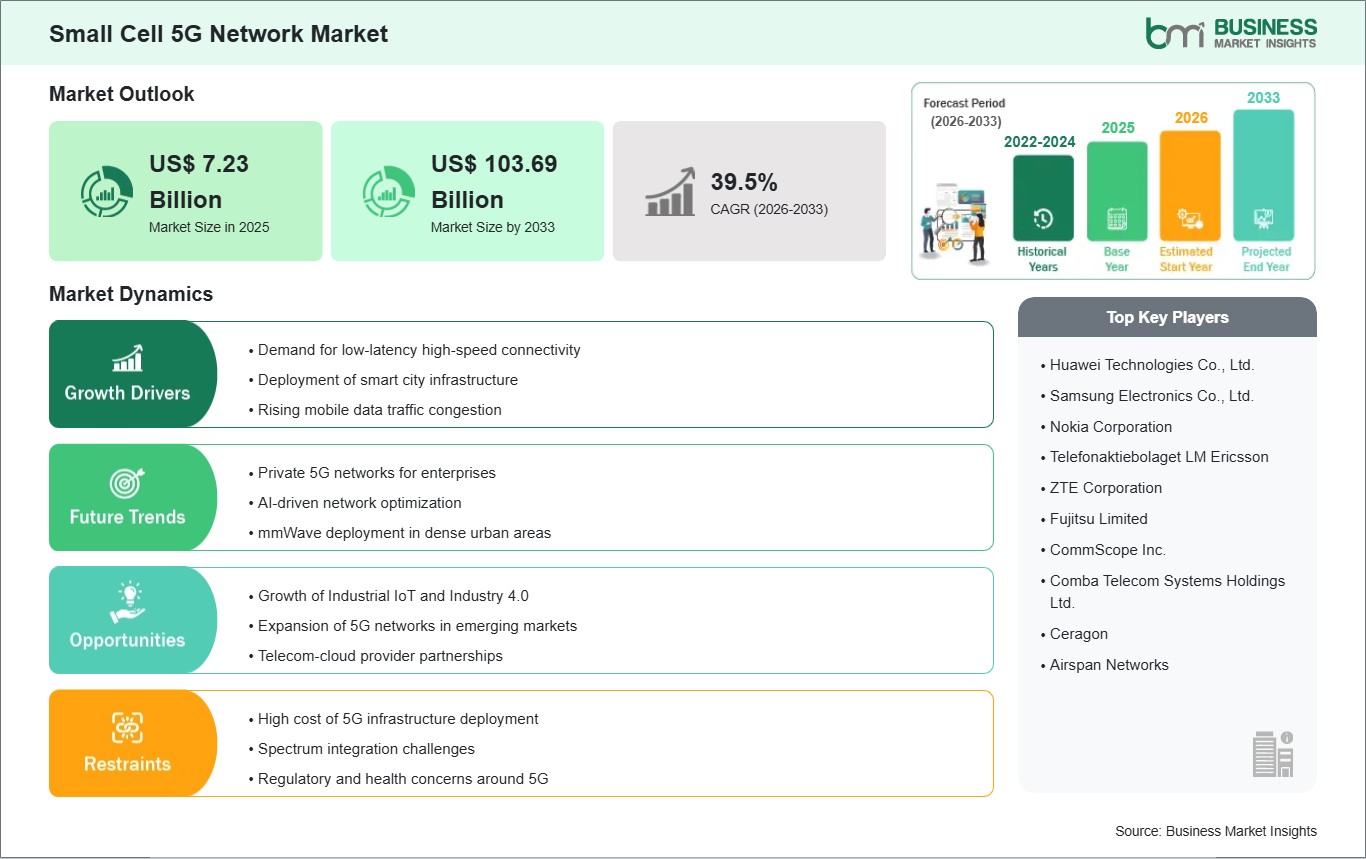
Small cell 5G networks are low-powered, compact wireless service nodes or base stations that function in a spectrum range covering from ten meters to several kilometers. These systems deliver immense strategic value by offloading traffic from congested macrocells and providing the last-meter connectivity required for high-density environments. Market expansion is primarily attributed to the explosive surge in global mobile data usage, the rapid acceleration of Private 5G network deployments for enterprise automation, and the increasing demand for ultra-reliable low-latency communication (URLLC) in mission-critical applications. Furthermore, the shift toward virtualized and Open RAN (O-RAN) architectures, which allow for more modular and cost-effective deployments, is substantially lowering the barrier to entry for non-traditional network operators.
However, several challenges can restrain market growth: high upfront capital expenditures for the dense deployment required in urban centers and the ongoing costs of securing backhaul connectivity can strain operator budgets. Regulatory and zoning hurdles, where local municipalities impose strict aesthetic or placement rules for equipment on street furniture, can lead to significant roll-out delays. Additionally, the industry faces constraints due to technical complexities in interference management, as the proximity of numerous small cells requires sophisticated AI-driven coordination to prevent signal overlap and maintain service quality.
Despite these hurdles, the market holds immense opportunities in the universal mandate for smart city digitalization and the accelerating deployment of edge computing-enabled nodes. The expansion of 5G-enabled healthcare robotics and the development of energy-efficient, solar-powered small cells for rural connectivity are expected to create significant opportunities for long-term market growth.
Segment Analysis
Small Cell 5G Network Market Segmentation
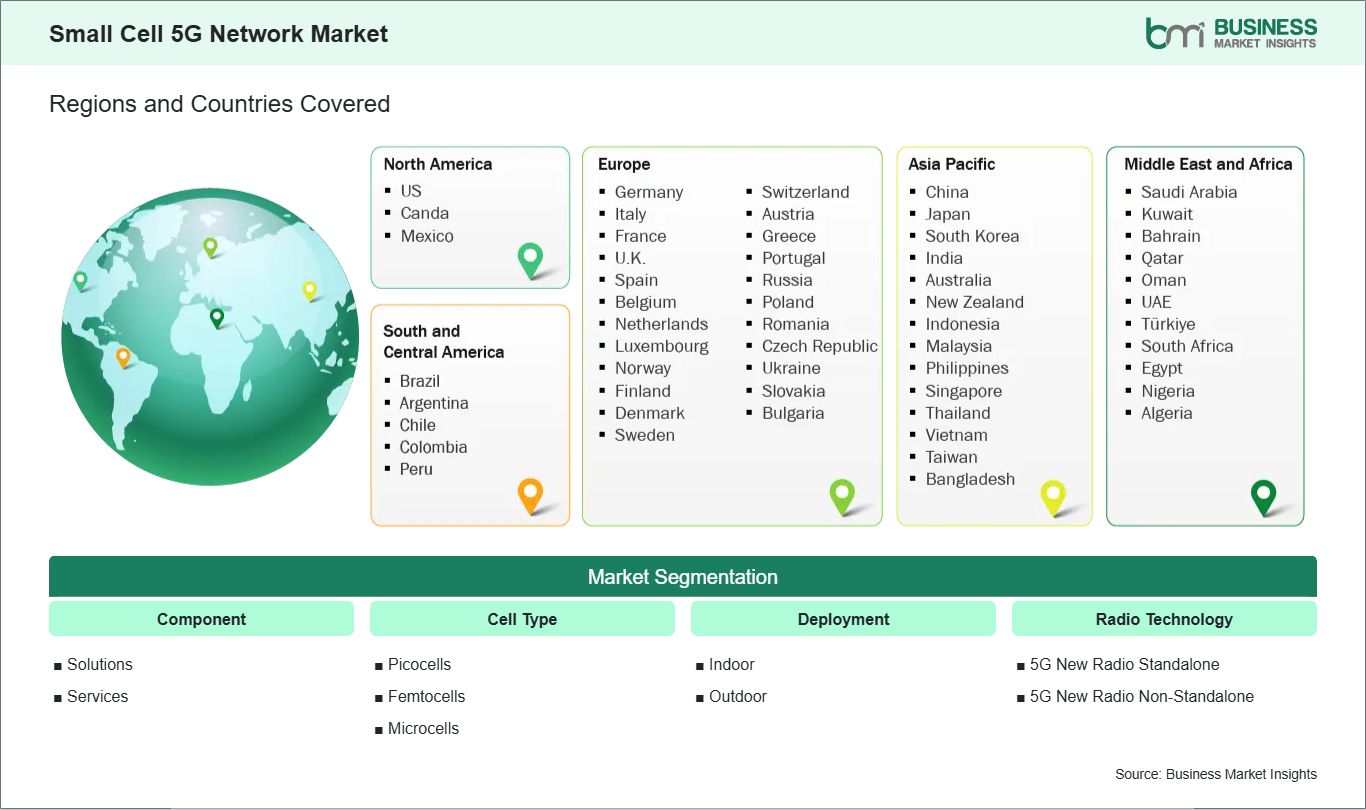
Key segments that contributed to the derivation of the Small Cell 5G Network market analysis are component, cell type, deployment, radio technology, and application.
- By Component, the market is segmented into Solutions and Services.
- By Cell Type, the market is divided into Picocells, Femtocells, and Microcells.
- By Deployment, the market is categorized into Indoor and Outdoor.
- By Radio Technology, the market is segmented into 5G New Radio Standalone, and 5G New Radio Non-Standalone.
- By Application, the market is divided into Enhanced Mobile Broadband, IoT, Machine Type Communications, Ultra Reliable Low Latency Communications, and Others.
Market Forces
Small Cell 5G Network Market Drivers and Opportunities
Advancing Network Densification and Enterprise Digital Transformation
The primary driver of the Small Cell 5G Network Market is the systemic need to manage the exponential increase in mobile data traffic while achieving the ultra-low latency specified by 5G standards. The transition to Industry 4.0 is a significant influence, as smart factories and logistics centers require localized, high-reliability networks to support autonomous mobile robots (AMRs) and real-time sensor arrays. This trend is further accelerated by the widespread deployment of Private 5G Networks, which enable enterprises to avoid public cellular network congestion and maintain strict control over data security and quality of service. In urban environments, the demand for Enhanced Mobile Broadband (eMBB) is prompting operators to install small cells on street furniture and utility poles to address coverage gaps in high-density locations such as stadiums, shopping malls, and transportation hubs.
Additionally, the global adoption of Standalone (SA) 5G Architectures has made small cells essential for supporting network slicing and edge computing, ensuring that mission-critical applications receive dedicated bandwidth. Collectively, these factors, data congestion, industrial digitization, and the physical constraints of high-frequency spectrum, are driving robust and rapid growth in small cell infrastructure across global technology hubs.
AI-Native Self-Optimization and Smart City Integration
The convergence of Small Cell 5G Networks with AI-driven Self-Organizing Networks (SON) represents a significant high-value opportunity. Next-generation small cells are equipped with autonomous AI agents capable of optimizing interference mitigation, power consumption, and load balancing in real time, thereby reducing the operational complexity associated with managing dense node deployments. Another major growth area is the integration of small cells with smart city ecosystems. Embedding connectivity nodes into intelligent lighting and traffic sensors enables municipalities to establish a unified digital infrastructure that supports applications ranging from autonomous transit to environmental monitoring.
Additionally, the expansion of Open Radio Access Network (Open RAN) architectures creates opportunities for a broader range of software and hardware vendors to deliver modular, interoperable small cell solutions, which reduces reliance on a limited number of dominant equipment manufacturers. Beyond terrestrial networks, the development of integrated satellite-to-small-cell connectivity offers a long-term solution for delivering high-speed 5G to remote or underserved regions. Manufacturers prioritizing energy-efficient small cell designs and those advancing neutral-host business models are likely to lead the most innovative and high-margin segments of the global 5G market.
Size and Share Analysis
Small Cell 5G Network Market Size and Share Analysis
The Small Cell 5G Network market demonstrates steady growth, with size and share analysis revealing evolving trends and competitive positioning among key players. The report further examines subsegments categorized within component, cell type, deployment, radio technology, and application, offering insights into their contribution to overall market performance.
Based on component, the Solutions subsegment holds a significant market share, serving as the industry benchmark for physical network deployment. Solutions, including radio units and baseband processing hardware, are indispensable for the Telecommunications vertical, where they facilitate the rapid densification of urban 5G footprints. A notable trend is the surge in the Services subsegment, which is registering a higher growth rate. These services, ranging from network planning and site acquisition to managed maintenance, are becoming essential for Large Enterprises deploying private 5G networks, providing a strategic roadmap for organizations to manage the increased complexity of multi-node indoor environments without expanding their internal IT overhead.
Report Coverage
Small Cell 5G Network Market Report Coverage and Deliverables
The "Small Cell 5G Network Market Size and Forecast (2022 - 2033)" report provides a detailed analysis of the market covering below areas:
- Small Cell 5G Network market size and forecast at global, regional, and country levels for all the key market segments covered under the scope
- Small Cell 5G Network market trends, as well as market dynamics such as drivers, restraints, and key opportunities
- Small Cell 5G Network market analysis covering key market trends, global and regional framework, major players, regulations, and recent market developments
- Industry landscape and competition analysis covering market concentration, heat map analysis, prominent players, and recent developments for the Small Cell 5G Network market
- Detailed company profiles, including SWOT analysis
Geographic Insights
Small Cell 5G Network Market Geographic Insights
The geographical scope of the Small Cell 5G Network market report is divided into five regions: North America, Asia Pacific, Europe, Middle East & Africa, and South & Central America.
North America constitutes a high-value market, with a focus on mid-band and millimeter-wave (mmWave) deployments to address the data requirements of enterprise campuses and smart cities. In Europe, there is a pronounced emphasis on industrial private networks and the integration of small cells into urban infrastructure such as lamp posts and traffic lights, which facilitates the circumvention of traditional site acquisition challenges. The Asia-Pacific Small Cell 5G Network Market is divided into China, Japan, South Korea, India, Australia, and the Rest of Asia. China serves as the primary driver in the region, propelled by its Dual Gigabit city initiatives and extensive deployment in smart manufacturing facilities. Japan and South Korea have emerged as early adopters of high-frequency small cells to enable advanced robotics and augmented reality applications.
Industry Activity
Recent Developments
The Small Cell 5G Network market is evaluated by gathering qualitative and quantitative data post primary and secondary research, which includes important corporate publications, association data, and databases. A few of the key developments in the Small Cell 5G Network market are:
- In February 2025, Mavenir and EdgeQ unveiled the industry’s first software-defined small cells supporting both 4G and 5G on a single chip. The collaboration focuses on flexible, low-power, and rapidly deployable solutions for indoor and outdoor environments, enabling seamless 4G-to-5G migration, urban densification, and enhanced network capacity, strengthening the small cell 5G network market.
- In January 2025, Airspan partnered with Space Compass to deploy 5G Air-to-Ground (ATG) connectivity for high-altitude maritime surveillance, enabling reliable, wide-area coverage from HAPS aircraft to ground stations up to 300 km. Initial validations are planned for 2026, showcasing new applications for 5G small cells beyond terrestrial networks.
Trust & Transparency
Research Methodology
The market analysis combines proprietary research with secondary data from government agencies, company disclosures, regulatory filings, industry databases and expert interviews. Market estimates are validated through data triangulation, cross-market benchmarking and analyst
review.
View Full Research Methodology
Key Sources Referred:
World Bank - Global Trade IndicatorsWorld Trade Organization (WTO)International Monetary Fund (IMF)International Trade Administration (ITA)Company websiteCompany annual reportsCompany investor presentations