
5G Small Cell Market Outlook: Size, Share, Trends, Growth Analysis, Competitive Landscape & Forecast, 2026-2033

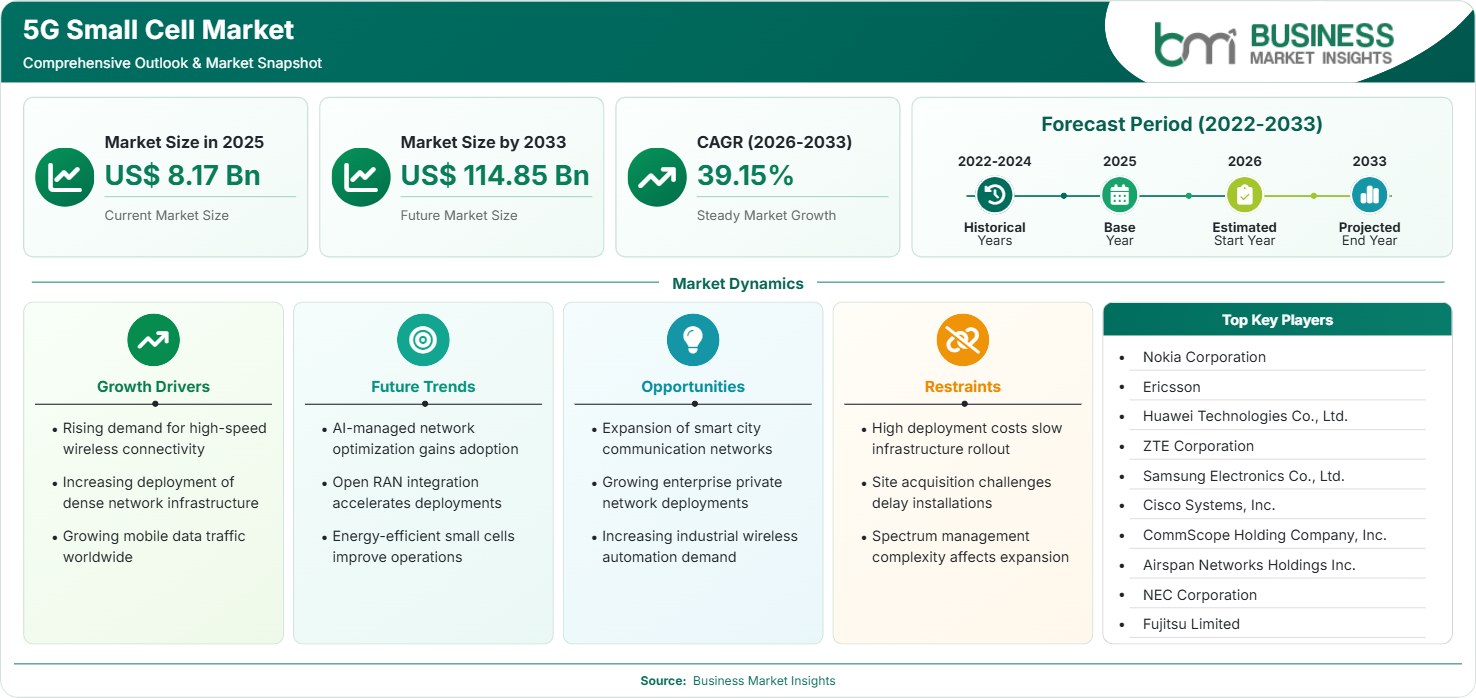
The 5G Small Cell Market size was valued at US$ 8.17 billion in 2025 and is projected to reach US$ 114.85 billion by 2033, growing at a CAGR of 39.15% during 2026–2033. Rising demand for high-speed wireless connectivity, increasing deployment of dense network infrastructure, and growing mobile data traffic are accelerating investments, while smart city communication networks and enterprise private wireless deployments create significant long-term opportunities.

Report Coverage
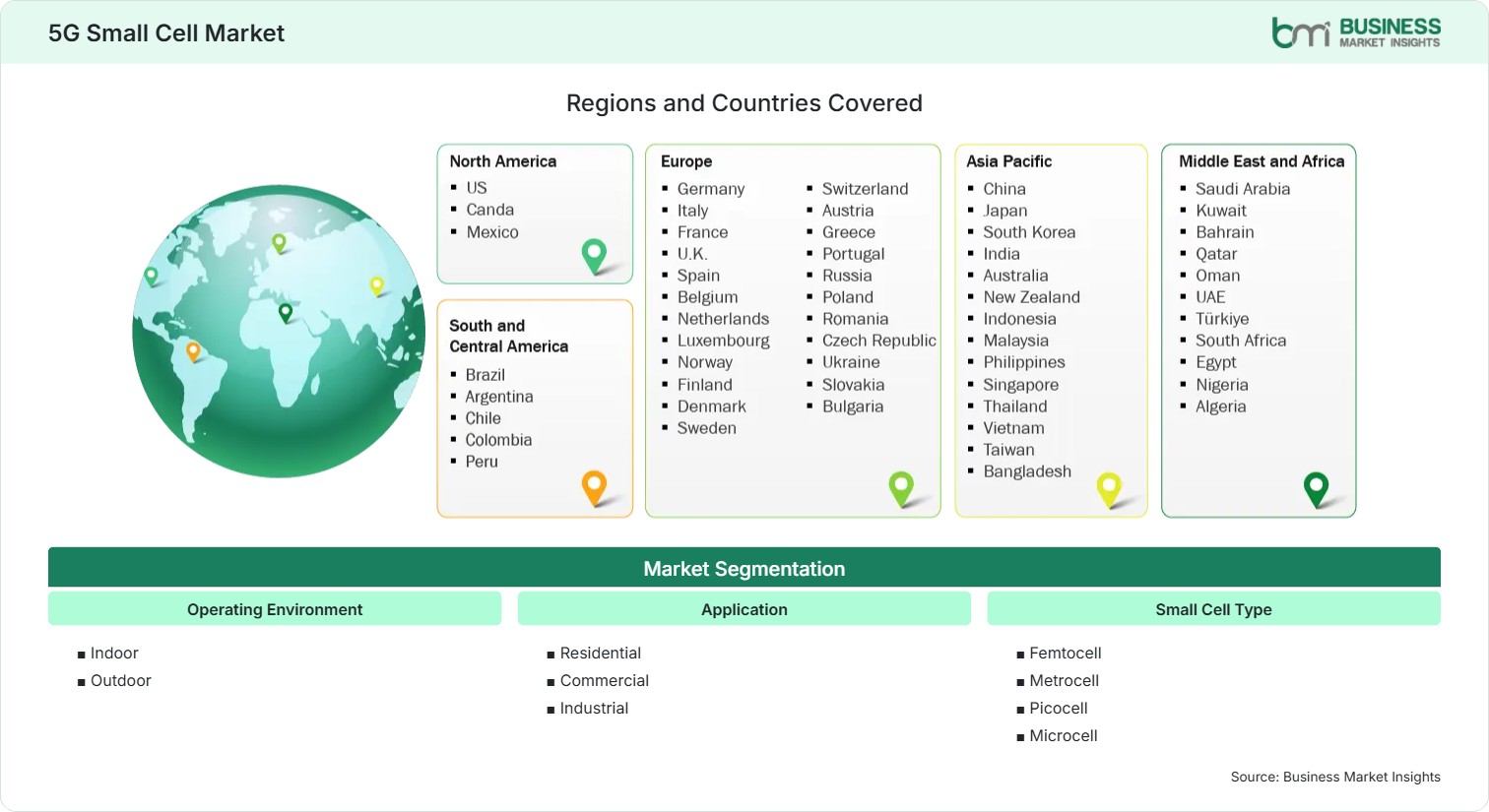
  • Operating Environment: Indoor, Outdoor
  • Application: Residential, Commercial, Industrial
  • Small Cell Type: Femtocell, Metrocell, Picocell, Microcell
US$ 8.17 Bn Market size in 2025
US$ 114.85 Bn Market Size by 2033
39.15% CAGR, 2026 - 2033
2026-2033 Forecast Period

01 AI Overview

5G Small Cell Market Summary

  • North America Region: North America holds 34%–37% market share in 2025 and is projected to expand at a CAGR of 37.5%–38.8% during 2026–2033. Strong 5G investments, spectrum availability, enterprise digitalization, and urban network densification continue driving regional demand. The U.S. leads the regional market through extensive 5G rollout, private wireless deployments, and operator investments, advancing at an estimated CAGR of 38.0%–39.2% during 2026–2033.
  • Fastest Growing Region: Asia Pacific accounts for 29%–32% market share in 2025 and is expected to register a CAGR of 41.5%–42.8% during 2026–2033. Expanding telecom infrastructure, smart city initiatives, industrial digitalization, and large-scale 5G deployments support rapid regional expansion.
  • Leading Segment: Outdoor represents 56%–59% market share in 2025 and is anticipated to grow at a CAGR of 38.5%–39.8% owing to increasing deployment across urban streets, transportation hubs, stadiums, and public infrastructure.
  • High Growth Segment: Industrial accounts for 21%–24% market share in 2025 and is forecast to expand at a CAGR of 42.8%–44.2% as manufacturers increasingly deploy private 5G networks for automation and real-time industrial communications.
  • Key Market Opportunity: Expansion of smart city communication infrastructure, enterprise private wireless networks, and industrial wireless automation is creating long-term opportunities for advanced 5G small cell deployments.
  • Major Market Players: Nokia Corporation, Ericsson, Huawei Technologies Co., Ltd., ZTE Corporation, Samsung Electronics Co., Ltd., Cisco Systems, Inc., CommScope Holding Company, Inc., Airspan Networks Holdings Inc., NEC Corporation, and Fujitsu Limited.
02 Strategic Insights

5G Small Cell Market: Strategic Insights

5G Small Cell Market Strategic Framework
FREE PDF
Request your free sample
Request free sample
03 Stakeholder View

Key Takeaways

  • Telecom operators are increasingly adopting dense small cell architectures to improve network capacity, coverage quality, and user experience across high-traffic urban environments.
  • Industrial facilities, smart cities, and enterprise private networks represent the strongest commercial opportunities as organizations continue accelerating digital transformation initiatives.
  • Open RAN, virtualization, edge computing, and AI-enabled network optimization are driving product innovation while enhancing network efficiency and deployment flexibility.
  • Asia Pacific presents the most attractive investment opportunity because of rapid 5G deployment, expanding manufacturing activity, and supportive government digital infrastructure initiatives.
  • Strategic partnerships among telecom operators, infrastructure providers, and technology companies continue accelerating commercial deployments while improving network performance and operational efficiency.
04 Geographic Outlook

5G Small Cell Market Regional Highlights

North America 5G Small Cell Market

North America accounted for 34%–37% of the 5G Small Cell Market Share in 2025 and is expected to register a CAGR of 37.5%–38.8% during 2026–2033. Strong investments in standalone 5G networks, expanding Open RAN deployments, and increasing enterprise digitalization continue supporting market expansion across the region.

  • Telecom operators are expanding dense urban small cell deployments to improve network capacity and low-latency connectivity.
  • Increasing private 5G adoption across manufacturing, healthcare, and logistics supports sustained infrastructure investments.
  • Growing edge computing implementation strengthens demand for high-performance small cell solutions.
  • Public infrastructure modernization and smart city projects continue accelerating deployment across metropolitan areas.

US 5G Small Cell Market

The U.S. represented 74%–77% of the North American market in 2025 and is projected to grow at a CAGR of 38.0%–39.2% through 2033. Strong operator investments, spectrum availability, and enterprise wireless transformation continue driving nationwide deployment.

  • Large telecom operators continue expanding standalone 5G coverage using dense small cell architectures.
  • Enterprise private wireless networks support manufacturing, logistics, and campus connectivity.
  • Rising mobile data consumption accelerates infrastructure upgrades across urban regions.
  • Smart transportation and connected city initiatives generate additional deployment opportunities.

Europe 5G Small Cell Market

Europe held 24%–27% market share in 2025 and is forecast to expand at a CAGR of 36.8%–38.0% through 2033. Germany leads regional deployment, while the United Kingdom records the fastest growth, supported by nationwide digital infrastructure investments and industrial connectivity initiatives.

  • Government-backed digital transformation programs encourage wider small cell deployment.
  • Industrial automation projects increase demand for private 5G communication networks.
  • Transportation hubs and commercial buildings remain major deployment locations.
  • Open RAN initiatives strengthen supplier diversity and network modernization.

Asia Pacific 5G Small Cell Market

Asia Pacific accounted for 29%–32% market share in 2025 and is expected to register the fastest 5G Small Cell Market Forecasts, expanding at a CAGR of 41.5%–42.8% during 2026–2033. China leads regional revenue, while India demonstrates the highest growth owing to rapid 5G infrastructure expansion.

  • Large-scale 5G rollouts continue increasing demand for outdoor and indoor small cells.
  • Smart manufacturing initiatives accelerate deployment across industrial facilities.
  • Smart city development programs support communication infrastructure investments.
  • Expanding mobile subscribers increase network densification requirements.
  • Government support for digital connectivity strengthens long-term market potential.

Rest of World 5G Small Cell Market

The Rest of World region represented 10%–13% market share in 2025 and is projected to grow at a CAGR of 38.2%–39.4% through 2033. Brazil leads adoption in South America, while the United Arab Emirates records the strongest growth across the Middle East and Africa through continuous telecom infrastructure investments.

  • Smart city developments encourage deployment of advanced wireless communication infrastructure.
  • Industrial diversification projects increase demand for private 5G networks.
  • Expanding digital connectivity programs support telecom infrastructure investments.
  • Rising enterprise digital transformation accelerates adoption across commercial sectors.
Global Market Geography
FREE PDF
Request your free sample
Request free sample
05 Segment Analysis

5G Small Cell Market Segmentation

Operating Environment

The Operating Environment segment accounted for the largest Market Analysis across deployment categories, representing 56%–59% market share in 2025 and expanding at a CAGR of 38.5%–39.8%. The 5G Small Cell Market Trends indicate growing deployment of outdoor infrastructure to strengthen network coverage, improve capacity, and support high-density urban communication environments.

  • Indoor: Increasing deployment across offices, shopping malls, hospitals, airports, and educational campuses supports reliable indoor connectivity and improved network performance.
  • Outdoor: Widely deployed across streets, transportation hubs, stadiums, and public spaces to enhance network coverage, capacity, and user experience.

Application

The Application segment reflects growing adoption of small cell technology across multiple end-use environments. Commercial deployments continue dominating revenue, while industrial applications demonstrate the strongest growth driven by enterprise digital transformation and private wireless adoption.

  • Residential: Home broadband enhancement and fixed wireless access solutions continue supporting residential deployment opportunities.
  • Commercial: Offices, retail centers, airports, hotels, and healthcare facilities increasingly deploy small cells to improve connectivity and user capacity.
  • Industrial: Manufacturing plants, warehouses, ports, and energy facilities adopt private 5G networks for automation, monitoring, and real-time communication.

Small Cell Type

The Small Cell Type segment continues expanding as network operators optimize coverage and capacity according to deployment requirements. Different cell types address varying coverage ranges, subscriber densities, and application scenarios across indoor and outdoor environments.

  • Femtocell: Primarily deployed in homes and small offices to improve indoor mobile coverage and broadband performance.
  • Metrocell: Designed for urban outdoor deployments requiring wider coverage across city streets and commercial districts.
  • Picocell: Commonly installed inside enterprises, airports, shopping malls, and hospitals to improve network capacity in high-density locations.
  • Microcell: Supports large outdoor coverage areas including transportation corridors, stadiums, campuses, and metropolitan communication networks.
06 Market Forces

5G Small Cell Market Dynamics

Key Market Drivers

Rising Demand for High-Speed Wireless Connectivity

The increasing demand for ultra-fast wireless communication is a major factor supporting the 5G Small Cell Market Growth. Consumers and enterprises require seamless connectivity for high-definition video streaming, cloud computing, online gaming, augmented reality, and mission-critical business applications. According to the GSM Association (GSMA), the number of 5G connections continues to grow at an accelerating rate as operators step up the rollout of the network. The small cells boost the network's capacity, reduce latency, and enhance indoor and outdoor coverage in highly concentrated areas. The use of small cells allows telecom companies to provide quality services even as the need for higher bandwidth continues to increase.

Increasing Deployment of Dense Network Infrastructure

Telecommunication providers are investing heavily in dense network architectures to support expanding mobile broadband requirements. Unlike conventional macro base stations, small cells improve spectral efficiency and strengthen network performance in urban environments with high subscriber density. Governments and operators continue expanding 5G coverage through infrastructure modernization initiatives and spectrum investments. Increasing use in transport nodes, commercial sites, educational centers, healthcare facilities, and public spaces is another factor that helps support demand for equipment. Open RAN and virtual networks are additional elements that allow more flexibility in deploying such equipment and simplifying operation in the future.

Growing Mobile Data Traffic Worldwide

Global mobile data consumption continues increasing because of video streaming, Internet of Things devices, cloud applications, and enterprise digitalization. According to Ericsson Mobility research, mobile network traffic is projected to maintain strong growth throughout the forecast period. Telecom operators therefore require additional network capacity to maintain service quality and low latency. The small cell solution is efficient at offloading traffic from macro networks and delivering improved experiences to users within high-density urban areas. The ongoing rise in the use of smartphones and industrial connections, along with real-time digital services, continues to drive investments in infrastructure solutions.

Key Market Opportunities

Expansion of Smart City Communication Networks

The expansion of smart city projects presents substantial opportunities for infrastructure vendors and telecom equipment manufacturers. Governments worldwide continue investing in intelligent transportation systems, connected public services, digital surveillance, smart lighting, and environmental monitoring. The 5G Small Cell Market Forecasts indicate increasing deployment of small cells to provide reliable, low-latency communication supporting these connected ecosystems. The cities need infrastructure that will provide the capacity of accommodating millions of devices at once. As the cities are increasingly investing in digitization efforts, there is going to be a significant increase in the need for an energy-efficient 5G network infrastructure.

Growing Enterprise Private Network Deployments

Private 5G networks are becoming increasingly important across manufacturing, logistics, healthcare, mining, airports, and large commercial campuses. Enterprises require secure, reliable, and low-latency connectivity for autonomous operations, industrial automation, predictive maintenance, and connected workforce applications. Small cells provide flexible deployment options while enabling dedicated wireless coverage across large facilities. Increasing investments in Industry 4.0 technologies, artificial intelligence, and cloud-connected production environments continue supporting enterprise adoption. Equipment suppliers offering integrated hardware, software, and network management solutions are expected to benefit from expanding commercial opportunities throughout the forecast period.

Increasing Industrial Wireless Automation Demand

Manufacturers are increasingly adopting wireless automation technologies to improve productivity, operational visibility, and production flexibility. Small cells enable reliable communication between industrial robots, autonomous guided vehicles, sensors, and connected machinery operating within production facilities. Industries including automotive, electronics, pharmaceuticals, and energy continue investing in digital factories that require uninterrupted wireless connectivity. The integration of artificial intelligence, edge computing, and Industrial Internet of Things platforms further increases the need for dependable 5G communication infrastructure. These technological advancements create significant opportunities for suppliers delivering high-performance industrial networking solutions.

Market Restraints and Challenges

High Deployment Costs Slow Infrastructure Rollout

Deploying extensive 5G small cell networks requires considerable investment in equipment, fiber backhaul, site preparation, installation, and maintenance, making infrastructure expansion capital intensive.

Factor: High capital expenditure associated with network deployment.

Impact: Telecom operators often prioritize high-demand urban markets while delaying deployments in lower-density locations because of longer investment recovery periods. Rising installation expenses, equipment costs, and supporting network infrastructure requirements may reduce deployment speed, particularly among smaller operators with limited capital resources, thereby affecting the pace of overall market expansion.

Site Acquisition Challenges Delay Installations

Obtaining suitable locations for small cell deployment remains a major operational challenge because installations require access to street furniture, buildings, utility poles, and other urban infrastructure.

Factor: Lengthy site approvals and regulatory permitting procedures.

Impact: Delays in securing installation permissions increase project timelines, elevate deployment costs, and slow commercial network expansion. Differences in municipal regulations, right-of-way approvals, zoning requirements, and infrastructure accessibility continue creating operational challenges for telecom operators seeking rapid nationwide 5G network deployment.

07 Company Analysis

Competitive Landscape

The market remains highly competitive as leading telecommunications equipment manufacturers focus on expanding their 5G radio access portfolios, Open RAN compatibility, cloud-native architectures, and energy-efficient network solutions. The 5G Small Cell Market Analysis indicates that companies are strengthening their positions through strategic collaborations with telecom operators, software vendors, and infrastructure providers while investing in research and development to support dense network deployments, enterprise private wireless networks, and smart city connectivity.

Company Name

Overview

Products and Services Relevant to this Market

Nokia Corporation

Global telecommunications technology company providing end-to-end network infrastructure and advanced wireless communication solutions for mobile operators worldwide.

5G small cells, AirScale radio solutions, Open RAN products, cloud-native core networks, private wireless solutions, and network management software.

Ericsson

Leading provider of mobile network infrastructure supporting telecom operators through advanced radio access technologies and digital connectivity solutions.

5G Radio Dot System, indoor and outdoor small cells, Open RAN solutions, network software, transport solutions, and managed services.

Huawei Technologies Co., Ltd.

Global ICT infrastructure provider delivering comprehensive wireless communication products and intelligent network technologies.

5G small cells, distributed antenna systems, radio access equipment, transport networks, AI-enabled network management, and enterprise wireless solutions.

ZTE Corporation

Telecommunications equipment manufacturer specializing in mobile broadband infrastructure and intelligent wireless communication technologies.

Indoor and outdoor small cells, 5G base stations, Open RAN products, transport equipment, and enterprise communication solutions.

Samsung Electronics Co., Ltd.

Technology company offering advanced 5G infrastructure supporting public and private wireless network deployments globally.

Compact 5G radios, indoor small cells, virtualized RAN solutions, network automation software, and enterprise wireless infrastructure.

Cisco Systems, Inc.

Global networking technology provider delivering enterprise connectivity and secure communication infrastructure solutions.

Private 5G networking, enterprise wireless infrastructure, edge networking, cloud management software, and secure networking platforms.

CommScope Holding Company, Inc.

Communications infrastructure manufacturer supporting broadband and wireless network deployments across global markets.

Small cell antennas, distributed antenna systems, fiber connectivity, network cabinets, and wireless infrastructure solutions.

Airspan Networks Holdings Inc.

Specialist wireless network provider focused on Open RAN and next-generation broadband connectivity technologies.

Indoor and outdoor small cells, Open RAN radios, private 5G solutions, fixed wireless access equipment, and network software.

NEC Corporation

Global technology company delivering advanced communication infrastructure and digital transformation solutions.

5G radio units, Open RAN equipment, transport systems, private wireless solutions, and network integration services.

Fujitsu Limited

Information and communication technology company supporting telecom operators through advanced wireless networking solutions.

Open RAN radios, 5G small cells, wireless transport technologies, network optimization software, and telecom infrastructure services.

10 Trust & Transparency

Research Methodology

The market analysis combines proprietary research with secondary data from government agencies, company disclosures, regulatory filings, industry databases and expert interviews. Market estimates are validated through data triangulation, cross-market benchmarking and analyst review.

View Full Research Methodology

11 Questions Answered

Frequently Asked Questions

What does the 5G Small Cell Market Report include?

The Market Report provides detailed insights into market size, regional outlook, segmentation, competitive landscape, emerging technologies, growth drivers, opportunities, recent developments, and future industry outlook.

Which application offers the highest growth potential?

Industrial applications are projected to experience the fastest growth as manufacturers increasingly deploy private 5G networks for automation, robotics, predictive maintenance, and real-time industrial communication.

Which operating environment leads the market?

Outdoor deployments lead the market owing to extensive installation across urban streets, transportation hubs, commercial districts, public venues, and smart city infrastructure requiring continuous high-capacity wireless coverage.

Which region is expected to witness the fastest growth?

Asia Pacific is expected to record the highest growth during the forecast period because of extensive 5G rollouts, strong government support, increasing smartphone adoption, and rapid investments in digital infrastructure.

What is driving the 5G Small Cell Market?

The market is primarily driven by increasing mobile data traffic, rising demand for high-speed wireless connectivity, expanding 5G infrastructure, enterprise digital transformation, and growing deployment of smart city communication networks.

Access the Full 5G Small Cell Market Report

Get segment-level forecasts, regional estimates, competitive benchmarking, company profiles and downloadable Excel datasets.

Access the full 5G Small Cell Market Report
350 pages PDF & Excel | 2026-08-06