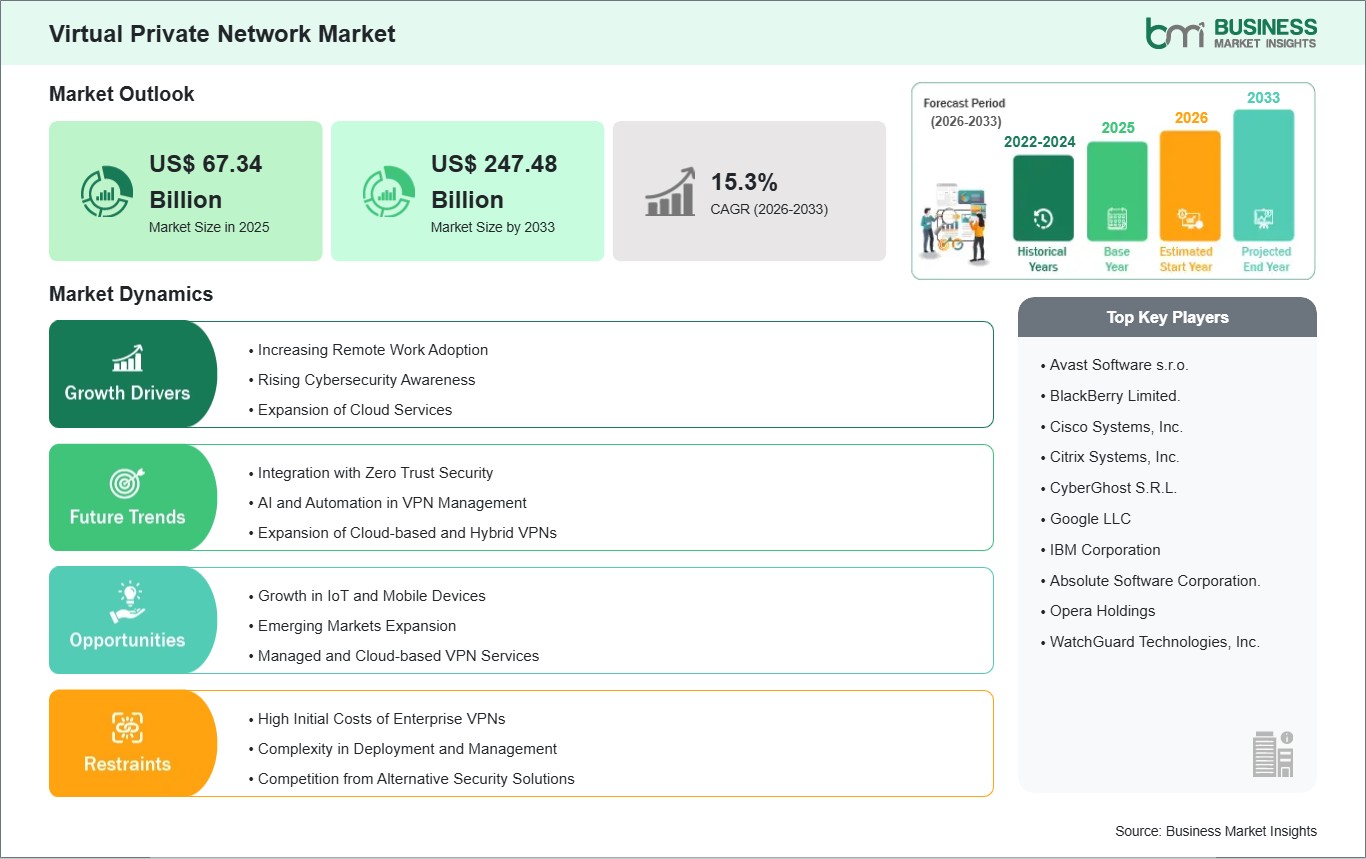
The virtual private network market size is expected to reach US$247.48 billion by 2033 from US$67.34 billion in 2025. The market is estimated to record a CAGR of 15.30% from 2026 to 2033.
A Virtual Private Network (VPN) is a technology that creates a secure and encrypted connection over public networks like the internet, allowing users to transmit data privately and safely. It essentially extends a private network across shared infrastructure, safeguarding information from unauthorized access and eavesdropping. The primary benefits of using VPNs include enhanced data privacy and security, protection of sensitive information, anonymous or obscured browsing, and secure remote access to enterprise systems or cloud resources. VPNs are widely used across enterprise IT environments, remote/hybrid work scenarios, government and military systems, individual privacy applications, and for bypassing geographical content restrictions.
The VPN market is growing robustly, driven by several key factors. Market drivers include the proliferation of cybersecurity threats, increasing demand for secure remote access (particularly in a post-pandemic era with remote/hybrid work models), and rising data protection and compliance requirements across sectors like BFSI, healthcare, and IT. Enterprises are investing in VPN solutions as fundamental components of their secure network infrastructure, pushing broad adoption. Additionally, there are strong market opportunities in cloud-based VPN services, mobile VPN adoption, and expansion in emerging regions where internet penetration and cybersecurity awareness continue to rise.

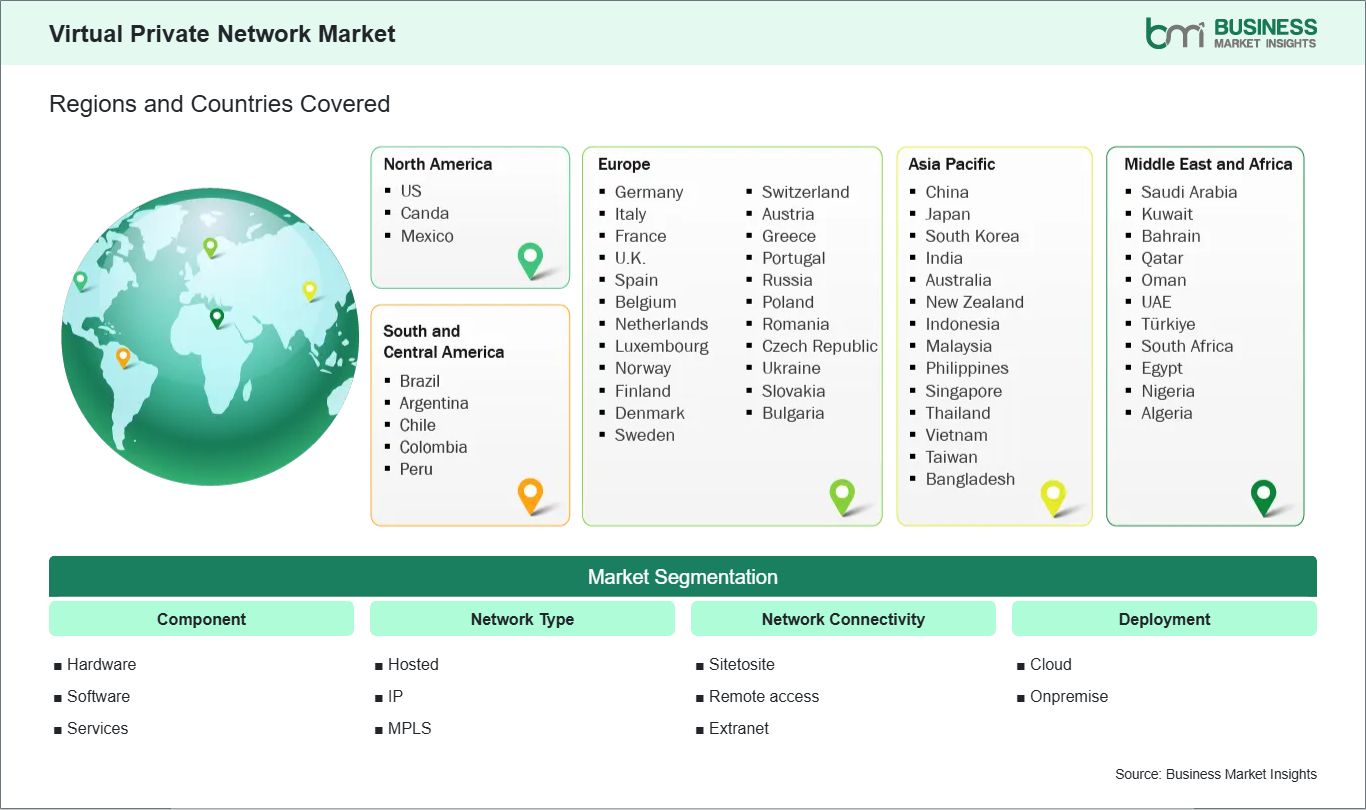
Key segments that contributed to the derivation of the virtual private network market analysis are Component, Network Type, Network Connectivity, Deployment, and End-Use.
The widespread adoption of remote work and hybrid workplace models is a primary driver of the VPN market. Organizations require secure, encrypted access to their internal networks for employees working from home or remote locations. VPNs ensure the confidentiality, integrity, and availability of corporate data, enabling uninterrupted business operations. The growing need to maintain productivity while securing sensitive information has pushed enterprises to invest heavily in reliable VPN solutions, boosting market demand globally. Additionally, cloud-based VPNs enhance accessibility and management, further supporting remote work initiatives.
The demand for managed and cloud-based VPN solutions offers considerable opportunities for providers. Organizations increasingly prefer outsourcing VPN management to reduce operational complexity, maintenance costs, and resource requirements. Cloud-based VPNs allow scalability and flexibility, enabling businesses to adapt to changing network requirements quickly. Service providers offering secure, reliable, and easy-to-manage VPN solutions can capitalize on this growing segment and capture market share.
By Component, the market is segmented into Hardware, Software, and Services. The Software segment dominated the market in 2024. This dominance is driven by cloud adoption, remote work, and scalability. Software-based VPNs offer flexible deployment, lower costs, rapid updates, and strong encryption. Enterprises prefer centralized management, compatibility across devices, and seamless integration with modern IT and security platforms for global enterprises and providers.
By Network Type, the market is segmented into Hosted, IP, and MPLS. The IP segment held the largest share of the market in 2024. capturing the largest share due to its network type, offering secure, reliable, and high-performance connectivity. It supports large enterprises with dedicated private networks, ensuring low latency and consistent data transfer. IP-based VPNs enable seamless communication between branch offices, enhance network control, and provide robust security for sensitive organizational data.
By Network Connectivity, the market is segmented into Site-to-Site, Remote Access, and Extranet. The Site-to-Site segment held the largest share of the market in 2024. The Site-to-Site segment dominates the VPN market by network connectivity, connecting multiple office locations securely over the internet or private networks. It ensures consistent, reliable communication, centralized management, and enhanced data security. Ideal for enterprises, it reduces operational costs, improves collaboration, and supports large-scale, geographically distributed business operations efficiently.
By Deployment, the market is segmented into Cloud, On-premise. The Cloud segment held the largest share of the market in 2024. The Cloud segment dominates the VPN market by deployment, offering scalable, flexible, and cost-effective solutions. Cloud-based VPNs enable remote access, seamless integration with existing IT infrastructure, and rapid deployment without physical hardware. They enhance security, support global workforce connectivity, and allow businesses to manage networks efficiently with minimal maintenance.

By End-use, the market is segmented into Commercial, Individual, and Service providers. The Commercial segment held the largest share of the market in 2024. The Cloud segment dominates the VPN market by deployment, offering scalable, flexible, and cost-effective solutions. Cloud-based VPNs enable remote access, seamless integration with existing IT infrastructure, and rapid deployment without physical hardware. They enhance security, support global workforce connectivity, and allow businesses to manage networks efficiently with minimal maintenance.
| Report Attribute | Details |
|---|---|
| Market size in 2025 | US$ 67.34 Billion |
| Market Size by 2033 | US$ 247.48 Billion |
| Global CAGR (2026 - 2033) | 15.3% |
| Historical Data | 2022-2024 |
| Forecast period | 2026-2033 |
| Segments Covered | By Component
|
| Regions and Countries Covered | North America
|
| Market leaders and key company profiles |
|
The Virtual Private Network Market Size and Forecast (2022–2033) report provides a detailed analysis of the market covering below areas:
The geographical scope of the virtual private network Market report is divided into five regions: North America, Asia Pacific, Europe, Middle East & Africa, and South & Central America. The virtual private network Market in Asia Pacific is expected to grow significantly during the forecast period.
The Asia-Pacific Virtual private network market is segmented into China, Japan, South Korea, India, Australia, New Zealand, Indonesia, Malaysia, the Philippines, Singapore, Thailand, Vietnam, Taiwan, Bangladesh, and the Rest of Asia. The Asia-Pacific virtual private network market is experiencing robust growth, driven by increasing internet penetration, rising adoption of cloud services, remote work trends, and growing cybersecurity awareness. Expanding SMEs, digital transformation initiatives, and government support for secure networks further fuel demand, making the region a key contributor to the global VPN market.
Additionally, rapid technological advancements, the proliferation of smartphones and IoT devices, and the rising demand for secure data transmission across enterprises and service providers accelerate VPN adoption in Asia-Pacific, strengthening market expansion.

The Virtual private network market is evaluated by gathering qualitative and quantitative data post primary and secondary research, which includes important corporate publications, association data, and databases. A few of the key developments in the virtual private network market are:
The Virtual Private Network Market is valued at US$ 67.34 Billion in 2025, it is projected to reach US$ 247.48 Billion by 2033.
As per our report Virtual Private Network Market, the market size is valued at US$ 67.34 Billion in 2025, projecting it to reach US$ 247.48 Billion by 2033. This translates to a CAGR of approximately 15.3% during the forecast period.
The Virtual Private Network Market report typically cover these key segments-
The historic period, base year, and forecast period can vary slightly depending on the specific market research report. However, for the Virtual Private Network Market report:
The Virtual Private Network Market is populated by several key players, each contributing to its growth and innovation. Some of the major players include:
The Virtual Private Network Market report is valuable for diverse stakeholders, including:
Essentially, anyone involved in or considering involvement in the Virtual Private Network Market value chain can benefit from the information contained in a comprehensive market report.
Please tell us your area of interest
(Market Segments/ Regions and Countries/ Companies)