
Network As A Service Market Outlook: Size, Share, Trends, Growth Analysis, Competitive Landscape & Forecast, 2026-2033

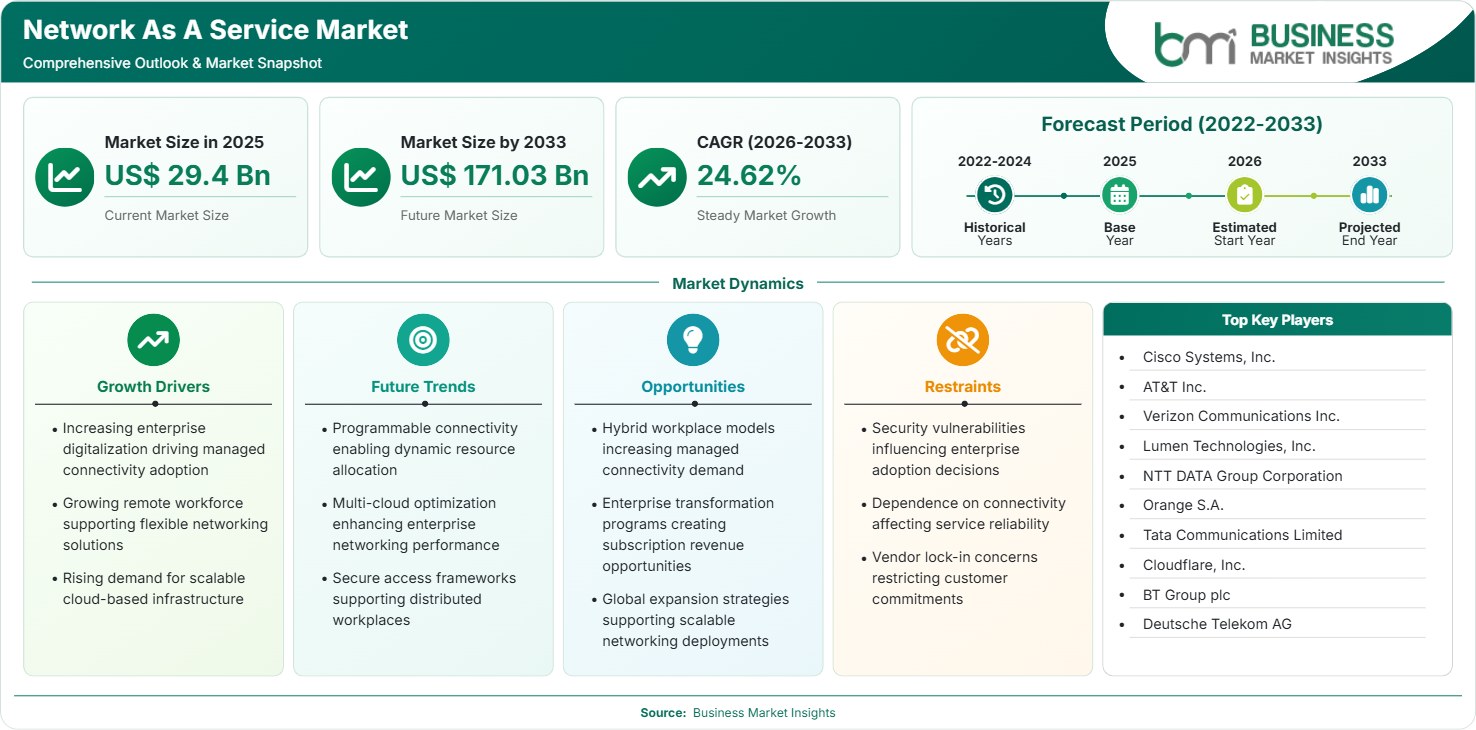
The Network As A Service Market size was valued at US$ 29.4 Billion in 2025 and is projected to reach US$ 171.03 Billion by 2033, growing at a CAGR of 24.62% during 2026–2033, driven by cloud-native networking, SD-WAN adoption, network automation, SASE deployment, and growing enterprise demand for scalable consumption-based connectivity services.

Report Coverage
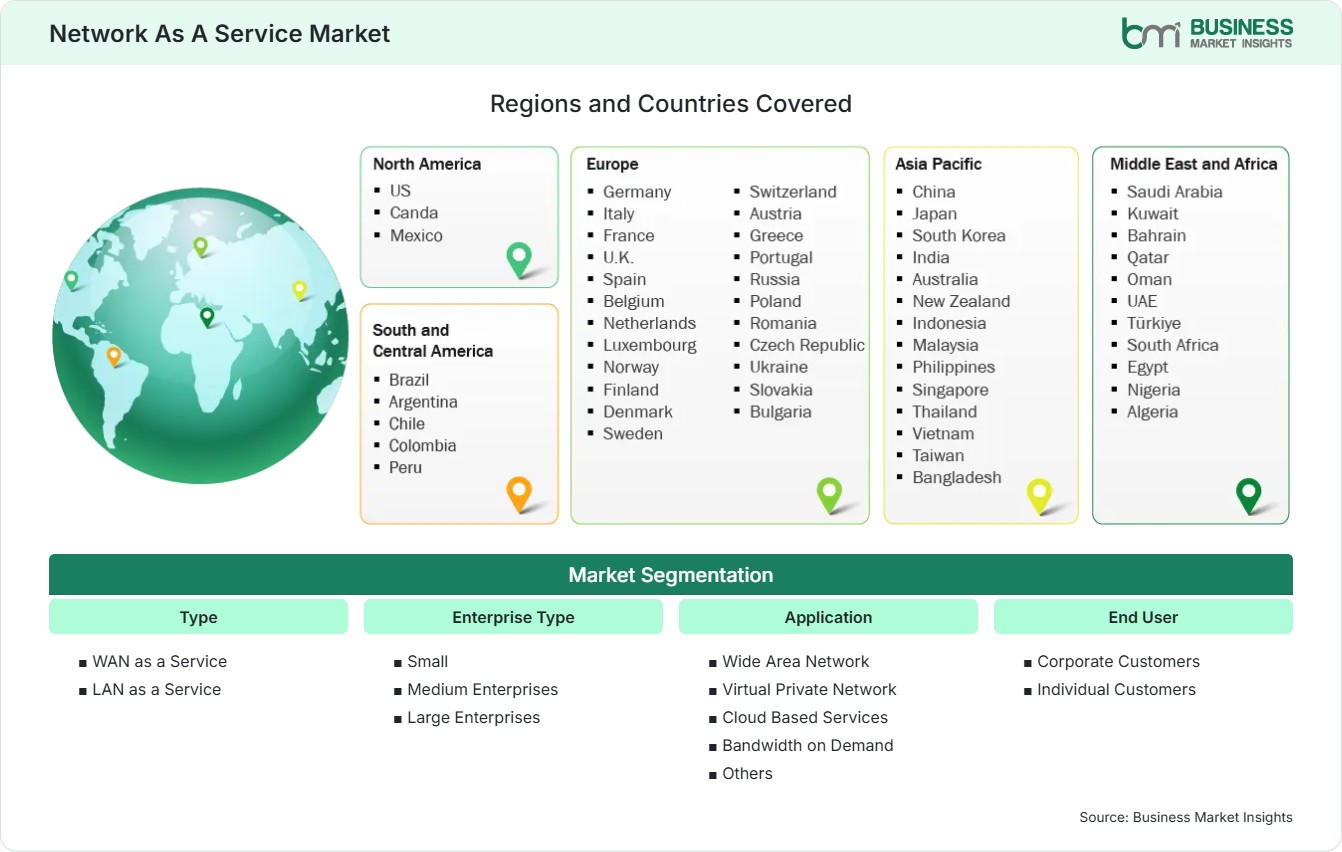
  • Type: WAN as a Service, LAN as a Service
  • Enterprise Type: Small, Medium Enterprises, Large Enterprises
  • Application: Wide Area Network, Virtual Private Network, Cloud Based Services, Bandwidth on Demand, Others
  • End User: Corporate Customers, Individual Customers
  • Industry: Corporate Customers, BFSI, IT & Telecom, Manufacturing, Healthcare, Retail, Others
US$ 29.4 Bn Market size in 2025
US$ 171.03 Bn Market Size by 2033
24.62% CAGR, 2026 - 2033
2026-2033 Forecast Period

AI Overview

Network As A Service Market Summary

  • North America Region: North America holds a market share of 36%–39% in 2025, growing at a CAGR of 22%–24% during 2026–2033. Demand is supported by SD-WAN modernization, multicloud integration, AI-enabled monitoring, telecom investment, cybersecurity requirements, and subscription-based infrastructure consumption models. The U.S. remains the regional anchor, supported by hyperscale cloud ecosystems and enterprise digital transformation initiatives, with CAGR estimated at 22%–24%.
  • Fastest Growing Region: Asia Pacific holds a market share of 25%–28% in 2025 and is projected to expand at a CAGR of 27%–29%. Accelerating cloud migration, 5G deployment, manufacturing digitization, smart cities, and rising enterprise connectivity requirements continue stimulating demand across emerging economies.
  • Leading Segment: WAN as a Service accounts for 58%–61% of the Network As A Service Market share in 2025 and advances at a CAGR of 24%–26%. Growth reflects demand for centralized network management, branch connectivity optimization, application performance visibility, flexible provisioning, and lower infrastructure ownership costs.
  • High Growth Segment: Cloud-Based Services represent a 22%–25% share in 2025 and expand at a CAGR of 28%–30%. Organizations increasingly prioritize cloud-native architectures, workload mobility, security integration, automation capabilities, and scalable networking consumption aligned with hybrid environments.
  • Key Market Opportunity: Expansion of AI-enabled network orchestration platforms creates opportunities for autonomous operations, predictive maintenance, dynamic bandwidth allocation, and integrated security services across distributed enterprise and edge environments.
  • Major Market Players: Cisco Systems, Inc.; AT&T Inc.; Verizon Communications Inc.; Lumen Technologies, Inc.; NTT DATA Group Corporation; Orange S.A.; Tata Communications Limited; Cloudflare, Inc.; BT Group plc; Deutsche Telekom AG.
Strategic Insights

Network As A Service Market: Strategic Insights

Network As A Service Market Strategic Framework
FREE PDF
Request your free sample
Request free sample
Stakeholder View

Key Takeaways

  • The value chain increasingly integrates telecom operators, cloud providers, cybersecurity vendors, managed service providers, and network software specialists into unified service delivery ecosystems.
  • Cloud-based connectivity and WAN transformation projects present the strongest medium-term revenue opportunities as enterprises modernize branch, campus, and remote-work environments.
  • AI-driven orchestration, intent-based networking, and predictive performance management are emerging as key innovation priorities across service portfolios.
  • Asia Pacific offers one of the most attractive investment environments due to enterprise digitization, 5G infrastructure deployment, and cloud adoption momentum.
  • Strategic partnerships between carriers, hyperscale cloud providers, and security vendors are accelerating market consolidation and solution bundling activity.
  • Demand for integrated networking and security platforms is reshaping procurement strategies, encouraging migration from isolated infrastructure purchases toward subscription models.
Geographic Outlook

Network As A Service Market Regional Highlights

North America Network As A Service Market

North America accounts for 36%–39% of revenue in 2025 and is forecast to grow at 22%–24% CAGR through 2033. The region benefits from mature cloud infrastructure, extensive fiber networks, and high SD-WAN penetration among enterprises. The Network As A Service Market share remains highest in this region due to strong technology spending, cybersecurity modernization, and multicloud deployment strategies. Enterprises increasingly prioritize integrated networking and security architectures while telecom operators expand managed service offerings to support hybrid work and edge computing requirements.

  • Large enterprises continue replacing legacy MPLS networks with flexible subscription-based architectures.
  • Strong hyperscale cloud presence supports advanced networking service integration.
  • SASE deployments are accelerating across financial services and healthcare organizations.
  • Telecom operators are increasing investment in network automation and orchestration platforms.

US Network As A Service Market

The United States represents 73%–76% of North American revenue and records an estimated CAGR of 22%–24%. Enterprise cloud migration, cybersecurity investment, and digital workplace initiatives remain important demand drivers. Growing adoption of AI-enabled network monitoring and automation strengthens service deployment. Demand remains particularly robust among BFSI, healthcare, retail, and technology sectors seeking scalable connectivity solutions across geographically distributed environments.

  • Hyperscale cloud ecosystems enhance service innovation and interoperability.
  • Federal cybersecurity priorities encourage adoption of managed secure networking.
  • Technology enterprises increasingly deploy advanced programmable networking platforms.
  • Data-center interconnection demand continues supporting service expansion.

Europe Network As A Service Market

Europe captures 28%–31% market share in 2025 and expands at 23%–25% CAGR of the Network As A Service Market. Strong regulatory frameworks, digital sovereignty priorities, and enterprise cloud adoption sustain growth. Germany remains the leading market, while Spain and Poland exhibit relatively faster expansion rates. Organizations increasingly deploy software-defined connectivity solutions to support cross-border operations, cybersecurity compliance, and digital transformation programs across manufacturing, banking, and public-sector environments.

  • Germany leads regional adoption through industrial digitalization initiatives.
  • Spain records strong growth driven by cloud and telecom investments.
  • Manufacturing modernization projects support networking transformation programs.
  • EU cybersecurity policies encourage secure network service consumption.
  • Multicloud adoption increases demand for flexible connectivity architectures.

Asia Pacific Network As A Service Market

Asia Pacific holds a 25%–28% share in 2025 and delivers the fastest expansion at 27%–29% CAGR. The region benefits from large-scale enterprise digitization, cloud investment, and expanding 5G infrastructure. China and Japan represent the largest revenue contributors, while India exhibits the strongest growth. The Network As A Service Market growth outlook remains supported by smart manufacturing, e-commerce expansion, and rising demand for secure connectivity solutions.

  • India demonstrates rapid adoption across enterprise and government sectors.
  • China benefits from extensive digital infrastructure investments.
  • Japan emphasizes automation and network reliability enhancements.
  • ASEAN economies increase cloud deployment and connectivity modernization.
  • Growing data-center capacity strengthens demand fundamentals.

Rest of World Network As A Service Market

Rest of World accounts for 8%–10% share and advances at 24%–26% CAGR of the Network As A Service Market. South and Central America benefit from enterprise digitization initiatives and increasing cloud adoption. The Middle East and Africa gain momentum through smart-city programs, telecom modernization, and digital government strategies. Brazil leads Latin America, while the UAE and Saudi Arabia remain key growth markets across the Middle East.

  • Brazil drives regional demand through cloud transformation projects.
  • UAE accelerates adoption through digital economy initiatives.
  • Saudi Arabia benefits from diversified technology investment programs.
  • Managed network services gain traction among mid-sized enterprises.
  • Security and compliance requirements support service adoption.
Global Market Geography
FREE PDF
Request your free sample
Request free sample
Segment Analysis

Network As A Service Market Segmentation

Type

The type segment reflects diverse enterprise connectivity requirements. It represented a major revenue contributor in 2025, with WAN-focused offerings accounting for 58%–61% share and segment growth between 24%–26% CAGR. The Network As A Service Market scope continues expanding as organizations seek agile network consumption, operational flexibility, and simplified management across hybrid and multicloud environments.

  • WAN as a Service: Enables centralized connectivity management, dynamic routing, and secure branch networking while reducing infrastructure complexity and supporting geographically dispersed business operations.
  • LAN as a Service: Adoption increases among enterprises pursuing subscription-based campus networking, simplified lifecycle management, and integrated support for wireless, wired, and device connectivity environments.

Enterprise Type

Enterprise demand varies significantly with organization size. Enterprises contribute around 60%–63% of current expenditure, and SMEs are the fastest adopters due to cost efficiency and a cloud-first operating strategy. Growth expectations exceed the industry average during the forecast period.

  • Small and Medium Enterprises: SMEs increasingly adopt managed networking to avoid significant upfront infrastructure investment while improving scalability and security across distributed operations.
  • Large Enterprises: Demand is driven by multicloud management, branch modernization, and network automation programs supporting complex operational ecosystems and global connectivity requirements.

Application

Application diversity continues to increase as companies upgrade their infrastructure architecture. The Network As A Service Market trends have shifted their focus towards connectivity, visibility, security, and the ability to provision on demand. This has been seen more prominently in workloads that rely heavily on cloud computing.

  • Wide Area Network: Remains a foundational use case supporting distributed enterprise connectivity and centralized network governance.
  • Virtual Private Network: Supports secure remote access, encrypted communications, and regulatory compliance requirements across multiple sectors.
  • Cloud-Based Services: Experiences rapid adoption driven by workload mobility, hybrid cloud architectures, and application-centric networking strategies.
  • Bandwidth on Demand: Enables dynamic resource allocation according to real-time business and application requirements.

End User

The end-user requirement shows different consumption needs among both organizations and end users. The corporate space still accounts for the largest share of income due to connectivity and digital transformation needs. Growth persists as networks integrate with applications and cybersecurity services.

  • Corporate Customers: Adoption is fueled by cloud migration, automation initiatives, and secure connectivity requirements across distributed enterprise networks.
  • Individual Customers: Flexible networking subscriptions support remote work, digital services access, and simplified connectivity management.

Industry (Corporate Customers)

Industry adoption is most evident among the highly interconnected and data-intensive Network As A Service Market. BFSI, IT & telecom, manufacturing, healthcare, and retail firms continue to emphasize network modernization projects to enhance resilience and performance.

  • BFSI: Focuses on secure connectivity, compliance, business continuity, and customer experience optimization.
  • IT & Telecom: Leads adoption through cloud-centric operations and advanced digital service delivery requirements.
  • Manufacturing: Supports industrial connectivity, automation systems, and smart-factory implementations.
  • Healthcare: Prioritizes secure data exchange, telehealth enablement, and resilient network performance.
  • Retail: Uses advanced networking for omnichannel operations, analytics integration, and customer engagement.
Market Forces

Network As A Service Market Dynamics

Key Market Drivers

Rapid Enterprise Cloud Migration

Workloads originating from the enterprise side have been migrating to public and hybrid clouds, necessitating a robust connectivity model. It has become a trend for cloud providers to collaborate with telecom operators to simplify network deployment and improve application performance. As companies roll out their multicloud strategies and progress, they require more advanced networks that must be managed for visibility, orchestration, and security. The convergence of cloud networking, automation, and policy-based management remains a primary catalyst supporting long-term adoption across industries.

Expansion of SD-WAN and SASE Architectures

Enterprises are now moving from traditional networking solutions to SD-WAN and SASE approaches in order to improve flexibility and security. Centralized management, improved traffic control, and enhanced security can be enabled by these technologies. The rising importance of remote work, cloud computing, and digital business practices makes it possible. In addition, networking and cybersecurity can be easily combined into one solution.

Increasing Demand for Operational Flexibility

Subscription-based service consumption ensures that the investment in networking aligns with the business's needs. It is increasingly preferred by firms because it enables scalability and easy management of the entire service lifecycle. Provisioning and usage-based billing ensure effective resource management. The demand is especially high amongst firms that require quick deployment, predictable costs, and continuous availability of networking capabilities in highly dynamic operating environments.

Key Market Opportunities

AI-Driven Autonomous Networking Platforms

AI opens up numerous possibilities for monitoring, orchestration, predictive maintenance, and optimization. AI-based systems can help spot anomalies, take necessary steps to fix them, and ensure optimal network utilization. Firms that have been focusing on automation can differentiate themselves while minimizing support expenses. New application scenarios within manufacturing, BFSI, and telecom industries have been continuously growing the total addressable market.

5G-Enabled Enterprise Connectivity Services

The rollout of 5G technologies presents opportunities to deliver flexible networking solutions that meet the needs of low-latency services, industrial automation, and edge computing applications. Enterprises look for connectivity platforms that offer both wireless and cloud network services. Network As A Service Market Forecasts suggest growing demand for managed connectivity models that make deployment easy and guarantee performance and reliability.

Expansion Across Emerging Digital Economies

Market spaces in emerging countries present significant whitespace opportunities due to increased cloud adoption, investments in data centers, and enterprise modernization efforts. Digital transformation programs that receive government backing boost the demand side of businesses. Providers that can develop services tailored to regional needs could benefit from increased infrastructure spending and digital service consumption.

Market Restraints and Challenges

Cybersecurity Complexity and Compliance Requirements

As digital ecosystems grow larger, they pose challenges for attacks and compliance. As companies use cloud computing, connectivity, and distributed applications, the cybersecurity challenge is becoming more complicated. The time required for companies to implement the deployment will depend on the risk assessment, governance approach, and required compliance standards. Compliance standards are industry- and region-specific; therefore, implementation costs will be higher. It is necessary for technology companies to invest more in security research and compliance, and such investment will affect their profitability and deployment timelines.

Legacy Infrastructure Integration Challenges

The legacy infrastructure that many companies have is usually complex and diverse because it has evolved over several generations of technologies. This poses challenges when integrating legacy systems with current trends, such as software-defined networking and cloud computing, due to compatibility issues and limited interoperability. The result is that organizations face higher migration costs, longer implementation times, and a greater likelihood of operational disruptions. To avoid these obstacles, businesses tend to use phased approaches of modernization, resulting in longer implementation efforts.

Company Analysis

Competitive Landscape

Network As A Service Market analysis indicates competition is driven by cloud connectivity capabilities, automation expertise, security integration, and global network reach.

Company Name

Overview

Products and Services relevant to this market

Cisco Systems, Inc.

Global networking leader with extensive enterprise infrastructure and software portfolio.

SD-WAN, cloud networking, automation platforms, managed network solutions.

AT&T Inc.

Major telecommunications provider serving multinational enterprises.

WAN services, managed networking, SD-WAN, secure connectivity offerings.

Verizon Communications Inc.

Global carrier with strong enterprise networking presence.

Network management, SD-WAN, security services, cloud connectivity.

Lumen Technologies, Inc.

Digital networking specialist with extensive fiber infrastructure.

Edge networking, WAN services, security, cloud interconnection.

NTT DATA Group Corporation

International ICT and managed services provider.

Managed networks, cloud connectivity, digital infrastructure solutions.

Orange S.A.

Multinational telecom operator serving enterprise customers globally.

Secure networking, SD-WAN, unified communications, managed connectivity.

Tata Communications Limited

Global connectivity and digital ecosystem provider.

WAN solutions, cloud networking, managed security, network services.

Cloudflare, Inc.

Cloud-native connectivity and security platform company.

SASE, secure access, performance optimization, connectivity services.

BT Group plc

Major communications services provider serving multinational organizations.

Managed networking, WAN transformation, security, cloud connectivity.

Deutsche Telekom AG

European telecommunications leader with enterprise capabilities.

Connectivity services, SD-WAN, managed infrastructure, cybersecurity solutions.

Trust & Transparency

Research Methodology

The market analysis combines proprietary research with secondary data from government agencies, company disclosures, regulatory filings, industry databases and expert interviews. Market estimates are validated through data triangulation, cross-market benchmarking and analyst review.

View Full Research Methodology

Questions Answered

Frequently Asked Questions

What does a Network As A Service Market Report typically evaluate?

It evaluates market size, competitive positioning, regional dynamics, segmentation trends, technology developments, investment activity, and future growth prospects.

How are SMEs benefiting from these services?

SMEs gain access to enterprise-grade networking, predictable operating costs, simplified management, and scalability without large capital investments.

Which application area offers the strongest growth potential?

Cloud-based services demonstrate strong expansion potential because organizations increasingly operate hybrid and multicloud application environments.

Which region leads the market currently?

North America maintains the largest revenue contribution due to mature cloud ecosystems, enterprise technology spending, and advanced telecommunications infrastructure.

What is driving adoption of Network As A Service solutions?

Cloud migration, SD-WAN implementation, cybersecurity modernization, and demand for subscription-based infrastructure are the primary adoption drivers across enterprises.

Access the Full Network As A Service Market Report

Get segment-level forecasts, regional estimates, competitive benchmarking, company profiles and downloadable Excel datasets.

Access the full Network As A Service Market Report
350 pages PDF & Excel | 2026-09-18
Similar Research

Related Market Reports