
Disaster Recovery As A Service Draas Market Outlook: Size, Share, Trends, Growth Analysis, Competitive Landscape & Forecast, 2026–2033

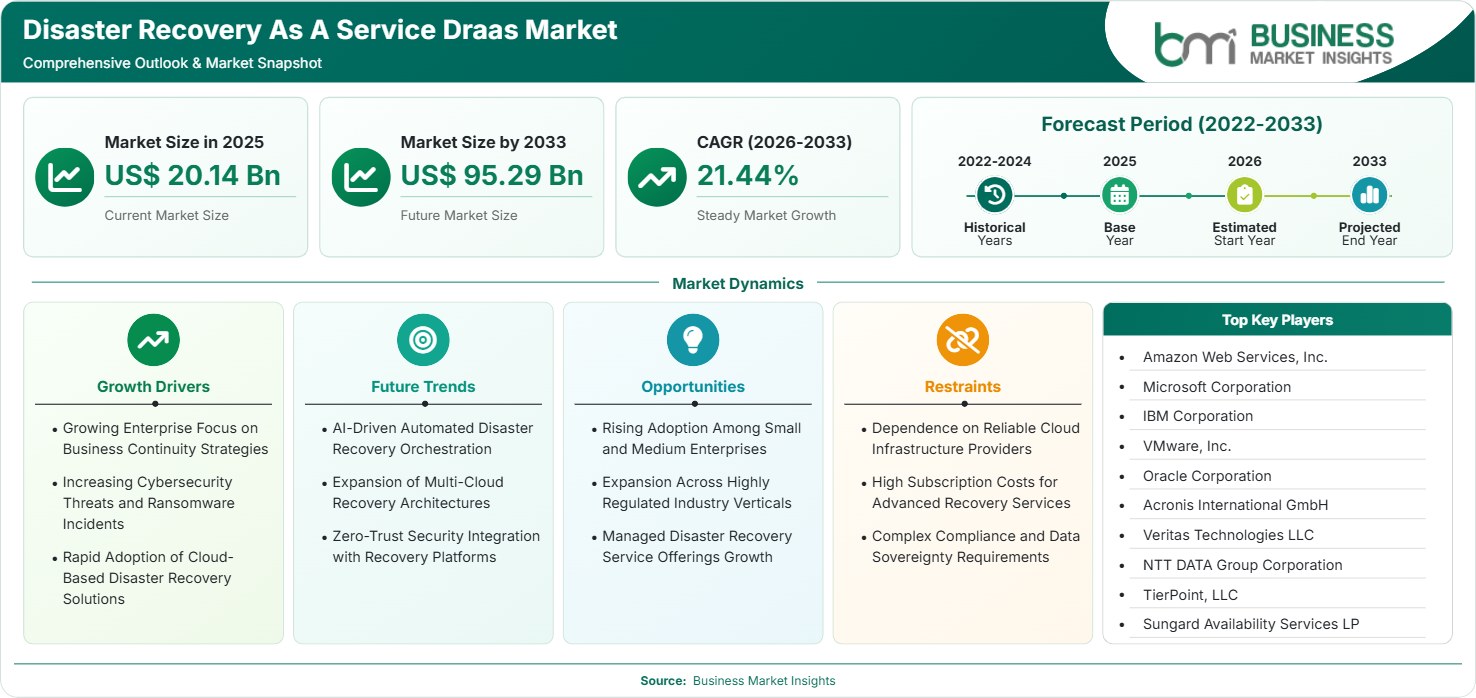
The Disaster Recovery as a Service (DRaaS) Market size was valued at US$ 20.14 Billion in 2025 and is projected to reach US$ 95.29 Billion by 2033, growing at a CAGR of 21.44% during 2026–2033. Rising enterprise focus on business continuity, increasing ransomware threats, cloud adoption, and demand for scalable recovery solutions are accelerating market expansion.

Report Coverage
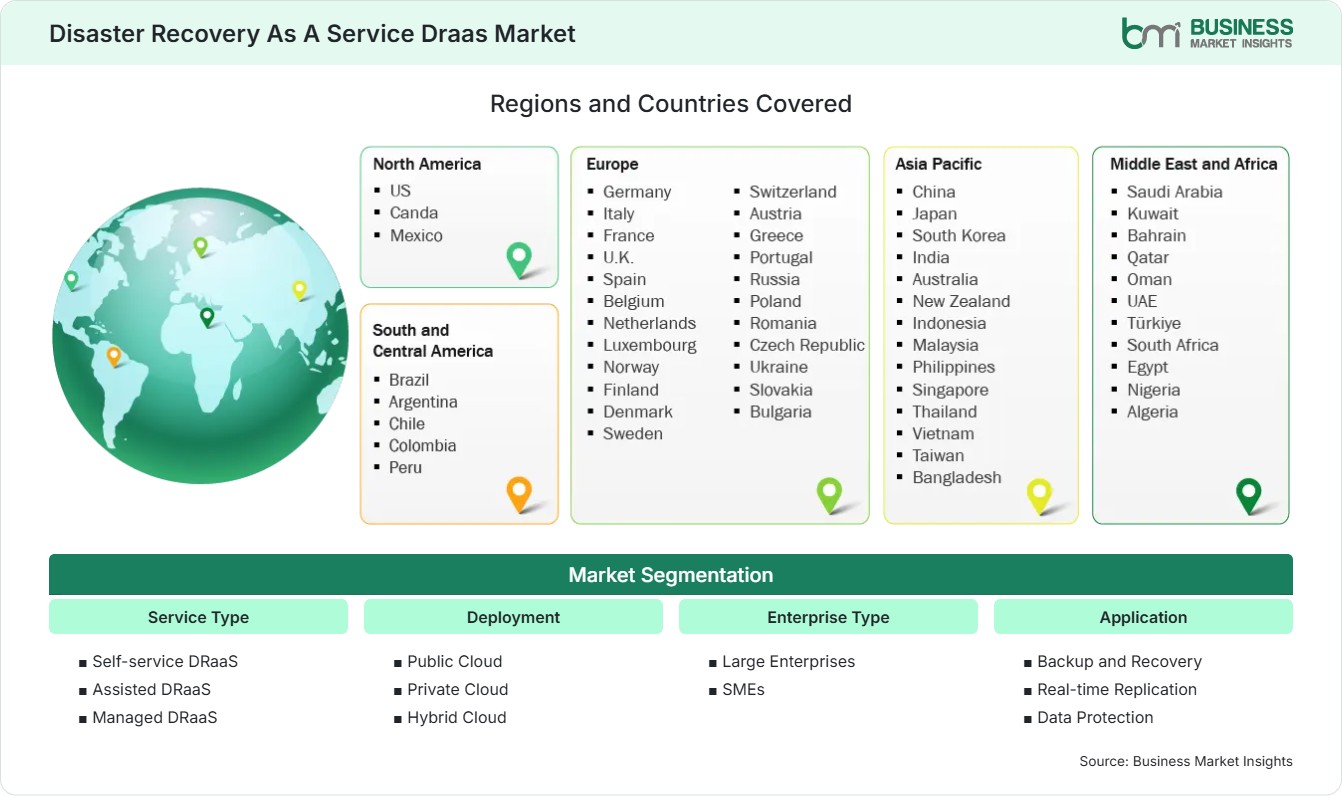
  • Service Type: Self-service DRaaS, Assisted DRaaS, Managed DRaaS
  • Deployment: Public Cloud, Private Cloud, Hybrid Cloud
  • Enterprise Type: Large Enterprises, SMEs
  • Application: Backup and Recovery, Real-time Replication, Data Protection
  • Industry: BFSI, IT & Telecommunication, Government & Public Sector, Retail & Consumer Goods, Healthcare, Media & Entertainment, Others
US$ 20.14 Bn Market size in 2025
US$ 95.29 Bn Market Size by 2033
21.44% CAGR, 2026 - 2033
2026-2033 Forecast Period

AI Overview

Disaster Recovery As A Service Draas Market Summary

  • North America Region: North America holds 39%–42% market share in 2025 and is projected to grow at a 20.5%–21.2% CAGR during 2026–2033. Strong cloud infrastructure, high cybersecurity investments, increasing ransomware concerns, and enterprise demand for resilient IT environments are supporting regional adoption. The U.S. dominates due to extensive cloud usage, large enterprise presence, and advanced cybersecurity spending, expanding at approximately 20.8%–21.5% CAGR.
  • Fastest Growing Region: Asia Pacific accounts for 26%–29% market share in 2025 and is expected to expand at a 22.8%–23.5% CAGR through 2033. Rapid digital transformation, cloud migration, expanding SME adoption, cybersecurity awareness, and increasing investments in business continuity infrastructure are driving regional growth.
  • Leading Segment: Managed DRaaS holds 45%–48% market share in 2025 and is expected to grow at a 21.8%–22.5% CAGR during 2026–2033. Enterprises prefer managed services due to reduced operational complexity, expert monitoring, faster recovery, and continuous infrastructure management.
  • High Growth Segment: Hybrid Cloud Deployment represents 34%–37% market share in 2025 and is projected to grow at a 23.0%–23.7% CAGR. Increasing preference for flexible IT architectures, workload optimization, security requirements, and regulatory compliance is accelerating adoption of hybrid disaster recovery models.
  • Key Market Opportunity: Growing adoption among SMEs, expansion of disaster recovery solutions across regulated industries, and increasing demand for managed recovery services are creating opportunities for providers offering automated, scalable, and AI-enabled resilience platforms.
  • Major Market Players: Amazon Web Services, Inc., Microsoft Corporation, IBM Corporation, VMware, Inc., Oracle Corporation, Acronis International GmbH, Veritas Technologies LLC, NTT DATA Group Corporation, TierPoint, LLC, Sungard Availability Services LP.
Strategic Insights

Disaster Recovery As A Service Draas Market: Strategic Insights

Disaster Recovery As A Service Draas Market Strategic Framework
FREE PDF
Request your free sample
Request free sample
Stakeholder View

Key Takeaways

  • The disaster recovery environment is shifting from traditional backup solutions to advanced, automatic, and cloud-powered systems that can help achieve real-time recovery, availability, and protection against cyber-attacks.
  • Managed DRaaS services offer significant opportunities for growth due to companies turning to third-party specialists to take care of their disaster recovery needs.
  • Artificial intelligence, automation, and machine learning are among the areas for innovation.
  • Asia Pacific offers strong investment potential due to rapid cloud adoption, expanding digital economies, increasing cybersecurity awareness, and growing demand among SMEs and regulated industries.
  • Strategic partnerships, cloud ecosystem expansion, and acquisitions are shaping competitive dynamics as technology providers strengthen disaster recovery capabilities and broaden service portfolios.
  • Industry-specific recovery solutions are gaining importance as organizations require customized disaster recovery frameworks aligned with compliance standards, operational requirements, and sector-specific risks.
Geographic Outlook

Disaster Recovery As A Service Draas Market Regional Highlights

North America Disaster Recovery as a Service (DRaaS) Market

North America accounts for 39%–42% of the Disaster Recovery as a Service (DRaaS) Market share in 2025 and is projected to grow at a 20.5%–21.2% CAGR during 2026–2033. The U.S. represents the largest contributor, supported by extensive adoption among BFSI, healthcare, technology, and government organizations. Enterprises are increasingly implementing automated recovery platforms to reduce downtime and strengthen cyber resilience.

  • Rising ransomware attacks and cybersecurity incidents are encouraging organizations across North America to invest in advanced disaster recovery platforms with automated backup, monitoring, and recovery capabilities.
  • Cloud service providers are expanding infrastructure availability, enabling enterprises to adopt scalable recovery solutions without maintaining expensive physical disaster recovery environments.
  • Regulated industries such as banking, healthcare, and government are increasing investments in recovery frameworks to meet compliance requirements and improve operational resilience.

US Disaster Recovery as a Service (DRaaS) Market

The United States Disaster Recovery as a Service (DRaaS) Market contributes approximately 82%–85% of North American demand and is expected to expand at a 20.8%–21.5% CAGR through 2033. The country maintains strong market leadership due to widespread cloud adoption, advanced cybersecurity infrastructure, high enterprise technology spending, and increasing demand for business continuity solutions.

  • Increasing ransomware incidents are driving enterprises to strengthen recovery capabilities through automated backup, real-time replication, and managed disaster recovery services.
  • Cloud-native businesses are adopting DRaaS solutions to maintain application availability, improve scalability, and reduce dependency on traditional recovery infrastructure.
  • Government agencies are investing in resilient digital infrastructure to protect critical systems and improve continuity of public services.

Europe Disaster Recovery as a Service (DRaaS) Market

Europe represents approximately 24%–27% market share in 2025 and Europe Disaster Recovery as a Service (DRaaS) Market forecast to grow at a 20.0%–20.8% CAGR during 2026–2033. Germany, the United Kingdom, and France remain key markets due to strong enterprise technology adoption, regulatory focus on cybersecurity, and increasing cloud migration. Data protection regulations and business continuity requirements are encouraging organizations to implement advanced recovery solutions.

  • European enterprises are adopting cloud-based recovery solutions to improve resilience while reducing operational costs associated with maintaining dedicated recovery infrastructure.
  • Increasing cybersecurity regulations are encouraging organizations to strengthen disaster recovery strategies and improve protection against data breaches and operational disruptions.
  • Manufacturing companies are implementing recovery solutions to protect connected production systems, supply chain applications, and industrial digital platforms.

Asia Pacific Disaster Recovery as a Service (DRaaS) Market

Asia Pacific Disaster Recovery as a Service (DRaaS) Market holds 26%–29% market share in 2025 and is expected to achieve the fastest growth at a 22.8%–23.5% CAGR during 2026–2033. The region benefits from rapid digital transformation, expanding cloud adoption, increasing cybersecurity awareness, and rising enterprise technology investments. China, India, Japan, and Southeast Asian economies are becoming major adoption centers as organizations modernize IT infrastructure.

  • China’s expanding digital economy and enterprise cloud adoption are increasing demand for automated recovery platforms across technology, financial, and industrial sectors.
  • India’s growing IT services industry and digital transformation initiatives are creating significant opportunities for cloud-based disaster recovery providers.
  • Japanese and South Korean enterprises are investing in advanced recovery technologies to protect critical digital infrastructure and improve operational continuity.
  • Southeast Asian businesses are adopting managed recovery services due to limited internal IT resources and increasing cybersecurity requirements.

Rest of World Disaster Recovery as a Service (DRaaS) Market

The Rest of World region accounts for approximately 8%–10% market share in 2025 and is forecast to grow at a 21.0%–21.8% CAGR through 2033. Latin America is experiencing increased adoption due to digital transformation, cloud migration, and growing cybersecurity awareness among enterprises. The Middle East and Africa region is expanding through government digitization initiatives, smart infrastructure investments, and increasing focus on protecting critical digital systems. Growing investments in financial technology, telecommunications, and public sector modernization are creating demand for scalable disaster recovery platforms.

  • Brazil and Mexico are emerging as important Latin American markets due to expanding enterprise cloud adoption and increasing cybersecurity investments.
  • Middle Eastern countries are implementing digital transformation programs that require reliable recovery solutions for critical infrastructure and government applications.
  • African enterprises are adopting cloud-based recovery services to improve resilience while avoiding high investments in physical recovery infrastructure.
  • Telecommunications providers across developing regions are investing in disaster recovery platforms to support increasing digital service dependencies.
Global Market Geography
FREE PDF
Request your free sample
Request free sample
Segment Analysis

Disaster Recovery As A Service Draas Market Segmentation

Service Type

The Service Type segment accounted for approximately 58%–61% Disaster Recovery as a Service (DRaaS) market share in 2025 and is projected to grow at a 21.8%–22.5% CAGR during 2026–2033. Enterprises are increasingly adopting disaster recovery service models based on operational requirements, internal expertise, and cybersecurity priorities. Managed services are gaining traction due to limited in-house recovery capabilities and increasing complexity of IT environments.

  • Self-service DRaaS: Self-service platforms enable organizations to independently configure, manage, and execute recovery processes, appealing to enterprises with skilled IT teams seeking greater control and operational flexibility.
  • Assisted DRaaS: Assisted DRaaS combines customer control with provider support, helping organizations optimize recovery strategies through expert guidance, configuration assistance, and technical support during implementation and operations.
  • Managed DRaaS: Managed DRaaS is witnessing strong adoption as providers handle monitoring, testing, recovery execution, and infrastructure management, reducing complexity for enterprises requiring comprehensive business continuity solutions.

Deployment

The Deployment segment represented approximately 63%–66% Disaster Recovery as a Service (DRaaS) market share in 2025 and is expected to expand at a 22.0%–22.7% CAGR through 2033. Enterprises are adopting flexible cloud deployment models to improve scalability, reduce infrastructure costs, and strengthen disaster recovery capabilities.

  • Public Cloud: Public cloud deployment is gaining adoption due to lower infrastructure costs, scalability, rapid provisioning, and accessibility for organizations seeking efficient disaster recovery capabilities.
  • Private Cloud: Private cloud solutions support enterprises requiring enhanced security, customization, compliance management, and dedicated recovery environments for sensitive workloads and regulated applications.
  • Hybrid Cloud: Hybrid cloud deployment is expanding rapidly as enterprises combine public cloud scalability with private infrastructure control to achieve flexible, secure, and optimized disaster recovery strategies.

Enterprise Type

The Enterprise Type segment accounted for approximately 66%–69% market share in 2025 and is projected to grow at a 21.2%–21.9% CAGR during 2026–2033. Large enterprises remain major adopters due to extensive IT infrastructure, complex application environments, and higher requirements for operational continuity.

  • Large Enterprises: Large enterprises adopt disaster recovery solutions to protect complex IT ecosystems, maintain application availability, comply with regulations, and minimize operational losses caused by disruptions.
  • SMEs: SMEs are increasingly adopting DRaaS through affordable subscription models that provide scalable recovery capabilities without requiring significant investments in dedicated disaster recovery infrastructure.

Application

The Application segment represented approximately 54%–57% market share in 2025 and is expected to grow at a 21.5%–22.2% CAGR during the forecast period. Increasing cyber threats, growing data volumes, and rising dependency on digital applications are driving adoption across multiple recovery use cases.

  • Backup and Recovery: Backup and recovery applications remain widely adopted as organizations prioritize data protection, faster restoration, and prevention of operational disruptions caused by system failures or cyber incidents.
  • Real-time Replication: Real-time replication solutions are gaining importance among enterprises requiring continuous availability, minimal downtime, and synchronized data environments for mission-critical applications.
  • Data Protection: Data protection applications are expanding due to increasing cybersecurity risks, regulatory requirements, and enterprise focus on safeguarding sensitive information across distributed environments.

Industry

The Industry segment accounted for approximately 57%–60% market share in 2025 and is projected to grow at a 21.6%–22.3% CAGR through 2033. Industries are adopting disaster recovery solutions to address increasing digital dependency, cybersecurity threats, compliance requirements, and operational continuity needs. BFSI, healthcare, government, and telecommunications sectors represent major adoption areas due to their reliance on uninterrupted digital services.

  • BFSI: Financial institutions adopt DRaaS solutions to ensure transaction continuity, protect customer information, manage cybersecurity risks, and comply with stringent operational resilience requirements.
  • IT & Telecommunication: Technology and telecom companies utilize disaster recovery services to maintain network availability, protect digital infrastructure, and support increasing dependence on cloud-based applications.
  • Government & Public Sector: Government organizations implement recovery platforms to protect critical infrastructure, maintain essential services, and strengthen resilience against cyber threats and system failures.
  • Retail & Consumer Goods: Retail companies adopt disaster recovery solutions to protect e-commerce platforms, customer data, payment systems, and supply chain applications.
  • Healthcare: Healthcare organizations use recovery services to safeguard patient information, improve system availability, and support compliance with healthcare data protection requirements.
  • Media & Entertainment: Media companies deploy disaster recovery solutions to protect digital content, streaming platforms, and high-volume data environments requiring continuous availability.
Market Forces

Disaster Recovery As A Service Draas Market Dynamics

Key Market Drivers

Growing Enterprise Focus on Business Continuity Strategies

Businesses are now placing more emphasis on business continuity planning due to their reliance on digital technology. Businesses in BFSI, health care, telecoms, and government are now spending money on disaster recovery services that will allow them to continue offering services even when cyber attacks and other disruptions take place. Higher costs of downtime have encouraged businesses to adopt automated recovery platforms that offer fast restoration of services and better resilience.

Increasing Cybersecurity Threats and Ransomware Incidents

With the growing number of ransomware attacks, data leaks, and cyber threats becoming increasingly complex, more businesses around the world are finding themselves in need of disaster recovery. Organizations understand the inadequacy of conventional backup methods in dealing with new-age cyber threats that need quick restoration, immutability of data, and constant monitoring abilities. Recovery vendors on the cloud are introducing more security features like threat detection, automatic failover, and encryption in their offerings. These advancements are supporting broader adoption among industries handling sensitive information and essential digital services.

Rapid Adoption of Cloud-Based Disaster Recovery Solutions

Cloud-based disaster recovery solutions are gaining traction as companies look for a more efficient way to recover from disasters compared to the conventional approach. Organizations are shifting their applications to cloud-based services hence the need for disaster recovery solutions that will work well with the existing cloud computing architecture. Cloud DRaaS solutions ensure easier implementation, automation, minimized infrastructure costs, and access regardless of geographical locations. The rising popularity of cloud computing is one of the main factors influencing Disaster Recovery as a Service (DRaaS) Market trends in the coming years.

Key Market Opportunities

Rising Adoption Among Small and Medium Enterprises

The small and medium enterprises presents an excellent business opportunity due to the growing digital dependency of these organizations on business applications, cloud services, and internet-based applications. Most SMEs do not have the capacity to support traditional DR facilities, and this creates an opportunity for managed and subscription-based recovery facilities. DRaaS vendors are offering simplified platforms that are cost-effective, manageable, and scalable to cater to SME needs. With the growing cybersecurity awareness among SMEs, adoption of cloud-based DR is poised to rise.

Expansion Across Highly Regulated Industry Verticals

Sectors that are highly regulated, like BFSI, healthcare, government, and telecom, have become a huge source of opportunity for providers of disaster recovery services. Sectors that operate in this environment need to be highly resilient and have tight security policies to ensure they comply with the regulations. Companies are spending more on recovery solutions tailored to their specific needs, which include secure management of data, restoration, and availability.

Managed Disaster Recovery Service Offerings Growth

There is a rising adoption of managed disaster recovery services, with more companies willing to leverage third-party expertise to meet their increasingly complex disaster recovery needs. There is an increase in companies opting to outsource their disaster recovery processes, such as testing, monitoring, management, and recovery, to providers with high levels of technological expertise. The adoption of managed services minimizes the burden on internal processes while ensuring greater reliability and faster recovery operations.

Market Restraints and Challenges

Dependence on Reliable Cloud Infrastructure Providers

Factor: The DRaaS solution architecture is dependent on cloud infrastructure providers for availability, network performance, access to data, and reliability in a distributed environment. Impact: The use of third-party cloud infrastructure can lead to problems related to potential outages, performance bottlenecks, vendor lock in, and lack of control in the recovery environment. The companies that need to be available 24/7 might have difficulties in case of any problems with cloud infrastructure.

High Subscription Costs for Advanced Recovery Services

Factor: DRaaS solutions with advanced features such as real-time replication, recovery automation, security management, and managed support demand huge ongoing expenditures. Impact: Higher costs of subscriptions may prevent their use by financially sensitive companies, especially SMEs, which have limited budgets for technological purchases. Enterprises may find it difficult to reconcile the need to invest in recovery with their current tasks regardless of the future benefits.

Company Analysis

Competitive Landscape

Competition in the industry is influenced by the presence of global cloud players, enterprise software vendors, cybersecurity professionals, and managed service providers with scalable disaster recovery solutions. Disaster Recovery as a Service (DRaaS) Market analysis shows that the top players have been concentrating on building cloud-based systems, automation, AI integration, cybersecurity skills, and managed recovery services to gain an edge in the market.

Company Name

Overview

Products and Services Relevant to this Market

Amazon Web Services, Inc.

Global cloud computing provider offering infrastructure, platform, and disaster recovery solutions for organizations of different sizes.

AWS Elastic Disaster Recovery, backup solutions, cloud infrastructure services, automated recovery workflows, and resilience management capabilities.

Microsoft Corporation

Global technology company providing cloud platforms, enterprise software, cybersecurity, and business continuity solutions.

Azure Site Recovery, Azure Backup, cloud disaster recovery services, hybrid recovery solutions, and enterprise resilience platforms.

IBM Corporation

Technology and consulting company delivering cloud, artificial intelligence, cybersecurity, and enterprise recovery solutions.

IBM Storage Protect, IBM Cloud disaster recovery services, automated backup solutions, hybrid cloud recovery, and business continuity services.

VMware, Inc.

Enterprise virtualization and cloud infrastructure provider specializing in workload management and recovery technologies.

VMware Cloud Disaster Recovery, Site Recovery Manager, cloud workload protection, replication technologies, and recovery automation solutions.

Oracle Corporation

Enterprise software and cloud technology provider offering database, infrastructure, and business continuity solutions.

Oracle Cloud Infrastructure disaster recovery, and enterprise workload protection platforms.

Acronis International GmbH

Cyber protection company providing integrated backup, recovery, and cybersecurity solutions for businesses.

Acronis Cyber Protect Cloud, backup and disaster recovery services, ransomware protection, and endpoint security solutions.

Veritas Technologies LLC

Data management company specializing in enterprise backup, recovery, and information governance solutions.

Veritas Alta Recovery Vault, NetBackup, data protection platforms, cloud recovery services, and enterprise resilience solutions.

NTT DATA Group Corporation

Global IT services provider delivering cloud, infrastructure, consulting, and managed technology solutions.

Managed disaster recovery services, cloud recovery platforms, IT infrastructure management, backup solutions, and enterprise continuity services.

TierPoint, LLC

Managed IT service provider offering cloud, colocation, cybersecurity, and disaster recovery solutions.

Disaster recovery as a service, managed backup, cloud recovery solutions, data center services, and business continuity consulting.

Sungard Availability Services LP

IT resilience provider specializing in disaster recovery, cloud recovery, and business continuity services.

Managed recovery services, cloud disaster recovery, IT resilience solutions, recovery planning, testing, and infrastructure support services.

Trust & Transparency

Research Methodology

The market analysis combines proprietary research with secondary data from government agencies, company disclosures, regulatory filings, industry databases and expert interviews. Market estimates are validated through data triangulation, cross-market benchmarking and analyst review.

View Full Research Methodology

Questions Answered

Frequently Asked Questions

What factors should enterprises consider when selecting a DRaaS provider?

Enterprises should evaluate recovery time objectives, security capabilities, compliance support, cloud compatibility, service reliability, scalability, and total ownership costs before selecting providers.

How does artificial intelligence improve disaster recovery solutions?

AI enhances disaster recovery through predictive monitoring, automated threat detection, intelligent resource allocation, faster incident response, and improved recovery decision-making capabilities.

Which industries are major adopters of Disaster Recovery as a Service (DRaaS) Market report?

BFSI, healthcare, government, telecommunications, retail, and media industries are adopting DRaaS due to high data dependency, regulatory requirements, and the need for uninterrupted operations.

Why are enterprises shifting from traditional disaster recovery to DRaaS platforms?

DRaaS platforms provide faster deployment, reduced infrastructure costs, automated recovery, expert management, and improved scalability compared with traditional internally managed recovery environments.

What is driving the adoption of Disaster Recovery as a Service (DRaaS) solutions?

Rising cyber threats, increasing cloud adoption, digital transformation, regulatory requirements, and enterprise focus on business continuity are accelerating demand for scalable disaster recovery services.

Access the Full Disaster Recovery As A Service Draas Market Report

Get segment-level forecasts, regional estimates, competitive benchmarking, company profiles and downloadable Excel datasets.

Access the full Disaster Recovery As A Service Draas Market Report
350 pages PDF & Excel | 2026-08-25
Similar Research

Related Market Reports