
Robotic Sensors Market Outlook: Size, Share, Trends, Growth Analysis, Competitive Landscape & Forecast, 2026-2033

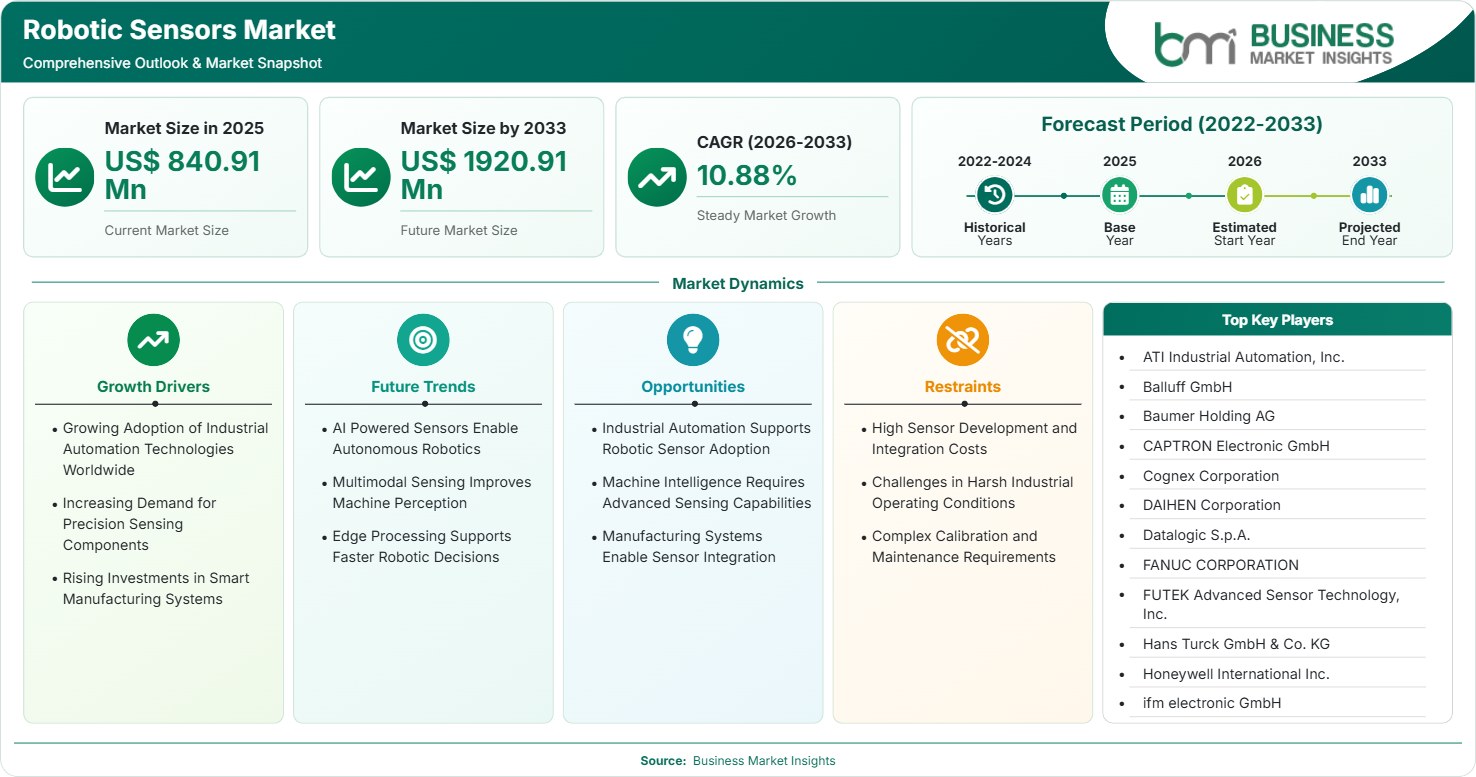
The Robotic Sensors Market size was valued at US$ 840.91 Million in 2025 and is projected to reach US$ 1920.91 Million by 2033, growing at a CAGR of 10.88% during 2026–2033, driven by automation, machine vision, safety requirements, logistics digitization, and expanding opportunities across collaborative robots, autonomous systems, precision manufacturing, healthcare, and intelligent inspection.

Report Coverage
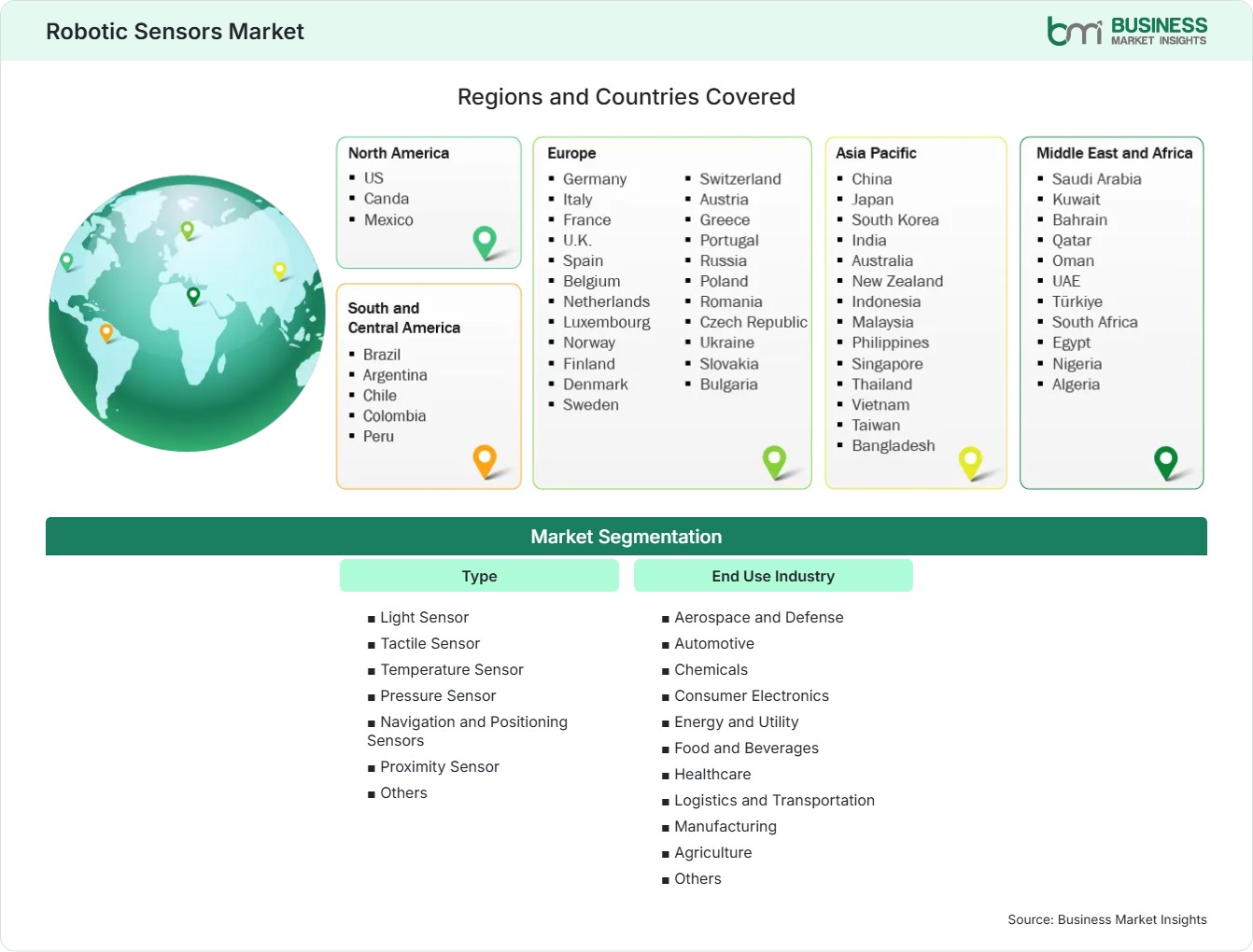
  • Type: Light Sensor, Tactile Sensor, Temperature Sensor, Pressure Sensor, Navigation and Positioning Sensors, Proximity Sensor, Others
  • End Use Industry: Aerospace and Defense, Automotive, Chemicals, Consumer Electronics, Energy and Utility, Food and Beverages, Healthcare, Logistics and Transportation, Manufacturing, Agriculture, Others
US$ 840.91 Mn Market size in 2025
US$ 1920.91 Mn Market Size by 2033
10.88% CAGR, 2026 - 2033
2026-2033 Forecast Period

AI Overview

Robotic Sensors Market Summary

  • North America Region: North America holds a 26%–29% market share in 2025 and is growing at a CAGR of 9.8%–10.4%, supported by warehouse automation, advanced manufacturing, surgical robotics, AI vision adoption, and opportunities in reshoring-driven smart factories. The United States dominates regional demand, expanding at a 10.0%–10.6% CAGR through automation investment and increasing deployment of intelligent industrial systems.
  • Fastest Growing Region: Asia Pacific holds a 45%–49% market share in 2025 and is growing at a CAGR of 11.8%–12.6%, propelled by Chinese automation investment, Japanese robotics leadership, Indian manufacturing expansion, electronics production, and opportunities in autonomous logistics and collaborative systems.
  • Leading Segment: Navigation and Positioning Sensors hold a 22%–25% market share in 2025 and grow at a CAGR of 11.2%–11.9%, supported by mobile robotics, autonomous material handling, localization accuracy requirements, and rising demand for flexible factory navigation systems.
  • High Growth Segment: Tactile Sensor applications hold a 9%–12% market share in 2025 and advance at a CAGR of 13.0%–14.0%, benefiting from collaborative robotics, dexterous manipulation, advanced grippers, healthcare automation, and emerging humanoid robot development worldwide.
  • Key Market Opportunity: Combining multimodal sensing, edge AI, and software-defined perception can create higher-value platforms for autonomous robots, enabling vendors to monetize data, predictive maintenance, adaptive control, and application-specific performance improvements.
  • Major Market Players: ATI Industrial Automation, Inc., Balluff GmbH, Baumer Holding AG, CAPTRON Electronic GmbH, Cognex Corporation, DAIHEN Corporation, Datalogic S.p.A., FANUC CORPORATION, FUTEK Advanced Sensor Technology, Inc., Hans Turck GmbH & Co. KG, Honeywell International Inc., ifm electronic GmbH, Infineon Technologies AG, and KEYENCE CORPORATION.
Strategic Insights

Robotic Sensors Market: Strategic Insights

Robotic Sensors Market Strategic Framework
FREE PDF
Request your free sample
Request free sample
Stakeholder View

Key Takeaways

  • The value chain is shifting toward closer collaboration among sensor manufacturers, robot OEMs, software developers, semiconductor suppliers, and system integrators. Suppliers able to provide validated hardware, embedded software, and application support can capture greater lifecycle value than component-only vendors.
  • The strongest commercial upside lies where sensing directly improves robot autonomy or throughput. Mobile robots, precision inspection, autonomous logistics, collaborative workcells, and complex manipulation require richer feedback than conventional fixed automation, supporting demand for differentiated sensing platforms.
  • Innovation is increasingly focused on sensor fusion, edge processing, compact form factors, self-calibration, and machine-learning-based perception. Product development is therefore moving beyond accuracy specifications toward contextual awareness, predictive diagnostics, and adaptive decision-making.
  • Asia Pacific offers the broadest investment case because robot deployment density is expanding across China, Japan, South Korea, India, and Southeast Asian production networks. Electronics, automotive manufacturing, logistics, and local automation ecosystems create multiple demand channels.
  • Strategic investment activity is likely to favor acquisitions and partnerships that add machine vision, force sensing, AI software, semiconductor expertise, or safety capabilities. Larger automation companies can accelerate portfolio integration by acquiring specialized perception technologies.
  • Buyers increasingly evaluate total integration cost rather than sensor purchase price alone. Open interfaces, rapid commissioning, software compatibility, cybersecurity, and service availability are becoming decisive factors in vendor selection.
Geographic Outlook

Robotic Sensors Market Regional Highlights

North America Robotic Sensors Market

North America accounts for a 26%–29% share in 2025 and is projected to record a 9.8%–10.4% CAGR during 2026–2033. Demand is concentrated in advanced manufacturing, logistics automation, automotive production, healthcare, aerospace, and defense. The Robotic Sensors Market share will be backed up by a mature system integrator eco-system, as well as investments in AI-enabled automation. The US continues to be the region’s anchor, whereas Canada and Mexico provide additional avenues in automotive value chains, warehousing, and manufacturing due to nearshoring.

  • Autonomous mobile robots that need navigation, sensing, and positioning technology are being used in warehouses. The segment of transportation and logistics accounted for over 50% of all professional service robot sales in 2024.
  • Reshoring and advanced manufacturing initiatives are increasing requirements for machine vision and precision inspection. Sensors capable of reducing commissioning time and supporting flexible production lines provide a compelling advantage for North American manufacturers.
  • Aerospace, defense, and medical applications prioritize reliability, traceability, and functional safety. These requirements favor suppliers with specialized calibration capabilities, robust certification processes, and products designed to operate under demanding environmental conditions.
  • The regional growth outlook benefits from a large installed automation base. U.S. factories operated 393,700 industrial robots in 2024, creating continuing opportunities for sensor upgrades, retrofits, replacement demand, and smarter peripheral systems.

US Robotic Sensors Market

The United States represents approximately 66%–70% of North American Robotic Sensors Market demand and is expected to expand at a 10.0%–10.6% CAGR during 2026–2033. Demand integrates industrial automation together with warehouse robotics, machine vision, semiconductor manufacturing, healthcare, and defense sectors. Industrial robot installations per year grew to 34,200 units in 2024, while the inventory was 393,700 units. The installed base provides an opportunity for high-performance replacements of sensors, perception, diagnostics, and automated processes through AI technology.

  • Manufacturing investment increasingly targets flexible automation, where sensors help robots accommodate product variation rather than perform only repetitive, fixed-path operations.
  • Logistics networks require robust localization and proximity sensing to improve fleet coordination. Faster order fulfillment and labor constraints strengthen investment cases for autonomous material-handling equipment.
  • Semiconductor and electronics manufacturing support demand for precise position, pressure, temperature, and optical measurement. High-value production environments reward low failure rates and repeatable sensor performance.
  • Healthcare automation provides a specialized expansion path as robotic systems require force feedback, precise positioning, and safety-oriented sensing for controlled interaction with equipment, clinicians, and patients.

Europe Robotic Sensors Market

Europe holds a 19%–22% share in 2025 and is forecast to grow at an 8.9%–9.7% CAGR during 2026–2033. Germany remains the leading market, supported by automotive, machinery, and industrial automation capabilities, while Italy provides strong opportunities in flexible manufacturing. The Robotic Sensors Market benefits due to nearshoring, energy efficiency, and safety considerations. The number of robots in Germany was 26,982 units in 2024, and that of Europe was 85,000 units, showing an established base of automation.

  • Germany leads regional industrial demand, while its 32% share of European robot installations in 2024 highlights the scale of its manufacturing ecosystem and continuing need for advanced vision, position, and force-feedback technologies.
  • Italy remains a high-value automation market because machinery manufacturers and automotive suppliers increasingly adopt flexible cells. Sensor demand benefits from requirements for rapid changeovers, inspection, and precise component handling.
  • France offers growth through aerospace, food processing, logistics, and advanced manufacturing investment, although adoption cycles remain influenced by broader industrial capital expenditure and public incentives.
  • European machine-safety standards encourage investments in dependable proximity, position, and presence-detection technologies. Suppliers combining functional safety with digital diagnostics can improve their competitive position across industrial installations.

Asia Pacific Robotic Sensors Market

Asia Pacific holds the largest 45%–49% share in 2025 and is anticipated to grow at an 11.8%–12.6% CAGR through 2033. China leads volume demand, while Japan, South Korea, and India provide distinct opportunities across electronics, automotive, logistics, and industrial automation. The Robotic Sensors Market growth will be stimulated through economies of scale in manufacturing and increased local technological capabilities. The share of Asia in the installations of robots in the industrial segment was 74% in 2024.

  • China represented 54% of global industrial robot deployments in 2024, with 295,000 installations. Its expanding domestic robot ecosystem increases demand for competitively priced optical, tactile, force, position, and proximity sensing technologies.
  • Japan combines a large installed robot base with leadership in industrial equipment and precision components. Demand increasingly favors compact, high-accuracy sensors supporting electronics production, collaborative systems, and sophisticated automation exports.
  • South Korea's electronics and automotive industries support high-value adoption of machine vision and precision sensing. Advanced semiconductor manufacturing also requires stringent measurement capabilities and stable operation in tightly controlled environments.
  • India installed a record 9,120 industrial robots in 2024, up 7%, with automotive automation remaining the principal driver. Expanding electronics and logistics investment should widen sensor demand beyond traditional automotive applications.
  • Southeast Asia offers an emerging opportunity as multinational manufacturers diversify production. New factories can adopt connected sensing architectures from inception rather than retrofitting legacy automation, improving prospects for integrated suppliers.

Rest of World Robotic Sensors Market

The demand from South and Central America constitutes a relatively low but steadily growing base, with countries like Brazil and Mexico benefiting from the presence of the automotive industry, food processing facilities, warehousing operations, and industrial automation. As for the Rest of World segment in total, the compound annual growth rate (CAGR) during the period of 2026 to 2033 is expected to be 8.5% to 9.3%.

The Middle East and Africa market development for robots starts at a lower level due to logistical applications, energy applications, infrastructure applications, agriculture, and select manufacturing applications. Investment opportunities exist through diversification of industries in Gulf countries and through established automotive and mining automation in South Africa. Adoption will depend largely on access to funding, integration skills, and technical services.

  • Mexico remains a significant regional manufacturing opportunity because automotive applications accounted for 63% of its industrial robot installations in 2024, creating demand for machine vision, position sensing, and force-control applications.
  • Brazil's diversified industrial base supports opportunities in automotive, consumer goods, agriculture, and food processing, particularly where automation improves consistency and addresses skilled-labor constraints.
  • Gulf Cooperation Council countries increasingly invest in logistics hubs and industrial diversification. Autonomous warehouse equipment and smart manufacturing projects can create demand for navigation, proximity, and environmental sensing.
  • African adoption remains selective but opportunities are emerging in mining, agriculture, healthcare, and logistics. Rugged sensors capable of operating reliably under dust, vibration, temperature, and connectivity constraints can address localized requirements.
Global Market Geography
FREE PDF
Request your free sample
Request free sample
Segment Analysis

Robotic Sensors Market Segmentation

Type

Type-based demand is led by Navigation and Positioning Sensors, holding a 22%–25% share in 2025 and expanding at an 11.2%–11.9% CAGR during 2026–2033. Adoption reflects rising autonomous mobility and flexible automation. The Robotic Sensors Market scope is broadening as robots require simultaneous environmental awareness, accurate localization, motion feedback, and adaptive control across increasingly dynamic workplaces and applications.

  • Light Sensor: Optical sensing supports object detection, line following, presence recognition, and visual inspection, with adoption strengthened by compact machine designs, faster processing, and expanding quality-control requirements.
  • Tactile Sensor: Tactile technologies enable robots to detect contact and grip conditions, supporting delicate manipulation, collaborative tasks, advanced grippers, medical devices, and emerging humanoid applications requiring richer physical feedback.
  • Temperature Sensor: Temperature measurement protects motors, batteries, electronics, and processes from overheating while supporting predictive maintenance, thermal management, welding, food handling, and reliability in demanding robotic environments.
  • Pressure Sensor: Pressure sensors provide controlled pneumatic, hydraulic, and fluidic feedback, supporting grippers, process automation, medical equipment, and force-sensitive operations where stable control improves repeatability and safety.
  • Navigation and Positioning Sensors: These sensors enable localization, route planning, motion control, and obstacle-aware movement, making them essential for autonomous mobile robots, warehouse systems, field robots, and flexible production environments.
  • Proximity Sensor: Proximity technologies support collision avoidance, presence detection, workpiece identification, and safety functions, with growing relevance as collaborative robots operate closer to workers and in less structured spaces.

End Use Industry

Manufacturing represents the leading end-use industry, accounting for a 28%–32% share in 2025 and advancing at a 10.5%–11.3% CAGR during 2026–2033. Demand is driven by inspection, assembly, material handling, welding, and predictive maintenance. Robotic Sensors Market trends increasingly favor flexible cells capable of responding to changing product designs, shorter production runs, stricter quality requirements, and rising labor costs.

  • Aerospace and Defense: High-precision assembly, inspection, autonomous systems, and hazardous operations require reliable sensing, robust environmental performance, accurate positioning, and comprehensive traceability throughout complex production workflows.
  • Automotive: Sensors support welding, painting, assembly, inspection, battery production, and autonomous material handling, while electric vehicle manufacturing creates additional demand for precision automation and quality assurance.
  • Chemicals: Robotics applications benefit from sensors that monitor position, temperature, pressure, and environmental conditions, helping automate hazardous tasks and maintain repeatable handling under demanding safety requirements.
  • Consumer Electronics: Miniaturized products require high-speed vision, precision positioning, tactile feedback, and defect detection, supporting automation where manual assembly struggles to maintain consistency at elevated production volumes.
  • Energy and Utility: Inspection robots, autonomous maintenance platforms, and remote monitoring systems require navigation and environmental sensing to improve worker safety and support operations across dispersed infrastructure assets.
  • Food and Beverages: Hygienic automation increasingly uses vision, proximity, temperature, and position sensors for sorting, packaging, palletizing, and quality inspection while supporting productivity amid labor availability constraints.
  • Healthcare: Surgical, laboratory, rehabilitation, and hospital logistics robots require highly accurate force, position, and vision feedback, supporting controlled movement, delicate interaction, and increasingly sophisticated automated workflows.
  • Logistics and Transportation: Autonomous mobile robots depend on navigation, positioning, vision, and proximity sensing to coordinate movement, avoid obstacles, identify goods, and improve throughput across dynamic fulfillment environments.
  • Manufacturing: Factory automation remains the largest application base because sensors improve robot precision, flexibility, quality inspection, equipment diagnostics, and integration across assembly, machining, welding, packaging, and material handling.
  • Agriculture: Autonomous machines use vision, navigation, proximity, and environmental sensing for precision spraying, harvesting, crop monitoring, and material handling, particularly where seasonal labor shortages constrain productivity.
Market Forces

Robotic Sensors Market Dynamics

Key Market Drivers

Industrial Automation Expands Demand for Intelligent Perception

This factor has been driving automation in industries within the manufacturing and logistics sectors. This has led to an increasing demand for sensors that allow robots to perceive changes in the environment, as opposed to just following predefined instructions. According to IFR, 542,000 installations of industrial robots have been made around the world in 2024, where more than 500,000 industrial robots have been installed every year for four years running, amounting to 4.664 million operational units. Robotic Sensors Market growth is therefore increasingly tied to system intelligence and integration. As factories seek higher utilization, sensors that improve uptime, inspection accuracy, and adaptive control become central to automation economics.

Autonomous Logistics Raises Navigation and Safety Requirements

The reason is the quick deployment of professional service and logistics robots. The effect is a higher need for navigation, position, proximity, and vision systems that can safely work alongside people and dynamically changing obstacles. According to IFR, sales of professional service robots in 2024 amounted to almost 200,000 units, whereas transport and logistics were 102,900 units, up by 14 percent.  Robotic Sensors Market trends therefore encourage multimodal sensing and sensor fusion. Modern warehouses demand continuous positioning, fleet management, detection of objects, and obstacle avoidance. The increased need for throughput efficiency further drives the adoption of sensors with low latency and high reliability, pushing vendors to offer integrated perception systems with reduced software complexity and faster customer integration time.

Collaborative and Advanced Robots Require Richer Feedback

The driver is the move towards robots that operate closer to humans and handle more unpredictable objects. The consequence is the higher use of tactile sensing, force sensing, proximity sensing, and vision technology. Industrial automation can operate in a controllable environment, but collaboration needs to be aware of constant contact and surroundings. This expands the demand for sensing hardware in the Robotic Sensors Market, with improved accuracy and functional safety. Increasing emphasis on humanoid robots makes the study of touch and multimodality even more relevant. Vendors able to integrate compact design and intelligent capabilities will be able to solve problems related to precise assembly, food manipulation, medicine, and laboratory automation.

Key Market Opportunities

Edge AI and Multimodal Sensor Fusion Create Premium Platforms

There is a chance to use edge AI technology to make each sensor more valuable: a platform for perception. Robotic Sensors Market Forecasts for increasing use of systems combining vision, force, motion, and environmental feedback sensors in real time have been made, decreasing latency and reliance on the cloud. The opportunity exists wherever there are robots that are functioning in an environment that requires decision-making in real time. Suppliers could generate software and analytics subscription revenue by providing calibration services, monitoring, anomaly detection, and application libraries. Advancements in semiconductor technology can enable small and power-efficient edge computing. Investors could prefer businesses having proprietary sensing technology and software able to process data into robot actions.

Healthcare Robotics Offers High-Value Specialized Demand

There is tremendous potential within healthcare due to the unique sensing performance required by robotic systems and the high value of technology compared to many generic automation use cases. Robotic surgery, rehab, lab automation, and hospital logistics all use different permutations of force, vision, positioning, and safety feedback. As stated by IFR, Medical robot sales exceeded 16,700 units in 2024, up by 91% on sales in 2023, and therefore show a lot of progress within the professional service robotics ecosystem. Certification, precise calibration, biocompatibility where applicable, and long product lifetimes could be key differentiation factors.

Emerging Asian Manufacturing Hubs Expand the Addressable Base

Investment opportunities are broadening beyond established robot markets as India and Southeast Asian economies increase automation intensity. Robotic Sensors Market Forecasts would be aided by the creation of new greenfield sites with connected sensing systems built in at the time of equipment installation. There were 9,120 industrial robots installed in India in 2024, up 7% year-on-year, with automotive demand driving the growth. Examples of application areas include electronics, batteries, logistics, and consumer goods manufacturing. The investment strategy needs to favor a scalable portfolio of products for both high-end and more budget-conscious applications backed by local engineering and distribution capabilities.

Market Restraints and Challenges

High Integration Complexity Can Delay Commercial Deployment

Factor: advanced robots often require sensors, controllers, software, and communication interfaces from multiple suppliers.

Impact: The integration complexity leads to increased time and costs for engineering and validation as well as higher risks of performance incompatibilities, thus slowing down procurement processes. In contrast to commodity components with standardized interfaces, robotic perception often involves application-dependent calibration and programming of software. Small companies may not have the in-house capability of integrating multimodal systems, thus preventing use of the technology even though it would be economical to automate. The proprietary interfaces might add up to the problem of vendor lock-in. Thus, suppliers are forced to offer their technologies with open interfaces, development kits, simulators, and better engineering support.

Price Pressure and Supply-Chain Exposure Challenge Sensor Suppliers

Factor: intense competition, semiconductor dependence, and customer pressure to reduce automation capital expenditure.

Impact: The margin squeeze could hinder research and development, calibration equipment, and other support services, particularly in small sensor firms. There would be need for highly integrated chips, optical systems, and precision engineering in order to manufacture such products, leading to supply risk for suppliers due to the volatile purchasing process. In addition, customers may compare the sensor’s price with that of the robot cell itself, preferring integrated packages from large automation vendors. This is particularly the case in volume markets in Asia where there is growing competition from local rivals.

Company Analysis

Competitive Landscape

Robotic Sensors Market analysis indicates a competitive environment shaped by machine vision, force measurement, industrial sensing, semiconductor innovation, and vertically integrated automation portfolios. Differentiation depends increasingly on integration capability, application expertise, software support, and sensor intelligence.

Company Name

Overview

Products and Services relevant to this market

ATI Industrial Automation, Inc.

U.S.-based specialist focused on advanced robotic tooling and force measurement technologies used in demanding automation applications requiring precise interaction and control.

Force-torque sensors, robotic tool changers, compliance devices, and automation integration components supporting assembly, material handling, testing, finishing, and other precision robotic operations.

Balluff GmbH

German industrial automation company supplying sensor technologies and connectivity solutions across factory automation and intelligent manufacturing environments.

Position, proximity, identification, optical, and condition-monitoring sensors, plus networking and industrial connectivity solutions supporting automated machinery and robotic workcells.

Baumer Holding AG

Swiss sensor and automation technology group serving industrial customers with measurement, imaging, and motion-related products.

Vision sensors, encoders, distance sensors, process sensors, and industrial cameras supporting positioning, inspection, object detection, and feedback control in robotic systems.

CAPTRON Electronic GmbH

German technology company specializing in industrial sensor and control technologies for automation, mobility, and demanding operating environments.

Capacitive sensors, safety and position solutions, touch controls, and sensor technologies supporting automated equipment, detection tasks, and specialized industrial applications.

Cognex Corporation

U.S. machine vision specialist with a strong presence in industrial automation, logistics, identification, and automated inspection applications.

Machine vision systems, smart cameras, vision sensors, barcode readers, and deep-learning-based inspection solutions for robotic guidance, quality control, and logistics automation.

DAIHEN Corporation

Japanese automation and robotics company with capabilities spanning welding, power electronics, industrial systems, and robotic automation.

Industrial robots, welding automation, control technologies, and related sensing capabilities supporting automated production, material handling, joining, and precision manufacturing applications.

Datalogic S.p.A.

Italian technology company focused on automatic data capture, industrial automation, machine vision, and sensing solutions.

Smart sensors, vision systems, barcode readers, laser marking technologies, and safety products supporting robot guidance, identification, inspection, and automated logistics.

FANUC CORPORATION

Japanese global automation leader providing CNC systems, industrial robots, and factory automation technologies across multiple manufacturing industries.

Industrial and collaborative robots, vision systems, force-sensing capabilities, controllers, and integrated automation platforms for handling, assembly, inspection, and machine tending.

FUTEK Advanced Sensor Technology, Inc.

U.S. manufacturer specializing in precision load cells and force-measurement technologies used in industrial, medical, aerospace, and robotic applications.

Load cells, force sensors, torque sensors, amplifiers, and instrumentation enabling force feedback, testing, gripping, assembly, and precision robotic process control.

Hans Turck GmbH & Co. KG

German automation technology supplier known for rugged industrial sensing, connectivity, identification, and distributed control solutions.

Proximity, position, RFID, process, ultrasonic, and condition-monitoring sensors, alongside industrial networking products supporting robotic cells and automated production systems.

Honeywell International Inc.

Diversified U.S. technology company serving automation, aerospace, logistics, safety, and industrial markets through sensors and intelligent operational technologies.

Position, pressure, temperature, magnetic, and force-related sensing technologies, plus automation software supporting mobile robotics, industrial control, safety, and connected operations.

ifm electronic GmbH

German industrial automation company specializing in sensor technologies, machine vision, connectivity, and condition-monitoring systems for digital factories.

Position, process, vibration, vision, safety, and identification sensors with IO-Link and networking technologies supporting robotic automation and predictive maintenance.

Infineon Technologies AG

German semiconductor manufacturer supplying power, sensing, microcontroller, connectivity, and security technologies for intelligent electronic systems.

Magnetic and pressure sensors, microcontrollers, power semiconductors, radar technologies, and edge-control components enabling compact, energy-efficient robotic sensing and motion systems.

KEYENCE CORPORATION

Japanese automation technology leader specializing in factory automation sensors, measurement systems, machine vision, and high-speed inspection technologies.

Vision systems, laser displacement sensors, photoelectric sensors, measurement systems, code readers, and proximity technologies supporting robotic guidance, inspection, positioning, and quality assurance.

Trust & Transparency

Research Methodology

The market analysis combines proprietary research with secondary data from government agencies, company disclosures, regulatory filings, industry databases and expert interviews. Market estimates are validated through data triangulation, cross-market benchmarking and analyst review.

View Full Research Methodology

Questions Answered

Frequently Asked Questions

What should investors evaluate when assessing sensor companies?

Investors should examine technology differentiation, application diversity, software capability, integration support, semiconductor exposure, customer concentration, intellectual property, and recurring revenue opportunities. Companies combining proprietary hardware with AI, analytics, and application software may achieve stronger margins and customer retention.

How does machine vision influence robotic sensor demand?

Machine vision allows robots to identify objects, inspect products, guide movement, and respond to variation. AI-based image processing further improves recognition in less structured environments, increasing the value of cameras, vision sensors, illumination, edge processors, and integrated perception software.

Why is Asia Pacific important for suppliers?

Asia Pacific combines the largest manufacturing base with the strongest industrial robot deployment volume. The Robotic Sensors Market Report identifies China, Japan, South Korea, India, and Southeast Asia as important markets because automation investment spans electronics, automotive, logistics, consumer goods, and emerging advanced manufacturing.

Which sensor category offers the strongest growth potential?

Tactile sensing offers particularly strong long-term potential because advanced manipulation, collaborative robots, healthcare systems, and humanoid platforms require richer physical feedback. Navigation and positioning also remain strategically important as autonomous mobile robots expand across warehouses, factories, and service environments.

What factors are accelerating the adoption of the Robotic Sensors Market?

Automation investment, labor shortages, stricter quality requirements, autonomous logistics, and collaborative robotics are major adoption factors. Sensors are increasingly required to provide perception and adaptive feedback rather than simple binary detection, raising demand for vision, tactile, force, navigation, and integrated sensing technologies.

Access the Full Robotic Sensors Market Report

Get segment-level forecasts, regional estimates, competitive benchmarking, company profiles and downloadable Excel datasets.

Access the full Robotic Sensors Market Report
350 pages PDF & Excel | 2026-09-16
Similar Research

Related Market Reports