
Robotic NDT Systems Market Outlook: Size, Share, Trends, Growth Analysis, Competitive Landscape & Forecast, 2026-2033

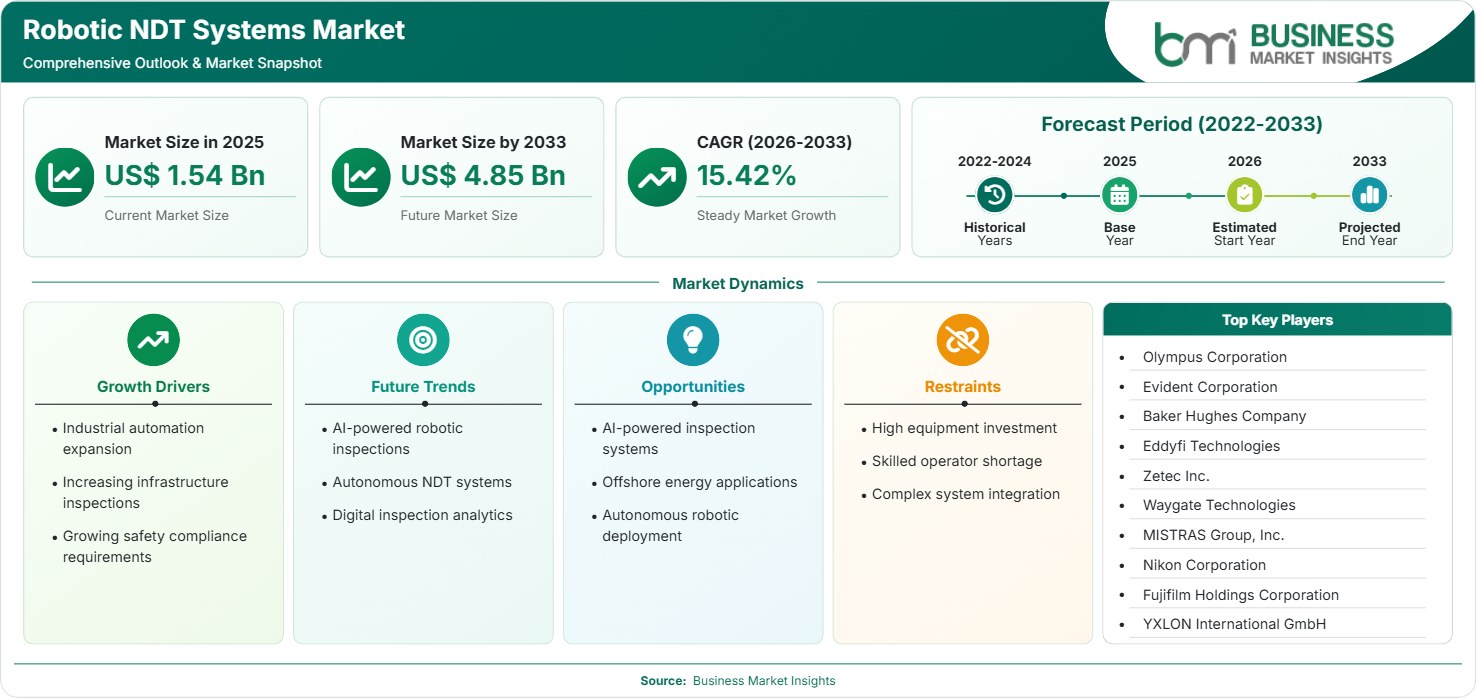
The Robotic NDT Systems Market size was valued at US$ 1.54 billion in 2025 and is projected to reach US$ 4.85 billion by 2033, growing at a CAGR of 15.42% during 2026–2033. Growth is driven by industrial automation expansion, increasing infrastructure inspections, and growing safety compliance requirements, while opportunities are emerging through AI-powered inspection systems, offshore energy applications, and autonomous robotic deployment.

Report Coverage
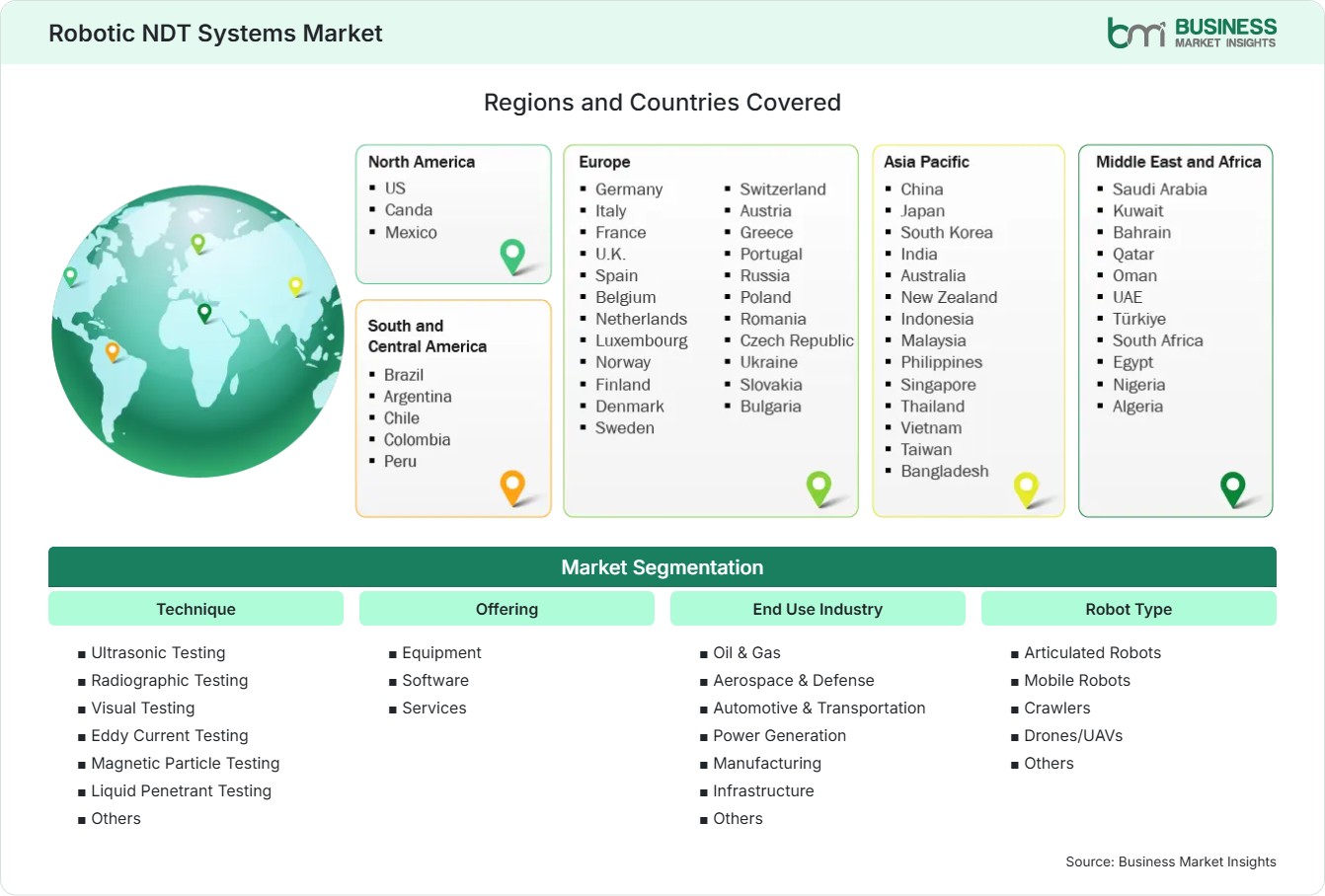
  • Technique: Ultrasonic Testing, Radiographic Testing, Visual Testing, Eddy Current Testing, Magnetic Particle Testing, Liquid Penetrant Testing, Others
  • Offering: Equipment, Software, Services
  • End Use Industry: Oil & Gas, Aerospace & Defense, Automotive & Transportation, Power Generation, Manufacturing, Infrastructure, Others
  • Robot Type: Articulated Robots, Mobile Robots, Crawlers, Drones/UAVs, Others
US$ 1.54 Bn Market size in 2025
US$ 4.85 Bn Market Size by 2033
15.42% CAGR, 2026 - 2033
2026-2033 Forecast Period

01 AI Overview

Robotic NDT Systems Market Summary

  • North America Region: North America accounts for approximately 34%–38% market share in 2025 and is projected to grow at a 14.5%–15.5% CAGR during 2026–2033. The region benefits from advanced industrial automation adoption, aging infrastructure inspection needs, aerospace maintenance activities, and stringent safety standards. The U.S. market is supported by energy and industrial inspection demand and is estimated to grow at approximately 14.8%–15.8% CAGR.
  • Fastest Growing Region: Asia Pacific represents around 28%–32% of the global market in 2025 and is expected to expand at 16.0%–17.0% CAGR through 2033. Industrial modernization, infrastructure development, manufacturing growth, and increasing adoption of automated inspection technologies are accelerating regional demand.
  • Leading Segment: Ultrasonic Testing holds approximately 35%–39% market share in 2025 and is expected to grow at a 15.0%–16.0% CAGR. High accuracy, defect detection capabilities, and adoption across energy, aerospace, and manufacturing sectors are supporting segment growth.
  • High Growth Segment: Drones/UAVs represent approximately 12%–16% market share in 2025 and are projected to grow at 18.0%–19.0% CAGR. Remote inspection capabilities, hazardous environment applications, and reduced operational risks are accelerating adoption.
  • Key Market Opportunity: AI-based inspection analytics, autonomous robotic systems, offshore asset monitoring, and integration of advanced sensors are creating opportunities for inspection providers across industrial sectors.
  • Major Market Players: Olympus Corporation, Evident Corporation, Baker Hughes Company, Eddyfi Technologies, Zetec Inc., Waygate Technologies, MISTRAS Group, Inc., Nikon Corporation, Fujifilm Holdings Corporation, and YXLON International GmbH.
02 Strategic Insights

Robotic NDT Systems Market: Strategic Insights

Robotic NDT Systems Market Strategic Framework
FREE PDF
Request your free sample
Request free sample
03 Stakeholder View

Key Takeaways

  • The market ecosystem is evolving through integration of robotics manufacturers, NDT technology providers, software developers, and industrial inspection service companies.
  • Ultrasonic testing and autonomous robotic platforms provide strong growth opportunities due to increasing demand for accurate and efficient inspection methods.
  • AI-powered analytics, sensor fusion, and digital inspection platforms are transforming traditional non-destructive testing workflows.
  • Asia Pacific offers significant investment potential due to industrial expansion, infrastructure development, and manufacturing automation initiatives.
  • Companies are pursuing partnerships, technology acquisitions, and product development strategies to strengthen robotic inspection capabilities.
  • Offshore energy and hazardous industrial environments represent important application areas for autonomous inspection solutions.
04 Geographic Outlook

Robotic NDT Systems Market Regional Highlights

North America Robotic NDT Systems Market

North America accounted for approximately 34%–38% of the global market in 2025 and is projected to grow at a 14.5%–15.5% CAGR during 2026–2033. The region maintains a leading position due to advanced industrial automation adoption, aerospace inspection demand, energy infrastructure monitoring, and strict safety compliance requirements. The Robotic NDT Systems Market share is supported by investments in predictive maintenance.

  • The United States represents the largest regional contributor due to strong demand from aerospace, energy, and manufacturing industries.
  • Canada is expanding robotic inspection adoption through infrastructure monitoring and energy asset maintenance initiatives.
  • Industrial companies are integrating AI-enabled inspection platforms to improve defect detection and operational efficiency.
  • Regulatory requirements for asset safety are encouraging adoption of automated non-destructive testing solutions.

US Robotic NDT Systems Market

The United States represented approximately 30%–34% of the global market revenue in 2025 and is expected to expand at a 14.8%–15.8% CAGR through 2033. The country benefits from advanced industrial infrastructure, strong aerospace and defense activities, and increasing automation across manufacturing facilities. Growing investments in pipeline inspection, and industrial digitalization are accelerating demand for robotic NDT systems across multiple application areas.

  • Aerospace and defense sectors are increasing adoption of robotic inspection for complex component evaluation.
  • Oil and gas operators are deploying robotic systems for pipeline and facility condition monitoring.
  • Manufacturing companies are integrating automated inspection technologies to improve quality control processes.

Europe Robotic NDT Systems Market

Europe accounted for approximately 24%–28% of the global market in 2025 and is expected to grow at a 14.0%–15.0% CAGR between 2026 and 2033. Germany, the United Kingdom, France, and Italy are key markets due to advanced manufacturing capabilities and industrial safety regulations. Germany is estimated to grow at 14.3%–15.3% CAGR, while the United Kingdom is projected to expand at 14.1%–15.1% CAGR supported by energy infrastructure inspection and automation adoption.

  • Germany leads regional demand through advanced manufacturing, automotive production, and industrial automation expertise.
  • The United Kingdom is expanding robotic inspection adoption across offshore energy and infrastructure applications.
  • France is supporting market development through aerospace maintenance and industrial modernization initiatives.
  • European manufacturers are focusing on digital inspection platforms and automated quality management solutions.

Asia Pacific Robotic NDT Systems Market

Asia Pacific accounted for approximately 28%–32% of global revenue in 2025 and represents the fastest-growing region with a projected 16.0%–17.0% CAGR during 2026–2033. China, Japan, India, and South Korea are driving regional expansion through manufacturing growth. China is projected to grow at 16.2%–17.2% CAGR, while India is expected to expand at 16.5%–17.5% CAGR due to infrastructure investments and industrial modernization.

  • China is increasing robotic NDT adoption through manufacturing automation and large-scale infrastructure projects.
  • India is developing inspection capabilities through industrial expansion and energy infrastructure investments.
  • Japan is supporting market growth through advanced robotics expertise and precision manufacturing applications.
  • South Korea is adopting automated inspection systems across electronics, automotive, and industrial sectors.
  • Growing investment in renewable energy infrastructure is increasing demand for robotic inspection technologies.

Rest of World Robotic NDT Systems Market

Latin America, the Middle East, and Africa collectively represented approximately 6%–10% of global revenue in 2025 and are forecast to grow at a 15.0%–16.0% CAGR between 2026 and 2033. Brazil, UAE, Saudi Arabia, and South Africa are emerging markets due to energy infrastructure expansion, industrial modernization, and increasing safety requirements. The Robotic NDT Systems Market growth in these regions is supported by offshore energy projects, mining operations, and infrastructure development initiatives.

  • Latin American industries are adopting robotic inspection systems for energy and industrial asset monitoring.
  • Brazil is expanding demand through oil and gas infrastructure inspection requirements.
  • Middle Eastern countries are investing in automated inspection solutions for offshore and energy assets.
  • UAE and Saudi Arabia are supporting adoption through industrial diversification programs.
  • African markets are gradually increasing adoption through mining, infrastructure, and energy sector development.
Global Market Geography
FREE PDF
Request your free sample
Request free sample
05 Segment Analysis

Robotic NDT Systems Market Segmentation

Technique

Technique segmentation accounted for approximately 92%–96% of global revenue in 2025 and is projected to grow at a 15.0%–15.8% CAGR between 2026 and 2034. Increasing demand for accurate defect detection, automated inspection workflows, and predictive maintenance is driving adoption across industrial sectors. Ultrasonic testing remains a leading technique in robotic NDT systems market due to its precision in detecting internal flaws, and electromagnetic inspection methods are gaining traction through robotic integration and advanced sensor capabilities.

  • Ultrasonic Testing: Ultrasonic testing dominates adoption due to accurate internal defect detection, advanced sensor integration, and applications across aerospace, energy, and manufacturing industries.
  • Radiographic Testing: Radiographic testing supports critical inspection requirements through detailed imaging capabilities.
  • Visual Testing: Visual testing is expanding through robotic cameras, drones, and automated imaging systems that improve accessibility and inspection efficiency.
  • Eddy Current Testing: Eddy current testing enables non-contact inspection of conductive materials and supports applications requiring surface and near-surface defect identification.
  • Magnetic Particle Testing: Magnetic particle testing provides reliable detection of surface defects in ferromagnetic materials across industrial maintenance applications.
  • Liquid Penetrant Testing: Liquid penetrant testing supports detection of small surface flaws and is used across aerospace, automotive, and manufacturing inspection processes.

Offering

Offering segmentation accounted for approximately 88%–92% of market demand in 2025 and is expected to expand at a 15.2%–16.0% CAGR through 2034. Equipment remains essential due to rising demand for robotic inspection platforms, sensors, and automated testing hardware. Software adoption is increasing as industries prioritize data analytics, digital reporting, and AI-driven defect identification. Services are also expanding as organizations seek specialized inspection expertise and system maintenance support.

  • Equipment: Equipment adoption is increasing through demand for robotic platforms, advanced sensors, imaging systems, and automated inspection hardware.
  • Software: Software solutions are expanding through AI analytics, inspection data management, cloud connectivity, and automated defect recognition capabilities.
  • Services: Services support market growth through inspection expertise, system integration, maintenance, calibration, and operational support requirements.

End Use Industry

End Use Industry segmentation represented approximately 90%–94% of market demand in 2025 and is projected to grow at a 15.1%–15.9% CAGR during 2026–2034. Oil and gas, aerospace, power generation, and manufacturing sectors are major adopters due to safety requirements and complex asset inspection needs. Infrastructure modernization and industrial automation initiatives are increasing demand for robotic inspection systems across multiple industries.

  • Oil & Gas: Oil and gas industries utilize robotic NDT systems for pipeline inspection, offshore asset monitoring, and hazardous environment assessments.
  • Aerospace & Defense: Aerospace and defense sectors adopt robotic inspection for precision component evaluation, maintenance efficiency, and safety compliance.
  • Automotive & Transportation: Automotive manufacturers use robotic NDT systems for quality control, component testing, and production process optimization.
  • Power Generation: Power generation facilities implement robotic inspection for turbine, pipeline, and critical equipment condition monitoring.
  • Manufacturing: Manufacturing industries adopt automated inspection technologies to improve quality assurance, productivity, and operational reliability.
  • Infrastructure: Infrastructure applications include bridge, building, and structural inspections requiring efficient monitoring and defect detection.

Robot Type

Robot Type segmentation accounted for approximately 86%–90% of market adoption in 2025 and is expected to grow at a 15.5%–16.5% CAGR between 2026 and 2034. Different robotic platforms are being deployed based on inspection complexity, accessibility requirements, and operational environments. Articulated robots maintain strong adoption in industrial facilities in robotic NDT systems market, while drones, crawlers, and mobile robots are gaining momentum for remote and hazardous inspection applications.

  • Articulated Robots: Articulated robots support precise industrial inspections through flexible movement, repeatability, and integration with advanced NDT sensors.
  • Mobile Robots: Mobile robots enable automated inspection across large facilities, warehouses, and industrial environments requiring flexible deployment.
  • Crawlers: Crawlers are used for challenging inspections involving pipelines, tanks, and confined environments where accessibility is limited.
  • Drones/UAVs: Drones and UAVs are expanding through aerial inspections, reduced operational risks, and applications in infrastructure and energy sectors.
06 Market Forces

Robotic NDT Systems Market Dynamics

Key Market Drivers

Industrial Automation Expansion

The growing implementation of industrial automation has led to the increased uptake of robotic inspection technologies due to the need for efficiency, accuracy, and worker safety in the industry. Businesses are leveraging robots, sensors, and digital platforms for the automation of repetitive and dangerous inspection processes. The Robotic NDT Systems Market will benefit from the rise in adoption of the concepts of Industry 4.0 and smart manufacturing. In addition, the shift to predictive maintenance strategies is supporting the market. Automation leads to reduced inspection time and increased consistency in the detection of flaws. Major end-users such as manufacturing firms, aerospace, energy, and transport organizations are adopting robotic technologies.

Increasing Infrastructure Inspection Requirements

Infrastructure deterioration and growth in industrial assets have increased the need for inspection technology solutions that can inspect difficult and complex structures effectively. There is an increase in the need for regular inspection of bridges, pipelines, power installations, and industrial machinery to ensure safety and continuous operations. Robotic NDT technology has increased accessibility to difficult sites while minimizing human exposure to risky environments. The emphasis on infrastructure upgrade and asset life cycle management is increasing demand both in developed and developing countries, aligning with robotic NDT systems market trends. There is an increase in the investment in inspection technologies in order to plan maintenance and avoid failures.

Growing Safety Compliance Requirements

The increased pressure on industries from various safety regulatory authorities has led to adoption of inspection technologies that provide accurate inspection results. Industries such as oil and gas, aerospace, power production and chemical industries have very strict standards which require frequent inspection of their assets. Inspection robots will assist these industries to become compliant with the various regulatory standards by providing more accurate inspection results. With the increasing attention towards reducing risk levels within industries, there has been increasing preference for automating processes such as inspection. Companies have been using inspection robots to conduct inspection in risky environment without any effect on productivity.

Key Market Opportunities

AI-Powered Inspection Systems

Incorporation of artificial intelligence is a huge potential opportunity as various industries look to achieve defect detection that is faster and more efficient. The combination of artificial intelligence robots for NDT is capable of analysing data obtained during inspection, identifying defects and making recommendations regarding preventive maintenance. Machine learning techniques coupled with imaging and sensor technology have enhanced inspection efficiency while relying less on manual inspection. Opportunities are available in various industries for firms offering intelligent inspection services. AI inspection techniques enable remote monitoring, automation of reporting process and digital asset management in robotic NDT systems market. More investments in industrial analytics and smart maintenance techniques will drive adoption of AI driven robots for inspection.

Offshore Energy Applications

The development of offshore energy generation is creating many business prospects for providers of robotic NDT systems because of tough conditions and need for more maintenance. Oil rigs, wind power plants at sea, subsea facilities, and other marine infrastructure need to be inspected on a regular basis with minimal interference in their operation and safety risks. Using crawlers, remotely-operated platforms, and drones will make it possible to effectively monitor hard-to-reach objects. Increasing investment in offshore renewable energy and maintenance of oil and gas facilities at sea contribute to higher demands for inspection technology.

Autonomous Robotic Deployment

Autonomous robot deployment offers possibilities as more companies turn towards self-operating inspection equipment that is able to provide ongoing surveillance without the need for any human involvement. Due to developments in areas such as navigation, sensors, and artificial intelligence, it has become possible for robots to carry out complicated inspections efficiently. Autonomous systems are able to work in dangerous sites, gather real time information, and help make decisions remotely. More industrial firms are looking at adopting autonomous inspection to enhance asset management and save costs of operations. Developing versatile robots that can work in different environments will promote uptake of the technology, during robotic NDT systems market forecasts.

Market Restraints and Challenges

High Equipment Investment Requirements

Factor: Robotic NDT systems require substantial initial investment due to advanced robotics hardware, specialized sensors, software platforms, and integration requirements.

Impact: The cost of setting up can limit the acceptance of the technology for use by small and medium-sized manufacturers. The application of advanced inspection robotics may need customization according to the nature of the equipment and the environment of use, thereby complicating the process. When adopting automation inspection technologies, organizations should consider the efficiency gains in the long term against the costs incurred at the onset. While the cost of technology is expected to fall with adoption, the cost of set-up is still a big barrier.

Skilled Operator Shortage

Factor: Robotic NDT systems require specialized professionals capable of operating advanced equipment, interpreting inspection data, and managing integrated software platforms.

Impact: The unavailability of qualified manpower could slow down the implementation process and lessen the effectiveness of investment into robot inspection technology. It is necessary to have manpower that is adequately trained in terms of robotics, non-destructive testing techniques, and digital diagnostics. The issue of manpower development and certification is gaining more importance as the technology becomes more widespread. However, there is still a problem with the availability of such manpower, especially in regions where the technology of inspections is just starting to emerge.

07 Company Analysis

Competitive Landscape

The Robotic NDT Systems Market analysis highlights a competitive environment driven by NDT technology providers, industrial inspection specialists, robotics developers, and advanced imaging solution companies. Leading players are focusing on AI-enabled inspection platforms, robotic automation, sensor integration, and digital inspection workflows to improve asset monitoring capabilities. Companies are strengthening their market presence through technology partnerships, product innovation, and expansion into energy, aerospace, infrastructure, and manufacturing applications requiring accurate and efficient non-destructive testing solutions.

Company Name

Overview

Products and Services relevant to this market

Olympus Corporation

Global technology company providing advanced inspection and imaging solutions.

Ultrasonic testing systems, industrial scanners, inspection instruments, and robotic NDT technologies.

Evident Corporation

Precision technology company specializing in scientific and industrial solutions.

Ultrasonic equipment, remote visual inspection systems, testing technologies, and inspection software.

Baker Hughes Company

Energy technology company offering industrial inspection and asset integrity solutions.

Robotic inspection systems, NDT services, pipeline inspection, and digital asset monitoring solutions.

Eddyfi Technologies

NDT technology provider focused on advanced inspection solutions.

Eddy current testing, ultrasonic inspection, robotic scanners, and inspection platforms.

Zetec Inc.

NDT solutions company specializing in advanced testing technologies.

Eddy current systems, ultrasonic testing equipment, inspection software, and automated solutions.

Waygate Technologies

Industrial inspection technology provider offering imaging solutions.

Radiographic testing systems, industrial CT, robotic inspection technologies, and analytics platforms.

MISTRAS Group, Inc.

Asset protection company providing inspection and monitoring services.

NDT inspection services, robotic inspection solutions, asset integrity management, and monitoring technologies.

Nikon Corporation

Technology company offering precision imaging and measurement solutions.

Industrial imaging systems, inspection equipment, advanced measurement technologies, and analysis solutions.

Fujifilm Holdings Corporation

Imaging technology company serving industrial inspection markets.

Digital radiography systems, inspection imaging solutions, sensors, and testing technologies.

YXLON International GmbH

Industrial inspection company specializing in X-ray and CT technologies.

Automated X-ray inspection systems, CT inspection solutions, and industrial imaging platforms.

08 Industry Activity

Recent Developments

March 2026

Innerspec Technologies entered into an agreement with Genesis Systems–IPG Photonics to assume responsibility for the existing fleet of robotic non-destructive testing (NDT) systems across North America. The agreement expands Innerspec's robotic inspection services through after-sales support, system upgrades, and lifecycle management for existing customers.

March 2026

Gecko Robotics was awarded a five-year U.S. Navy IDIQ contract with a ceiling value of US$71 million to deploy AI-powered robotic inspection technologies for assessing and maintaining military assets. The contract strengthens the adoption of automated non-destructive testing (NDT) solutions for naval fleet maintenance.

January 2026

JetRay Corporation announced the operational deployment of its JetRay Rover automated inspection platform in support of Northrop Grumman programs. The sensor-agnostic robotic system enables efficient non-destructive testing (NDT) of large and complex structures by integrating multiple inspection payloads.

January 2026

HausBots partnered with EDF and ACS-Solutions GmbH to validate the use of wall-climbing robots for inspecting tall concrete infrastructure. The robotic platform, integrated with ultrasonic tomography technology, successfully completed non-destructive testing (NDT) of a 200-meter concrete chimney, demonstrating safer and more efficient infrastructure inspections.

10 Trust & Transparency

Research Methodology

The market analysis combines proprietary research with secondary data from government agencies, company disclosures, regulatory filings, industry databases and expert interviews. Market estimates are validated through data triangulation, cross-market benchmarking and analyst review.

View Full Research Methodology

11 Questions Answered

Frequently Asked Questions

What challenges limit robotic NDT adoption?

High equipment investment, technology integration complexity, and shortage of skilled operators remain key challenges affecting widespread adoption across industrial sectors.

Which industries are adopting robotic NDT solutions?

Oil and gas, aerospace and defense, power generation, automotive, manufacturing, and infrastructure industries are adopting robotic systems for safer and more efficient inspections.

How is artificial intelligence impacting robotic NDT systems?

AI improves defect recognition, inspection data analysis, predictive maintenance capabilities, and automation by enabling faster and more accurate interpretation of inspection results.

Which inspection technique leads the market?

In robotic NDT systems market report, ultrasonic testing represents a leading technique due to its accuracy, versatility, and widespread use across aerospace, energy, manufacturing, and industrial asset inspection applications.

What is driving demand for robotic NDT systems?

Industrial automation expansion, infrastructure inspection requirements, safety regulations, and increasing adoption of predictive maintenance are driving demand for robotic non-destructive testing solutions.

Access the Full Robotic NDT Systems Market Report

Get segment-level forecasts, regional estimates, competitive benchmarking, company profiles and downloadable Excel datasets.

Access the full Robotic NDT Systems Market Report
350 pages PDF & Excel | 2026-07-31