
Modular Robotics Market Outlook: Size, Share, Trends, Growth Analysis, Competitive Landscape & Forecast, 2026-2033

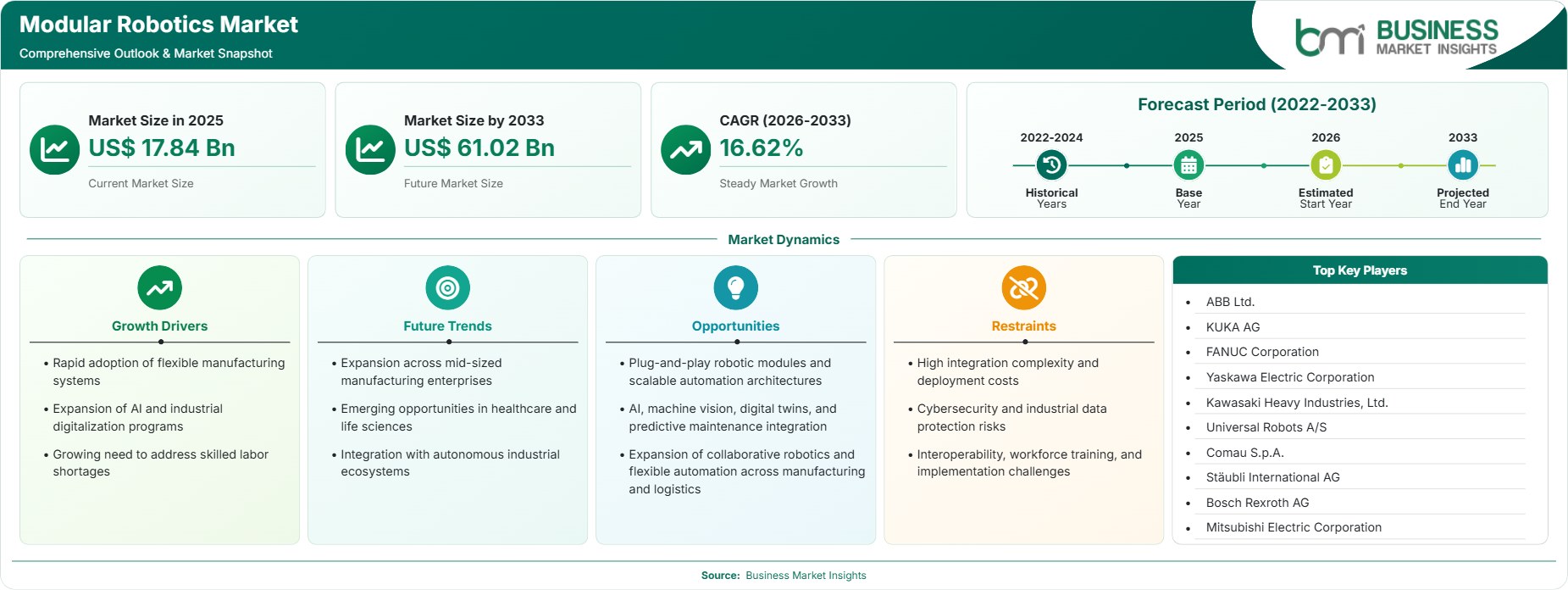
The Modular Robotics Market size was valued at US$ 17.84 Billion in 2025 and is projected to reach US$ 61.02 Billion by 2033, growing at a CAGR of 16.62% during 2026–2033, driven by flexible automation, Industry 4.0 adoption, collaborative manufacturing, smart factories, labor shortages, AI-enabled robotic systems, and expanding deployment across automotive, electronics, healthcare, and logistics applications worldwide.

Report Coverage
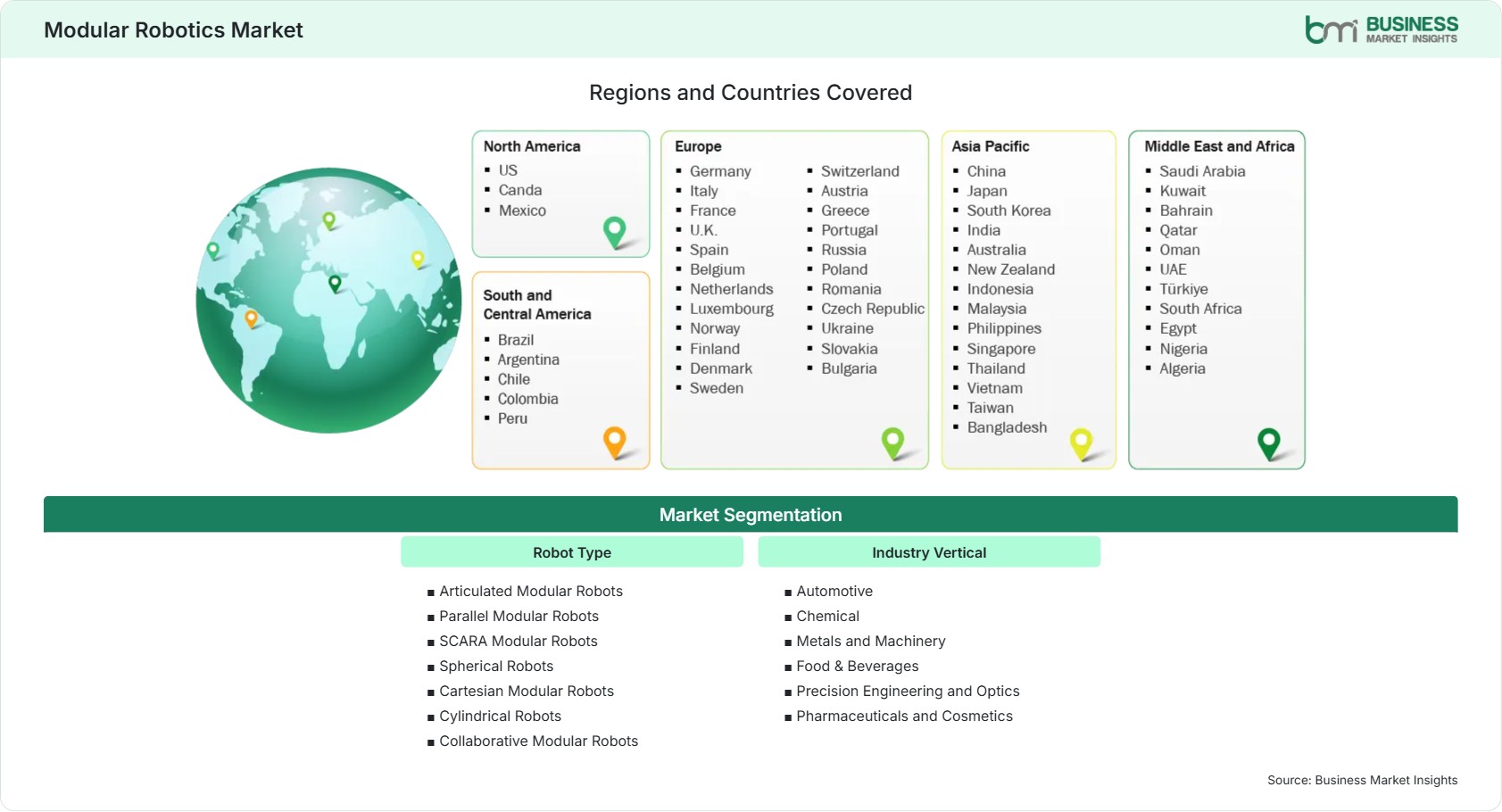
  • Robot Type: Articulated Modular Robots, Parallel Modular Robots, SCARA Modular Robots, Spherical Robots, Cartesian Modular Robots, Cylindrical Robots, Collaborative Modular Robots
  • Industry Vertical: Automotive, Chemical, Metals and Machinery, Food & Beverages, Precision Engineering and Optics, Pharmaceuticals and Cosmetics
US$ 17.84 Bn Market size in 2025
US$ 61.02 Bn Market Size by 2033
16.62% CAGR, 2026 - 2033
2026-2033 Forecast Period

AI Overview

Modular Robotics Market Summary

  • North America Region: Holds a market share of 34%–37% in 2025, growing with a CAGR of 15.2%–16.0% during 2026–2033, supported by reshoring initiatives, smart manufacturing investment, warehouse automation expansion, AI integration, and labor productivity improvement opportunities across industrial operations. U.S. demand remains strong through automotive, aerospace, and logistics automation, advancing at an estimated 15.5%–16.3% CAGR.
  • Fastest Growing Region: Asia Pacific accounts for 28%–31% share in 2025 and is projected to expand at 18.5%–19.5% CAGR, supported by rapid industrialization, electronics production growth, robot density expansion, government incentives, and manufacturing modernization programs.
  • Leading Segment: Articulated Modular Robots represent 30%–33% share in 2025 and are expected to grow at 15.8%–16.8% CAGR, benefiting from deployment flexibility, welding automation, assembly precision, payload versatility, and integration across complex manufacturing environments.
  • High Growth Segment: Collaborative Modular Robots account for 13%–16% share in 2025 while advancing at 20.0%–21.0% CAGR, supported by human-machine collaboration, SME automation adoption, safety compliance improvements, and simplified programming requirements.
  • Key Market Opportunity: AI-driven modular robotic platforms are enabling scalable automation architectures, reducing deployment costs, improving production agility, supporting predictive maintenance strategies, and expanding adoption across mid-sized manufacturers worldwide.
  • Major Market Players: ABB Ltd., KUKA AG, FANUC Corporation, Yaskawa Electric Corporation, Kawasaki Heavy Industries, Ltd., Universal Robots A/S, Comau S.p.A., Stäubli International AG, Bosch Rexroth AG, Mitsubishi Electric Corporation.
Strategic Insights

Modular Robotics Market: Strategic Insights

Modular Robotics Market Strategic Framework
FREE PDF
Request your free sample
Request free sample
Stakeholder View

Key Takeaways

  • The value chain is evolving from standalone robot manufacturing toward integrated ecosystems combining sensors, controllers, software platforms, AI analytics, and modular hardware architectures.
  • Collaborative systems and electronics manufacturing applications offer the strongest near-term commercial upside due to shorter payback periods and growing SME adoption.
  • Product innovation is shifting toward plug-and-play robotic modules, machine vision integration, digital twins, and predictive maintenance capabilities.
  • Asia Pacific presents an attractive investment case owing to rising robot density, manufacturing relocation trends, and government-backed industrial automation programs.
  • Strategic partnerships between robot manufacturers, software vendors, and factory automation providers are increasing as customers seek end-to-end automation solutions.
  • Sustainability objectives are encouraging deployment of energy-efficient robotic systems capable of supporting resource optimization and reduced material waste.
Geographic Outlook

Modular Robotics Market Regional Highlights

North America Modular Robotics Market

North America held 34%–37% Modular Robotics Market share in 2025 and is projected to expand at a 15.2%–16.0% CAGR through 2033. Strong adoption across automotive manufacturing, logistics automation, semiconductor fabrication, and aerospace production supports demand. The region benefits from substantial investment in smart factories, advanced robotics software, and AI-enabled industrial automation. Labor shortages and reshoring strategies continue encouraging deployment of flexible robotic platforms that improve efficiency while supporting rapid production reconfiguration requirements.

  • U.S. and Canadian manufacturers continue increasing robotics investments to improve production resilience and reduce dependence on labor-intensive processes.
  • Logistics operators are deploying modular robotic systems across distribution centers to enhance throughput and warehouse productivity.
  • Semiconductor expansion projects are creating significant demand for high-precision robotic modules and automation components.
  • Industrial AI integration is improving robot utilization rates and predictive maintenance performance.

US Modular Robotics Market

The U.S. accounts for 78%–82% of North American revenue share and is expected to expand at a 15.5%–16.3% CAGR. Automotive assembly plants, aerospace manufacturing facilities, consumer goods producers, and warehouse operators remain major users. Federal support for domestic manufacturing and continuing industrial digitalization initiatives support long-term automation spending. Demand increasingly focuses on modular systems capable of supporting flexible production environments while minimizing operational disruptions during expansion activities.

  • Automotive manufacturers increasingly deploy configurable robotic cells for EV production and battery assembly operations.
  • Warehouse automation projects continue accelerating adoption of modular platforms integrated with AI-enabled software.
  • Aerospace manufacturers utilize advanced robotic solutions for precision assembly and inspection applications.
  • SME adoption is increasing as robot programming and system deployment become more accessible.

Europe Modular Robotics Market

Europe represented 25%–28% share in 2025 and is forecast to grow at a 15.7%–16.5% CAGR. Germany remains the leading regional market, while Poland and Czechia demonstrate faster expansion due to industrial investment. Strong manufacturing capabilities, stringent quality requirements, and workforce productivity priorities continue supporting automation demand. The region maintains a robust robotics ecosystem supported by engineering expertise, industrial software integration, and widespread Industry 4.0 initiatives.

  • Germany leads regional adoption through automotive, machinery, and industrial manufacturing applications.
  • Italy and France continue expanding deployment in packaging, food processing, and precision engineering sectors.
  • Poland records one of the strongest regional growth trajectories due to industrial modernization investments.
  • Sustainability and energy-efficiency objectives support replacement of legacy automation systems.
  • Industrial digitalization programs encourage integration of robotics with connected factory environments.

Asia Pacific Modular Robotics Market

Asia Pacific maintained 28%–31% share in 2025 and is expected to register the highest CAGR of 18.5%–19.5%. China, Japan, South Korea, and India are major contributors. Rapid factory automation, electronics manufacturing growth, and government-backed smart manufacturing initiatives are expanding demand. The region benefits from large-scale production ecosystems and increasing robot density across industrial sectors. Adoption continues accelerating among both multinational corporations and domestic manufacturers.

  • China remains the largest regional market due to extensive manufacturing activity and automation investment.
  • India demonstrates strong momentum through electronics production expansion and industrial modernization programs.
  • South Korea maintains advanced robotic deployment levels across semiconductor and electronics sectors.
  • Japan continues investing in next-generation manufacturing technologies and collaborative automation platforms.
  • Supply-chain diversification supports new factory construction and robotic equipment demand.

Rest of World Modular Robotics Market

The Rest of World region held 9%–11% share in 2025 and is anticipated to grow at a 16.5%–17.5% CAGR. South and Central America are benefiting from manufacturing upgrades and automotive investments. Meanwhile, Middle East and Africa markets are supported by industrial diversification programs, logistics infrastructure development, and smart factory initiatives. Countries including Brazil, Mexico, Saudi Arabia, and the UAE continue increasing automation spending to improve competitiveness.

  • Brazil remains a leading Latin American adopter of industrial robotic systems across manufacturing industries.
  • Mexico benefits from nearshoring activity and expanding automotive production capacity.
  • Saudi Arabia supports automation through industrial diversification and advanced manufacturing strategies.
  • UAE investments in logistics, warehousing, and smart industry projects create new robotic deployment opportunities.
  • Industrial modernization remains the principal demand catalyst across emerging economies.
Global Market Geography
FREE PDF
Request your free sample
Request free sample
Segment Analysis

Modular Robotics Market Segmentation

Robot Type

This segment accounted for approximately 58%–62% market share in 2025 and is projected to grow at a 16.5%–17.3% CAGR. The Modular Robotics Market scope continues expanding as manufacturers prioritize adaptable robotic architectures capable of serving multiple production requirements. Flexible deployment, scalability, lower lifecycle costs, and integration compatibility remain primary adoption factors.

  • Articulated Modular Robots: Widely used in welding, assembly, material handling, and industrial automation where multi-axis flexibility and payload versatility are critical operational requirements.
  • Parallel Modular Robots: Preferred for high-speed pick-and-place applications requiring rapid movement, precision positioning, and consistent repeatability across manufacturing environments.
  • SCARA Modular Robots: Strong adoption in electronics assembly and packaging tasks due to compact designs, accuracy, and efficient horizontal motion capabilities.
  • Spherical Robots: Utilized in specialized manufacturing applications where broad work envelopes and flexible movement trajectories support operational efficiency.
  • Cartesian Modular Robots: Popular in material handling and CNC operations because of straightforward programming, precision control, and scalable deployment.
  • Cylindrical Robots: Applied in machine tending and handling tasks where rotational motion and compact installation requirements are important.
  • Collaborative Modular Robots: Experiencing rapid adoption as manufacturers seek safe human-robot interaction and simplified automation implementation.

Industry Vertical

Industry vertical deployment represented approximately 38%–42% share in 2025 and is expected to expand at a 17.0%–18.0% CAGR. Growing automation investments, productivity objectives, labor constraints, and quality improvement priorities continue strengthening demand. Modular Robotics Market trends indicate rising adoption across both high-volume and customized manufacturing environments.

  • Automotive: Leading application area supported by welding, painting, assembly, inspection, and EV manufacturing automation requirements.
  • Chemical: Growing utilization for hazardous material handling, process automation, and operational safety improvements within production facilities.
  • Metals and Machinery: Demand driven by fabrication, machining support, material movement, and precision production requirements.
  • Food & Beverages: Adoption supported by packaging automation, hygiene compliance objectives, and high-throughput processing operations.
  • Precision Engineering and Optics: High demand for accurate positioning and repeatability in component manufacturing environments.
  • Pharmaceuticals and Cosmetics: Increasing implementation across packaging, inspection, filling, and contamination-sensitive production workflows.
Market Forces

Modular Robotics Market Dynamics

Key Market Drivers

Rapid Adoption of Flexible Manufacturing Systems

Manufacturers increasingly require production environments that can accommodate changing product mixes without substantial capital reinvestment. Modular robotics solutions fulfill this requirement by facilitating rapid reconfiguration and scalable automation. As per robotics industry trends, installations of industrial robots continue to be limited to the automotive, electronics, and machinery industries, where flexible production has now become an important consideration. Firms are implementing robotic systems that can be configured easily to minimize production downtimes and increase their responsiveness, in addition to meeting manpower limitations. Thus, decisions involving purchases are increasingly being made in favor of such systems that are flexible and easy to deploy.

Expansion of AI and Industrial Digitalization Programs

Artificial intelligence, machine vision, and industrial analytics are transforming factory automation capabilities. Robots are being increasingly designed using advanced predictive diagnostic technologies, adaptive motion control, and optimization technologies to enhance performance. Companies undertaking digital transformation projects are keen to invest in automation technologies that can create operational intelligence alongside their functional performance. Integration of robots with software platforms in the industry is helping achieve improved production and maintenance planning. Increased investments in smart factories in developed and developing nations keep encouraging use of the technology. This enhances the value proposition of modular systems through wider application in the industry.

Growing Need to Address Skilled Labor Shortages

Persistent workforce constraints are encouraging manufacturers to automate repetitive, hazardous, and precision-oriented tasks. Shortage of labor is most noticeable in the automobile industry, logistics, and electronics sectors. Automated systems give companies the ability to ensure continuity of production without relying on hard-to-fill positions. The productivity achieved helps in achieving the business's competitive edge and product quality goals. This demand increases due to changes in the demographic structure of the workforce in developed industrial countries. This situation creates an ideal platform for robotics adoption, especially when scalability is possible through automation.

Key Market Opportunities

Expansion Across Mid-Sized Manufacturing Enterprises

Big companies embraced robots at an early stage, but today, there are possibilities for growth even for medium-scale manufacturers. Simpler implementation process, cloud monitoring, and modularity make robotics more accessible. There are cheap automation kits that will enable companies to automate selected manufacturing stages without any risk. As awareness rises, Modular Robotics Market Forecasts increasingly incorporate SME-driven demand as an important growth contributor. Vendors capable of offering flexible financing, training services, and software integration support are positioned to capitalize on this expanding customer base throughout the forecast period.

Emerging Opportunities in Healthcare and Life Sciences

Healthcare and life-science organizations are accelerating automation adoption for laboratory processes, pharmaceutical production, packaging, and sterile material handling. Modular robotic systems facilitate tightly controlled environments wherein accuracy and reproducibility are vital. There has been an increase in the need for biologics, personalized medicine, and diagnostic products, thus driving interest in automation. Such companies are often required to have adaptable and scalable processes that could change with the production needs. Companies offering robotic solutions with compliance features stand to gain from increased funding in automation technology.

Integration with Autonomous Industrial Ecosystems

Future manufacturing environments will increasingly depend on connected systems capable of making data-driven decisions. Modular robotics technology may serve as a basis for more comprehensive autonomous production systems such as digital twins, industrial internet of things, autonomous mobile robots, and other analytical capabilities. Opportunities for integration go beyond traditional manufacturing into logistics, warehousing, and infrastructure maintenance sectors. Companies looking to invest in smart operations will look for scalable solutions. Developers of platform-oriented and open architecture products will benefit from this trend.

Market Restraints and Challenges

High Integration Complexity and Deployment Costs

Factor: Integrating robotic modules with existing factory infrastructure, software systems, and production equipment often requires specialized expertise and engineering resources. Impact: Such demands escalate the cost of implementation and can even lead to delay in the time of deployment, especially in organizations that have no experience of automation. Small manufacturers may delay making investment decisions due to integration risks that affect their budgeting choices. The additional cost of staff training, customization, and testing is another important factor affecting economic viability. Even though modular design enhances flexibility, interoperability between systems from different vendors still poses a great challenge.

Cybersecurity and Industrial Data Protection Risks

Factor: Increased connectivity between robots, cloud platforms, sensors, and enterprise software expands potential exposure to cybersecurity threats. Impact: Operational failures, data leaks, and production delays might result in the emergence of financial and reputational implications for the industrial companies. It means that any manufacturer needs a strong cybersecurity strategy prior to the full-scale application of the connected robots. Compliance and risk management issues further complicate the process. Network protection, control, and staff training become necessary and bring additional costs and potential delays of the decision-making process.

Company Analysis

Competitive Landscape

The Modular Robotics Market analysis highlights competition centered on flexibility, software capabilities, AI integration, robotics performance, and industrial automation expertise.

Company Name

Overview

Products and Services relevant to this market

ABB Ltd.

Global automation leader with extensive industrial robotics and software capabilities serving manufacturing sectors.

Industrial robots, collaborative robots, automation software, digital factory solutions, robot controllers.

KUKA AG

Major robotics provider focused on industrial automation and intelligent manufacturing solutions.

Modular robots, robotic cells, automation platforms, digital engineering software.

FANUC Corporation

Leading industrial robot manufacturer with a strong global installed base.

Industrial robots, collaborative robots, CNC systems, factory automation technologies.

Yaskawa Electric Corporation

Automation specialist known for advanced motion control and robotics systems.

Industrial robots, drives, controllers, integrated manufacturing automation.

Kawasaki Heavy Industries, Ltd.

Diversified industrial company supplying robotic systems across sectors.

Robotic arms, collaborative robots, welding and assembly automation solutions.

Universal Robots A/S

Pioneer in collaborative robotics and flexible automation deployment.

Collaborative robots, programming software, ecosystem integration tools.

Comau S.p.A.

Global industrial automation provider serving automotive and manufacturing industries.

Robotic systems, automation platforms, digital manufacturing technologies.

Stäubli International AG

Engineering company recognized for precision robotics solutions.

Industrial robots, pharmaceutical automation, machine tool integration systems.

Bosch Rexroth AG

Industrial automation and motion control technology provider.

Automation platforms, control systems, robotic subsystems, software services.

Mitsubishi Electric Corporation

Advanced factory automation company with global manufacturing presence.

Industrial robots, controllers, manufacturing software, mechatronic solutions.

Trust & Transparency

Research Methodology

The market analysis combines proprietary research with secondary data from government agencies, company disclosures, regulatory filings, industry databases and expert interviews. Market estimates are validated through data triangulation, cross-market benchmarking and analyst review.

View Full Research Methodology

Questions Answered

Frequently Asked Questions

What does a Modular Robotics Market Report typically evaluate?

It typically evaluates market size, competitive dynamics, regional trends, technology developments, industry adoption patterns, segmentation performance, investment opportunities, and future growth scenarios.

What factors influence return on investment?

Labor savings, productivity improvements, maintenance efficiency, uptime enhancement, quality gains, deployment flexibility, and software integration capabilities significantly affect investment returns.

Which region offers the strongest growth potential?

Asia Pacific offers the most attractive expansion prospects due to industrialization, electronics manufacturing growth, government automation programs, and increasing robot density across factories.

How do modular robots differ from conventional industrial robots?

Modular robots use configurable components that can be reassembled or upgraded for different applications, enabling greater flexibility and lower lifecycle adaptation costs than fixed robotic systems.

What industries generate the highest demand for modular robotics?

Automotive, electronics, machinery, logistics, pharmaceuticals, and food processing industries generate the strongest demand because they require production flexibility, precision, and automation scalability.

Access the Full Modular Robotics Market Report

Get segment-level forecasts, regional estimates, competitive benchmarking, company profiles and downloadable Excel datasets.

Access the full Modular Robotics Market Report
350 pages PDF & Excel | 2026-08-31