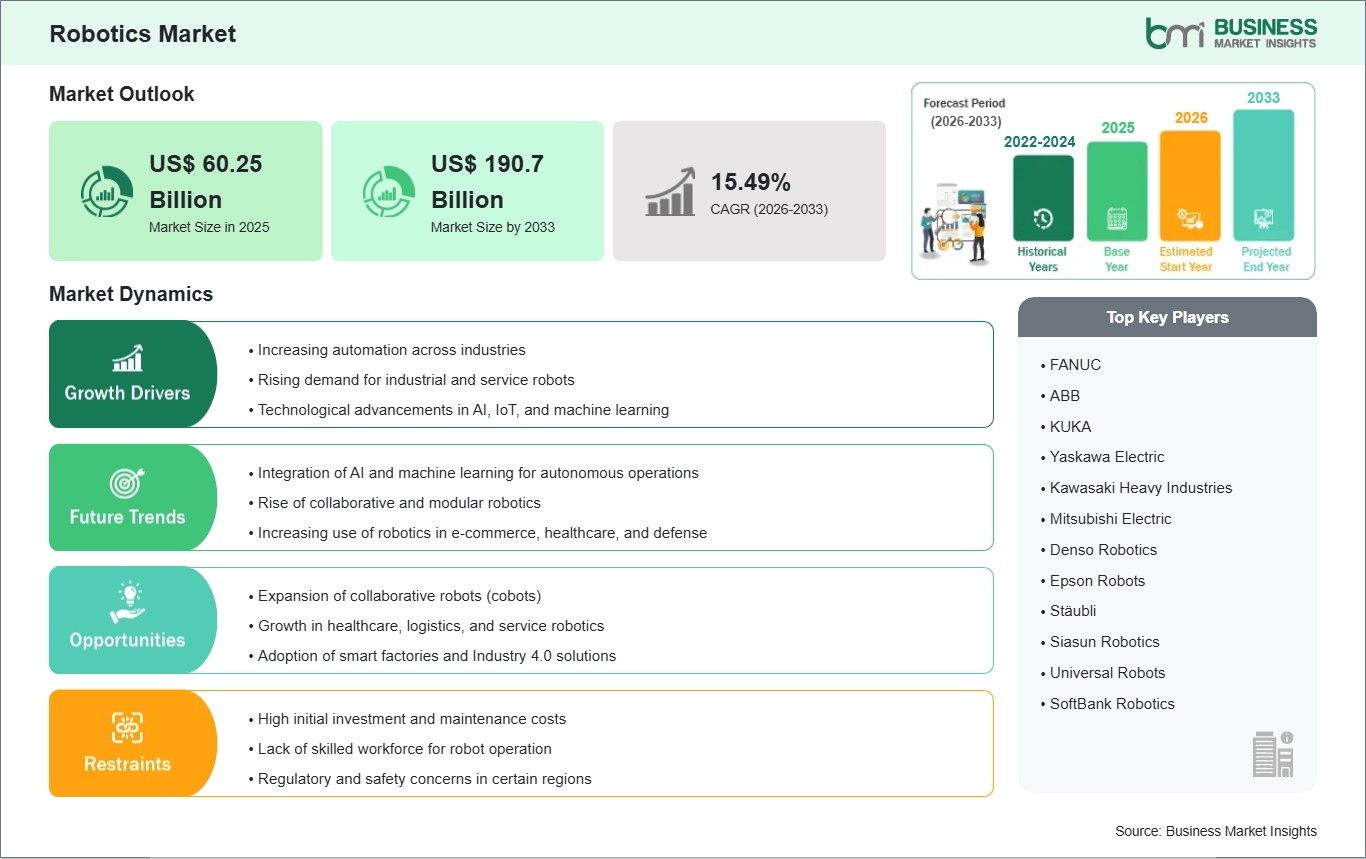
The Robotics Market size is expected to reach US$ 190.7 Billion by 2033 from US$ 60.25 Billion in 2025. The market is estimated to record a CAGR of 15.49% from 2026 to 2033.
The Global Robots Market is the ensemble of the supply chain entities that design, manufacture, distribute and implement robots that can be of either industrial or service types and are utilized in any of the sectors such as manufacturing, healthcare, logistics and consumer services. It covers the entire range of robotic systems such as industrial robots, collaborative robots (cobots), autonomous mobile robots (AMRs), and service robots which are mainly influenced by technological advancements, automation needs, and the rising demand for efficiency, precision, and labor cost reduction.As the need for increased efficiency increases, the robot market continues to grow. The market is driven by automation, a reduction in labor costs, and an increase in the number of individuals using AI-enhanced and collaborative robots for their work (especially within the industries of manufacturing, logistics, and health care). Companies are enhancing their robots through innovations in sensor technology, the utilization of machine learning, and the development of the Fourth Industrial Revolution. Due to increased regulation, standardization also enhances market confidence in robots. The greatest growth opportunities are in the service robotics industry, healthcare, parcel delivery, the use of robotics for SME's, the emergence of developing countries, and the integration of robots with smart factories, IoT devices, and data analytics; providing many new avenues of growth across multiple industries.

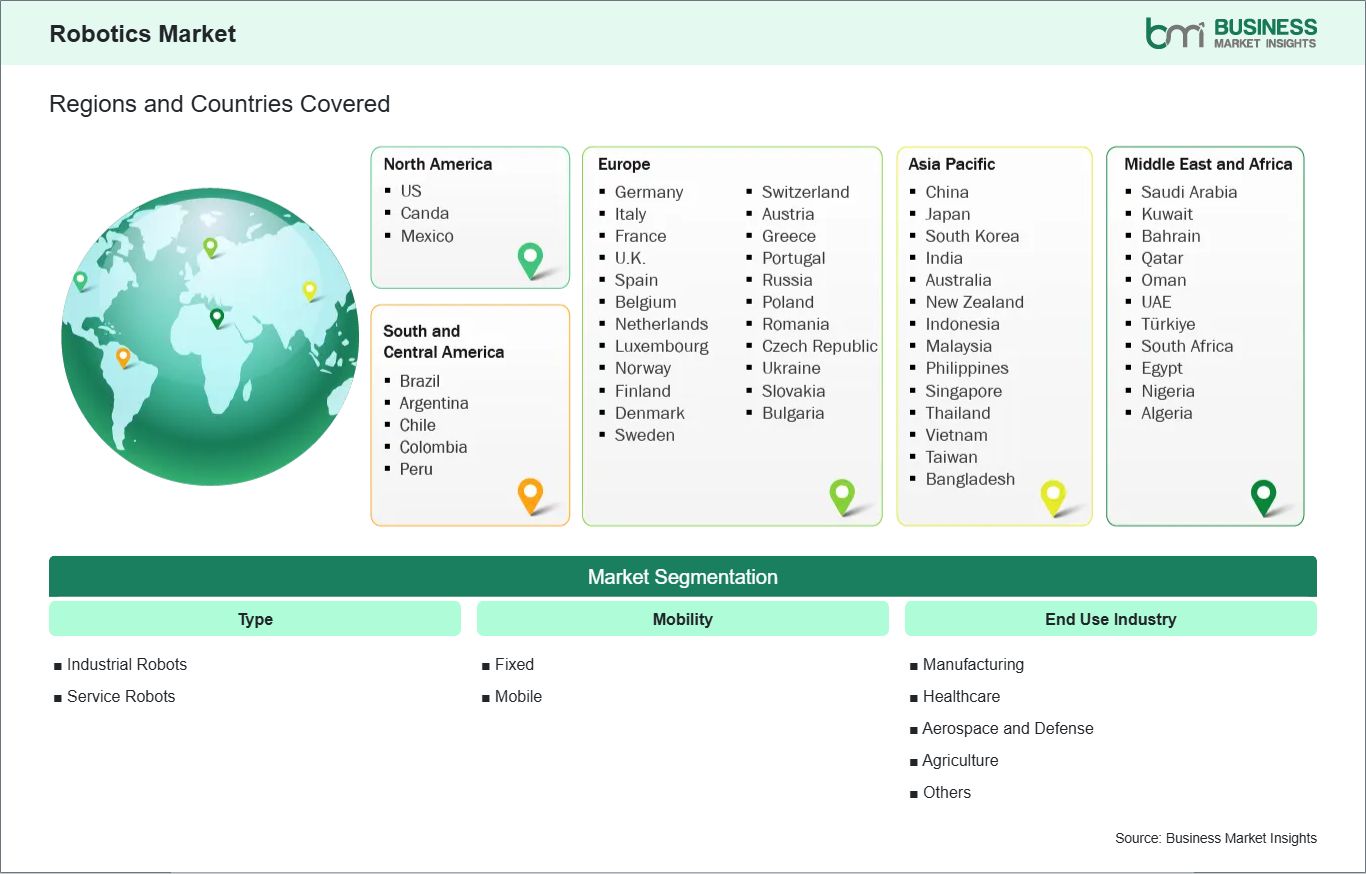
Key segments that contributed to the derivation of the Robotics market analysis are type, mobility, and end use.
The rapid growth of industrial automation is reshaping how organizations operate across a wide range of sectors, including manufacturing, logistics, and healthcare. Companies are increasingly turning to robotics and automation solutions to improve operational efficiency, reduce reliance on manual labor, minimize human error, and maintain consistent product quality. In industries such as automotive, electronics, and consumer goods, where precision, speed, and scalability are critical, automation has become a key enabler of competitiveness and long-term sustainability.
Robotic systems now play a central role in modern production environments by seamlessly integrating sensors, actuators, and advanced software, including artificial intelligence and machine learning algorithms, into cohesive production ecosystems. These systems enable real-time monitoring and control of manufacturing processes, allowing companies to quickly detect issues, optimize workflows, and reduce unplanned downtime. By automating repetitive or hazardous tasks, robotics also helps create safer working environments and lowers the risk of workplace injuries.
The growing adoption of collaborative robots, or cobots, is becoming a major force behind the expansion of the robotics market. Unlike traditional industrial robots that operate in isolated environments, cobots are designed to work safely alongside humans, combining human judgment and creativity with robotic precision and consistency. This shift is being accelerated by the convergence of robotics with enabling technologies such as the Industrial Internet of Things (IIoT), edge computing, and machine learning.
Modern cobots are no longer rigid, standalone machines. Instead, they function as intelligent, interconnected systems that can communicate with other machines, production lines, and digital platforms in real time. Through IIoT integration, cobots continuously collect and transmit operational data, enabling remote monitoring, predictive diagnostics, and performance optimization. Edge computing allows data to be processed closer to the source, reducing latency and enabling faster decision-making, while machine learning algorithms help robots adapt to changing conditions and improve their performance over time.

By type, the market divides into Industrial Robots and Service Robots. Industrial Robots dominated in 2024, driven by widespread adoption in high-volume manufacturing for tasks like welding, assembly, and material handling. Service Robots support applications in logistics, cleaning, and inspection amid labor shortages and e-commerce demands.
By mobility, the market splits into Fixed and Mobile Robots. Fixed Robots held the larger share in 2024, favored for precision in structured environments like automotive lines where repeatability ensures quality control. Mobile Robots gain traction in dynamic warehouses for flexible navigation, supported by AI pathfinding and 5G connectivity.
By end use, segments include Manufacturing, Healthcare, Aerospace & Defense, Agriculture, and Others. Manufacturing led in 2024, fueled by Industry 4.0 upgrades in electronics and heavy machinery. Healthcare advances via surgical and assistive bots; Aerospace/Defense leverages precision machining; Agriculture progresses with autonomous harvesters; Others encompass retail and logistics with cobot deployments.
| Report Attribute | Details |
|---|---|
| Market size in 2025 | US$ 60.25 Billion |
| Market Size by 2033 | US$ 190.7 Billion |
| Global CAGR (2026 - 2033) | 15.49% |
| Historical Data | 2022-2024 |
| Forecast period | 2026-2033 |
| Segments Covered | By Type
|
|
Regions and Countries Covered
| |
| North America | US, Canada, Mexico |
| Europe | Belgium, Austria, Finland, Denmark, Greece, Poland, Romania, Russia, Ukraine, Czech Republic, Slovakia, Bulgaria, Italy, Luxembourg, Germany, Switzerland, France, Netherlands, Norway, Portugal, Spain, Sweden, United Kingdom |
| Asia-Pacific | Australia, China, India, Japan, South Korea, Indonesia, Malaysia, Philippines, Singapore, Thailand, Vietnam, Bangladesh, New Zealand, Taiwan |
| South and Central America | Brazil, Argentina, Peru, Chile, Colombia |
| Middle East and Africa | Bahrain, Kuwait, Oman, Qatar, Saudi Arabia, United Arab Emirates, Turkiye, South Africa, Egypt, Algeria, Nigeria |
| Market leaders and key company profiles |
|
The Robotics Market Size and Forecast (2022–2033) report provides a detailed analysis of the market covering below areas:
The geographical scope of the Robotics market report is divided into five regions: North America, Asia Pacific, Europe, Middle East & Africa, and South & Central America. The Robotics market in Asia Pacific is expected to grow significantly during the forecast period.
The Asia Pacific Robotics market includes key countries such as China, Japan, South Korea, India, Australia, New Zealand, Indonesia, Malaysia, the Philippines, Singapore, Thailand, Vietnam, Taiwan, Bangladesh, and the Rest of Asia. Growth in this region is supported by strong demand from industries such as automotive, electronics, manufacturing, logistics, and healthcare. Governments and enterprises across Asia Pacific are investing heavily in modernizing production lines, deploying cobots in flexible manufacturing, and enhancing warehouse automation, all of which are driving Robotics adoption.
China continues to dominate the regional Robotics market due to its vast manufacturing base, large-scale electronics and automotive production, and strong government focus on industrial automation and smart factories. Japan and South Korea are leading adopters of advanced Robotics solutions, leveraging their strong technological capabilities in precision engineering, AI integration, and collaborative systems to improve operational efficiency and workforce productivity. Meanwhile, India is emerging as a high-growth market, supported by rapid industrialization, expanding electronics assembly, and increasing adoption of automation across automotive and consumer goods sectors.

The Robotics market is evaluated by gathering qualitative and quantitative data post primary and secondary research, which includes important corporate publications, association data, and databases. A few of the key developments in the Robotics market are:
The Robotics Market is valued at US$ 60.25 Billion in 2025, it is projected to reach US$ 190.7 Billion by 2033.
As per our report Robotics Market, the market size is valued at US$ 60.25 Billion in 2025, projecting it to reach US$ 190.7 Billion by 2033. This translates to a CAGR of approximately 15.49% during the forecast period.
The Robotics Market report typically cover these key segments-
The historic period, base year, and forecast period can vary slightly depending on the specific market research report. However, for the Robotics Market report:
The Robotics Market is populated by several key players, each contributing to its growth and innovation. Some of the major players include:
The Robotics Market report is valuable for diverse stakeholders, including:
Essentially, anyone involved in or considering involvement in the Robotics Market value chain can benefit from the information contained in a comprehensive market report.
Please tell us your area of interest
(Market Segments/ Regions and Countries/ Companies)