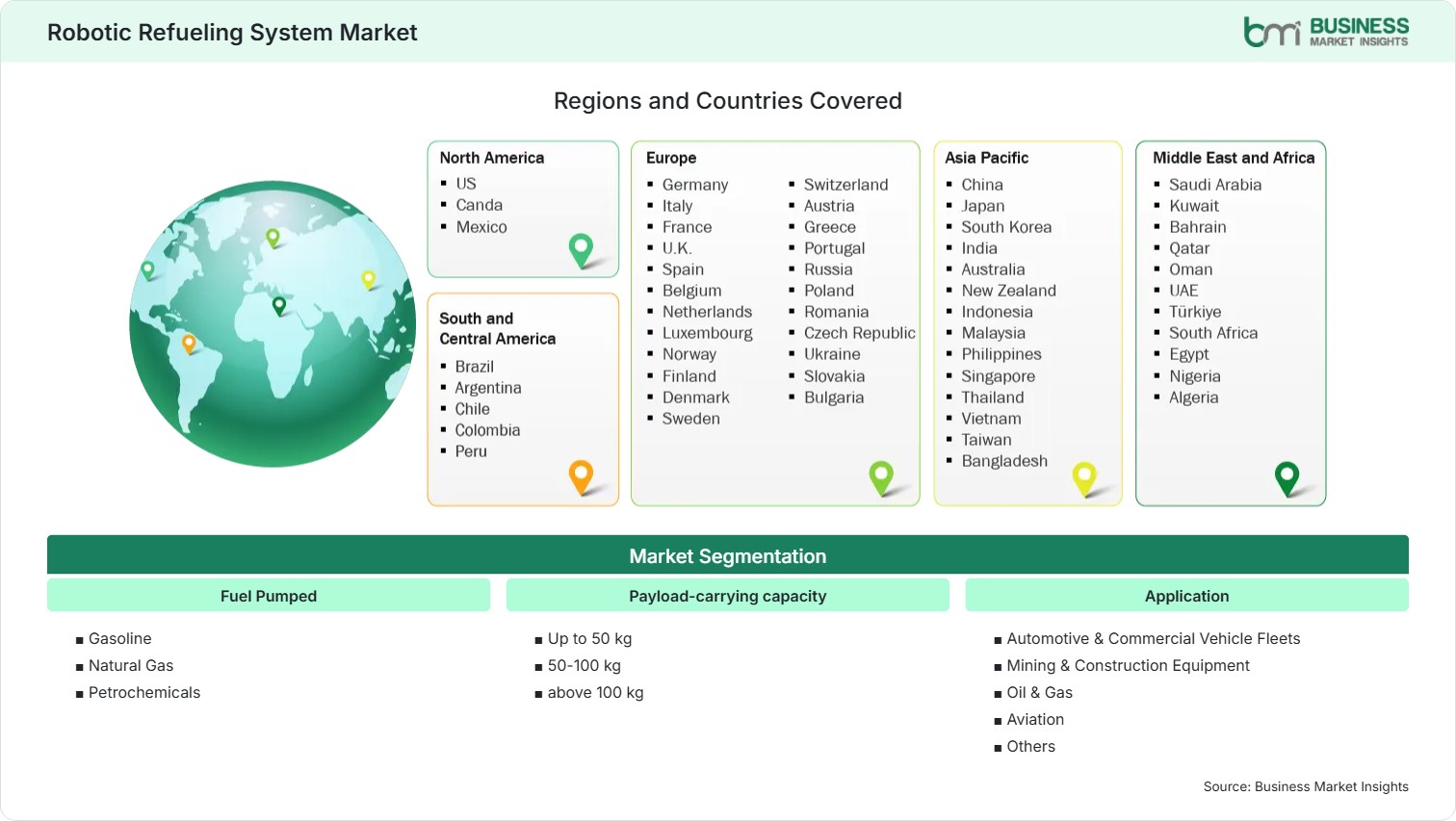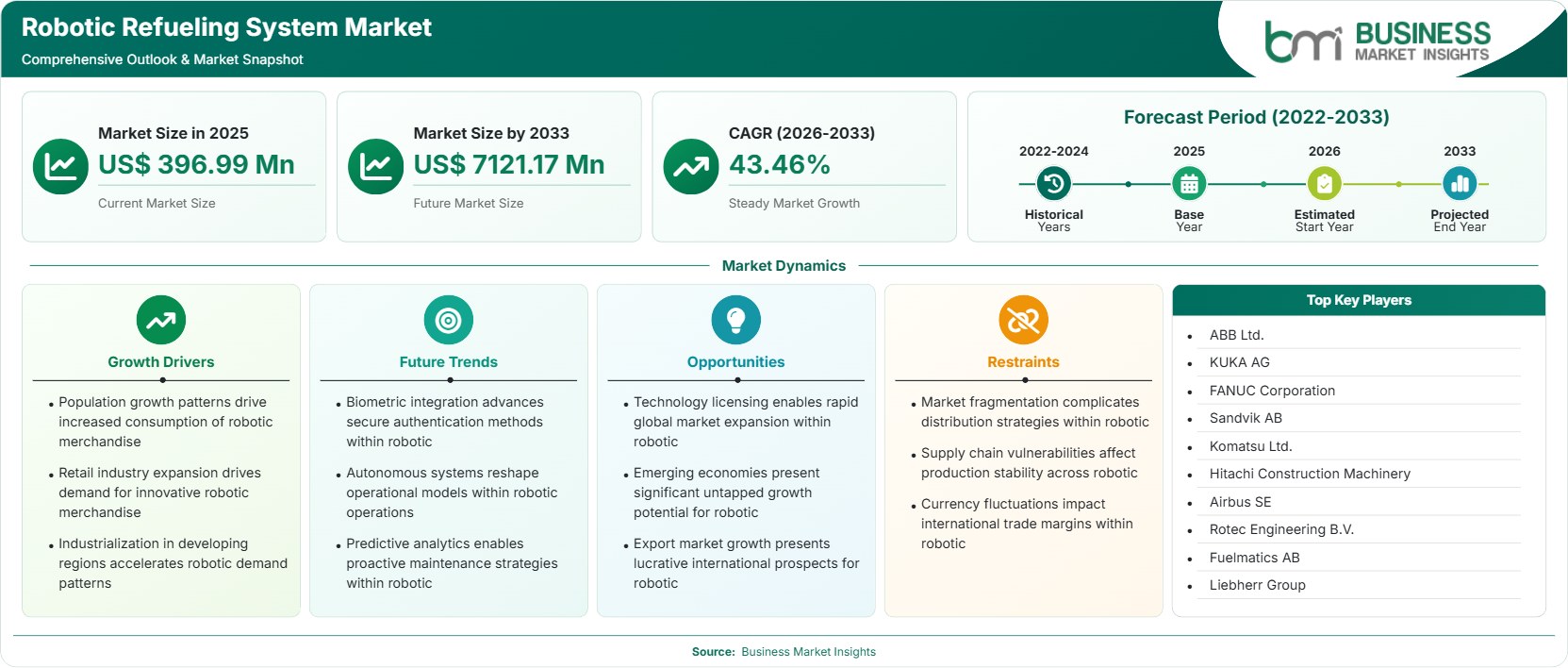
Robotic Refueling System Market Regional Highlights
North America Robotic Refueling System Market
North America held a 28%–32% share in 2025 and is projected to expand at a 40%–43% CAGR during 2026–2033. The region benefits from mining automation, commercial fleet digitization, labor constraints, and strong adoption of autonomous equipment. The US remains the principal contributor, while Canada provides opportunities through mining and energy operations. Demand increasingly centers on high-throughput facilities where automated fueling can coordinate with fleet management, remote supervision, predictive maintenance, and autonomous vehicle scheduling.
- Mining operators increasingly connect autonomous haulage with automated service functions, creating demand for robotic fueling infrastructure that reduces human exposure and supports continuous equipment utilization.
- Fleet depots are evaluating unattended fueling to improve throughput, reduce queueing, and integrate dispensing activity with telematics, vehicle identification, payment controls, and centralized operational monitoring.
- Industrial automation suppliers benefit from established robotics ecosystems, enabling integration of manipulators, machine vision, safety controls, and remote diagnostics into standardized fueling installations.
- Canada offers a high-value opportunity through mining and oilfield automation, where harsh operating conditions and dispersed assets increase the economic rationale for autonomous servicing technologies.
US Robotic Refueling System Market
The US accounted for 23%–27% of the North American share in 2025 and is projected to grow at a 41%–44% CAGR during 2026–2033. Robotic Refueling System Market Adoption is supported by advanced industrial robotics, large commercial fleets, mining operations, and demand for safer fueling workflows. The strongest deployments are likely at high-utilization facilities where automation can reduce service interruptions. Integration with autonomous vehicles, fleet software, and remote monitoring creates additional value beyond robotic dispensing equipment.
- Mining and construction fleets provide an attractive application base because autonomous equipment increasingly requires automated service processes capable of operating without frequent human intervention.
- Commercial fleet operators can use robotic fueling to standardize vehicle identification, nozzle positioning, transaction controls, and operational data collection across high-volume depots.
- US technology ecosystems support partnerships among robotics vendors, fuel infrastructure providers, software developers, and equipment manufacturers, accelerating integrated deployment models.
Europe Robotic Refueling System Market
Europe held a 30%–34% Robotic Refueling System Market share in 2025 and is projected to expand at a 39%–42% CAGR during 2026–2033. Germany, Sweden, Switzerland, and the Netherlands remain important technology centers, while Norway and the United Kingdom offer deployment opportunities across advanced fleets and industrial automation. Europe's Robotic Refueling System share reflects established robotics capabilities, strict workplace safety expectations, and strong engineering expertise. Germany is projected at 40%–43% CAGR, while Sweden may reach 42%–45%, supported by mining automation and industrial robotics adoption.
- Germany's engineering base supports sophisticated integration of robotic manipulators, sensing systems, industrial controls, and automated fueling equipment for commercial and industrial applications.
- Sweden benefits from mining automation expertise and autonomous equipment development, creating strong potential for robotic servicing systems integrated into digitally managed mine operations.
- Switzerland contributes through advanced robotics and industrial automation capabilities, supporting precision handling, safety controls, and high-reliability systems for demanding operating environments.
- The Netherlands provides opportunities in logistics, engineering, and aerospace ecosystems where automated ground operations can improve asset turnaround and operational consistency.
Asia Pacific Robotic Refueling System Market
Asia Pacific represented a 24%–28% Robotic Refueling System Market share in 2025 and is projected to register a 47%–50% CAGR during 2026–2033. China, Japan, South Korea, India, and Australia provide the principal growth centers. Japan is a leading technology market, while China and India offer large-scale industrial deployment opportunities. Australia is particularly attractive for mining automation. Asia Pacific's Robotic Refueling System growth is supported by industrial robotics adoption, fleet modernization, mining investment, and manufacturing localization.
- China offers significant potential through expanding industrial automation, large commercial vehicle fleets, and increasing deployment of autonomous technologies across logistics and heavy industry.
- Japan's established robotics ecosystem supports high-precision manipulation, sensing, and control technologies applicable to automated fueling and broader autonomous maintenance workflows.
- India provides emerging opportunities as commercial fleets, logistics infrastructure, and industrial automation expand, creating demand for productivity-focused fueling systems at high-volume facilities.
- Australia remains strategically important because autonomous mining equipment and remote operations require dependable automated servicing solutions capable of functioning with limited onsite personnel.
Rest of World Robotic Refueling System Market
South and Central America represented approximately 8%–11% of the 2025 Robotic Refueling System Market demand, while the Middle East and Africa accounted for the remaining 9%–12%. Combined Rest of World growth is projected at 42%–46% CAGR through 2033. Brazil, Chile, Mexico, Saudi Arabia, and the United Arab Emirates offer notable opportunities. Mining, energy infrastructure, fleet modernization, and remote-site automation provide deployment pathways, particularly where automated servicing can address workforce availability and operational safety constraints.
Brazil and Chile provide compelling mining opportunities, while Mexico benefits from industrial and logistics activity. Saudi Arabia and the UAE offer technology investment potential through energy, infrastructure, and smart industrial initiatives. The regional opportunity increasingly centers on controlled environments where robotic fueling can be integrated with centralized operations management and remote supervision.
- Chile's mining sector creates demand for automated servicing technologies that can support heavy equipment utilization while reducing personnel exposure to demanding operational environments.
- Brazil's large mining and commercial transport ecosystems provide opportunities for robotic fueling deployment where fleet throughput and equipment availability directly influence operating economics.
- Saudi Arabia and the UAE can support premium automation projects through energy-sector investment, advanced industrial infrastructure, and controlled environments suited to integrated robotic systems.
- Mexico offers opportunities across logistics and commercial fleets, particularly where high vehicle volumes justify automated fueling, identification, monitoring, and operational data integration.