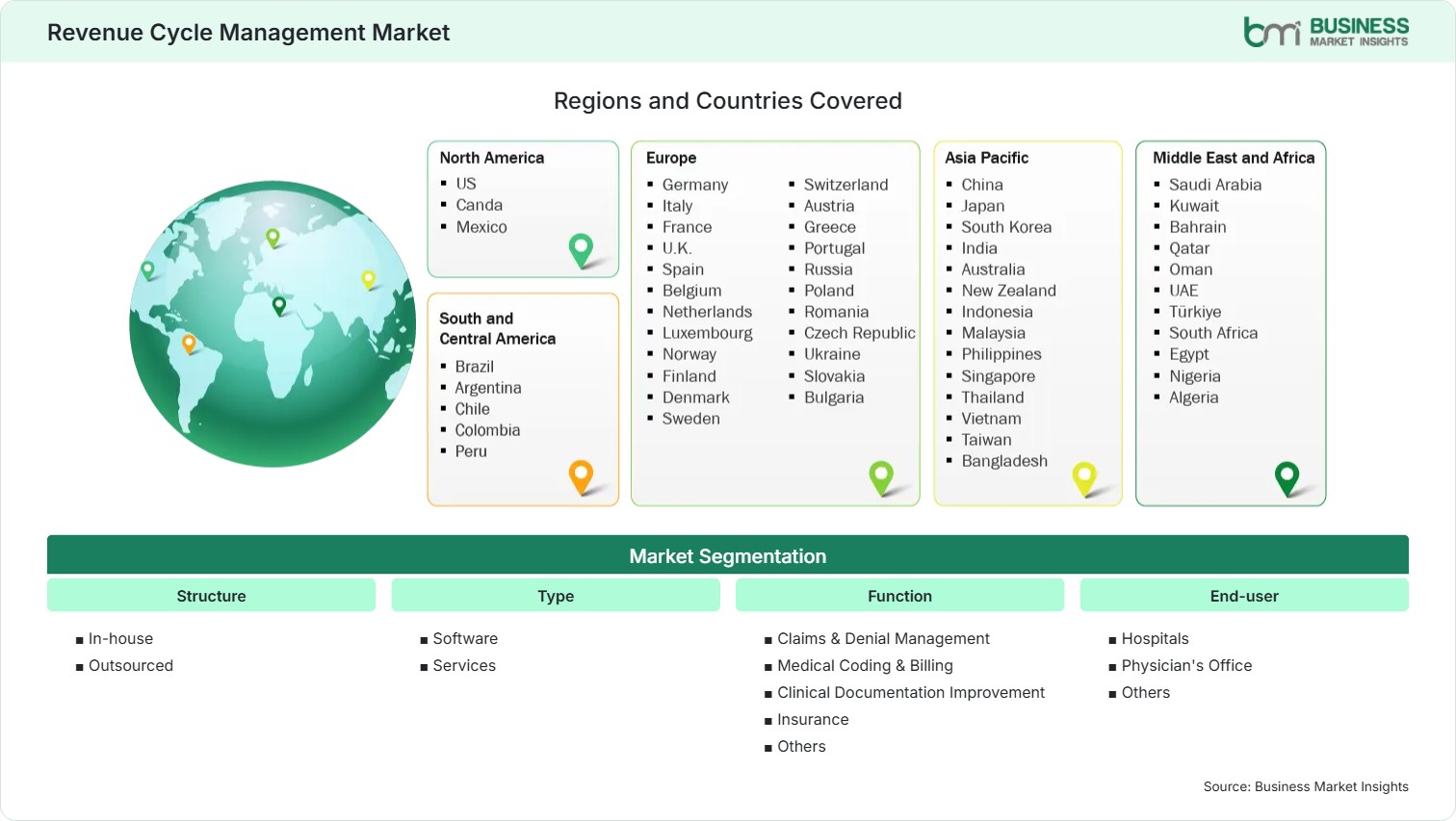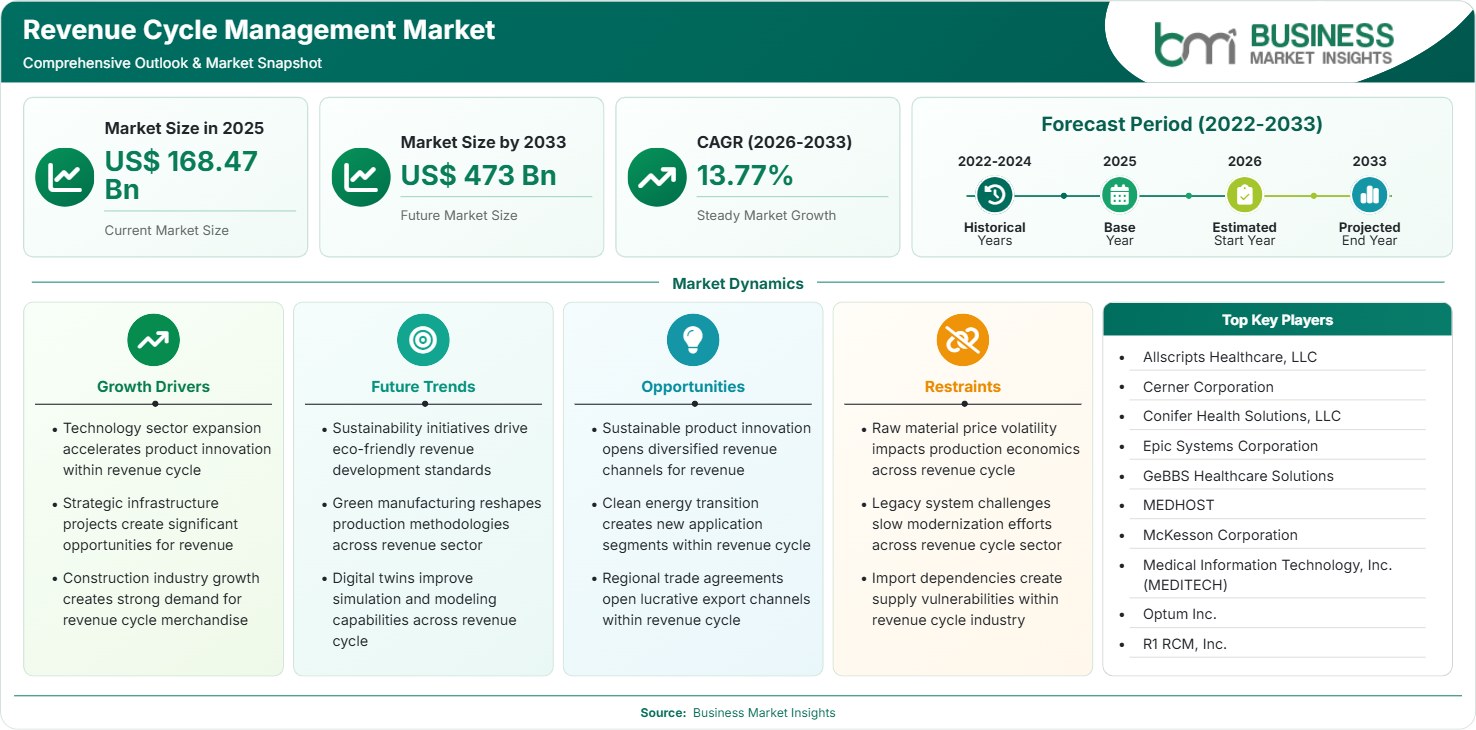
Revenue Cycle Management Market Regional Highlights
North America Revenue Cycle Management Market
North America accounted for approximately 42%–45% of global Revenue Cycle Management Market revenue in 2025 and is projected to register a CAGR of 12.5%–13.5% during 2026–2033. Strong healthcare IT investments, widespread electronic health record adoption, evolving reimbursement regulations, and expanding value-based care initiatives continue supporting regional leadership. Healthcare providers increasingly deploy artificial intelligence and cloud-enabled financial management platforms to streamline administrative operations, minimize claim denials, strengthen compliance, and improve reimbursement efficiency while addressing persistent workforce shortages across hospitals and physician organizations.
- The United States remains the regional innovation center, supported by mature payer-provider ecosystems, extensive cloud migration initiatives, and increasing investments in predictive analytics that improve financial visibility while reducing administrative costs throughout complex reimbursement workflows.
- Large integrated delivery networks continue replacing fragmented legacy billing systems with unified revenue cycle platforms capable of supporting automation, interoperability, and real-time financial reporting across multiple healthcare facilities and provider groups.
- Regulatory requirements concerning medical coding accuracy, patient data privacy, and reimbursement transparency encourage providers to modernize financial operations using intelligent automation and advanced analytics to strengthen compliance while improving operational efficiency.
- Growing adoption of outsourced financial management services enables healthcare providers to manage workforce shortages, accelerate reimbursement cycles, reduce claim backlogs, and improve overall operational scalability during periods of increasing patient volumes.
US Revenue Cycle Management Market
The United States represented approximately 82%–85% of the North American Revenue Cycle Management Market during 2025 while advancing at a CAGR of 12.8%–13.4% through 2026–2033. Healthcare providers continue investing in integrated revenue management ecosystems as reimbursement policies become increasingly sophisticated. Advanced analytics, AI-powered coding, automated eligibility verification, and digital patient payment platforms are strengthening operational efficiency while supporting value-based reimbursement models and improving financial sustainability across both public and private healthcare organizations.
- Large healthcare systems increasingly adopt enterprise-wide cloud platforms integrating clinical documentation, billing, coding, claims management, and patient payment capabilities into unified operational environments supporting faster reimbursement and improved revenue integrity.
- Artificial intelligence applications continue expanding across denial prediction, coding automation, payment forecasting, and workflow optimization, helping providers improve financial performance while minimizing administrative burden and operational inefficiencies.
- Healthcare mergers and acquisitions encourage standardization of financial management systems across multi-hospital networks, increasing demand for scalable software platforms capable of supporting centralized governance and interoperability requirements.
- Growing consumer expectations for digital payment experiences encourage healthcare organizations to introduce transparent billing, flexible payment plans, and self-service financial portals that enhance patient satisfaction while accelerating collections.
Europe Revenue Cycle Management Market
Europe held approximately 26%–29% of global Revenue Cycle Management Market revenue during 2025 and is anticipated to expand at a CAGR of 12.7%–13.8% throughout 2026–2033. Increasing healthcare digitalization, government-supported interoperability initiatives, electronic health record modernization, and expanding public-private healthcare partnerships continue driving adoption. Western European providers increasingly prioritize automation, data security, and standardized reimbursement management while improving operational efficiency amid growing healthcare expenditure and aging populations.
- Germany leads regional implementation through substantial healthcare IT investments, sophisticated hospital infrastructure, and expanding adoption of integrated financial management platforms supporting reimbursement accuracy and operational transparency.
- The United Kingdom represents one of the fastest-transforming healthcare environments, supported by digital health initiatives, cloud adoption, and increasing modernization of administrative workflows throughout public healthcare organizations.
- France and the Nordic countries continue strengthening healthcare interoperability frameworks that facilitate integrated patient records, electronic billing processes, and streamlined reimbursement management across healthcare providers and insurance systems.
- Growing cybersecurity regulations encourage vendors to strengthen cloud security, encryption technologies, compliance management, and secure data exchange capabilities supporting trusted digital financial operations.
Asia Pacific Revenue Cycle Management Market
Asia Pacific represented approximately 20%–23% of worldwide Revenue Cycle Management Market revenue in 2025 and is forecast to achieve a CAGR of 15.8%–17.2% during 2026–2033, making it the fastest-growing regional market. Expanding healthcare infrastructure, rising insurance enrollment, government digital health initiatives, increasing private hospital investments, and rapid healthcare IT adoption continue accelerating implementation of intelligent revenue management technologies across emerging healthcare systems.
- China maintains the largest regional opportunity through continuous healthcare modernization, expanding hospital capacity, and widespread deployment of digital health platforms supporting financial process automation and reimbursement efficiency.
- India records the strongest Revenue Cycle Management Market growth momentum owing to expanding private healthcare networks, digital public health initiatives, increasing medical tourism, and accelerating adoption of cloud-based healthcare administration technologies.
- Japan continues investing in advanced automation, artificial intelligence, and healthcare analytics to improve operational productivity while addressing workforce constraints associated with an aging population.
- Southeast Asian healthcare providers increasingly adopt subscription-based software platforms because they offer scalable implementation, lower upfront investment requirements, and improved interoperability with existing hospital information systems.
Rest of World Revenue Cycle Management Market
The Rest of World region accounted for approximately 8%–10% of global Revenue Cycle Management Market revenue in 2025 and is projected to expand at a CAGR of 13.4%–14.5% during 2026–2033.
South and Central America continue strengthening healthcare modernization through growing private healthcare investments, insurance expansion, and digital transformation initiatives supporting improved financial management capabilities. Brazil remains the leading regional market, while Mexico demonstrates the fastest adoption driven by healthcare infrastructure improvements and increasing private hospital investments.
The Middle East and Africa are steadily expanding healthcare digitalization through national transformation programs, hospital modernization, and electronic health record implementation. Saudi Arabia leads regional adoption through extensive healthcare investment strategies, while the United Arab Emirates records strong growth supported by smart hospital initiatives and cloud-enabled healthcare administration.
- Private healthcare operators increasingly invest in integrated financial management solutions to improve reimbursement accuracy, optimize operational efficiency, and strengthen patient financial engagement across expanding healthcare networks.
- Government-led healthcare modernization strategies encourage digital transformation projects supporting electronic billing, standardized reimbursement procedures, and broader healthcare interoperability across national healthcare ecosystems.
- Cloud deployment models reduce implementation complexity and infrastructure costs, enabling mid-sized healthcare providers to access enterprise-grade financial management capabilities without significant capital expenditure.
- Regional technology partnerships between healthcare providers, software developers, and managed service organizations accelerate knowledge transfer, improve implementation efficiency, and support long-term digital healthcare transformation initiatives.
- Rising medical tourism and expanding private insurance markets continue increasing demand for scalable revenue management platforms capable of handling complex reimbursement processes and multilingual patient engagement workflows.