
Radiation Dose Management Market Outlook: Size, Share, Trends, Growth Analysis, Competitive Landscape & Forecast, 2026-2033

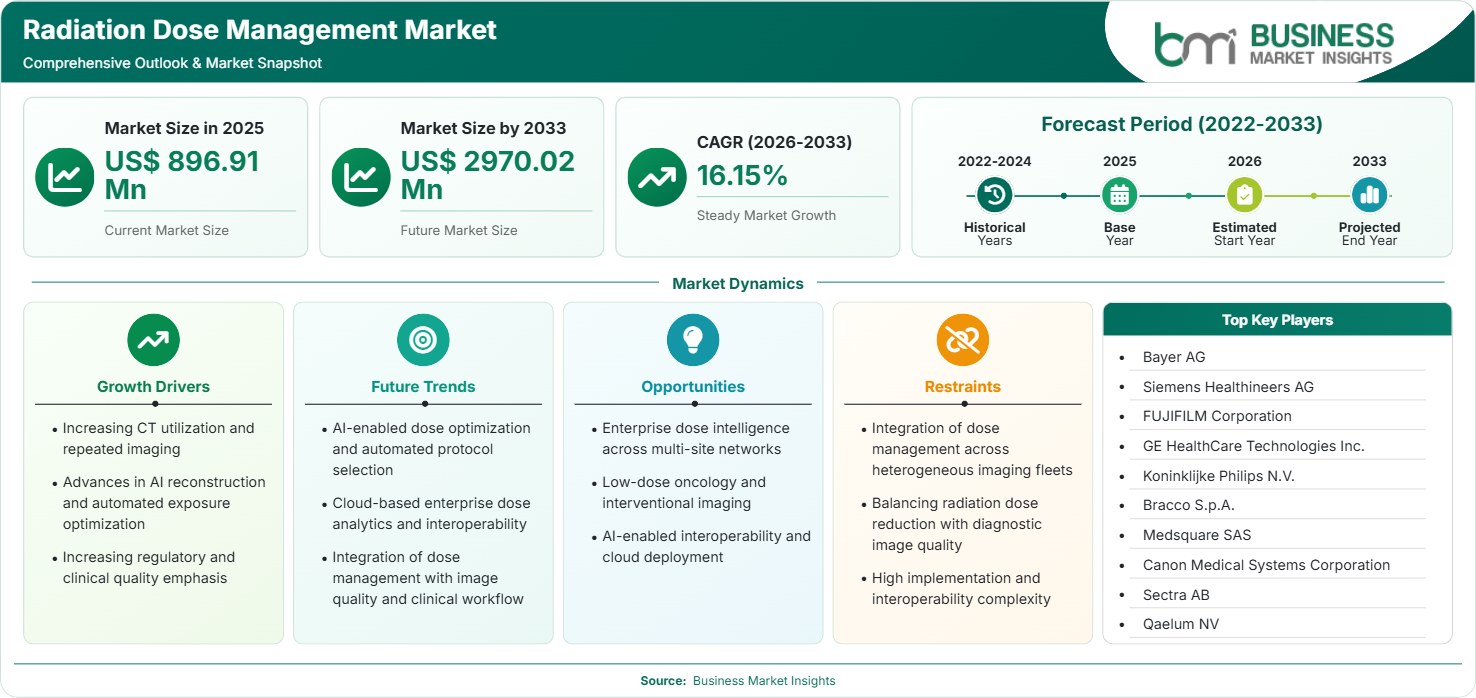
The Radiation Dose Management Market size was valued at US$ 896.91 Million in 2025 and is projected to reach US$ 2970.02 Million by 2033, growing at a CAGR of 16.15% during 2026–2033, driven by imaging volumes, dose optimization, AI reconstruction, regulatory oversight, and demand for safer precision diagnostics.

Report Coverage
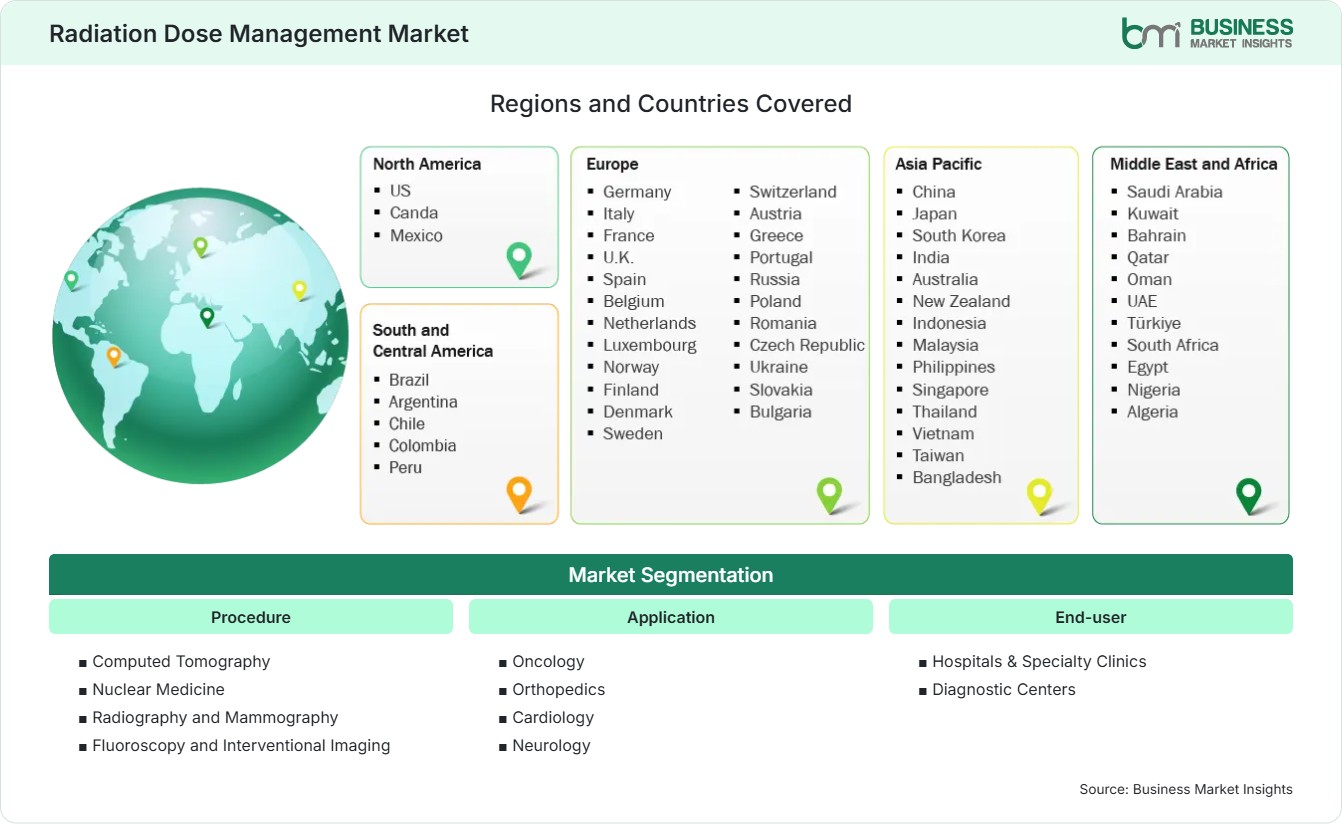
  • Procedure: Computed Tomography, Nuclear Medicine, Radiography and Mammography, Fluoroscopy and Interventional Imaging
  • Application: Oncology, Orthopedics, Cardiology, Neurology
  • End-user: Hospitals & Specialty Clinics, Diagnostic Centers
US$ 896.91 Mn Market size in 2025
US$ 2970.02 Mn Market Size by 2033
16.15% CAGR, 2026 - 2033
2026-2033 Forecast Period

AI Overview

Radiation Dose Management Market Summary

  • North America Region: North America holds a 34%–38% share of the Radiation Dose Management Market in 2025, growing at a 15.2%–16.4% CAGR during 2026–2033, supported by CT utilization, dose registries, reimbursement-linked quality measures, AI reconstruction, and hospital modernization. The US market advances at a 15.5%–16.7% CAGR, supported by regulatory dose tracking, advanced CT installations, and enterprise imaging integration.
  • Fastest Growing Region: Asia Pacific holds a 24%–28% share in 2025, expanding at a 18.0%–20.0% CAGR during 2026–2033, driven by imaging infrastructure expansion, cancer screening, private diagnostic investment, technology localization, and rising awareness of radiation safety.
  • Leading Segment: Computed Tomography holds a 43%–47% share in 2025, advancing at a 16.0%–17.2% CAGR during 2026–2033, supported by high CT examination volumes, AI reconstruction, automated exposure control, dose registries, and protocol standardization.
  • High Growth Segment: Oncology applications represent a 22%–26% share of the Radiation Dose Management Market in 2025, increasing at a 17.5%–19.0% CAGR during 2026–2033, supported by repeated imaging, treatment planning, image-guided interventions, personalized dosimetry, and expanding cancer care capacity.
  • Key Market Opportunity: Enterprise platforms combining dose analytics, AI reconstruction, protocol optimization, clinical decision support, and interoperability can convert radiation safety into measurable quality improvement across multi-site imaging networks.
  • Major Market Players: Bayer AG, Siemens Healthineers AG, FUJIFILM Corporation, GE HealthCare Technologies Inc., Koninklijke Philips N.V., Bracco S.p.A., Medsquare SAS, Canon Medical Systems Corporation, Sectra AB, and Qaelum NV.
Strategic Insights

Radiation Dose Management Market: Strategic Insights

Radiation Dose Management Market Strategic Framework
FREE PDF
Request your free sample
Request free sample
Stakeholder View

Key Takeaways

  • The value chain is moving from standalone dosimeters and reporting applications toward connected ecosystems linking scanners, PACS, radiology information systems, dose registries, medical physicists, and quality-management teams.
  • CT provides the strongest commercial opportunity because dose-intensive examinations, protocol variability, pediatric sensitivity, and repeated oncology imaging create recurring requirements for automated monitoring and optimization.
  • AI reconstruction is changing product economics by allowing vendors to combine detector improvements, exposure modulation, noise suppression, and advanced reconstruction into integrated dose-efficiency propositions.
  • Asia Pacific offers the strongest expansion case as diagnostic infrastructure develops across China, India, Japan, South Korea, and Southeast Asia while private diagnostic networks increasingly invest in high-throughput imaging.
  • Investment is concentrating around interoperability, cloud analytics, AI workflow, and enterprise imaging. Partnerships between imaging manufacturers and health-IT companies are becoming important for converting technical dose data into clinical workflow actions.
Geographic Outlook

Radiation Dose Management Market Regional Highlights

North America Radiation Dose Management Market

North America holds 34%-38% market share in 2025 and is expected to witness a 15.2%-16.4% CAGR during 2026-2033. North America dominates owing to the maturity of CT technology infrastructure, the presence of established medical physics programs, enterprise imaging use, and quality reporting systems. The US is the major contributor to regional demand, and Canada contributes through hospital modernization and radiation safety programs. Growth in North America is being driven by better assessment of dose performance, adoption of AI-reconstruction, and linking of imaging devices and clinical analytics.

  • CT dose monitoring is increasingly linked with quality programs, with ACR’s 2025 eCQM 494 evaluating excessive radiation dose alongside image quality.
  • Large health systems are prioritizing enterprise analytics capable of comparing protocols, facilities, scanners, and patient groups to identify optimization opportunities.
  • AI reconstruction is strengthening demand for software that can document dose-quality relationships rather than simply record exposure values.
  • Oncology and interventional cardiology remain important applications because repeated procedures make cumulative exposure management commercially relevant.

US Radiation Dose Management Market

The US accounts for around 28%–32% of total demand in 2025, registering a CAGR of 15.5%–16.7% for 2026–2033. Factors driving this growth include FDA regulation, ACR quality initiatives, advanced hospital infrastructure, and the availability of CT and fluoroscopy equipment. Initiatives from both the government and professionals include justification, optimization, QA, and protocolization. According to FDA guidelines, CT, fluoroscopy, and nuclear medicine require optimization to achieve adequate image quality while minimizing the reasonably achievable radiation dose.

  • CMS-linked quality measurement and ACR registry participation encourage hospitals to quantify dose performance and address outlier examinations.
  • Large integrated delivery networks increasingly require centralized dose dashboards across multiple hospitals, scanners, locations, and clinical protocols.
  • Pediatric imaging and high-volume oncology workflows create demand for patient-size adjustment and protocol-level dose intelligence.

Europe Radiation Dose Management Market

Europe accounts for 27%-31% of the market share in 2025, growing with a CAGR of 14.2%-15.8% between 2026 and 2033. Germany, France, the UK, Italy, and the Nordic countries will be among the most prominent markets, while Spain and other Central European countries will offer lucrative growth opportunities. Medical device regulations in the EU, radiation protection policies, clinical quality initiatives, and increasing use of digital imaging technology will drive investments. The growth rate of Germany is estimated at 14.8%-16.0%, and that of France and the UK at 15.0%-16.2%.

  • Germany benefits from advanced hospital infrastructure and strong medical physics capabilities, supporting sophisticated protocol optimization and dose analytics deployments.
  • France and the United Kingdom are expanding digital imaging interoperability, creating opportunities for vendor-neutral dose monitoring and enterprise analytics.
  • Nordic markets emphasize standardized care pathways and digital workflows, favoring integrated dose-quality dashboards across imaging departments.
  • European imaging suppliers increasingly combine AI reconstruction with dose-efficient acquisition, strengthening the Radiation Dose Management Market growth outlook.

Asia Pacific Radiation Dose Management Market

Asia Pacific is anticipated to have a 24%-28% share in 2025 and to grow at a CAGR of 18.0%-20.0% between 2026 and 2033, thus representing the fastest growing regional market. China, Japan, South Korea, India, and Australia are the top adopters, whereas Southeast Asia presents growing opportunities. The market in Japan will grow at a CAGR of 17.5%-18.7%, in India at 19.0%-21.0%, and in China at 18.2%-20.2%. Hospital expansion, diagnostic-center growth, cancer screening, and increasing access to advanced CT are accelerating demand.

  • China combines large imaging volumes with modernization of tertiary hospitals, supporting dose optimization across high-throughput CT departments.
  • India offers strong potential through private diagnostic chains, oncology expansion, and growing deployment of advanced CT and interventional imaging systems.
  • Japan’s mature imaging infrastructure creates demand for software upgrades, patient-specific protocols, and AI-supported reconstruction rather than only new hardware.
  • Southeast Asian healthcare investment is creating opportunities for cloud-based dose platforms that can support distributed diagnostic networks.

Rest of World Radiation Dose Management Market

South and Central America combined account for about 6%–9% of demand by 2025, increasing at a 15.0%–17.0% CAGR for the period 2026–2033. The two leading countries driving growth in this region are Brazil and Mexico, which have been embracing advanced imaging in their private hospitals. The Middle East and Africa account for 5%–7% and have a CAGR of 16.0%–18.0%, driven by healthcare investment in the Gulf region and improvements in tertiary care. The Radiation Dose Management Market share remains smaller than developed regions, but new imaging installations create opportunities for integrated optimization from inception.

  • Brazil is supported by private diagnostic networks and oncology investments, while Mexico benefits from expanding private healthcare capacity and advanced imaging procurement.
  • Gulf countries are investing in tertiary hospitals and digital health infrastructure, creating favorable conditions for enterprise dose analytics and connected imaging platforms.
  • South Africa provides a regional technology hub for advanced diagnostic services, supporting gradual adoption of structured dose monitoring.
  • Latin American markets increasingly require cost-efficient cloud solutions that can standardize protocols without extensive local IT infrastructure.
Global Market Geography
FREE PDF
Request your free sample
Request free sample
Segment Analysis

Radiation Dose Management Market Segmentation

Procedure

Procedure-driven demand will be dominated by CT, accounting for 43%-47% in 2025, with a CAGR of 16.0%-17.2% from 2026 to 2033. It is supported by high examination volume, automated exposure control, and artificial intelligence reconstruction.

  • Computed Tomography: CT generates the strongest demand because examinations involve measurable radiation exposure, repeated protocols, pediatric considerations, and increasing requirements for automated dose-quality optimization.
  • Nuclear Medicine: Nuclear medicine requires structured management of administered radiopharmaceutical activity, acquisition protocols, and patient-specific considerations, supporting software that links quantitative imaging with dosimetry workflows.
  • Radiography and Mammography: Digital radiography and mammography create demand for exposure monitoring, protocol consistency, quality assurance, and automated alerts across high-volume screening and diagnostic environments.
  • Fluoroscopy and Interventional Imaging: Interventional procedures require real-time exposure awareness because procedure duration and complexity can vary substantially, increasing demand for live dose indicators and post-procedure analytics.

Application

The demand for applications is driven by oncology, which is projected to account for 22% to 26% of the market share by 2025 and to grow at a CAGR of 17.5% to 19.0% from 2026 to 2033. The need for repetitive diagnostic imaging, planning, and image-guided procedures

  • Oncology: Oncology workflows involve repeated CT, PET/CT, fluoroscopy, and treatment-planning imaging, creating demand for cumulative exposure visibility and protocol optimization throughout patient pathways.
  • Orthopedics: Orthopedic imaging generates substantial radiography and CT activity, encouraging dose-efficient protocols, automated positioning, and standardized exposure settings across trauma and surgical departments.
  • Cardiology: Cardiac CT and fluoroscopy require precise synchronization of image quality, motion management, and exposure, making automated dose modulation and low-dose acquisition increasingly valuable.
  • Neurology: Neuroimaging benefits from optimized CT and fluoroscopy protocols because stroke intervention and repeated diagnostic studies require high-quality visualization while limiting unnecessary exposure.

End-user

Hospital & specialty clinics constitute the largest end-user category owing to the widespread use of modalities, the availability of medical physicists, and enterprise imaging needs. The hospital & specialty clinics end-user category accounts for a 48%-52% market share in 2025 and grows at a CAGR of 15.8%-17.0% between 2026 and 2033, while diagnostic centers increasingly adopt centralized software.

  • Hospitals & Specialty Clinics: Hospitals require enterprise-level monitoring across multiple departments, supporting integrated analytics, protocol benchmarking, patient-specific alerts, quality reporting, and medical-physics oversight.
  • Diagnostic Centers: Diagnostic centers prioritize scalable solutions that improve protocol consistency and operational efficiency across high-volume CT, radiography, mammography, and specialty imaging services.
Market Forces

Radiation Dose Management Market Dynamics

Key Market Drivers

Increasing CT Utilization and Repeated Imaging

Demand for CT will continue due to the need to select a protocol, control exposure, evaluate image quality, and perform quality assurance for every exam. The FDA points out that CT must be medically appropriate and optimized with respect to radiation dose, using the minimum radiation necessary to obtain diagnostic data. Multiple repetitions for oncology surveillance, trauma cases, cardiac evaluations, and emergency diagnoses lead to the need to accumulate data about radiation exposure and identify protocols that do not fit the norm. ACR 2025 eCQM 494 adds dose and image quality performance together, thus creating a more robust case for analytics rather than reporting.

AI Reconstruction and Automated Exposure Optimization

AI-driven reconstruction will change how dose optimization is performed by enabling healthcare professionals to improve perceived image quality by reducing noise in images from lower-exposure acquisitions. The 2026 True Definition DL clearance granted by the FDA to GE HealthCare is an example of how deep-learning reconstruction technology is spreading into CT imaging applications. Likewise, other companies, such as FUJIFILM, integrate iterative reconstruction, dose modulation, and AI-driven imaging, including lower-dose CT imaging. As a result, the purchase decision becomes a holistic one, involving both hardware and software, with dose optimization included in the acquisition and reconstruction processes. Radiation Dose Management Market trends increasingly favor AI-enabled optimization, automated protocol selection, scanner intelligence, and software that can quantify the relationship between exposure and diagnostic quality.

Regulatory and Clinical Quality Emphasis

Increasingly, radiation safety has become a metrics-based quality function rather than a standalone regulatory function. While FDA guidelines focus on justification and optimization, the ACR registry enables facilities to benchmark performance and define site-specific dose levels. The shift towards a quality-based measurement approach leads to increased demand for software capable of processing DICOM dose data, standardizing dose metrics across scanners, detecting outliers, and providing recommendations for correction. Also, hospitals need to prove that reducing the dose does not affect the clinical performance. Such an approach is more conducive to solutions that combine dose metrics and image-quality metrics with workflow context.

Key Market Opportunities

Enterprise Dose Intelligence Across Multi-site Networks

Healthcare enterprises are expanding across hospitals, outpatient clinics, and specialty facilities, creating a fragmented imaging environment due to the diversity of scanners, procedures, operators, and practices. Fragmentation offers an opportunity to develop enterprise-scale intelligence solutions that gather cross-enterprise information and compare it against internal standards. ACR's current aggregated reporting already enables comparisons within the facilities, peer benchmarking, and discovery of performance improvement opportunities. Future platforms can evolve in the following ways by incorporating protocol suggestions, predictive alerts, longitudinal patient files, and integration with quality management systems. Vendor-neutral, interoperable vendors will be able to manage diverse fleets and generate software revenue by providing analytics and monitoring services.

Low-dose Oncology and Interventional Imaging

Radiation Dose Management Market forecasts that oncology and interventional care offer high-value opportunities because patients can undergo multiple imaging examinations during diagnosis, treatment planning, intervention, follow-up, and recurrence monitoring. For instance, Philips’ RADIQAL study was designed to test ultra-low-dose technology in 824 patients with coronary disease across six hospitals. This illustrates the trend towards generating clinical evidence for dose reduction within the industry. Other similar models of creating such evidence can be used in applications such as oncology CT scans, image-guided interventions, and cardiac imaging. The application goes beyond reporting on dose levels and can be used to optimize and automate protocols.

AI-enabled Interoperability and Cloud Deployment

Imaging Ecosystems in the cloud enable integration among dose management, PACS, radiology workflow, AI technologies, and remote clinical teams. Bayer’s AI Innovation Platform is an example of how the move to cloud-based infrastructures facilitates collaboration between healthcare institutions, technology providers, and imaging innovators. Radiation analytics may be another application within such integrated ecosystems, enabling unified governance without the need for identical hardware across all locations. This is especially relevant for diagnostic chains and regional hospital networks, which require uniform protocols for geographically dispersed sites. There are several business models that vendors could leverage – cloud subscriptions, analytics software, deployment services, and continuous optimization. The most promising model would be an ecosystem that combines interoperability and explainable recommendations.

Market Restraints and Challenges

Integration Complexity Across Heterogeneous Imaging Fleets

Factor: Hospitals often operate scanners from multiple manufacturers and generations, each producing different dose information, protocol structures, interfaces, and image-quality parameters.

Impact: Normalizing these datasets requires sophisticated interoperability, DICOM expertise, integration resources, and continuous validation. Smaller hospitals and diagnostic centers may lack dedicated medical physicists or IT teams capable of managing complex implementations. Differences in scanner configuration can also make direct comparison misleading unless data are adjusted for patient size, examination type, anatomy, and clinical purpose. Vendors therefore face pressure to prove that their platforms can operate across heterogeneous environments without creating additional workflow burdens. Implementation costs, data governance requirements, and integration delays can extend procurement cycles and limit adoption where institutions prioritize immediate clinical capacity over optimization infrastructure.

Balancing Dose Reduction With Diagnostic Image Quality

Factor: Excessive dose reduction can introduce noise or artifacts when acquisition parameters, reconstruction algorithms, patient size, and clinical objectives are not appropriately matched.

Impact: Clinicians may resist optimization programs if lower exposure compromises diagnostic confidence or creates additional rescans. FDA guidance specifically links optimization with achieving image quality adequate for the clinical task, rather than simply minimizing dose. This makes dose management a multidimensional problem requiring physicists, radiologists, technologists, and vendors to evaluate exposure alongside clinical performance. AI reconstruction can mitigate the trade-off, but institutions still require validation across protocols and patient groups. The resulting evidence burden increases deployment complexity, particularly for facilities introducing unfamiliar software or replacing established imaging workflows.

Company Analysis

Competitive Landscape

The Radiation Dose Management Market analysis indicates a competitive structure spanning imaging manufacturers, contrast and radiology technology companies, enterprise imaging specialists, and dedicated dose-management providers. Competition is shifting toward integrated platforms that combine acquisition optimization, AI reconstruction, dose analytics, interoperability, and workflow automation.

Company Name

Overview

Products and Services relevant to this market

Bayer AG

Germany-based life-sciences company with a major radiology portfolio spanning contrast media, injectors, and digital imaging solutions.

MEDRAD imaging systems, contrast-media technologies, Calantic Digital Solutions, AI-enabled radiology workflow and imaging applications.

Siemens Healthineers AG

Global medical-technology leader with extensive CT, molecular imaging, radiography, and image-guided therapy capabilities.

NAEOTOM CT systems, dose-optimized imaging technologies, AI reconstruction, imaging informatics, and photon-counting CT workflows.

FUJIFILM Corporation

Japanese imaging technology company offering CT and diagnostic imaging technologies focused on image quality and dose efficiency.

FCT iStream, SCENARIA systems, Intelli IPV, IntelliODM, dose reporting, AI-supported CT reconstruction and workflow.

GE HealthCare Technologies Inc.

US healthcare technology company combining imaging equipment with AI, software, and pharmaceutical diagnostics.

CT systems, TrueFidelity DL, True Definition DL, automated exposure technologies, AI reconstruction and imaging analytics.

Koninklijke Philips N.V.

Netherlands-based health-technology company with strong CT, image-guided therapy, and radiology informatics capabilities.

Verida, Rembra CT, Azurion, ClarityIQ, DoseAware, AI reconstruction and low-dose image-guided imaging technologies.

Bracco S.p.A.

Italian healthcare company specializing in diagnostic imaging products, particularly contrast media and imaging solutions.

Contrast agents, injector technologies, radiology workflow support, and solutions complementary to dose-efficient imaging.

Medsquare SAS

French imaging-software specialist focused on medical imaging quality, dose monitoring, and workflow applications.

Dose-management software, imaging analytics, quality monitoring, protocol oversight, and radiation-safety workflow tools.

Canon Medical Systems Corporation

Japanese medical-imaging manufacturer serving CT, radiography, MRI, ultrasound, and healthcare informatics markets.

Aquilion CT systems, iterative reconstruction, automatic exposure control, dose optimization, and advanced imaging technologies.

Sectra AB

Swedish medical-imaging IT company providing enterprise imaging and diagnostic workflow platforms.

Enterprise PACS, radiology applications, integration with advanced CT workflows, image management, and clinical visualization.

Qaelum NV

Belgium-based medical-imaging software specialist focused on radiation-dose monitoring and optimization.

Dose management, quality assurance, protocol analytics, radiation monitoring, benchmarking, and enterprise optimization software.

Trust & Transparency

Research Methodology

The market analysis combines proprietary research with secondary data from government agencies, company disclosures, regulatory filings, industry databases and expert interviews. Market estimates are validated through data triangulation, cross-market benchmarking and analyst review.

View Full Research Methodology

Questions Answered

Frequently Asked Questions

What will shape the Radiation Dose Management Market Report outlook?

The outlook will increasingly depend on AI reconstruction, cloud interoperability, enterprise dose governance, oncology imaging, interventional procedures, and regulatory quality measurement. Vendors that connect dose data with clinical workflow and image quality should gain stronger strategic relevance.

Which healthcare providers benefit most from enterprise dose analytics?

Multi-site hospitals, specialty networks, and diagnostic chains benefit strongly because centralized analytics can compare scanners, facilities, protocols, and patient groups. This helps organizations identify outliers and standardize optimization practices across distributed imaging operations.

What role does DICOM play in dose monitoring?

DICOM structured reporting allows dose-related information to be transferred in standardized digital formats. This supports automated collection, normalization, analysis, benchmarking, and integration with PACS and enterprise imaging platforms.

How does AI reduce radiation exposure without sacrificing image quality?

AI reconstruction can suppress noise and artifacts generated during lower-dose acquisition. This allows imaging teams to balance exposure against diagnostic requirements rather than relying solely on conventional reconstruction techniques. Validation remains necessary for each clinical protocol.

Why is CT the largest procedure category for dose management?

CT combines high examination volumes with measurable radiation exposure and repeated use across emergency, oncology, cardiac, and screening pathways. These characteristics make automated monitoring, protocol comparison, patient-size adjustment, and image-quality assessment commercially important.

Access the Full Radiation Dose Management Market Report

Get segment-level forecasts, regional estimates, competitive benchmarking, company profiles and downloadable Excel datasets.

Access the full Radiation Dose Management Market Report
350 pages PDF & Excel | 2026-08-27