
Radiation Therapy Market Outlook: Size, Share, Trends, Growth Analysis, Competitive Landscape & Forecast, 2022-2033

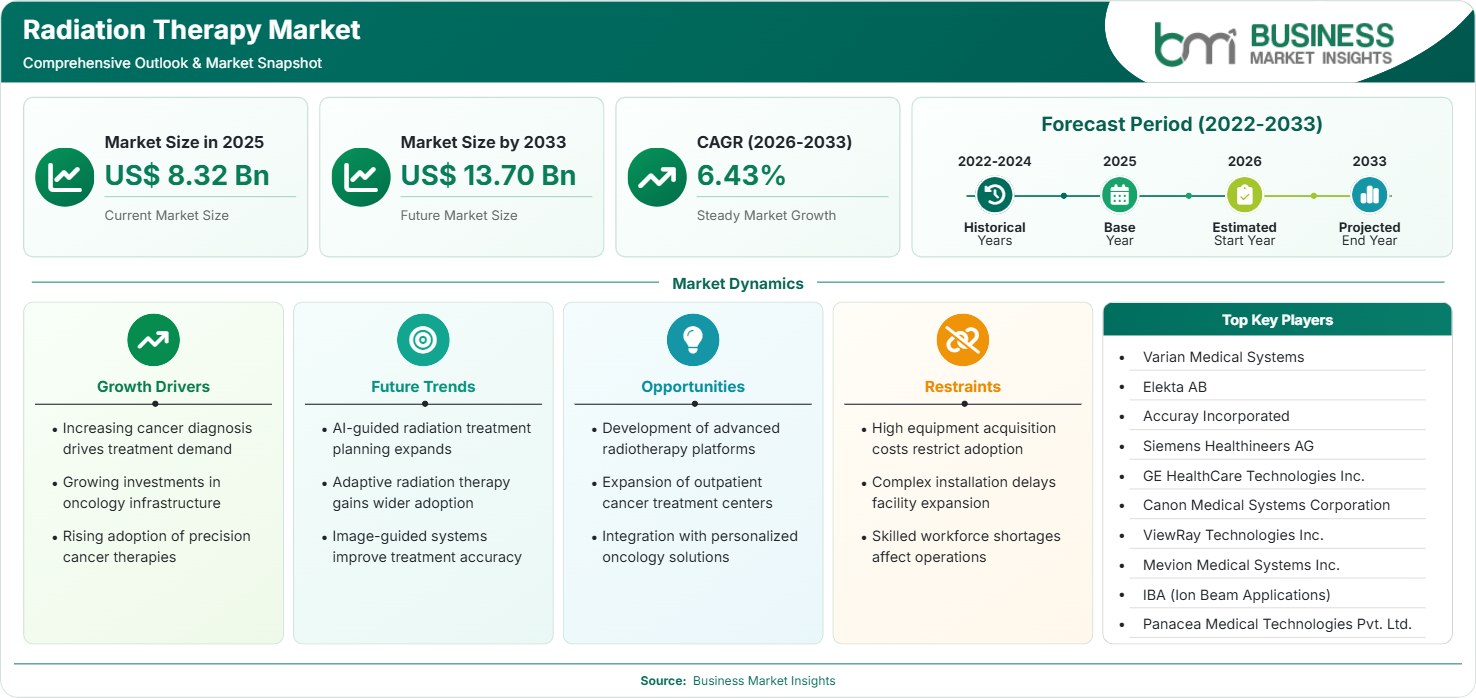
The Radiation Therapy Market size was valued at US$ 8.32 billion in 2025 and is projected to reach US$ 13.7 billion by 2033, growing at a CAGR of 6.43% during 2026–2033. Increasing cancer diagnoses, expanding investments in oncology infrastructure, rising adoption of precision cancer therapies, technological innovation in radiotherapy systems, and growing focus on personalized treatment approaches continue creating substantial opportunities for healthcare providers and equipment manufacturers.

Report Coverage
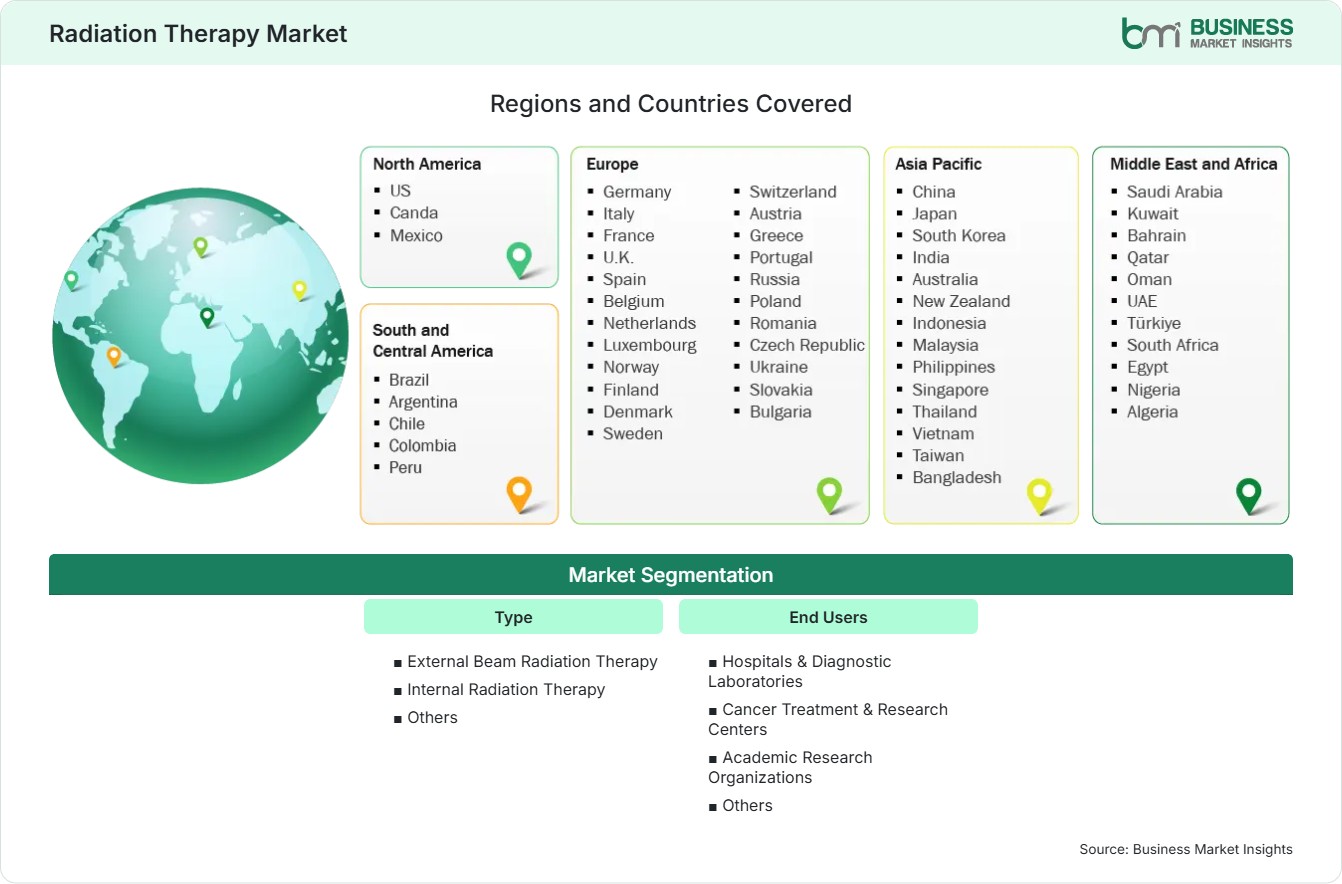
  • Type: External Beam Radiation Therapy, Internal Radiation Therapy, Others
  • End Users: Hospitals & Diagnostic Laboratories, Cancer Treatment & Research Centers, Academic Research Organizations, Others
US$ 8.32 Bn Market size in 2025
US$ 13.70 Bn Market Size by 2033
6.43% CAGR, 2026 - 2033
2026-2033 Forecast Period

01 AI Overview

Radiation Therapy Market Summary

  • North America Region: North America holds 38%–41% radiation therapy market share in 2025 and is projected to grow at a CAGR of 6.0%–6.4% during 2026–2033. Strong oncology infrastructure, continuous investments in advanced radiotherapy equipment, favorable reimbursement policies, and increasing cancer screening programs continue supporting regional market expansion. The United States remains the largest contributor, supported by extensive adoption of precision radiotherapy technologies, robust healthcare spending, and an estimated CAGR of 6.1%–6.5% during the forecast period.
  • Fastest Growing Region: Asia Pacific accounts for 25%–28% market share in 2025 and is expected to register a CAGR of 7.2%–7.7% during 2026–2033. Rising cancer incidence, expanding healthcare infrastructure, increasing government investments, growing installation of advanced radiation therapy systems, and improving access to specialized oncology services continue accelerating regional growth.
  • Leading Segment: Hospitals & Diagnostic Laboratories represent 48%–51% radiation therapy market share in 2025 and are forecast to grow at a CAGR of 6.2%–6.6% during 2026–2033. Comprehensive oncology services, high patient inflow, availability of multidisciplinary cancer care, and continuous investments in advanced treatment equipment continue strengthening segment leadership.
  • High Growth Segment: External Beam Radiation Therapy accounts for 61%–64% market share in 2025 and is anticipated to expand at a CAGR of 6.8%–7.2% during 2026–2033. Continuous technological advancements, higher treatment precision, expanding clinical applications, and increasing adoption of image-guided radiation therapy continue driving segment growth.
  • Key Market Opportunity: Advancements in artificial intelligence-enabled treatment planning, adaptive radiotherapy systems, proton therapy technologies, and personalized oncology solutions are expected to create significant commercial opportunities while improving treatment accuracy and patient outcomes.
  • Major Market Players: Varian Medical Systems, Elekta AB, Accuray Incorporated, Siemens Healthineers AG, GE HealthCare Technologies Inc., Canon Medical Systems Corporation, ViewRay Technologies, Inc., Mevion Medical Systems, Inc., IBA (Ion Beam Applications), and Panacea Medical Technologies Pvt. Ltd.
02 Strategic Insights

Radiation Therapy Market: Strategic Insights

Radiation Therapy Market Strategic Framework
FREE PDF
Request your free sample
Request free sample
03 Stakeholder View

Key Takeaways

  • The industry ecosystem keeps on developing through enhanced cooperation between equipment suppliers, software vendors, hospitals, educational organizations, and cancer research groups to foster innovations, increase treatment accuracy, and make clinical procedures more efficient.
  • External Beam Radiotherapy continues to be the most promising commercial segment due to growing clinical uses, development of technology, increased hospital adoption, as well as constant improvement of treatment planning, image integration, and precise dosage delivery.
  • Innovations are currently aimed at adaptive radiation therapy, AI-powered treatment planning, image-guided radiotherapy, proton therapy, and automation technologies to increase treatment accuracy and make it safer for patients and more efficient.
  • Asia Pacific region is developing into an increasingly favored investment region owing to higher cancer prevalence, development of the oncology industry infrastructure, increased health care spending, favorable government programs, and the increasing installations of cutting-edge radiotherapy systems in major health care facilities.
  • Strategic acquisitions, partnerships in technology development, joint research projects, and new product development activities help maintain a competitive position while allowing for market expansion on a global scale and faster introduction of the next generation of radiation therapy technologies.
  • Increasing adoption of digital oncology systems, cloud-based treatment planning tools, predictive analytics, and an individualized approach to cancer treatment is expected to increase the efficiency of clinical decisions and treatment results.
04 Geographic Outlook

Radiation Therapy Market Regional Highlights

North America Radiation Therapy Market

North America accounted for 38%–41% of the Radiation Therapy Market Share in 2025 and is projected to expand at a CAGR of 6.0%–6.4% during 2026–2033. Strengths of this region include advanced oncology infrastructure, a positive reimbursement structure, healthy healthcare expenditure, and the adoption of image-guided and precision radiotherapy equipment. Regular investment in cancer research, continued acquisition of advanced medical facilities, and rising preference for minimally invasive cancer treatment methods keep building regional superiority.

  • Hospitals and comprehensive cancer centers continue upgrading radiotherapy equipment with advanced linear accelerators, adaptive treatment planning software, and image-guided technologies to improve treatment precision and patient outcomes.
  • Strong collaboration between healthcare providers, academic institutions, and technology companies accelerates clinical adoption of innovative radiotherapy platforms while supporting continuous oncology research and product development.
  • Favorable reimbursement frameworks encourage broader utilization of advanced radiation therapy procedures, enabling healthcare institutions to expand access to high-quality oncology treatment services.
  • Continuous investments in artificial intelligence, automation, and digital treatment planning improve workflow efficiency while enhancing treatment accuracy across multidisciplinary cancer care facilities.
  • Growing emphasis on personalized oncology treatment supports wider adoption of adaptive radiotherapy systems capable of optimizing radiation dose delivery according to individual patient requirements.

US Radiation Therapy Market

The United States accounted for 32%–35% of global revenue in 2025 and is forecast to grow at a CAGR of 6.1%–6.5% through 2026–2033. Strong healthcare infrastructure, high adoption of advanced oncology technologies, favorable regulatory support, and significant investments in precision medicine continue driving market expansion across hospitals and specialized cancer treatment centers.

  • Leading healthcare institutions continue investing in next-generation radiotherapy platforms that combine imaging, treatment planning, and artificial intelligence to improve operational efficiency and treatment outcomes.
  • Expanding cancer screening initiatives support earlier diagnosis, increasing the number of patients eligible for radiation therapy as part of multidisciplinary treatment strategies.
  • Government-supported oncology research programs continue encouraging development of advanced treatment technologies while accelerating clinical evaluation of innovative radiotherapy solutions.
  • Increasing adoption of outpatient oncology services contributes to higher demand for compact, efficient, and technologically advanced radiation therapy equipment.

Europe Radiation Therapy Market

Europe held 27%–30% market share during 2025 and is anticipated to grow at a CAGR of 5.9%–6.3% through 2026–2033. Strong public healthcare systems, continuous investments in oncology modernization, and expanding access to advanced cancer treatment technologies continue supporting regional growth. Germany leads regional revenue with a CAGR of 6.0%–6.4%, while Poland is expected to record the fastest growth at 6.8%–7.2% during the forecast period.

  • Germany continues strengthening radiotherapy capabilities through investments in advanced treatment equipment, precision oncology technologies, and multidisciplinary cancer care infrastructure.
  • Poland benefits from expanding healthcare modernization programs, increasing oncology investments, and improving access to advanced radiation therapy services across regional healthcare facilities.
  • European research collaborations continue accelerating development of innovative treatment planning software, adaptive radiotherapy technologies, and personalized oncology solutions.
  • Healthcare providers increasingly adopt digital treatment management platforms that improve workflow integration, treatment accuracy, and patient monitoring throughout therapy.
  • Government initiatives supporting modernization of cancer treatment infrastructure continue encouraging replacement of aging radiotherapy systems with technologically advanced platforms.

Asia Pacific Radiation Therapy Market

Asia Pacific accounted for 25%–28% of revenue in 2025 and is expected to witness a high CAGR of 7.2%–7.7% from 2026–2033. Cancer prevalence, the development of healthcare infrastructure, rising government healthcare expenditure, and the availability of cutting-edge technologies for oncology treatments are factors contributing to market growth in the region. China has the highest regional growth, at 7.1%–7.5%, while India records the fastest growth, at 7.8%–8.2%.

  • China continues expanding the installation of advanced radiotherapy systems while strengthening domestic manufacturing capabilities and investments in precision oncology technologies.
  • India benefits from the increasing number of specialized cancer hospitals, the expansion of healthcare infrastructure, and government initiatives that promote access to advanced cancer treatment.
  • Japan and South Korea continue advancing innovation through integration of artificial intelligence, robotics, and imaging technologies into radiation therapy workflows.
  • Rising healthcare expenditure across emerging Asian economies supports procurement of modern radiotherapy equipment while improving access to specialized oncology care.
  • International collaborations continue strengthening clinical research, technology transfer, and professional training programs supporting regional oncology development.

Rest of World Radiation Therapy Market

The Rest of World accounted for 7%–9% of the market share in 2025 and will maintain a CAGR of 6.3%–6.8% during 2026–2033. South & Central America are expanding their oncology infrastructure through healthcare infrastructure development and the growing use of advanced radiation therapy techniques.

The Middle East & Africa are strengthening specialized cancer care through the establishment of dedicated oncology centers, modernization of healthcare facilities, and growing investments in precision treatment technologies. Brazil leads South & Central America with a CAGR of 6.4%–6.8%, while Saudi Arabia records the fastest regional growth at 6.9%–7.3%.

  • Brazil continues investing in cancer treatment infrastructure, improving access to advanced radiotherapy equipment and expanding oncology services across major healthcare institutions.
  • Saudi Arabia is strengthening specialized oncology care through healthcare modernization initiatives, increased capital investment, and deployment of advanced radiation therapy technologies.
  • Growing international partnerships improve technology transfer, clinical training, and equipment installation across developing healthcare systems.
  • Rising awareness regarding early cancer diagnosis supports increasing utilization of radiation therapy as part of comprehensive oncology treatment pathways.
  • Continuous improvements in healthcare infrastructure create long-term opportunities for advanced radiotherapy equipment manufacturers and technology providers.
Global Market Geography
FREE PDF
Request your free sample
Request free sample
05 Segment Analysis

Radiation Therapy Market Segmentation

Type

The Type segment accounted for 61%-64% of total market share in 2025 and is expected to grow at a CAGR of 6.7%-7.1% during 2026-2033. Technological developments in precise dose delivery, imaging, and treatment planning have been aiding clinical uptake in healthcare organizations. The Radiation Therapy Market Forecasts an increasing need for high-end radiation delivery systems that enhance treatment accuracy while reducing harm to surrounding tissues.

  • External Beam Radiation Therapy: Continues dominating clinical practice due to broad application across multiple cancer types, advanced imaging integration, superior treatment precision, and ongoing technological improvements enhancing therapeutic outcomes.
  • Internal Radiation Therapy (Brachytherapy): Maintains important clinical relevance through localized radiation delivery, reduced exposure to surrounding healthy tissues, and effective treatment of selected solid tumors requiring targeted intervention.

End Users

The End Users segment occupied the market share of 48% to 51% in 2025 and is projected to grow at a CAGR of 6.2% to 6.6% during 2026 to 2033. Growing investment in oncological infrastructure, multidisciplinary cancer care, and specialty centers continues to fuel market growth. The Radiation Therapy Market Trends increasingly emphasize integrated cancer care models combining advanced treatment technologies with personalized clinical management.

  • Hospitals & Diagnostic Laboratories: Continue leading adoption through comprehensive oncology services, multidisciplinary treatment capabilities, high patient volumes, and continuous investments in advanced radiotherapy infrastructure.
  • Cancer Treatment & Research Centers: Drive innovation through specialized oncology expertise, clinical research activities, precision treatment approaches, and adoption of next-generation radiation therapy technologies.
  • Academic Research Organizations: Support advancement of radiation oncology through translational research, clinical trials, technology validation, and collaborative development of innovative treatment protocols.
06 Market Forces

Radiation Therapy Market Dynamics

Key Market Drivers

Increasing cancer diagnosis drives treatment demand

The rising number of cases of cancer all over the world means that there is a growing need for radiation therapy as a form of treatment. According to the WHO, cancer is one of the greatest killers in the world. This has been fueling research and development of equipment used in treating cancer. Early detection through screening is resulting in more people being suitable for radiotherapy. These developments continue supporting Radiation Therapy Market Growth by expanding treatment volumes, encouraging equipment modernization, and increasing adoption of precision radiation technologies across hospitals and specialized cancer centers.

Growing investments in oncology infrastructure

Governments and private healthcare providers are significantly increasing investments in oncology infrastructure to improve access to comprehensive cancer care. The establishment of dedicated hospitals for treating cancer patients and the introduction of new linear accelerators are making healthcare facilities more capable worldwide. Government spending on healthcare, collaboration with other countries, and healthcare modernization activities are promoting the purchase of innovative radiotherapy systems. Such moves also help develop the market potential.

Rising adoption of precision cancer therapies

Healthcare providers are increasingly adopting precision oncology approaches that combine advanced imaging, adaptive treatment planning, and highly targeted radiation delivery. Combining image-guided radiation therapy, stereotactic radiosurgery, intensity-modulated radiation therapy, and AI-driven planning enables accurate treatment with minimal radiation exposure to healthy tissue. Technological developments continue to improve performance, encourage the replacement of legacy systems, and meet the increasing demand for radiation therapy systems in developed and emerging healthcare markets.

Key Market Opportunities

Development of advanced radiotherapy platforms

Manufacturers are investing in next-generation radiotherapy systems that include artificial intelligence, adaptive treatment planning, real-time imaging, and workflow automation. Such advancements offer enhanced treatment accuracy, increased operational efficiency, and improved patient safety. The increasing demand for accurate cancer treatment technology offers a business opportunity for manufacturers. The Radiation Therapy Market Forecasts indicate that continued technological innovation will remain a major contributor to long-term industry expansion.

Expansion of outpatient cancer treatment centers

The growing establishment of outpatient oncology centers is creating significant opportunities for compact, cost-efficient, and high-performance radiation therapy systems. Outpatient care centers provide greater convenience for patients, reduce the burden on hospitals, make treatments accessible, and enhance clinical processes. The healthcare industry continues to allocate funds to highly technological radiotherapy devices intended for outpatient care settings, thereby creating business opportunities for manufacturers in both developed and developing healthcare markets.

Integration with personalized oncology solutions

The integration of radiation therapy with precision medicine, molecular diagnostics, biomarker-guided treatment planning, and digital oncology platforms is transforming cancer care delivery. Personalized treatment approaches allow physicians to tailor radiation doses to individual patients’ characteristics and enhance treatment effectiveness. Developers keep inventing technologies that are compatible with each other and contribute to the development of oncology care ecosystems.

Market Restraints and Challenges

High equipment acquisition costs restrict adoption

Factor: Advanced radiation therapy systems require substantial capital investment, specialized infrastructure, ongoing maintenance, and highly trained clinical personnel. Impact: High acquisition costs restrict adoption among smaller healthcare facilities, particularly in developing economies, limiting access to technologically advanced treatment systems despite increasing demand for modern oncology services. Financial constraints also delay equipment replacement cycles and reduce procurement of premium radiotherapy technologies.

Complex installation delays facility expansion

Factor: Radiation therapy equipment requires specialized construction, radiation shielding, regulatory approvals, and comprehensive technical validation before clinical operation. Impact: Lengthy installation processes increase project timelines, delay treatment capacity expansion, and raise implementation costs for healthcare providers. These challenges may postpone patient access to advanced radiotherapy services while slowing market penetration in emerging healthcare systems.

07 Company Analysis

Competitive Landscape

The competitive environment is characterized by continuous technological innovation, strategic collaborations, product development, and expansion of precision oncology solutions. Leading companies continue investing in artificial intelligence, adaptive radiotherapy, proton therapy, and integrated imaging technologies to strengthen their global presence. Ongoing innovation and commercialization activities continue supporting comprehensive Radiation Therapy Market Analysis across hospitals, cancer treatment centers, and research institutions.

Company Name

Overview

Products and Services Relevant to this Market

Varian Medical Systems

Global leader in radiation oncology technologies providing integrated cancer treatment solutions for healthcare providers worldwide.

Linear accelerators, treatment planning software, oncology informatics, adaptive radiotherapy systems, and imaging solutions.

Elekta AB

International medical technology company specializing in precision radiation therapy and neuroscience solutions.

Radiation therapy systems, stereotactic radiosurgery platforms, treatment planning software, and oncology workflow solutions.

Accuray Incorporated

Developer of advanced radiotherapy technologies focused on highly precise cancer treatment delivery.

CyberKnife systems, TomoTherapy platforms, adaptive radiation therapy, and oncology software solutions.

Siemens Healthineers AG

Global healthcare technology company offering advanced diagnostic imaging and oncology technologies.

Imaging systems, radiation therapy planning solutions, oncology software, and integrated diagnostic platforms.

GE HealthCare Technologies Inc.

Healthcare technology company delivering imaging, digital healthcare, and oncology support solutions.

Diagnostic imaging systems, oncology workflow technologies, artificial intelligence solutions, and healthcare software platforms.

Canon Medical Systems Corporation

Global provider of advanced medical imaging and healthcare technology solutions.

CT systems, MRI systems, diagnostic imaging, radiation treatment planning support, and healthcare informatics.

ViewRay Technologies, Inc.

Medical technology company specializing in MRI-guided radiation therapy systems.

MRI-guided radiotherapy platforms, adaptive treatment systems, and precision oncology technologies.

Mevion Medical Systems, Inc.

Developer of compact proton therapy systems for advanced cancer treatment.

Proton therapy systems, particle therapy technologies, treatment planning solutions, and oncology equipment.

IBA (Ion Beam Applications)

Global leader in proton therapy and particle accelerator technologies for cancer treatment.

Proton therapy solutions, dosimetry systems, particle accelerators, and oncology quality assurance technologies.

Panacea Medical Technologies Pvt. Ltd.

Medical technology manufacturer focused on radiation oncology equipment and cancer treatment solutions.

Linear accelerators, brachytherapy systems, radiotherapy planning software, and oncology equipment.


10 Trust & Transparency

Research Methodology

The market analysis combines proprietary research with secondary data from government agencies, company disclosures, regulatory filings, industry databases and expert interviews. Market estimates are validated through data triangulation, cross-market benchmarking and analyst review.

View Full Research Methodology

11 Questions Answered

Frequently Asked Questions

What does the Radiation Therapy Market Report include?

The Market Report provides comprehensive insights into market size, segmentation, competitive landscape, regional performance, emerging technologies, growth drivers, restraints, opportunities, recent developments, and future industry outlook.

What opportunities will shape future market expansion?

Artificial intelligence-enabled treatment planning, adaptive radiotherapy, personalized oncology solutions, advancements in proton therapy, and the expansion of outpatient cancer treatment centers are expected to create significant future growth opportunities.

Which segment holds the largest market share?

External Beam Radiation Therapy remains the leading modality due to its broad clinical applications, superior treatment precision, integration with advanced imaging technologies, and ongoing technological improvements that support effective cancer management.

Which region dominates the Market?

North America maintains its leading position due to advanced healthcare infrastructure, strong adoption of innovative radiotherapy technologies, favorable reimbursement systems, and ongoing investments in oncology research and treatment modernization.

What factors are driving the Radiation Therapy Market?

The market is driven by increasing cancer incidence, expanding oncology infrastructure, rising adoption of precision cancer therapies, technological advancements in radiation delivery systems, and growing investments in specialized cancer treatment facilities worldwide.

Access the Full Radiation Therapy Market Report

Get segment-level forecasts, regional estimates, competitive benchmarking, company profiles and downloadable Excel datasets.

Access the full Radiation Therapy Market Report
350 pages PDF & Excel | 2026-08-04