
Hormone Replacement Therapy (HRT) Market Outlook: Size, Share, Trends, Growth Analysis, Competitive Landscape & Forecast, 2026–2033

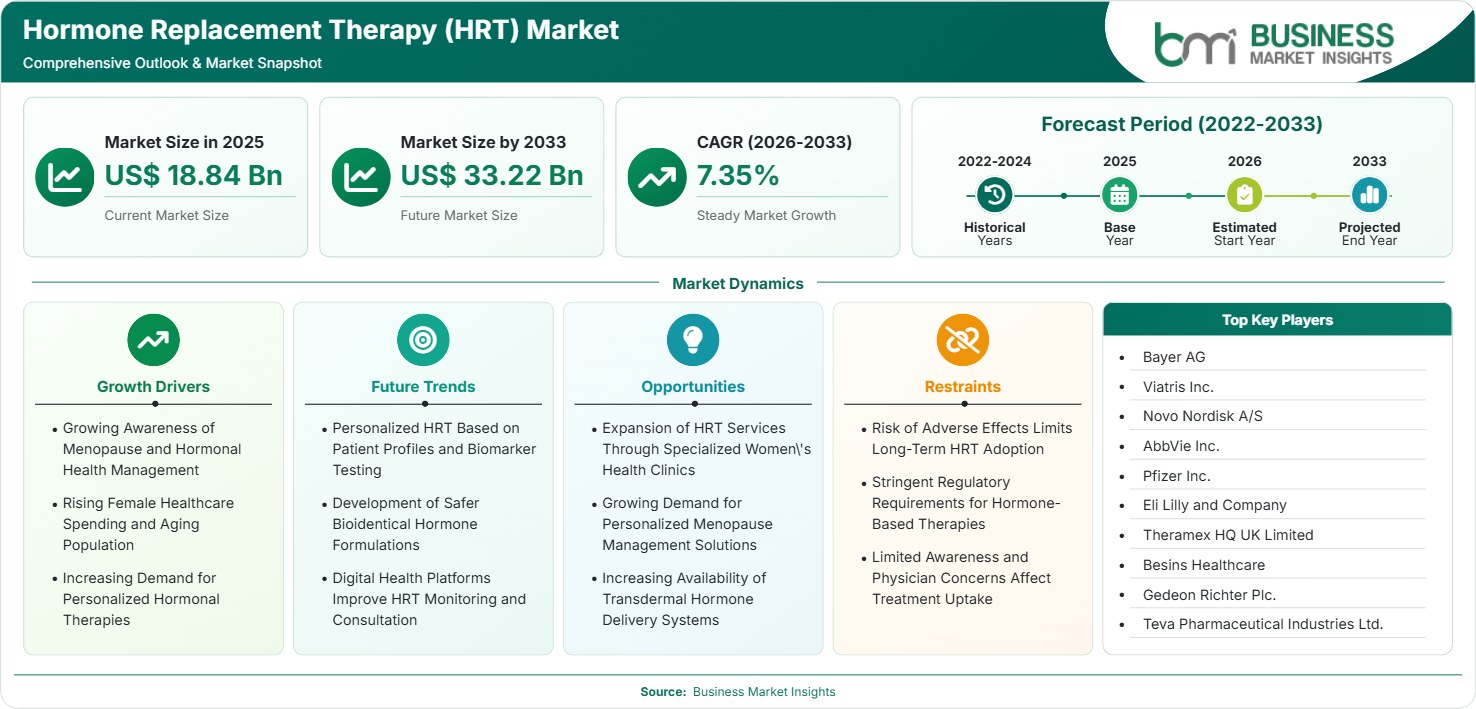
The Hormone Replacement Therapy (HRT) Market size was valued at US$ 18.84 Billion in 2025 and is projected to reach US$ 33.22 Billion by 2033, growing at a CAGR of 7.35% during 2026–2033, supported by menopause awareness, aging populations, specialized women's healthcare, and broader access to hormone-management services.

Report Coverage
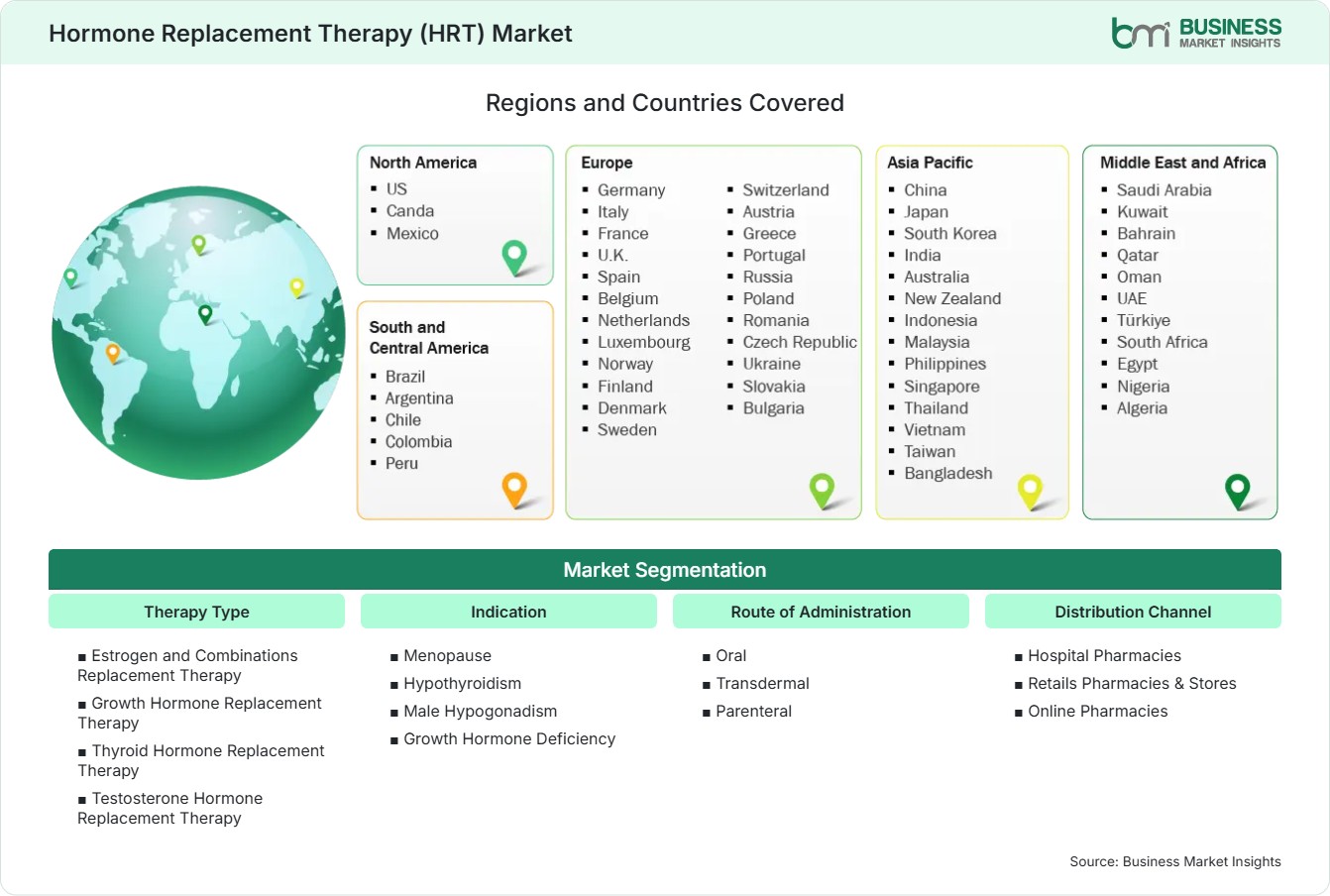
  • Therapy Type: Estrogen and Combinations Replacement Therapy, Growth Hormone Replacement Therapy, Thyroid Hormone Replacement Therapy, Testosterone Hormone Replacement Therapy
  • Indication: Menopause, Hypothyroidism, Male Hypogonadism, Growth Hormone Deficiency
  • Route of Administration: Oral, Transdermal, Parenteral
  • Distribution Channel: Hospital Pharmacies, Retails Pharmacies & Stores, Online Pharmacies
US$ 18.84 Bn Market size in 2025
US$ 33.22 Bn Market Size by 2033
7.35% CAGR, 2026 - 2033
2026-2033 Forecast Period

AI Overview

Hormone Replacement Therapy (HRT) Market Summary

  • North America Region: North America holds a modeled 38%–42% Hormone Replacement Therapy (HRT) Market share in 2025 and expands at a 6.8%–7.5% CAGR, supported by menopause awareness, specialist clinics, and expanding women's health services. The US represents the leading regional market, expanding at a 6.9%–7.6% CAGR through broader menopause care access, personalized treatment pathways, specialist services, and increasing availability of convenient hormone-delivery options.
  • Fastest Growing Region: Asia Pacific holds a modeled 15%–19% share in 2025 and expands at a 8.1%–8.9% CAGR, supported by improving women's healthcare access, rising awareness of menopause, urban healthcare spending, expanding specialist services, and wider pharmaceutical distribution.
  • Leading Segment: Estrogen and Combinations Replacement Therapy holds a modeled 51%–55% share in 2025 and expands at a 7.0%–7.6% CAGR, supported by menopause management, established prescribing practices, expanding treatment awareness, personalized regimens, and broader access to estrogen-based therapies.
  • High Growth Segment: Transdermal administration holds a modeled 24%–28% share in 2025 and expands at a 8.0%–8.8% CAGR, supported by patient convenience, differentiated delivery characteristics, expanding patch and gel availability, and increasing physician interest in personalized administration.
  • Key Market Opportunity: Expansion of specialized menopause clinics, personalized treatment platforms, transdermal systems, digital patient support, and coordinated pharmacy access can broaden treatment adoption and improve continuity of care.
  • Major Market Players: Bayer AG, Viatris Inc., Novo Nordisk A/S, AbbVie Inc., Pfizer Inc., Eli Lilly and Company, Theramex HQ UK Limited, Besins Healthcare Monaco S.A.M., Gedeon Richter Plc., Teva Pharmaceutical Industries Ltd.
Strategic Insights

Hormone Replacement Therapy (HRT) Market: Strategic Insights

Hormone Replacement Therapy (HRT) Market Strategic Framework
FREE PDF
Request your free sample
Request free sample
Stakeholder View

Key Takeaways

  • The competitive value chain increasingly extends beyond pharmaceutical manufacturing into specialist healthcare delivery, physician education, patient support, pharmacy access, and treatment monitoring.
  • Menopause management remains the strongest commercial opportunity, while thyroid, testosterone, and growth hormone therapies provide diversification across endocrine indications and patient populations.
  • Transdermal delivery is becoming an important product-development direction as manufacturers seek differentiated administration formats that support convenience, adherence, and individualized treatment planning.
  • Asia Pacific offers an attractive expansion pathway because improving healthcare access, increasing awareness, and growing specialist women's health infrastructure can widen the treated patient base.
  • Partnerships between pharmaceutical companies, specialist clinics, distributors, and digital healthcare platforms can strengthen patient acquisition, treatment continuity, and geographic reach.
  • Regulatory modernization and evolving clinical discussions are creating opportunities for companies that can provide clear evidence-based positioning, differentiated formulations, and patient-specific treatment options.
Geographic Outlook

Hormone Replacement Therapy (HRT) Market Regional Highlights

North America Hormone Replacement Therapy (HRT) Market

North America Hormone Replacement Therapy (HRT) Market holds a modeled 38%–42% share in 2025 and expands at a 6.8%–7.5% CAGR through 2033. The region benefits from established healthcare infrastructure, specialist menopause services, pharmaceutical availability, and strong physician awareness. The US represents the principal market, while Canada provides additional demand through established healthcare channels.

  • The US remains the principal demand center, supported by specialist healthcare services, established pharmaceutical distribution, physician awareness, and expanding attention to menopause management.
  • Transdermal therapies are gaining strategic importance as manufacturers develop differentiated delivery formats that support convenient administration and individualized treatment approaches.
  • Specialized women's health providers can strengthen treatment access by integrating consultation, therapy selection, monitoring, education, and pharmacy coordination within coordinated care pathways.
  • Pharmaceutical companies increasingly compete through formulation breadth, patient support, treatment continuity, and physician engagement rather than relying solely on established hormone molecules.

US Hormone Replacement Therapy (HRT) Market

The US Hormone Replacement Therapy (HRT) Market accounts for a modeled 80%–84% of North American demand in 2025 and expands at a 6.9%–7.6% CAGR through 2033. Demand is supported by established pharmaceutical infrastructure, specialist women's healthcare, broad pharmacy access, and growing attention to menopause management. The market increasingly emphasizes individualized therapy selection, administration-route preferences, and informed risk-benefit discussions.

  • Menopause care remains the primary commercial opportunity, with treatment providers emphasizing individualized therapy selection according to symptoms, health status, preferences, and treatment objectives.
  • Pharmacy and digital access models can improve continuity by simplifying prescription fulfillment, refills, education, and communication between patients and healthcare professionals.
  • Transdermal products provide manufacturers with opportunities to differentiate through convenient administration, formulation characteristics, patient preference, and treatment-management flexibility.

Europe Hormone Replacement Therapy (HRT) Market

Europe Hormone Replacement Therapy (HRT) Market holds a modeled 26%–30% share in 2025 and expands at a 6.3%–7.0% CAGR through 2033. The UK, Germany, France, Italy, and Spain represent major markets, while the UK and Germany offer comparatively strong growth opportunities. Established healthcare systems, increasing menopause awareness, specialist services, and pharmaceutical access support demand.

  • The UK remains a leading market where menopause awareness, healthcare discussions, and availability of established hormone therapies support continued treatment demand.
  • Germany provides strong commercial potential through established pharmaceutical distribution, specialist healthcare services, and increasing attention to individualized menopause management.
  • France and Italy provide substantial demand through established healthcare systems and pharmaceutical channels, while specialist women's health services support treatment continuity.
  • Transdermal delivery continues to provide product-development opportunities where manufacturers can address administration preferences and differentiated treatment-management requirements.

Asia Pacific Hormone Replacement Therapy (HRT) Market

Asia Pacific Hormone Replacement Therapy (HRT) Market holds a modeled 15%–19% share in 2025 and expands at a 8.1%–8.9% CAGR through 2033, making it the fastest-growing region. Japan, China, Australia, South Korea, and India represent important markets, while India and China provide strong expansion potential. Rising healthcare access, increasing awareness of menopause and endocrine disorders, urbanization, specialist services, and improving pharmaceutical distribution support adoption.

  • Japan remains a mature market with established healthcare capabilities and demand for endocrine and menopause therapies supported by specialist medical practice.
  • China provides strong growth potential as healthcare access, women's health awareness, pharmaceutical availability, and specialist services continue expanding across major urban centers.
  • India offers an emerging opportunity as women's healthcare spending, specialist clinics, pharmaceutical distribution, and awareness of menopause management improve.
  • Australia provides an established women's healthcare environment where therapy selection, clinical guidance, and access to specialized menopause services support market development.
  • Southeast Asian markets offer longer-term opportunities as healthcare infrastructure expands and pharmaceutical companies strengthen specialist distribution and physician education programs.

Rest of World Hormone Replacement Therapy (HRT) Market

Rest of World holds a modeled 9%–13% share in 2025 and expands at a 6.0%–6.8% CAGR through 2033. Latin America provides demand through Brazil, Mexico, Argentina, and Colombia, supported by expanding private healthcare and pharmaceutical access. Middle Eastern markets are developing through greater women's health investment, specialist healthcare expansion, and improving access to prescription therapies. Regional demand remains influenced by affordability, physician availability, insurance coverage, pharmacy networks, and awareness of menopause and endocrine conditions. The Middle East and Africa provide longer-term growth opportunities as healthcare systems expand specialist services and pharmaceutical distribution. Saudi Arabia, the United Arab Emirates, South Africa, and selected North African markets represent important opportunities.

  • Brazil represents an important Latin American market, supported by established pharmaceutical channels, private healthcare services, and increasing attention to women's health management.
  • Mexico provides opportunities through expanding healthcare access, pharmacy networks, specialist services, and increasing demand for differentiated hormone-delivery options.
  • Saudi Arabia and the United Arab Emirates offer opportunities through healthcare modernization, specialist service expansion, and increasing investment in women's health infrastructure.
  • South Africa provides a regional gateway for pharmaceutical distribution and specialist healthcare services, supporting longer-term adoption of endocrine and menopause therapies.
Global Market Geography
FREE PDF
Request your free sample
Request free sample
Segment Analysis

Hormone Replacement Therapy (HRT) Market Segmentation

Therapy Type

Estrogen and Combinations Replacement Therapy holds a modeled 51%–55% share in 2025 and expands at a 7.0%–7.6% CAGR through 2033. Its leading position reflects broad menopause applications and established treatment pathways. Growth Hormone Replacement Therapy, Thyroid Hormone Replacement Therapy, and Testosterone Hormone Replacement Therapy broaden the market across distinct endocrine indications and treatment requirements.

  • Estrogen and Combinations Replacement Therapy: Serves menopause-related hormone deficiency and remains central to treatment strategies, with demand influenced by symptom management, formulation choice, and individualized prescribing.
  • Growth Hormone Replacement Therapy: Addresses documented growth hormone deficiency and requires specialist assessment, monitoring, and treatment adjustment according to individual endocrine needs.
  • Thyroid Hormone Replacement Therapy: Supports management of thyroid hormone deficiency, with long-term treatment requiring consistent dosing, monitoring, formulation selection, and continued physician oversight.
  • Testosterone Hormone Replacement Therapy: Addresses testosterone deficiency through individualized treatment approaches, with demand influenced by diagnostic assessment, formulation preferences, monitoring, and clinical suitability.

Indication

Menopause holds a modeled 48%–52% share in 2025 and expands at a 7.1%–7.7% CAGR through 2033. Increasing awareness and specialized care support its leading position. Hypothyroidism provides a stable endocrine treatment base, while Male Hypogonadism and Growth Hormone Deficiency diversify demand. The Hormone Replacement Therapy (HRT) Market scope therefore spans both women's health and broader endocrine treatment pathways.

  • Menopause: Represents the leading indication, with demand shaped by symptom burden, awareness, physician engagement, personalized treatment, and availability of multiple hormone-delivery options.
  • Hypothyroidism: Generates recurring treatment requirements because patients require ongoing hormone replacement and appropriate dose management under clinical supervision.
  • Male Hypogonadism: Supports testosterone replacement demand where clinically confirmed deficiency requires individualized treatment, monitoring, formulation selection, and long-term management.
  • Growth Hormone Deficiency: Represents a specialist indication requiring endocrine evaluation, treatment planning, monitoring, and appropriate administration according to patient needs.

Route of Administration

Oral administration holds a modeled 53%–57% share in 2025 and expands at a 6.8%–7.4% CAGR through 2033. Transdermal delivery is the fastest-growing route, expanding at 8.0%–8.8% as patients and physicians consider administration flexibility and product characteristics. Parenteral therapies maintain specialist applications where injectable delivery is clinically appropriate.

  • Oral: Remains widely adopted because of familiarity, established prescribing practices, product availability, and straightforward administration across several hormone-replacement indications.
  • Transdermal: Gains momentum through patches and gels that provide alternative administration options and support differentiated product positioning within individualized treatment pathways.
  • Parenteral: Serves selected endocrine indications where injectable administration is clinically appropriate, with demand influenced by treatment requirements, dosing schedules, and specialist supervision.

Distribution Channel

Retails Pharmacies & Stores holds a modeled 45%–49% share in 2025 and expands at a 6.9%–7.5% CAGR through 2033. Hospital Pharmacies remain important for specialist and institutional care, while Online Pharmacies provide the fastest expansion at 8.3%–9.1%. Distribution competition increasingly centers on prescription convenience, availability, refill continuity, patient education, and integration with healthcare providers and digital services.

  • Hospital Pharmacies: Support specialist treatment pathways and institutional care, providing controlled dispensing, clinical coordination, and access to therapies prescribed within hospital-based healthcare settings.
  • Retails Pharmacies & Stores: Remain a major channel because of broad geographic accessibility, prescription fulfillment, pharmacist support, product availability, and recurring refill requirements.
  • Online Pharmacies: Expand through digital prescription management, home delivery, convenient refills, and integration with telehealth or remote patient-support services.
Market Forces

Hormone Replacement Therapy (HRT) Market Dynamics

Key Market Drivers

Growing Awareness of Menopause and Hormonal Health Management

Increasing awareness about menopause and the importance of hormone health is leading to more discussions between patients and healthcare practitioners, resulting in greater awareness of treatment choices at an earlier stage. Increasing awareness is also helping to change attitudes toward menopause. All these factors are encouraging doctors to make evaluations on symptoms, quality of life, patient history, and treatment preferences in a more organized manner. Hormone Replacement Therapy (HRT) Market trend is also demonstrating to growing interest in treatments that combine consultation and prescription facilities.

Rising Female Healthcare Spending and Aging Population

Growing healthcare attention toward women's health is expanding the addressable market for menopause and endocrine therapies. Aging populations create a broader need for healthcare services addressing hormonal changes, while increasing healthcare spending supports access to specialist consultations, pharmaceutical therapies, diagnostic services, and ongoing treatment management. This driver is particularly relevant in developed markets where established healthcare infrastructure enables broader treatment access. It is also becoming important in emerging economies as private healthcare networks, specialist clinics, and pharmaceutical distribution expand.

Increasing Demand for Personalized Hormonal Therapies

The use of hormone replacement therapies is becoming more personalized in terms of choosing the right medication. Doctors take into account such factors as patient symptoms, treatment goals, patient medical history, medication features, administration route, tolerance to medications, and patient’s choice. This leads to more opportunities for companies to differentiate their products based on different dosing options, transdermal medications, combination preparations, and convenient administration forms.

Key Market Opportunities

Expansion of HRT Services Through Specialized Women's Health Clinics

Specialized women's health clinics may enhance the accessibility of hormone replacement therapy through the integration of counseling, symptom evaluation, selection of appropriate treatment, monitoring, education, and follow-ups in the care pathway. Specific pharmaceutical firms can partner with specialist clinicians via educational programs, patient support services, clinical information, and management tools for treatment. Hormone Replacement Therapy (HRT) Market Forecasts are therefore facilitated through delivery models in healthcare that increase accessibility in addition to the availability of pharmaceuticals.

Growing Demand for Personalized Menopause Management Solutions

Personalization of menopause management creates opportunities for companies producing differentiated formulations, routes of administration, patient support systems, and treatment management solutions. Patient needs can vary with regard to their symptoms and the necessary treatment, thus making the need for personalization approaches. Such needs can be met through the development of formulations, dosing options, combination treatments, transdermal delivery systems, and educational materials facilitating proper discussions on treatment. Digital technology can enhance such products by allowing patients to report symptoms and manage prescriptions.

Increasing Availability of Transdermal Hormone Delivery Systems

Transdermal technology is presenting significant opportunity in the area of product development through its increasing use in the form of patches, gels, and similar delivery systems to deliver hormones. The use of such delivery systems offers an alternative in delivering treatment that patients may prefer due to convenience. Areas where product developers are focusing their attention include adhesion, dosing, convenience of application, packaging, and formulation stability. Companies with established transdermal expertise can make formulations, extend their portfolios through lifecycle management, and geographic expansion.

Market Restraints and Challenges

Risk of Adverse Effects Limits Long-Term HRT Adoption

Factor: The adverse effects and contraindications of hormone therapy must be individually assessed because they vary depending on the kind of treatment, administration route, dosage, period of treatment, and patient. Impact: Concerns over safety will prevent patients who are suitable for treatment from beginning or continuing the therapy, and it will also make doctors reluctant to prescribe such treatment if its benefit is not clear.

Stringent Regulatory Requirements for Hormone-Based Therapies

Factor: Hormone-based medications require extensive regulation of quality, safety, efficacy, manufacturing consistency, labeling, adverse drug reactions, and post-market responsibilities. Impact: The complex regulations could result in longer development periods, higher compliance costs, greater demands for evidentiary support, and increased commercialization complexities across various countries. Companies must have strong quality control systems and ensure their claims align with their approvals.

Company Analysis

Competitive Landscape

Hormone Replacement Therapy (HRT) Market analysis reveals that competition in the industry has been driven mainly by product portfolio, formulation, mode of administration, geographical reach, relationship with specialists and experience with women’s health care. The other competitive factors include regulatory abilities, physician training, support for patients, and product availability.

Company Name

Overview

Products and Services relevant to this market

Bayer AG

Global pharmaceutical and healthcare company with a substantial women's health portfolio and established menopause expertise.

Menopause therapies, hormone-related healthcare products, women's health services, and hormone-free menopause treatment options.

Viatris Inc.

Global healthcare company with broad pharmaceutical capabilities and experience in women's health and transdermal delivery.

Women's health medicines, hormone-related products, transdermal delivery technologies, and pharmaceutical lifecycle management.

Novo Nordisk A/S

Global healthcare company with strong endocrinology expertise and capabilities across hormone-related disease management.

Endocrine therapies, hormone-related medicines, metabolic healthcare products, and specialized pharmaceutical development.

AbbVie Inc.

Research-driven pharmaceutical company with established women's health and specialty-care capabilities.

Women's health medicines, hormone-related treatments, specialty pharmaceuticals, and patient-support resources.

Pfizer Inc.

Global biopharmaceutical company with longstanding pharmaceutical development and women's health capabilities.

Hormone therapies, women's health medicines, specialty pharmaceuticals, and healthcare information resources.

Eli Lilly and Company

Global pharmaceutical company with extensive endocrine and specialty-care research capabilities.

Endocrine medicines, hormone-related therapies, specialty pharmaceuticals, and clinical development capabilities.

Theramex HQ UK Limited

Dedicated women's health company focused on menopause, contraception, fertility, and osteoporosis care.

Menopause hormone therapies, women's health medicines, patient education, specialist resources, and treatment-support programs.

Besins Healthcare Monaco S.A.M.

Specialized hormone-health company focused on women's and men's reproductive and endocrine health.

Estrogen therapies, progesterone products, testosterone therapies, transdermal hormone systems, and menopause resources.

Gedeon Richter Plc.

European pharmaceutical company with a strong women's healthcare portfolio and hormone-therapy expertise.

Estrogen therapies, menopause hormone replacement products, transdermal hormone delivery, and women's health medicines.

Teva Pharmaceutical Industries Ltd.

Global pharmaceutical company with extensive generic and specialty medicine capabilities across multiple therapeutic areas.

Hormone-related medicines, generic pharmaceutical formulations, specialty products, and broad distribution capabilities.

Trust & Transparency

Research Methodology

The market analysis combines proprietary research with secondary data from government agencies, company disclosures, regulatory filings, industry databases and expert interviews. Market estimates are validated through data triangulation, cross-market benchmarking and analyst review.

View Full Research Methodology

Questions Answered

Frequently Asked Questions

What should pharmaceutical companies prioritize when developing HRT products?

Companies should prioritize clinically differentiated formulations, consistent manufacturing, regulatory compliance, patient convenience, clear safety communication, reliable distribution, and healthcare-professional education.

How are specialized women's health clinics affecting HRT access?

Specialized clinics can integrate consultation, symptom assessment, therapy selection, monitoring, education, and follow-up, creating more focused menopause-care pathways.

What is the role of transdermal delivery in Hormone Replacement Therapy (HRT) Market report?

Transdermal delivery provides an alternative to oral administration through systems such as patches and gels. Its expanding availability gives healthcare professionals additional route-specific options when developing individualized treatment plans.

How is personalized treatment changing HRT prescribing?

Personalized treatment encourages physicians to consider symptoms, medical history, treatment objectives, administration route, tolerability, and patient preferences when selecting therapy.

Which therapy type represents the core of hormone replacement treatment?

Estrogen and combination replacement therapy represents the central treatment category because of its broad relevance to menopause management. Growth hormone, thyroid hormone, and testosterone therapies expand the market across distinct endocrine conditions.

Access the Full Hormone Replacement Therapy (HRT) Market Report

Get segment-level forecasts, regional estimates, competitive benchmarking, company profiles and downloadable Excel datasets.

Access the full Hormone Replacement Therapy (HRT) Market Report
350 pages PDF & Excel | 2026-08-20
Similar Research

Related Market Reports