
Negative Pressure Wound Therapy Market Outlook: Size, Share, Trends, Growth Analysis, Competitive Landscape & Forecast, 2026-2033

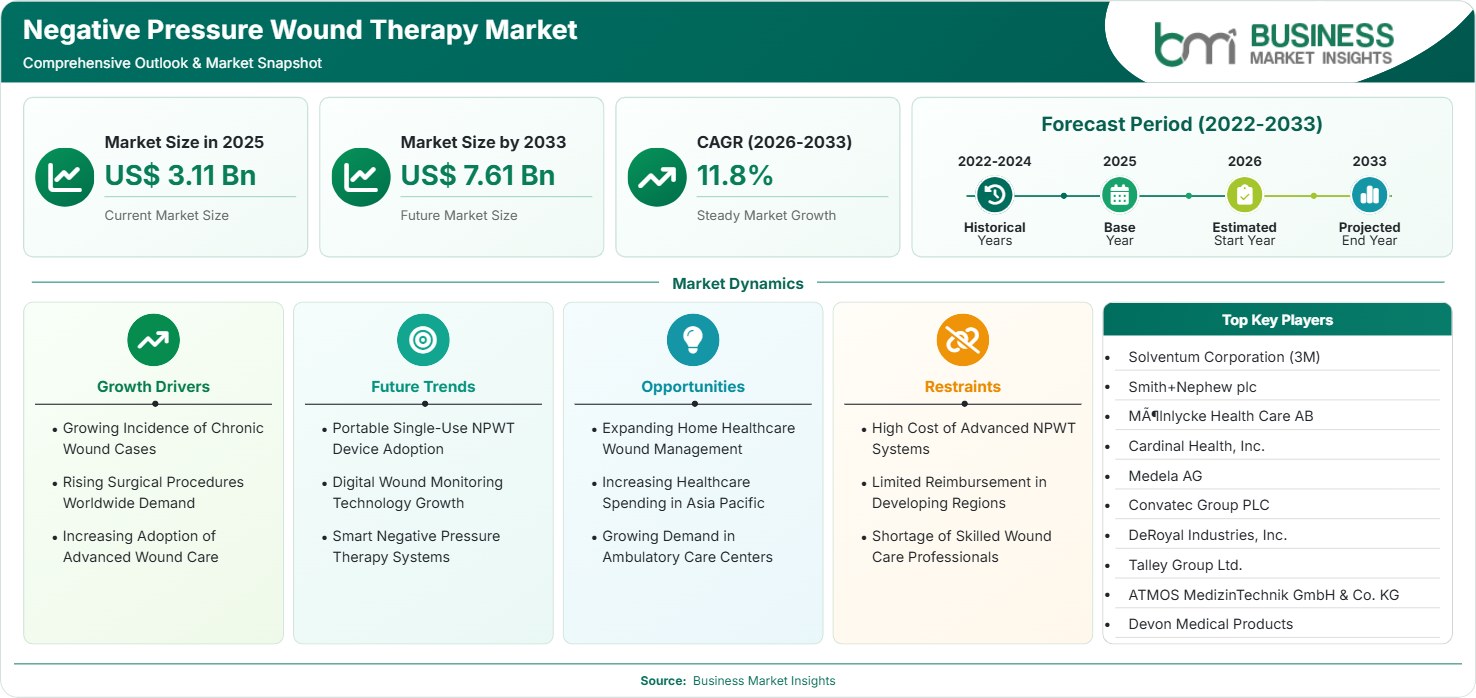
The Negative Pressure Wound Therapy Market size was valued at US$ 3.11 billion in 2025 and is projected to reach US$ 7.61 billion by 2033, growing at a CAGR of 11.8% from 2026 to 2033, driven by increasing chronic wound prevalence, rising surgical volumes, growing adoption of advanced wound management solutions, and expanding demand for portable healthcare technologies.

Report Coverage
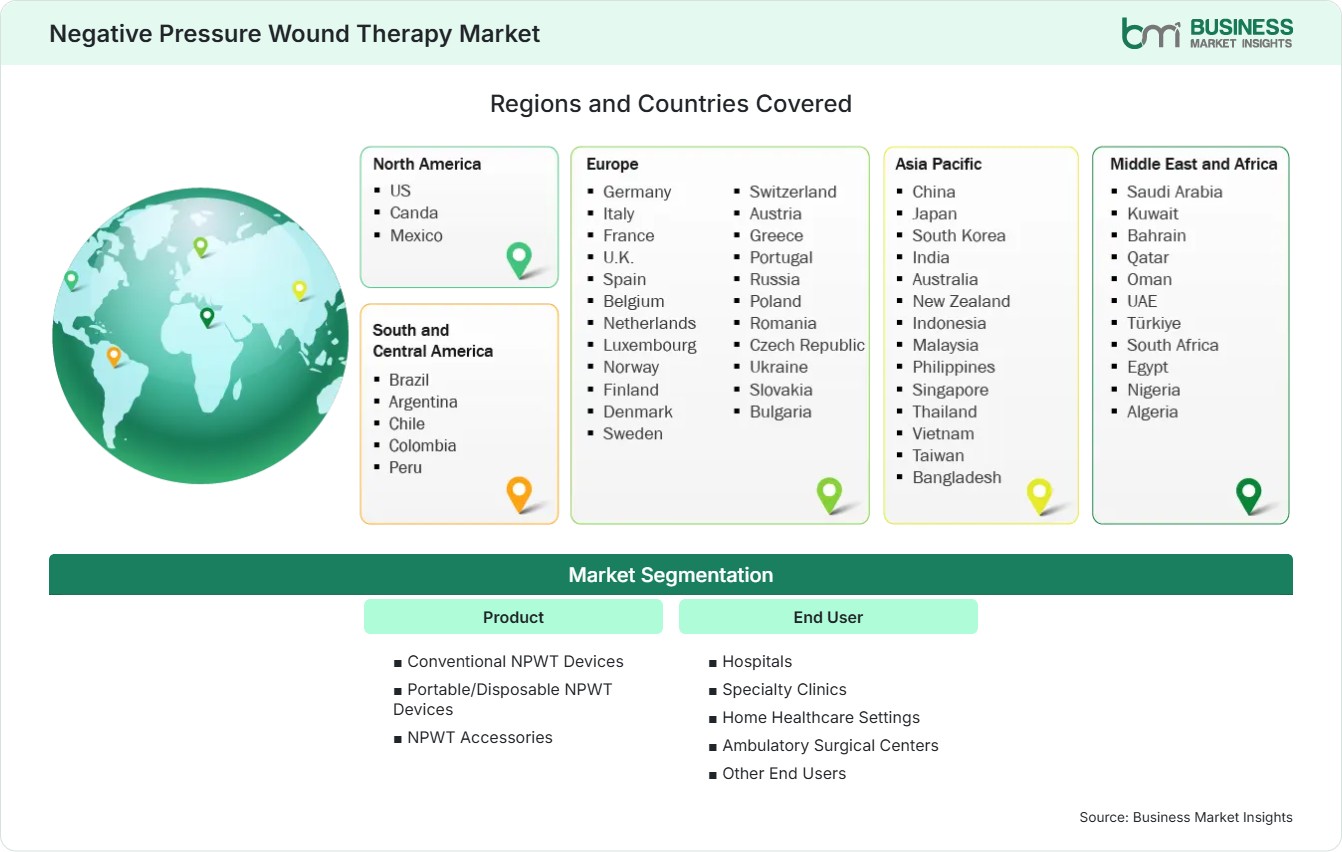
  • Product: Conventional NPWT Devices, Portable/Disposable NPWT Devices, NPWT Accessories
  • End User: Hospitals, Specialty Clinics, Home Healthcare Settings, Ambulatory Surgical Centers, Other End Users
US$ 3.11 Bn Market size in 2025
US$ 7.61 Bn Market Size by 2033
11.8% CAGR, 2026 - 2033
2026-2033 Forecast Period

AI Overview

Negative Pressure Wound Therapy Market Summary

  • North America Region: North America held 38%–41% share in 2025 and is projected to grow at a CAGR of 11.2%–11.7% from 2026–2033. The region benefits from advanced healthcare infrastructure, high adoption of advanced wound care technologies, increasing surgical procedures, and strong reimbursement frameworks. The US market is expected to register a CAGR of 11.3%–11.8% during the forecast period, supported by chronic wound management demand and hospital technology adoption.
  • Fastest Growing Region: Asia Pacific accounted for 23%–26% share in 2025 and is anticipated to expand at a CAGR of 12.5%–13.2% from 2026–2033. Growth is supported by increasing healthcare expenditure, rising diabetic wound cases, expanding hospital infrastructure, and growing adoption of advanced wound treatment systems.
  • Leading Segment: Conventional NPWT Devices represented 48%–52% share in 2025 and are projected to grow at a CAGR of 10.8%–11.4% from 2026–2033, driven by established clinical acceptance, hospital usage, proven therapeutic outcomes, and broad application across complex wound management.
  • High Growth Segment: Portable/Disposable (Single-use) NPWT Devices accounted for 27%–31% share in 2025 and are expected to register a CAGR of 13.0%–13.7%, supported by increasing home healthcare adoption, patient mobility requirements, reduced hospital stays, and demand for convenient wound care solutions.
  • Key Market Opportunity: Expansion of home-based wound management, increasing ambulatory care adoption, healthcare infrastructure development, and rising demand for cost-effective portable wound therapy solutions are creating significant opportunities.
  • Major Market Players: Solventum Corporation, Smith+Nephew plc, Mölnlycke Health Care AB, Cardinal Health, Inc., Medela AG, Convatec Group PLC, DeRoyal Industries, Inc., Talley Group Ltd., ATMOS MedizinTechnik GmbH & Co. KG, and Devon Medical Products.
Strategic Insights

Negative Pressure Wound Therapy Market: Strategic Insights

Negative Pressure Wound Therapy Market Strategic Framework
FREE PDF
Request your free sample
Request free sample
Stakeholder View

Key Takeaways

  • The market ecosystem includes NPWT device manufacturers, wound dressing suppliers, healthcare providers, distributors, reimbursement organizations, and home healthcare service companies.
  • Portable and disposable NPWT devices represent high-growth opportunities as healthcare systems prioritize outpatient treatment, reduced hospitalization periods, and patient mobility.
  • Innovation is shifting toward compact devices, digital wound monitoring, smart connectivity, improved battery performance, and user-friendly therapy management systems.
  • Asia Pacific provides strong expansion potential due to rising healthcare expenditure, increasing chronic disease burden, improving medical infrastructure, and growing adoption of advanced wound care.
  • Companies are pursuing strategic collaborations, product launches, geographic expansion, and portfolio diversification to strengthen their positions in advanced wound management.
  • Future market competitiveness will depend on clinical effectiveness, affordability, reimbursement availability, device portability, and integration of digital healthcare technologies.
Geographic Outlook

Negative Pressure Wound Therapy Market Regional Highlights

North America Negative Pressure Wound Therapy Market

North America accounted for 38%–41% of the Negative Pressure Wound Therapy Market share in 2025 and is projected to grow at a CAGR of 11.2%–11.7% from 2026–2033. The region maintains leadership due to advanced healthcare systems, high adoption of innovative wound care technologies, strong presence of leading manufacturers, and increasing demand for chronic wound management. The United States remains the major contributor because of extensive hospital networks and established reimbursement structures.

  • The United States continues leading adoption through advanced hospitals, surgical centers, and chronic wound treatment facilities.
  • Healthcare providers are increasingly integrating NPWT systems into postoperative and complex wound management protocols.
  • Manufacturers are focusing on portable solutions to support outpatient care and home healthcare applications.
  • Advanced reimbursement mechanisms encourage adoption of premium wound care technologies across healthcare facilities.

US Negative Pressure Wound Therapy Market

The US represented 34%–37% share in 2025 and is expected to grow at a CAGR of 11.3%–11.8% from 2026–2033. Growth is supported by increasing surgical procedures, rising diabetes-related wound cases, advanced healthcare infrastructure, and widespread adoption of innovative wound treatment systems. Hospitals, ambulatory surgical centers, and home healthcare providers continue expanding utilization of NPWT technologies.

  • Growing chronic wound prevalence is increasing demand for advanced treatment solutions across healthcare facilities.
  • Hospitals are adopting portable NPWT devices to improve patient discharge management and recovery outcomes.
  • Home healthcare providers are expanding wound management services using convenient therapy systems.
  • Healthcare companies are investing in advanced wound care technologies to improve clinical efficiency.

Europe Negative Pressure Wound Therapy Market

Europe accounted for 29%–32% share of the Negative Pressure Wound Therapy Market in 2025 and is projected to grow at a CAGR of 11.5%–12.0% from 2026–2033. The region benefits from advanced healthcare infrastructure, rising elderly population, increasing chronic wound prevalence, and strong adoption of evidence-based wound management practices. Germany, the United Kingdom, France, and Italy remain key markets due to established medical systems and increasing investments in advanced wound care technologies.

  • Germany continues supporting market expansion through advanced hospital infrastructure and increasing adoption of innovative wound management systems.
  • The United Kingdom is witnessing higher NPWT utilization due to growing surgical procedures and chronic wound treatment requirements.
  • France is increasing adoption through healthcare modernization programs and improved access to advanced medical devices.
  • Italy is experiencing demand growth through expanding wound care services and rising elderly patient populations.
  • European manufacturers and healthcare providers are focusing on improving cost-effective and patient-centered wound treatment approaches.

Asia Pacific Negative Pressure Wound Therapy Market

Asia Pacific accounted for 23%–26% of the market in 2025 and is expected to register a CAGR of 12.5%–13.2% in the Negative Pressure Wound Therapy Market Forecasts, making it the fastest-growing regional market. Increasing healthcare expenditure, rising diabetes prevalence, expanding hospital capacity, and improving access to advanced medical technologies are accelerating adoption. China, India, Japan, South Korea, and Southeast Asian countries are creating significant opportunities for NPWT manufacturers.

  • China is expanding advanced wound care adoption through healthcare infrastructure development and increasing medical technology investments.
  • India is witnessing rising demand due to increasing chronic wound cases and improving hospital treatment capabilities.
  • Japan continues supporting adoption through advanced healthcare systems and growing elderly care requirements.
  • South Korea is increasing utilization through technology-focused healthcare facilities and innovative medical device adoption.
  • Southeast Asian countries are developing healthcare infrastructure, creating new opportunities for advanced wound management solutions.

Rest of World Negative Pressure Wound Therapy Market

Rest of World accounted for 7%–10% share of the Negative Pressure Wound Therapy Market in 2025 and is expected to grow at a CAGR of 11.8%–12.4% from 2026–2033. Latin America, the Middle East, and Africa are gradually expanding adoption due to healthcare modernization, increasing awareness of advanced wound care, and improving medical infrastructure. Rising investments in hospitals and specialty clinics are supporting greater availability of NPWT technologies.

Middle Eastern countries are increasing healthcare spending and expanding specialized treatment facilities, while Latin American markets are improving access to advanced medical devices. African healthcare systems are gradually adopting NPWT solutions through hospital development programs and international healthcare initiatives.

  • Brazil is witnessing increased demand through expanding hospital networks and growing chronic wound management requirements.
  • Saudi Arabia is investing in healthcare modernization and specialized medical treatment infrastructure.
  • The United Arab Emirates is expanding advanced healthcare services through technology-focused hospital developments.
  • South Africa remains a key regional market supported by improving healthcare access and specialized wound care services.
  • Emerging economies are creating opportunities through increased awareness and adoption of modern wound treatment technologies.
Global Market Geography
FREE PDF
Request your free sample
Request free sample
Segment Analysis

Negative Pressure Wound Therapy Market Segmentation

Product

Product segmentation represents different NPWT solutions designed for varying clinical requirements, treatment settings, and patient needs. The segment accounted for 100% share in 2025 and is projected to grow at a CAGR of 11.8% from 2026–2033. Increasing demand for efficient wound healing, outpatient care solutions, and advanced therapy systems continues encouraging manufacturers to develop innovative NPWT devices and accessories.

  • Conventional NPWT Devices: Conventional NPWT devices maintain strong adoption due to established clinical effectiveness, extensive hospital usage, advanced wound management capabilities, and suitability for complex wound treatment procedures.
  • Portable/Disposable (Single-use) NPWT Devices: Portable and disposable NPWT devices are gaining momentum because of patient mobility benefits, reduced hospitalization requirements, simplified operation, and suitability for home healthcare environments.
  • NPWT Accessories: NPWT accessories support therapy effectiveness through specialized dressings, canisters, tubing systems, and components required for efficient wound treatment management.

End User

End User segmentation reflects expanding NPWT adoption across hospitals, specialty clinics, home healthcare settings, ambulatory surgical centers, and other medical facilities. The segment accounted for 100% share in 2025 and is expected to grow at a CAGR of 11.8% from 2026–2033. Increasing healthcare decentralization, outpatient treatment growth, and demand for efficient wound care solutions are supporting broader adoption.

  • Hospitals: Hospitals remain the primary users due to high volumes of complex wounds, surgical procedures, trauma cases, and availability of specialized wound care teams.
  • Specialty Clinics: Specialty clinics are increasingly adopting NPWT systems to provide focused wound management services and improve treatment outcomes for chronic and difficult-to-heal wounds.
  • Home Healthcare Settings: Home healthcare settings are expanding adoption due to demand for convenient wound management, shorter hospital stays, and improved patient comfort during recovery.
  • Ambulatory Surgical Centers (ASCs): Ambulatory surgical centers are increasing NPWT utilization for postoperative wound management, faster patient discharge, and efficient outpatient care delivery.
  • Other End Users: Other end users include rehabilitation facilities, long-term care centers, and specialized medical facilities requiring advanced wound treatment capabilities.
Market Forces

Negative Pressure Wound Therapy Market Dynamics

Key Market Drivers

Growing Incidence of Chronic Wound Cases

The increasing prevalence of chronic wounds, including diabetic foot ulcers, pressure ulcers, and venous leg ulcers, is driving demand for advanced wound management technologies. Aging populations, rising diabetes prevalence, and lifestyle-related health conditions are increasing the burden of difficult-to-heal wounds globally. Negative pressure wound therapy supports faster healing by promoting tissue formation, reducing wound complications, and improving clinical outcomes. Healthcare providers are increasingly adopting NPWT systems as part of comprehensive wound care protocols. The growing need for effective solutions in hospitals, specialty clinics, and home healthcare settings continues strengthening the Negative Pressure Wound Therapy Market growth through expanded clinical applications and improved patient management approaches.

Rising Surgical Procedures Worldwide Demand

The continuous increase in surgical procedures worldwide is creating strong demand for effective postoperative wound management solutions. Surgical incisions, trauma-related wounds, and complex procedures often require advanced healing support to reduce infection risks and improve recovery outcomes. Healthcare facilities are increasingly integrating NPWT technologies into surgical care pathways due to their ability to manage challenging wounds efficiently. Expansion of ambulatory surgical centers and improvements in surgical infrastructure are further supporting adoption. Rising healthcare access, increasing elective surgeries, and growing preference for minimally invasive procedures are expected to sustain demand for NPWT systems across hospitals and outpatient care environments.

Increasing Adoption of Advanced Wound Care

Healthcare providers are increasingly shifting from traditional wound management methods toward advanced wound care technologies that improve treatment efficiency and patient outcomes. NPWT systems are gaining adoption due to their ability to provide controlled wound environments, support tissue regeneration, and reduce healing complications. Advances in portable devices, disposable systems, and digital monitoring capabilities are making therapy more accessible across different healthcare settings. Growing awareness among clinicians regarding evidence-based wound management practices is encouraging broader implementation. These developments are supporting the Negative Pressure Wound Therapy Market trends toward patient-centered, technology-driven, and cost-efficient wound care solutions.

Key Market Opportunities

Expanding Home Healthcare Wound Management

The expansion of home healthcare services is creating significant opportunities for NPWT manufacturers as healthcare systems increasingly prioritize outpatient treatment models. Portable and disposable NPWT devices enable patients to continue therapy outside hospitals while reducing healthcare facility burden and improving recovery convenience. Rising elderly populations, increasing chronic disease cases, and demand for lower-cost care delivery are encouraging healthcare providers to adopt home-based wound management solutions. Companies developing easy-to-use devices, remote monitoring capabilities, and patient-friendly systems are positioned to benefit from this transition toward decentralized healthcare delivery models.

Increasing Healthcare Spending in Asia Pacific

Growing healthcare expenditure across Asia Pacific is creating new opportunities for advanced wound care technology adoption. Countries including China, India, Japan, and South Korea are investing in hospital infrastructure, medical technology modernization, and improved access to specialized treatment solutions. Increasing chronic disease prevalence and expanding healthcare coverage are encouraging adoption of advanced wound management systems. International and regional medical device companies are strengthening distribution networks to capture emerging demand. Continued healthcare investment, rising awareness among clinicians, and improving reimbursement structures are expected to accelerate NPWT penetration across developing Asian markets.

Growing Demand in Ambulatory Care Centers

The increasing role of ambulatory surgical centers in healthcare delivery is creating opportunities for NPWT adoption beyond traditional hospital environments. ASCs are expanding globally due to their ability to provide efficient procedures, shorter recovery periods, and cost-effective treatment options. NPWT systems support postoperative wound management in these facilities by improving healing outcomes and enabling efficient patient discharge. Manufacturers are developing compact and portable solutions specifically suited for outpatient applications. Growing investment in ambulatory healthcare infrastructure and increasing preference for outpatient procedures are expected to generate additional demand for NPWT technologies.

Market Restraints and Challenges

High Cost of Advanced NPWT Systems

Factor: Advanced NPWT systems involve significant costs associated with device procurement, specialized dressings, maintenance requirements, and continuous supply of therapy components. High treatment expenses can limit adoption among smaller healthcare facilities, price-sensitive patients, and regions with constrained healthcare budgets. Cost concerns may slow penetration despite clinical benefits, particularly where affordable alternatives or limited funding options influence purchasing decisions.

Limited Reimbursement in Developing Regions

Factor: Developing regions often have limited reimbursement coverage for advanced wound care technologies, creating financial barriers for healthcare providers and patients requiring NPWT treatment. Restricted reimbursement availability can reduce accessibility, delay adoption, and limit Negative Pressure Wound Therapy Market expansion in emerging economies. Healthcare systems may require stronger policy support, insurance coverage improvements, and cost-effective solutions to increase NPWT utilization.

Company Analysis

Competitive Landscape

The Negative Pressure Wound Therapy Market analysis highlights a competitive landscape consisting of medical technology companies, advanced wound care specialists, and healthcare solution providers. Companies are focusing on device innovation, portable NPWT systems, disposable technologies, strategic partnerships, and geographic expansion to strengthen market positions.

Company Name

Overview

Products and Services relevant to this market

Solventum Corporation

Healthcare technology company providing advanced wound care and medical solutions globally.

Negative pressure wound therapy systems, wound dressings, therapy accessories, and advanced wound care products.

Smith+Nephew plc

Global medical technology company specializing in wound management and surgical solutions.

NPWT devices, wound dressings, portable therapy systems, and wound care technologies.

Mölnlycke Health Care AB

Wound care company focused on innovative healthcare products and solutions.

NPWT solutions, wound dressings, surgical products, and wound management technologies.

Cardinal Health, Inc.

Healthcare solutions provider supporting medical products and clinical supply chains.

Wound care products, NPWT supplies, medical devices, and healthcare distribution services.

Medela AG

Medical technology company offering healthcare solutions across multiple clinical areas.

NPWT systems, wound care devices, therapy accessories, and medical equipment.

Convatec Group PLC

Global medical products company focused on chronic care solutions.

Negative pressure wound therapy products, wound dressings, and advanced wound management solutions.

DeRoyal Industries, Inc.

Healthcare manufacturer providing medical products for clinical applications.

NPWT equipment, wound care accessories, dressings, and hospital care solutions.

Talley Group Ltd.

Medical device company specializing in pressure care and wound management technologies.

NPWT systems, wound therapy equipment, and healthcare support products.

ATMOS MedizinTechnik GmbH & Co. KG

Medical technology company developing clinical equipment solutions.

NPWT devices, surgical equipment, wound management technologies, and healthcare systems.

Devon Medical Products

Medical device company focused on innovative wound care technologies.

NPWT systems, disposable wound therapy products, and advanced wound care solutions.

Industry Activity

Recent Developments

January 2026

Solventum Corporation introduced the V.A.C. Peel and Place Dressing in the United Kingdom, expanding the availability of its next-generation NPWT solution with up to seven days of wear time.

September 2024

Solventum Corporation launched the V.A.C. Peel and Place Dressing, an all-in-one extended-wear dressing for V.A.C. Therapy designed to simplify application, reduce dressing change time, and improve patient comfort in negative pressure wound therapy.

April 2024

Smith+Nephew plc introduced the RENASYS EDGE Negative Pressure Wound Therapy System in the U.S. for home-based chronic wound care and announced distribution partnerships with SunMED Medical Solutions and First Nation Group to expand market access.

April 2024

Smith+Nephew plc announced that the UK National Institute for Health and Care Excellence (NICE) reaffirmed guidance recommending the PICO Single Use Negative Pressure Wound Therapy System for patients at high risk of surgical site infections, supporting broader clinical adoption.

Trust & Transparency

Research Methodology

The market analysis combines proprietary research with secondary data from government agencies, company disclosures, regulatory filings, industry databases and expert interviews. Market estimates are validated through data triangulation, cross-market benchmarking and analyst review.

View Full Research Methodology

Questions Answered

Frequently Asked Questions

What does the Negative Pressure Wound Therapy Market Report cover?

The Negative Pressure Wound Therapy Report covers market size, segmentation analysis, regional outlook, competitive landscape, industry trends, growth factors, challenges, opportunities, and future projections through 2033.

How are companies improving NPWT technologies?

Manufacturers are focusing on compact device designs, disposable systems, digital monitoring features, improved portability, and user-friendly interfaces to enhance therapy effectiveness and patient convenience.

Why are home healthcare settings becoming important for NPWT adoption?

Home healthcare settings are expanding due to demand for cost-efficient treatment models, shorter hospital stays, improved patient comfort, and availability of portable NPWT technologies.

Which product segment is expected to experience strong adoption?

Portable/Disposable (Single-use) NPWT Devices are gaining momentum due to benefits including mobility, ease of use, reduced hospitalization requirements, and suitability for home healthcare applications.

What factors are driving the Negative Pressure Wound Therapy Market growth?

The market is driven by increasing chronic wound cases, rising surgical procedures, growing adoption of advanced wound care technologies, expansion of home healthcare services, and increasing demand for effective wound healing solutions.

Access the Full Negative Pressure Wound Therapy Market Report

Get segment-level forecasts, regional estimates, competitive benchmarking, company profiles and downloadable Excel datasets.

Access the full Negative Pressure Wound Therapy Market Report
350 pages PDF & Excel | 2026-08-04