
Healthcare Payer Network Management Market Outlook: Size, Share, Trends, Growth Analysis, Competitive Landscape & Forecast, 2026-2033

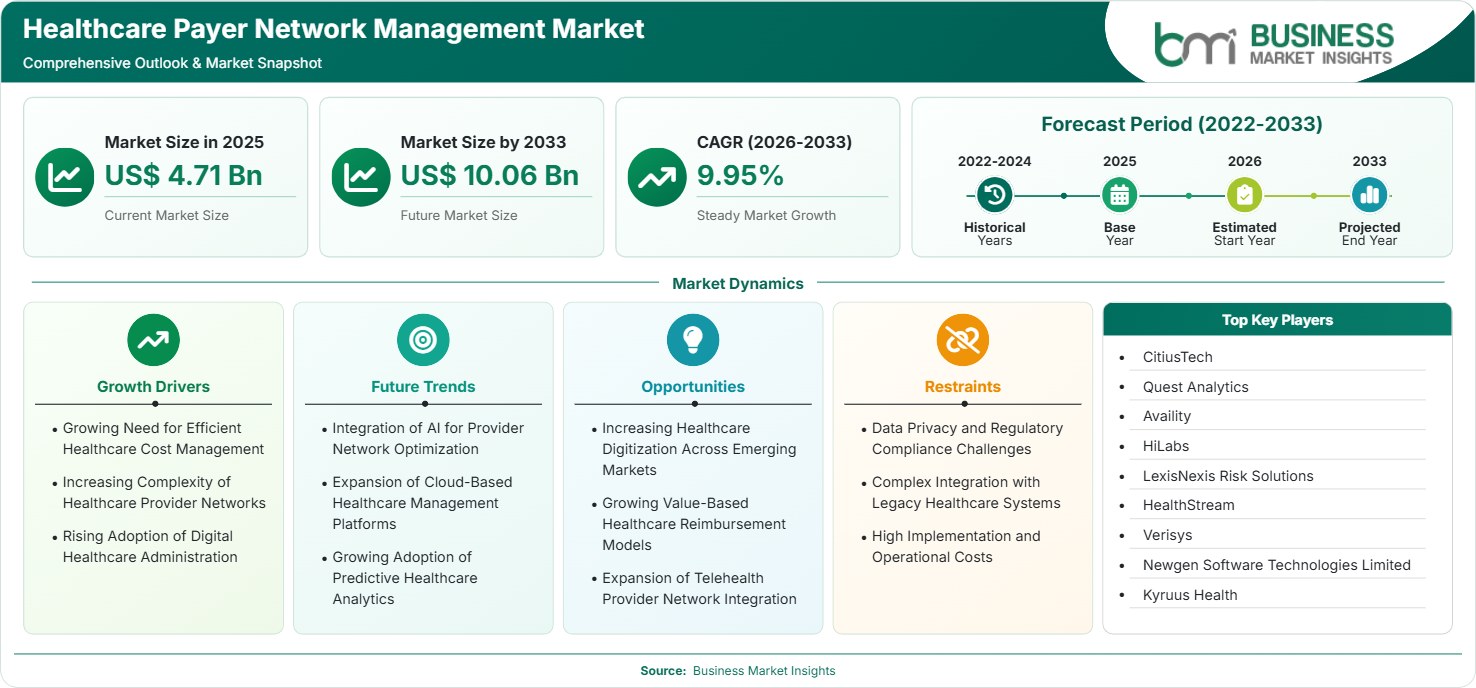
The Healthcare Payer Network Management Market size was valued at US$ 4.71 Billion in 2025 and is projected to reach US$ 10.06 Billion by 2033, growing at a CAGR of 9.95% during 2026–2033. Growing need for efficient healthcare cost management, increasing complexity of healthcare provider networks, rising adoption of digital healthcare administration, expanding telehealth ecosystems, and continuous innovation in healthcare IT platforms are driving sustained demand for advanced payer network management solutions.

Report Coverage
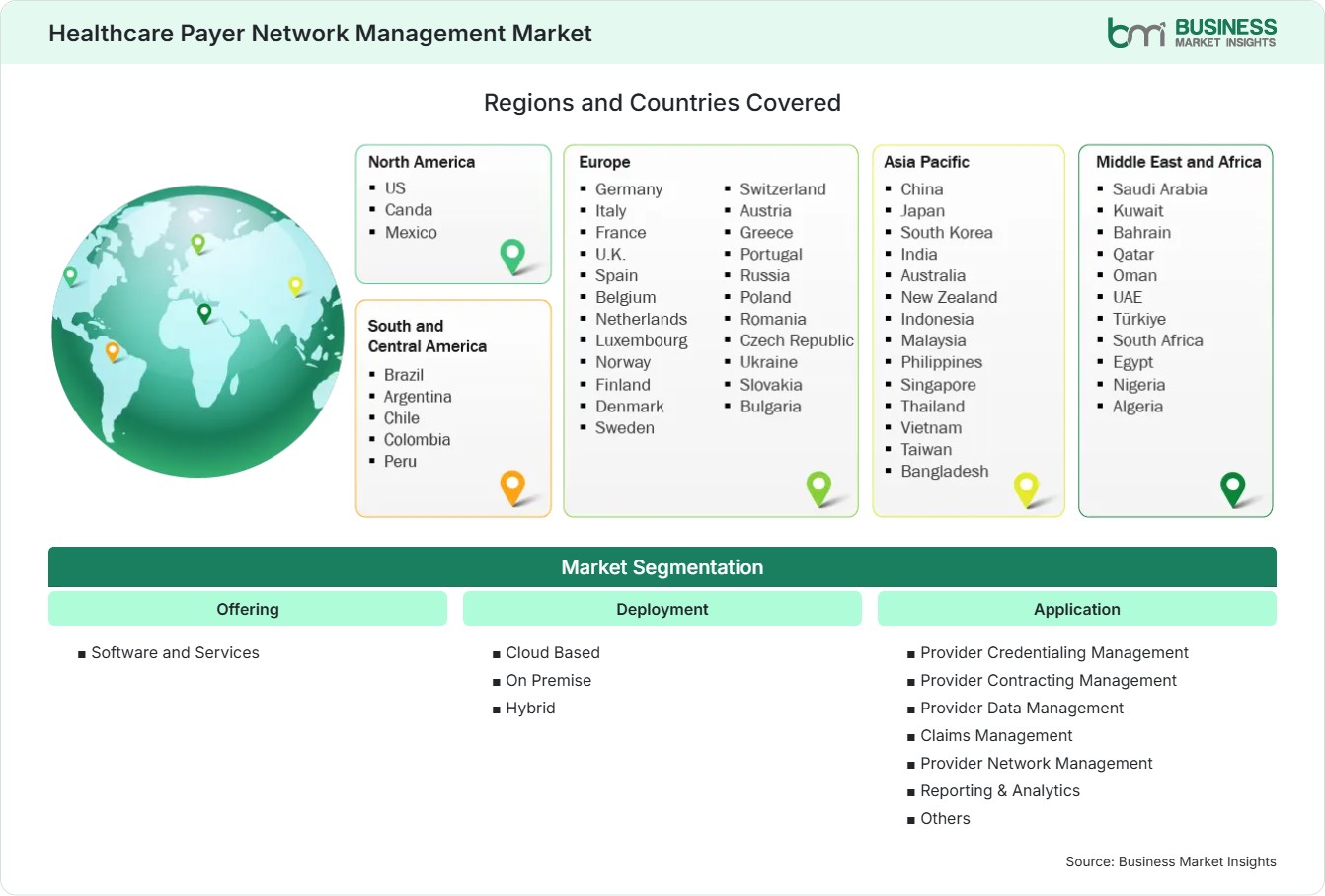
  • Offering: Software and Services
  • Deployment: Cloud Based, On Premise, Hybrid
  • Application: Provider Credentialing Management, Provider Contracting Management, Provider Data Management, Claims Management, Provider Network Management, Reporting & Analytics, Others
US$ 4.71 Bn Market size in 2025
US$ 10.06 Bn Market Size by 2033
9.95% CAGR, 2026 - 2033
2026-2033 Forecast Period

01 AI Overview

Healthcare Payer Network Management Market Summary

  • North America Region: North America holds 41%–44% healthcare payer network management market share in 2025 and is expected to grow at a CAGR of 9.3%–9.7% during 2026–2033. Strong digital healthcare infrastructure, widespread adoption of payer IT solutions, regulatory compliance initiatives, and increasing investment in provider network optimization continue supporting regional market expansion. The United States remains the largest regional contributor with an estimated CAGR of 9.4%–9.8%, supported by healthcare digitalization, value-based reimbursement models, and advanced payer technologies.
  • Fastest Growing Region: Asia Pacific accounts for 21%–24% market share in 2025 and is projected to register a CAGR of 11.1%–11.6% during 2026–2033. Expanding healthcare infrastructure, increasing healthcare IT investments, rapid digital transformation, and growing demand for efficient provider management platforms continue accelerating regional market development.
  • Leading Segment: Provider Network Management represents 26%–29% market share in 2025 and is forecast to expand at a CAGR of 10.1%–10.5% during 2026–2033. Rising demand for network optimization, provider performance monitoring, automated workflows, and value-based care initiatives continues strengthening segment leadership.
  • High Growth Segment: Reporting & Analytics accounts for 12%–15% market share in 2025 and is anticipated to grow at a CAGR of 11.4%–11.9% during 2026–2033. Increasing adoption of predictive analytics, AI-enabled decision support, real-time reporting, and healthcare performance measurement solutions continues driving rapid segment expansion.
  • Key Market Opportunity: Expanding digital healthcare ecosystems, artificial intelligence-enabled provider analytics, cloud-native payer platforms, and integrated telehealth network management solutions are expected to create substantial long-term growth opportunities for healthcare technology vendors.
  • Major Market Players: CitiusTech, Quest Analytics, Availity, HiLabs, LexisNexis Risk Solutions, HealthStream, Verisys, Newgen Software Technologies Limited, Kyruus Health, and Edifecs, Inc.
02 Strategic Insights

Healthcare Payer Network Management Market: Strategic Insights

healthcare-payer-network-management-market-market-strategic-framework
FREE PDF
Request your free sample
Request free sample
03 Stakeholder View

Key Takeaways

  • The market ecosystem is becoming increasingly interconnected as healthcare payers, providers, healthcare IT vendors, data management companies, and regulatory agencies collaborate to improve provider network efficiency, interoperability, and administrative automation.
  • Provider network management solutions continue presenting the strongest commercial opportunity owing to increasing demand for provider onboarding, network optimization, performance monitoring, and regulatory compliance across public and private healthcare systems.
  • Technology innovation is increasingly focused on artificial intelligence, machine learning, robotic process automation, predictive analytics, cloud-native architectures, and interoperable healthcare platforms that enhance administrative efficiency and provider data accuracy.
  • Asia Pacific is emerging as an attractive investment destination due to rapid healthcare digitalization, expanding health insurance coverage, increasing healthcare IT spending, and government initiatives promoting digital healthcare infrastructure modernization.
  • Strategic partnerships, mergers, technology collaborations, and platform integrations continue enabling healthcare technology companies to expand product capabilities, accelerate innovation, and strengthen their competitive positions across global payer network management solutions.
  • Growing adoption of value-based healthcare, digital provider engagement, telehealth integration, and intelligent workflow automation is expected to improve operational efficiency while supporting long-term modernization of healthcare payer administration worldwide.
04 Geographic Outlook

Healthcare Payer Network Management Market Regional Highlights

North America Healthcare Payer Network Management Market

North America accounted for 41%–44% of the Healthcare Payer Network Management Market Share in 2025 and is projected to expand at a CAGR of 9.3%–9.7% during 2026–2033. Strong healthcare IT infrastructure, extensive adoption of digital payer platforms, regulatory requirements for provider data accuracy, and increasing investments in value-based healthcare continue to support regional leadership. The continuous modernization of payer operations and the growing use of cloud-based administrative solutions further strengthen market expansion across the region.

  • Healthcare payers continue investing in AI-enabled provider management platforms to improve credentialing accuracy, automate workflows, strengthen compliance, and reduce administrative costs across increasingly complex healthcare ecosystems.
  • Expanding adoption of cloud-native payer technologies improves interoperability, enhances provider collaboration, and enables faster processing of provider enrollment, contracting, and reimbursement activities.
  • Government healthcare regulations continue encouraging modernization of provider network management systems while supporting higher standards for data accuracy and operational transparency.
  • Growing adoption of predictive analytics enables healthcare organizations to improve provider performance monitoring, optimize network adequacy, and strengthen strategic decision-making across payer operations.
  • Increasing integration of digital healthcare platforms with electronic health records and claims systems supports more efficient healthcare administration and enhanced patient access to quality care.

US Healthcare Payer Network Management Market

The United States Healthcare Payer Network Management Market accounted for 35%–38% of global revenue in 2025 and is forecast to grow at a CAGR of 9.4%–9.8% through 2026–2033. Strong investments in healthcare digital transformation, expanding value-based reimbursement initiatives, increasing health insurance enrollment, and rapid adoption of intelligent payer technologies continue maintaining national market leadership.

  • Healthcare insurers continue expanding investments in automated provider credentialing, network optimization, and digital contracting solutions to improve operational efficiency and regulatory compliance.
  • Widespread implementation of artificial intelligence and advanced analytics enhances provider data management, claims validation, fraud detection, and healthcare performance measurement.
  • Federal healthcare modernization programs continue promoting interoperability standards that strengthen digital healthcare administration and improve payer-provider collaboration.
  • Growing demand for integrated cloud-based healthcare platforms supports long-term adoption of scalable payer network management technologies across public and private healthcare organizations.

Europe Healthcare Payer Network Management Market

Europe Healthcare Payer Network Management Market held 27%–30% market share during 2025 and is anticipated to grow at a CAGR of 9.1%–9.5% through 2026–2033. Increasing healthcare digitization, expanding cross-border healthcare collaboration, and growing adoption of interoperable health information systems continue to support regional development. Germany leads regional adoption with a CAGR of 9.2%–9.6%, while the Netherlands records the fastest growth at 9.8%–10.2% during the forecast period.

  • Germany continues strengthening healthcare IT investments through advanced digital health initiatives, supporting efficient provider management and improved healthcare administration.
  • The Netherlands experiences accelerated adoption owing to expanding digital healthcare infrastructure, integrated payer-provider systems, and increasing healthcare data interoperability.
  • European healthcare organizations increasingly implement cloud-based provider management platforms to improve regulatory compliance, operational efficiency, and provider engagement.
  • Rising investment in healthcare analytics strengthens network planning, reimbursement optimization, and healthcare quality reporting across regional healthcare systems.
  • Digital health regulations continue encouraging secure healthcare information exchange while supporting modernization of payer administrative processes.

Asia Pacific Healthcare Payer Network Management Market

Asia Pacific accounted for 21%–24% of global revenue in 2025 and is projected to register the highest CAGR of 11.1%–11.6% during 2026–2033. Expanding healthcare infrastructure, increasing public and private healthcare investments, rapid adoption of digital health technologies, and growing health insurance coverage continue driving regional expansion. China leads regional revenue with a CAGR of 11.0%–11.4%, while India records the fastest growth at 11.6%–12.1%.

  • China continues investing in healthcare information systems that improve provider data management, reimbursement administration, and nationwide healthcare network modernization.
  • India benefits from expanding digital healthcare initiatives, increasing insurance penetration, and growing adoption of cloud-based healthcare administration platforms.
  • Japan and South Korea continue strengthening healthcare interoperability through investments in advanced analytics, artificial intelligence, and digital payer infrastructure.
  • Rising demand for healthcare operational efficiency encourages broader deployment of intelligent provider network management platforms throughout the region.
  • Expanding telehealth services increases the need for integrated provider directories, automated credentialing, and real-time network management capabilities.

Rest of World Healthcare Payer Network Management Market

The Rest of World accounted for 8%–10% market share in 2025 and is expected to register a CAGR of 9.4%–9.9% during 2026–2033. South & Central America continue to improve healthcare administration by expanding digital health initiatives and insurance modernization programs.

The Middle East & Africa are experiencing increasing investments in healthcare infrastructure, digital insurance platforms, and integrated provider management systems. Brazil leads South & Central America with a CAGR of 9.5%–9.9%, while the United Arab Emirates records the highest regional growth at 10.0%–10.5%, owing to accelerating healthcare digital transformation initiatives.

  • Brazil continues expanding healthcare IT implementation while strengthening digital insurance administration and provider management capabilities across public and private healthcare organizations.
  • The United Arab Emirates accelerates investments in smart healthcare ecosystems, improving provider network efficiency through advanced digital technologies and healthcare automation.
  • International healthcare technology partnerships continue supporting the deployment of integrated payer administration solutions across emerging healthcare markets.
  • Growing demand for digital healthcare governance encourages modernization of provider credentialing, contracting, and claims administration processes.
  • Expanding health insurance coverage continues driving investments in scalable healthcare payer network management platforms throughout emerging economies.
global-market-geography
FREE PDF
Request your free sample
Request free sample
05 Segment Analysis

Healthcare Payer Network Management Market Segmentation

Application

The Application segment accounted for 100% of the market and is projected to expand at a CAGR of 9.9% during 2026–2033. Healthcare organizations continue prioritizing automation, interoperability, artificial intelligence, and cloud-native platforms to improve operational efficiency and regulatory compliance. The Healthcare Payer Network Management Market Forecasts indicate sustained demand for integrated solutions that support end-to-end provider lifecycle management and strengthen payer administrative performance.

  • Provider Credentialing Management: Increasingly adopted to automate provider verification, licensing validation, compliance monitoring, and onboarding processes, reducing administrative workload while improving operational efficiency and provider data accuracy.
  • Provider Contracting Management: Supports efficient contract lifecycle management through digital negotiation, reimbursement optimization, compliance monitoring, and automated contract administration across healthcare payer networks.
  • Provider Data Management: Strengthens provider information accuracy through centralized data governance, real-time updates, standardized records, and improved interoperability between healthcare organizations and payer systems.
  • Claims Management: Continues supporting efficient reimbursement processing by automating claims validation, reducing administrative errors, improving fraud detection, and accelerating payment workflows across healthcare networks.
  • Provider Network Management: Maintains leadership by enabling provider directory optimization, network adequacy monitoring, provider performance evaluation, and strategic healthcare network planning.
  • Reporting & Analytics: Rapidly expanding due to growing adoption of artificial intelligence, predictive analytics, real-time reporting, performance measurement, and business intelligence solutions supporting data-driven healthcare decisions.
  • Others: Includes specialized administrative capabilities supporting provider enrollment optimization, compliance monitoring, workflow automation, document management, and integrated healthcare operational processes.
06 Market Forces

Healthcare Payer Network Management Market Dynamics

Key Market Drivers

Growing Need for Efficient Healthcare Cost Management

The efficiency and optimization of administrative functions have been prioritized in healthcare organizations as healthcare costs continue to rise globally. Advanced payer network management systems help automate the processes of onboarding providers, administering contracts, validating reimbursements, and managing workflows, thereby reducing operational expenses. Artificial intelligence, robotic process automation, and predictive analytics help increase the efficiency of resource utilization and decision-making. All of these factors are still helping drive Healthcare Payer Network Management Market Growth.

Increasing Complexity of Healthcare Provider Networks

Healthcare provider ecosystems continue to expand through multispecialty networks, telehealth integration, and value-based care initiatives, thereby increasing administrative complexity. Healthcare payers require centralized platforms to manage provider directories, credentialing, contracting, compliance, and network adequacy. Digital network management technologies improve operational transparency, strengthen provider relationships, and enhance regulatory compliance. Continuous expansion of healthcare delivery models further accelerates demand for scalable payer network management solutions.

Rising Adoption of Digital Healthcare Administration

The implementation of digital technologies, such as cloud computing, artificial intelligence, analytics, and healthcare information systems, accelerates healthcare organizations' digital transformation. All of the mentioned technologies contribute to simplifying provider management processes, improving data quality, automating administrative processes, and boosting collaboration among different entities in the healthcare sector. Increased investments in healthcare IT infrastructure facilitate the development of smart payer network management solutions.

Key Market Opportunities

Increasing Healthcare Digitization Across Emerging Markets

Rapid healthcare modernization across emerging economies is creating significant opportunities for digital payer management solution providers. Governments continue to invest in electronic health records, cloud-based healthcare platforms, and interoperable health information systems that improve providers' management capabilities. The Healthcare Payer Network Management Market Trends increasingly reflect growing adoption of intelligent administrative technologies supporting efficient healthcare delivery and sustainable digital transformation.

Growing Value-Based Healthcare Reimbursement Models

Global health care systems continue to move towards value-based reimbursement models that emphasize the quality of health care, health care provider performance, and patient outcomes. Payer network management software solutions enable performance tracking, provider quality measurement, contract management, and reimbursement analysis. This improves decision-making for health care payers and also opens up business opportunities for IT vendors.

Expansion of Telehealth Provider Network Integration

The rapid expansion of telehealth services increases demand for intelligent provider network management solutions that support virtual care delivery, provider credentialing, reimbursement administration, and digital patient access. Integrated payer platforms improve operational efficiency by connecting traditional healthcare providers with virtual care networks, enabling seamless administration across hybrid healthcare delivery environments.

Market Restraints and Challenges

Data Privacy and Regulatory Compliance Challenges

Factor: Healthcare payer platforms process highly sensitive provider and patient information while operating under stringent healthcare privacy regulations including HIPAA, GDPR, and regional healthcare compliance requirements.

Impact: Organizations must invest significantly in cybersecurity, governance frameworks, and regulatory compliance capabilities, increasing implementation costs and slowing technology adoption across highly regulated healthcare environments.

Complex Integration with Legacy Healthcare Systems

Factor: Many healthcare organizations continue operating legacy administrative platforms that lack interoperability with modern cloud-based payer management technologies.

Impact: Integration challenges increase implementation complexity, prolong deployment timelines, elevate project costs, and limit the full realization of digital transformation benefits, particularly within large healthcare organizations operating multiple legacy information systems.

07 Company Analysis

Competitive Landscape

The Healthcare Payer Network Management Market Analysis competitive environment is evolving through cloud-native platform development, artificial intelligence integration, healthcare interoperability, and strategic collaborations between technology vendors and healthcare organizations. Companies are strengthening product portfolios with intelligent automation, analytics, and provider lifecycle management capabilities. Continuous investment in innovation supports comprehensive while enabling healthcare payers to improve operational efficiency, regulatory compliance, and provider engagement.

Company Name

Overview

Products and Services Relevant to this Market

CitiusTech

Healthcare technology company specializing in digital transformation, data analytics, and healthcare interoperability solutions.

Provider network management, healthcare analytics, interoperability platforms, cloud healthcare solutions, and payer technology services.

Quest Analytics

Healthcare technology company focused on provider network optimization and regulatory compliance solutions.

Provider network management, network adequacy analysis, provider directory management, and healthcare compliance solutions.

Availity, LLC

Leading healthcare information network connecting payers, providers, and technology partners.

Provider data management, payer connectivity, claims administration, provider enrollment, and healthcare workflow automation.

HiLabs

AI-driven healthcare data management company focused on provider data quality and automation.

Provider data management, credentialing automation, AI-powered analytics, provider directory solutions, and healthcare data intelligence.

LexisNexis Risk Solutions

Global analytics company providing identity, risk, and healthcare data management solutions.

Provider verification, healthcare analytics, credentialing support, compliance solutions, and risk management technologies.

HealthStream, Inc.

Healthcare workforce and credentialing technology provider supporting healthcare organizations worldwide.

Provider credentialing, compliance management, workforce solutions, healthcare education, and digital credential management.

Verisys Corporation

Healthcare credentialing and provider verification company serving healthcare organizations and insurers.

Provider credentialing, sanctions monitoring, license verification, compliance management, and provider screening solutions.

Newgen Software Technologies Limited

Enterprise software provider delivering workflow automation and digital transformation platforms.

Business process automation, document management, healthcare workflow platforms, claims processing, and digital administration solutions.

Kyruus Health

Healthcare technology company specializing in provider search, scheduling, and network optimization solutions.

Provider network management, provider directories, scheduling optimization, digital patient access, and analytics platforms.

Edifecs, Inc.

Healthcare interoperability and payer technology company supporting administrative automation and regulatory compliance.

Healthcare interoperability, claims management, provider data exchange, value-based care solutions, and payer administration platforms.


10 Trust & Transparency

Research Methodology

The market analysis combines proprietary research with secondary data from government agencies, company disclosures, regulatory filings, industry databases and expert interviews. Market estimates are validated through data triangulation, cross-market benchmarking and analyst review.

View Full Research Methodology

11 Questions Answered

Frequently Asked Questions

What does the Healthcare Payer Network Management Market Report include?

The Market Report provides comprehensive insights into market size, competitive landscape, segmentation, regional analysis, technology developments, growth drivers, restraints, opportunities, recent industry developments, and future strategic outlook.

How is artificial intelligence transforming payer network management?

Artificial intelligence improves provider credentialing, data validation, predictive analytics, fraud detection, workflow automation, provider performance monitoring, and decision-making while reducing administrative costs and improving operational accuracy across healthcare organizations.

Why is Asia Pacific expected to witness the fastest growth?

Asia Pacific is experiencing rapid expansion due to increasing healthcare IT investments, healthcare digital transformation, expanding insurance coverage, government support for digital health infrastructure, and rising adoption of cloud-based healthcare administration technologies.

Which application segment holds the largest market share?

Provider Network Management remains the leading application because healthcare organizations increasingly require automated provider directory management, network optimization, performance monitoring, and regulatory compliance capabilities to support efficient healthcare delivery.

What is driving the Healthcare Payer Network Management Market?

The market is driven by increasing demand for healthcare cost optimization, expanding provider networks, rapid healthcare digitalization, regulatory compliance requirements, and growing adoption of cloud-based healthcare administration platforms that improve operational efficiency.

Access the Full Healthcare Payer Network Management Market Report

Get segment-level forecasts, regional estimates, competitive benchmarking, company profiles and downloadable Excel datasets.

Access the full Healthcare Payer Network Management Market Report
350 pages PDF & Excel | 2026-08-04