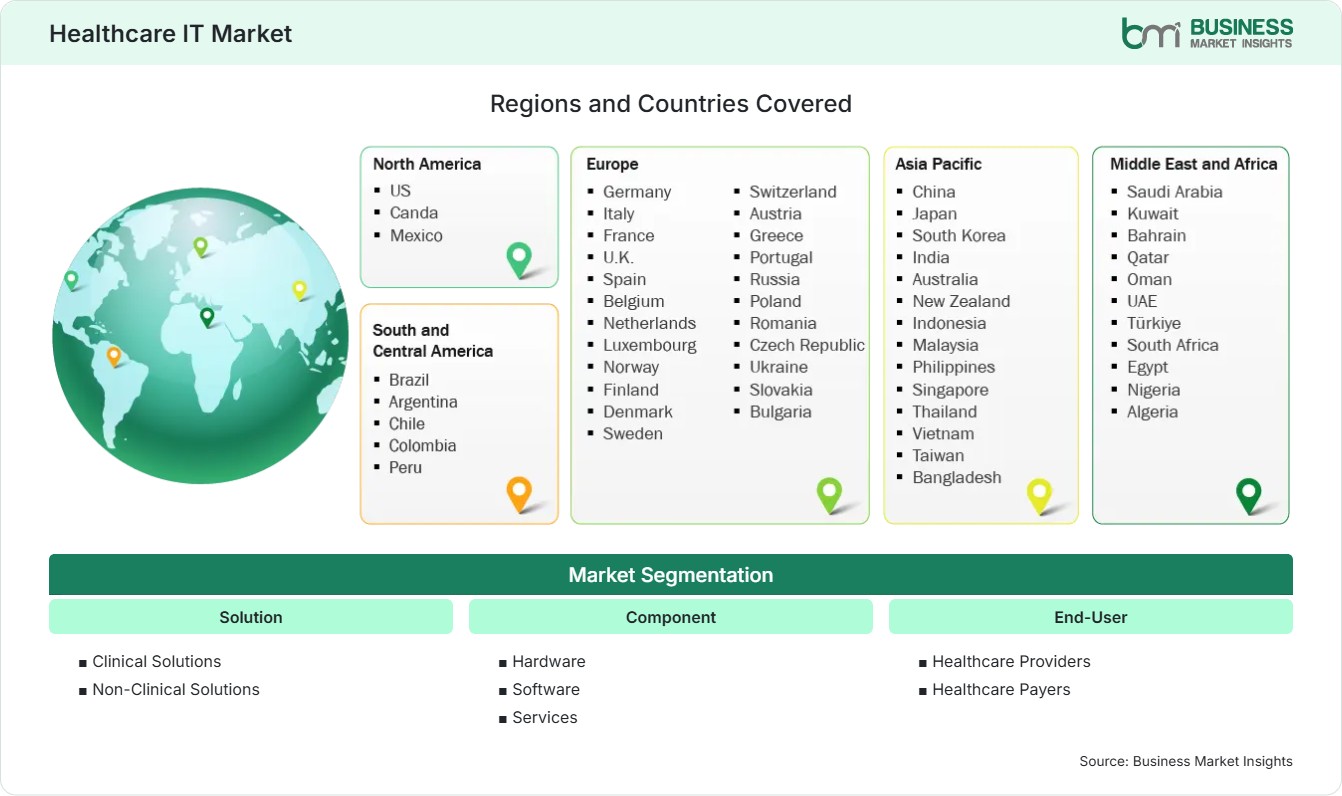
Healthcare IT Market Regional Highlights
North America Healthcare IT Market
North America accounted for 39%–43% Healthcare IT Market share in 2025 and is projected to expand at a CAGR of 16.0%–17.5% through 2033. The region benefits from mature EHR adoption, advanced payer infrastructure, high cloud penetration, and strong AI investment. US providers remain central to regional demand, while Canada contributes through public-sector digitization and interoperability initiatives.
- Mature EHR environments create demand for interoperability, data normalization, clinical intelligence, and application modernization as providers seek greater value from established digital infrastructure.
- AI-enabled documentation and automation are gaining traction because workforce constraints encourage organizations to reduce administrative workloads while preserving clinician attention for patient-facing activities.
- Cybersecurity spending remains strategically important as interconnected systems increase exposure to ransomware, identity threats, and operational disruption across hospitals, payers, and technology suppliers.
- Cloud migration is accelerating platform modernization, enabling scalable analytics, centralized infrastructure management, remote access, and faster deployment of new digital healthcare applications.
US Healthcare IT Market
The US represented approximately 33%–37% of worldwide demand and 82%–87% of North American demand in 2025, with CAGR of 15.8%–17.2% through 2033. Adoption is supported by extensive EHR penetration, sophisticated private payer systems, value-based care initiatives, and significant technology investment.
- Provider consolidation encourages enterprise-scale platforms that standardize workflows, analytics, security, and patient engagement across geographically distributed hospitals and outpatient networks.
- Payers are investing in automation and predictive analytics to improve claims processing, utilization management, fraud detection, member services, and value-based reimbursement administration.
- AI adoption is moving toward embedded workflow applications, particularly documentation, coding, clinical summarization, scheduling, and operational decision support.
Europe Healthcare IT Market
Europe held 24%–28% share in 2025 and is projected to grow at a CAGR of 16.5%–18.0% through 2033. Germany and the United Kingdom represent leading Healthcare IT Markets, while Spain, Italy, and Nordic countries offer attractive digital modernization opportunities. Germany is estimated to expand at 17.0%–18.5%, while the United Kingdom is projected at 16.5%–18.0%.
- National and regional digital health programs encourage modernization of patient records, connected care, remote services, and information exchange across fragmented healthcare environments.
- Data protection requirements elevate demand for secure architectures, identity controls, consent management, audit capabilities, and privacy-preserving analytics across clinical and administrative applications.
- Nordic countries maintain strong digital maturity, while Southern European systems provide modernization opportunities through hospital digitization, cloud migration, and integrated care initiatives.
- European AI governance is encouraging vendors to strengthen documentation, risk management, transparency, and accountability throughout technology development and deployment.
Asia Pacific Healthcare IT Market
Asia Pacific held 22%–26% share in 2025 and is forecast to register a CAGR of 19.0%–21.5% through 2033, making it the fastest-growing regional opportunity. China and Japan lead demand by scale and technology maturity, while India, Indonesia, and Southeast Asia offer faster expansion potential. India is projected at 20.0%–22.5% CAGR, supported by digital public infrastructure and expanding private healthcare.
- Government-backed digital health initiatives are creating demand for interoperable identity, health records, exchange platforms, and secure data infrastructure across national healthcare ecosystems.
- Mobile-first delivery models support remote consultations, chronic disease monitoring, appointment management, digital payments, and patient engagement where physical infrastructure remains uneven.
- India and Southeast Asia provide strong opportunities for scalable cloud platforms that can serve distributed providers without requiring extensive legacy infrastructure replacement.
- China and Japan are advancing AI, robotics, medical imaging, and hospital automation, creating demand for integrated platforms connecting clinical workflows with intelligent technologies.
Rest of World Healthcare IT Market
South and Central America represented 5%–7% share in 2025 and are projected to grow at a CAGR of 17.0%–19.0% through 2033. Brazil and Mexico lead regional adoption, while Colombia and Chile provide attractive digital modernization opportunities.
The Middle East and Africa contributed 6%–8% share in 2025 and are projected to expand at a CAGR of 18.0%–20.0%. Saudi Arabia and the United Arab Emirates lead investment, while South Africa represents a major regional technology hub. National transformation programs, smart hospitals, virtual care, and health data infrastructure are accelerating adoption.
- Brazil and Mexico are investing in digital records, telehealth, and administrative automation as providers seek broader access and operational efficiency.
- Gulf countries are developing digitally connected hospitals and centralized health platforms through ambitious healthcare modernization and national transformation programs.
- South Africa offers opportunities for cloud, analytics, and remote care solutions addressing geographically distributed populations and resource constraints.
- Latin American providers increasingly favor modular technologies that can integrate existing systems while reducing upfront modernization costs and implementation complexity.