
Healthcare Analytics Market Outlook: Size, Share, Trends, Growth Analysis, Competitive Landscape & Forecast, 2026-2033

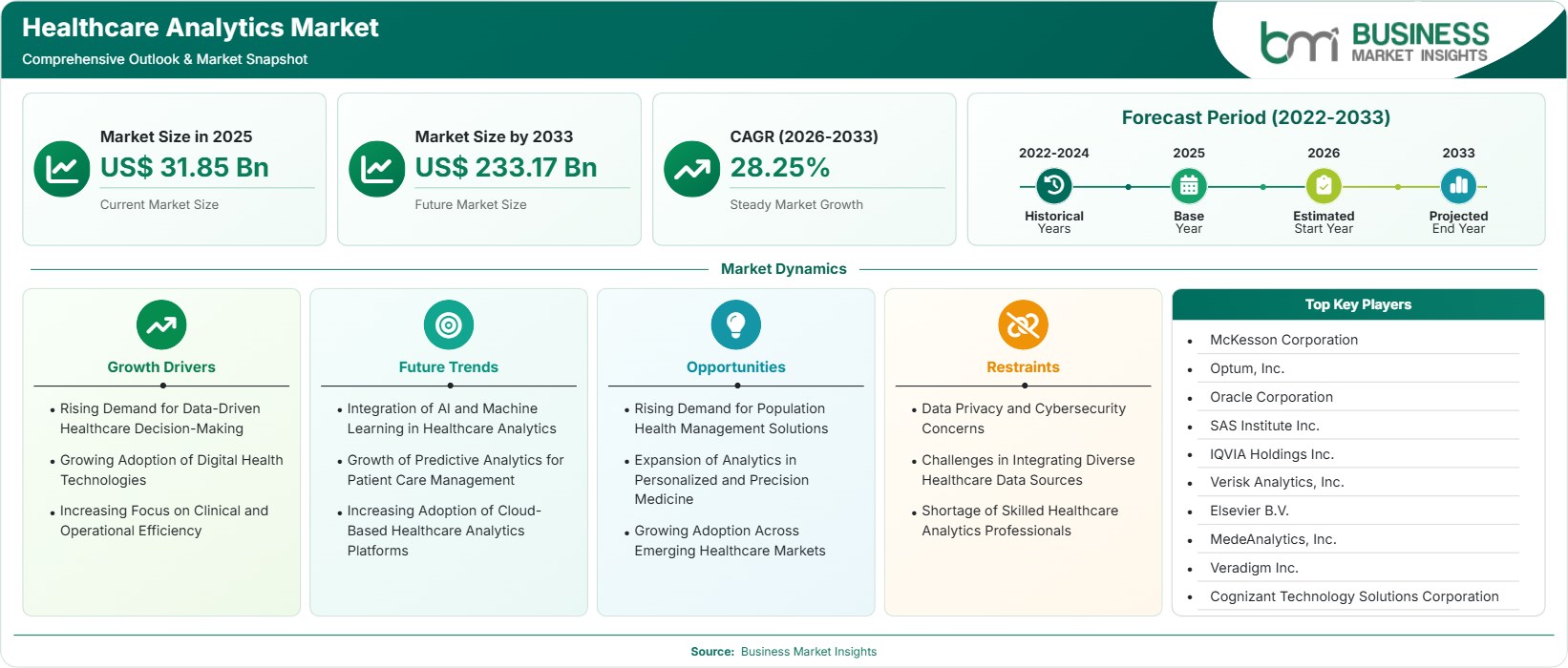
The Healthcare Analytics Market size was valued at US$ 31.85 Billion in 2025 and is projected to reach US$ 233.17 Billion by 2033, growing at a CAGR of 28.25% during 2026–2033. Rising healthcare data generation, growing adoption of artificial intelligence in clinical decision-making, increasing value-based care initiatives, expanding digital health infrastructure, and demand for data-driven operational efficiency are creating significant market opportunities.

Report Coverage
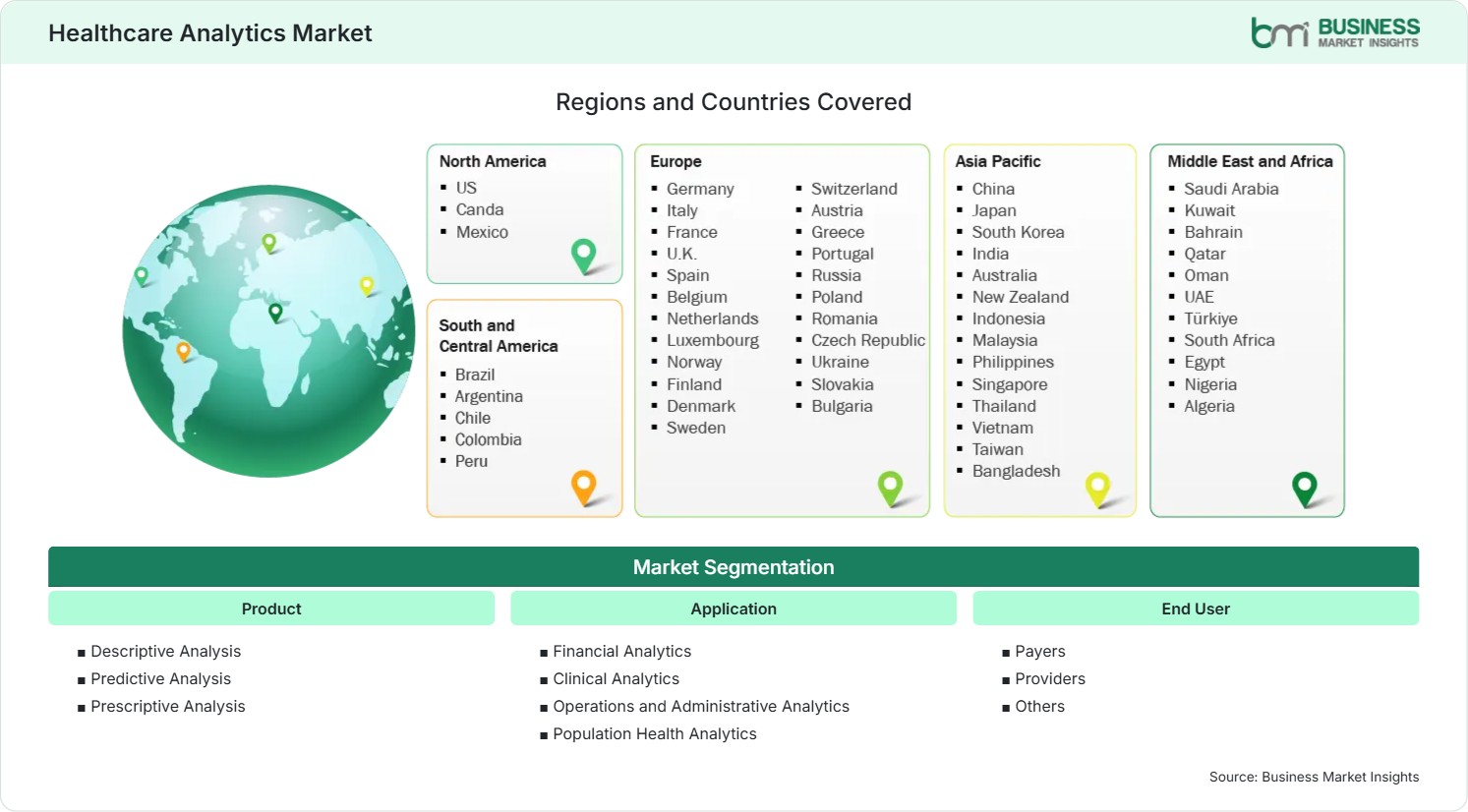
  • Product: Descriptive Analysis, Predictive Analysis, Prescriptive Analysis
  • Application: Financial Analytics, Clinical Analytics, Operations and Administrative Analytics, Population Health Analytics
  • End User: Payers, Providers, Others
US$ 31.85 Bn Market size in 2025
US$ 233.17 Bn Market Size by 2033
28.25% CAGR, 2026 - 2033
2026-2033 Forecast Period

01 AI Overview

Healthcare Analytics Market Summary

  • North America Region: North America holds a healthcare analytics market share of 42%–46% in 2025 and is projected to grow at a CAGR of 26.5%–27.5% during 2026–2033. Growth is supported by electronic health record adoption, healthcare digitization, advanced analytics deployment, AI integration, value-based healthcare models, payer-provider collaboration, regulatory compliance requirements, population health management initiatives, cloud infrastructure investments, and healthcare IT modernization. The U.S. remains the largest market owing to extensive healthcare technology adoption and strong analytics investments, advancing at a CAGR of 26.8%–27.8%.
  • Fastest Growing Region: Asia Pacific accounts for 20%–24% share in 2025 and is expected to register a CAGR of 31.0%–32.5% through 2033. Growth is fueled by healthcare digitalization, expanding healthcare infrastructure, government e-health initiatives, rising healthcare expenditures, increasing adoption of cloud platforms, AI-based diagnostics, population health management programs, medical data generation, healthcare interoperability investments, and growing technology awareness.
  • Leading Segment: Descriptive Analysis represents 44%–48% share in 2025 and is anticipated to grow at a CAGR of 26.0%–27.0% through 2033. Demand is supported by reporting requirements, healthcare performance monitoring, financial management applications, patient outcome assessment, operational benchmarking, regulatory compliance initiatives, and growing demand for actionable healthcare insights.
  • High Growth Segment: Population Health Analytics captures 24%–28% share in 2025 and is forecast to expand at a CAGR of 31.5%–33.0% during 2026–2033. Expansion is driven by preventive healthcare strategies, chronic disease management initiatives, risk stratification programs, healthcare cost optimization, public health surveillance, predictive care models, and increasing emphasis on value-based care.
  • Key Market Opportunity: Growing utilization of artificial intelligence, machine learning, and predictive analytics platforms is creating opportunities to improve patient outcomes, reduce healthcare costs, optimize resource allocation, and enhance clinical decision-making.
  • Major Market Players: McKesson Corporation, Optum, Inc., Oracle Corporation, SAS Institute Inc., IQVIA Holdings Inc., Verisk Analytics, Inc., Elsevier B.V., MedeAnalytics, Inc., Veradigm Inc., and Cognizant Technology Solutions Corporation.
02 Strategic Insights

Healthcare Analytics Market: Strategic Insights

Healthcare Analytics Market Strategic Framework
FREE PDF
Request your free sample
Request free sample
03 Stakeholder View

Key Takeaways

  • The healthcare analytics ecosystem is rapidly shifting from retrospective reporting toward predictive and prescriptive intelligence, enabling healthcare organizations to make faster and more accurate clinical, operational, and financial decisions.
  • Population Health Analytics presents the strongest growth opportunity due to increasing focus on preventive care, chronic disease management, risk stratification, and value-based healthcare reimbursement models.
  • Artificial intelligence, machine learning, natural language processing, and cloud-native analytics platforms are transforming healthcare data utilization across providers, payers, and public health organizations.
  • Asia Pacific represents a significant regional opportunity due to accelerating healthcare digitization, expanding healthcare infrastructure, growing patient data volumes, and increasing investments in healthcare information technology.
  • Strategic acquisitions, platform expansions, and partnerships between healthcare providers and technology vendors are strengthening analytics capabilities and accelerating digital transformation initiatives.
  • Interoperability and real-time data integration are becoming critical competitive differentiators as healthcare organizations seek comprehensive insights across clinical, financial, and administrative systems.
04 Geographic Outlook

Healthcare Analytics Market Regional Highlights

North America Healthcare Analytics Market

North America accounted for 42%–46% of global revenue in 2025 and is projected to expand at a CAGR of 26.5%–27.5% through 2033. The region benefits from widespread electronic health record adoption, advanced healthcare IT infrastructure, and significant investment in data-driven healthcare delivery. The Healthcare Analytics Market share remains highest in North America due to strong demand for value-based care solutions, regulatory reporting requirements, and sophisticated payer-provider analytics platforms. Increasing integration of artificial intelligence and cloud analytics further supports regional expansion.

  • Healthcare organizations continue investing in advanced analytics platforms to improve patient outcomes, operational efficiency, and financial performance.
  • Value-based reimbursement models are encouraging providers to utilize predictive and population health analytics solutions.
  • Artificial intelligence adoption is expanding across clinical decision support, risk management, and healthcare workflow optimization.
  • Regulatory requirements continue driving investments in healthcare reporting, compliance monitoring, and performance measurement capabilities.
  • Strong healthcare IT spending supports continuous innovation across analytics software and service offerings.

US Healthcare Analytics Market

The United States represents 82%–86% of North American demand and is expected to grow at a CAGR of 26.8%–27.8% through 2033. Strong digital health adoption, extensive healthcare data availability, and advanced reimbursement models support healthcare analytics market expansion. Healthcare organizations continue investing in analytics solutions to improve care quality, operational efficiency, and patient engagement outcomes.

  • Hospitals increasingly deploy advanced analytics for patient management, resource utilization, and clinical workflow optimization.
  • Health insurers utilize predictive analytics to improve risk assessment and cost management strategies.
  • Cloud-based healthcare platforms continue strengthening scalability and real-time data analysis capabilities.
  • Data interoperability initiatives are encouraging broader integration of healthcare information systems.

Europe Healthcare Analytics Market

Europe held 27%–31% of global revenue in 2025 and is forecast to register a CAGR of 27.0%–28.0% through 2033. Demand is supported by government-led healthcare digitization programs, growing electronic health record adoption, and increasing emphasis on data-driven patient care. Germany remains the leading healthcare analytics market, while the Nordic countries represent high-growth areas with CAGR ranging between 28.0%–29.5%. Investments in healthcare interoperability and public health management continue accelerating adoption.

  • Government initiatives aimed at healthcare modernization are driving deployment of advanced analytics platforms.
  • Germany benefits from strong healthcare infrastructure and significant investment in digital healthcare technologies.
  • Population health management programs continue supporting demand for predictive and preventive healthcare solutions.
  • Healthcare providers increasingly use analytics to optimize resource allocation and improve treatment outcomes.
  • Data privacy compliance initiatives are encouraging investment in secure healthcare analytics infrastructure.

Asia Pacific Healthcare Analytics Market

Asia Pacific accounted for 20%–24% of global revenue in 2025 and is expected to record the fastest CAGR of 31.0%–32.5% through 2033. Rapid healthcare digitalization, expanding healthcare infrastructure, and growing adoption of cloud technologies are supporting regional growth. China and India remain key markets, while Southeast Asia demonstrates significant expansion potential with CAGR of 32.0%–33.5%. Increasing investments in healthcare technology continue creating favorable market conditions.

  • Government-sponsored digital health initiatives are accelerating healthcare data utilization and analytics adoption.
  • Growing healthcare expenditures support investments in advanced clinical and operational analytics systems.
  • Healthcare organizations increasingly adopt artificial intelligence tools to improve efficiency and diagnostic capabilities.
  • Expanding patient populations generate substantial healthcare data volumes requiring advanced analytical solutions.
  • Cloud deployment models continue improving accessibility and scalability of healthcare analytics platforms.

Rest of World Healthcare Analytics Market

Rest of World accounted for 8%–12% of healthcare analytics market revenue in 2025 and is forecast to grow at a CAGR of 28.0%–29.0% through 2033. Demand is supported by healthcare modernization initiatives, increasing digital health adoption, and growing investment in healthcare infrastructure. The Middle East is witnessing significant healthcare transformation projects, while Brazil leads adoption across South America through expanding healthcare technology investments.

  • Healthcare digital transformation programs are driving demand for analytics platforms across emerging markets.
  • Public health management initiatives encourage broader adoption of population health and clinical analytics solutions.
  • Healthcare providers increasingly seek data-driven approaches for cost optimization and service improvement.
  • Government investments in health information systems support long-term market expansion.
  • Cloud-enabled healthcare platforms improve accessibility to advanced analytics capabilities across developing regions.
Global Market Geography
FREE PDF
Request your free sample
Request free sample
05 Segment Analysis

Healthcare Analytics Market Segmentation

Product

Descriptive Analysis holds the leading position with 44%–48% share in 2025 and is expected to grow at a CAGR of 26.0%–27.0% through 2033. The segment remains fundamental to healthcare reporting, performance tracking, and operational monitoring initiatives. The Healthcare Analytics Market scope continues expanding as healthcare organizations adopt data-driven strategies to improve care quality, financial management, and clinical outcomes.

  • Descriptive Analysis: Widely used for reporting, benchmarking, performance measurement, patient trend monitoring, and healthcare operational management across providers and payers.
  • Predictive Analysis: Supports risk stratification, disease forecasting, patient outcome prediction, and proactive healthcare intervention planning through advanced statistical modeling.
  • Prescriptive Analysis: Helps healthcare organizations identify optimal treatment strategies, resource allocation decisions, and operational improvements through actionable data recommendations.

Application

Population Health Analytics represents the fastest-growing application segment with 24%–28% share in 2025 and is forecast to expand at a CAGR of 31.5%–33.0% through 2033. Rising emphasis on preventive care, chronic disease management, and healthcare cost reduction is driving adoption. Current Healthcare Analytics Market trends indicate increased utilization of data-driven health management platforms across healthcare ecosystems.

  • Financial Analytics: Used to optimize reimbursement processes, revenue cycle management, fraud detection, cost analysis, and financial performance improvement.
  • Clinical Analytics: Supports treatment optimization, patient outcome improvement, diagnostic accuracy enhancement, and evidence-based clinical decision-making.
  • Operations and Administrative Analytics: Enables workflow optimization, resource planning, staffing efficiency, utilization management, and healthcare facility performance monitoring.
  • Population Health Analytics: Helps identify health risks, manage chronic conditions, improve preventive care outcomes, and support value-based healthcare initiatives.

End-User

Providers account for 46%–50% share in 2025 and are projected to grow at a CAGR of 28.5%–29.5% through 2033. Growth is driven by increasing use of analytics for clinical decision support, operational efficiency, and patient engagement strategies. Healthcare organizations continue expanding investments in enterprise-wide analytics platforms to support data-informed decision-making.

  • Payers: Utilize analytics for claims management, fraud detection, risk assessment, reimbursement optimization, and member health management programs.
  • Providers: Employ analytics to improve treatment outcomes, streamline operations, enhance patient experiences, and support clinical decision-making.
  • Others: Include government agencies, research institutions, pharmaceutical companies, and healthcare organizations using analytics for planning and policy development.
06 Market Forces

Healthcare Analytics Market Dynamics

Key Market Drivers

Rising Demand for Data-Driven Healthcare Decision-Making

Healthcare organizations increasingly rely on analytics to transform large volumes of clinical, financial, and operational data into actionable insights. Decision-makers use advanced analytical tools to improve patient care quality, reduce healthcare costs, enhance treatment effectiveness, and optimize resource utilization. The growing complexity of healthcare delivery systems has accelerated the need for evidence-based decision-making frameworks. Predictive and real-time analytics enable providers and payers to identify trends, manage risks, and improve strategic planning. As healthcare systems continue generating massive amounts of structured and unstructured data, demand for comprehensive analytics solutions remains a significant growth driver across the industry.

Growing Adoption of Digital Health Technologies

The increasing implementation of electronic health records, telehealth platforms, connected medical devices, cloud-based healthcare systems, and digital patient engagement tools is creating vast quantities of healthcare data. Healthcare analytics solutions help organizations extract meaningful insights from these expanding data ecosystems. Digital transformation initiatives are encouraging healthcare stakeholders to invest in advanced analytical capabilities to improve workflow efficiency, patient monitoring, and clinical decision support. As healthcare providers continue leveraging technology to enhance service delivery and operational performance, analytics platforms are becoming integral components of modern healthcare infrastructure.

Increasing Focus on Improving Clinical and Operational Efficiency

Healthcare providers face persistent pressure to improve patient outcomes while controlling costs and maximizing operational efficiency. Analytics solutions help identify inefficiencies, optimize staffing, improve patient flow, reduce readmissions, and support resource allocation decisions. Clinical analytics tools enhance treatment planning and facilitate evidence-based care delivery. Administrative analytics improve organizational performance by streamlining processes and identifying cost-saving opportunities. As healthcare systems increasingly prioritize efficiency and measurable outcomes, investments in analytics technologies continue growing across hospitals, clinics, and integrated healthcare networks.

Key Market Opportunities

Rising Demand for Population Health Management Solutions

Population health management has emerged as a strategic priority for healthcare organizations seeking to improve long-term patient outcomes and reduce healthcare expenditures. Analytics platforms enable identification of at-risk populations, support preventive care strategies, and facilitate chronic disease management. Healthcare Analytics Market Forecasts indicate substantial opportunities as governments, payers, and providers increasingly invest in health management programs focused on proactive intervention and value-based care delivery. Advanced analytics tools enhance risk assessment capabilities and allow organizations to improve resource allocation while delivering more targeted healthcare services across diverse patient populations.

Expansion of Analytics in Personalized and Precision Medicine

Advancements in genomics, biomarker research, and precision healthcare are creating new opportunities for analytics solutions. Healthcare organizations increasingly utilize analytical technologies to process complex datasets and deliver personalized treatment recommendations. These capabilities support improved disease diagnosis, treatment planning, and outcome prediction. Pharmaceutical companies and research institutions are also leveraging analytics to accelerate drug development and clinical research activities. As personalized healthcare continues gaining importance, advanced analytics platforms are expected to play a critical role in translating large-scale health data into individualized care strategies.

Growing Adoption Across Emerging Healthcare Markets

Healthcare systems across developing regions are investing heavily in digital transformation, healthcare infrastructure modernization, and data management capabilities. Expanding access to digital technologies is increasing demand for analytical solutions that improve healthcare delivery and operational performance. Governments are launching national health information initiatives and encouraging healthcare providers to implement modern IT systems. These developments create significant opportunities for analytics providers seeking expansion beyond mature healthcare markets. Growing awareness of the benefits associated with data-driven healthcare management further supports long-term market growth potential in emerging economies.

Market Restraints and Challenges

Data Privacy and Cybersecurity Concerns

Factor: Healthcare analytics platforms process highly sensitive patient, financial, and clinical information that must be protected against unauthorized access, breaches, and cyberattacks. Impact: Privacy concerns and regulatory compliance requirements can increase implementation costs, slow technology adoption, and create operational complexities for healthcare organizations. Providers must invest significantly in cybersecurity infrastructure, governance policies, and compliance frameworks to ensure secure data management. Failure to adequately protect healthcare information can result in financial penalties, reputational damage, and reduced stakeholder trust, making data security a persistent market challenge.

Challenges in Integrating Diverse Healthcare Data Sources

Factor: Healthcare organizations often manage information across multiple systems, including electronic health records, laboratory platforms, imaging systems, insurance databases, and connected medical devices. Impact: Data integration challenges can limit analytics effectiveness, increase deployment complexity, and delay realization of expected benefits. Inconsistent data formats, interoperability limitations, and fragmented information environments require substantial technical resources for successful integration. These challenges may increase implementation timelines and costs while affecting overall analytics performance, particularly for large healthcare organizations operating across diverse technology ecosystems.

07 Company Analysis

Competitive Landscape

The Healthcare Analytics Market analysis highlights intense competition among healthcare technology providers, analytics software vendors, consulting firms, and healthcare information management companies focused on artificial intelligence, predictive analytics, cloud integration, and population health management solutions.

Company Name

Overview

Products and Services Relevant to this Market

McKesson Corporation

Global healthcare services and technology company supporting providers, payers, and pharmaceutical organizations.

Healthcare analytics platforms, revenue cycle analytics, population health solutions, and clinical data management services.

Optum, Inc.

Healthcare technology and services company delivering data-driven insights across healthcare ecosystems.

Population health analytics, claims analytics, predictive modeling, care management, and healthcare intelligence solutions.

Oracle Corporation

Enterprise software leader expanding healthcare analytics through cloud-based healthcare technologies.

Healthcare data platforms, cloud analytics, interoperability solutions, and healthcare information management systems.

SAS Institute Inc.

Analytics software provider with extensive expertise in advanced data management and AI solutions.

Predictive analytics, healthcare intelligence, risk analytics, clinical analytics, and reporting platforms.

IQVIA Holdings Inc.

Global healthcare analytics and life sciences technology company serving healthcare stakeholders worldwide.

Clinical analytics, real-world evidence platforms, healthcare data solutions, and research analytics services.

Verisk Analytics, Inc.

Data analytics company supporting risk assessment and operational intelligence applications.

Healthcare risk analytics, predictive insights, data management, and operational analytics solutions.

Elsevier B.V.

Information and analytics company providing evidence-based clinical decision support technologies.

Clinical analytics tools, healthcare knowledge solutions, decision support systems, and research intelligence platforms.

MedeAnalytics, Inc.

Healthcare-focused analytics company specializing in financial and operational performance solutions.

Revenue cycle analytics, payer analytics, provider analytics, and population health management platforms.

Veradigm Inc.

Healthcare technology company focused on data connectivity and care optimization solutions.

Clinical data analytics, interoperability tools, healthcare intelligence, and value-based care solutions.

Cognizant Technology Solutions Corporation

Global technology consulting and digital transformation company serving healthcare organizations.

Healthcare analytics services, cloud transformation, AI solutions, and healthcare IT consulting services.

10 Trust & Transparency

Research Methodology

The market analysis combines proprietary research with secondary data from government agencies, company disclosures, regulatory filings, industry databases and expert interviews. Market estimates are validated through data triangulation, cross-market benchmarking and analyst review.

View Full Research Methodology

11 Questions Answered

Frequently Asked Questions

What does this Healthcare Analytics Market Report evaluate?

This report evaluates market growth drivers, application trends, technology developments, competitive positioning, regional opportunities, investment potential, and key challenges influencing industry expansion through 2033.

How is artificial intelligence influencing healthcare analytics?

Artificial intelligence enhances predictive modeling, clinical decision support, patient risk assessment, workflow automation, and operational optimization, allowing healthcare organizations to generate more accurate and actionable insights.

Why is North America the leading regional market?

North America benefits from advanced healthcare IT infrastructure, widespread electronic health record adoption, strong regulatory support, and significant investments in healthcare technology innovation.

Which application segment is expected to grow the fastest?

Population Health Analytics is expected to experience the fastest growth due to increasing focus on preventive care, chronic disease management, risk stratification, and healthcare cost optimization.

What is driving rapid growth in the healthcare analytics market?

Growth is driven by healthcare digitization, increasing healthcare data volumes, artificial intelligence adoption, value-based care initiatives, and rising demand for data-driven clinical and operational decision-making.

Access the Full Healthcare Analytics Market Report

Get segment-level forecasts, regional estimates, competitive benchmarking, company profiles and downloadable Excel datasets.

Access the full Healthcare Analytics Market Report
350 pages PDF & Excel | 2026-08-21