
Healthcare ERP Market Outlook: Size, Share, Trends, Growth Analysis, Competitive Landscape & Forecast, 2026-2033

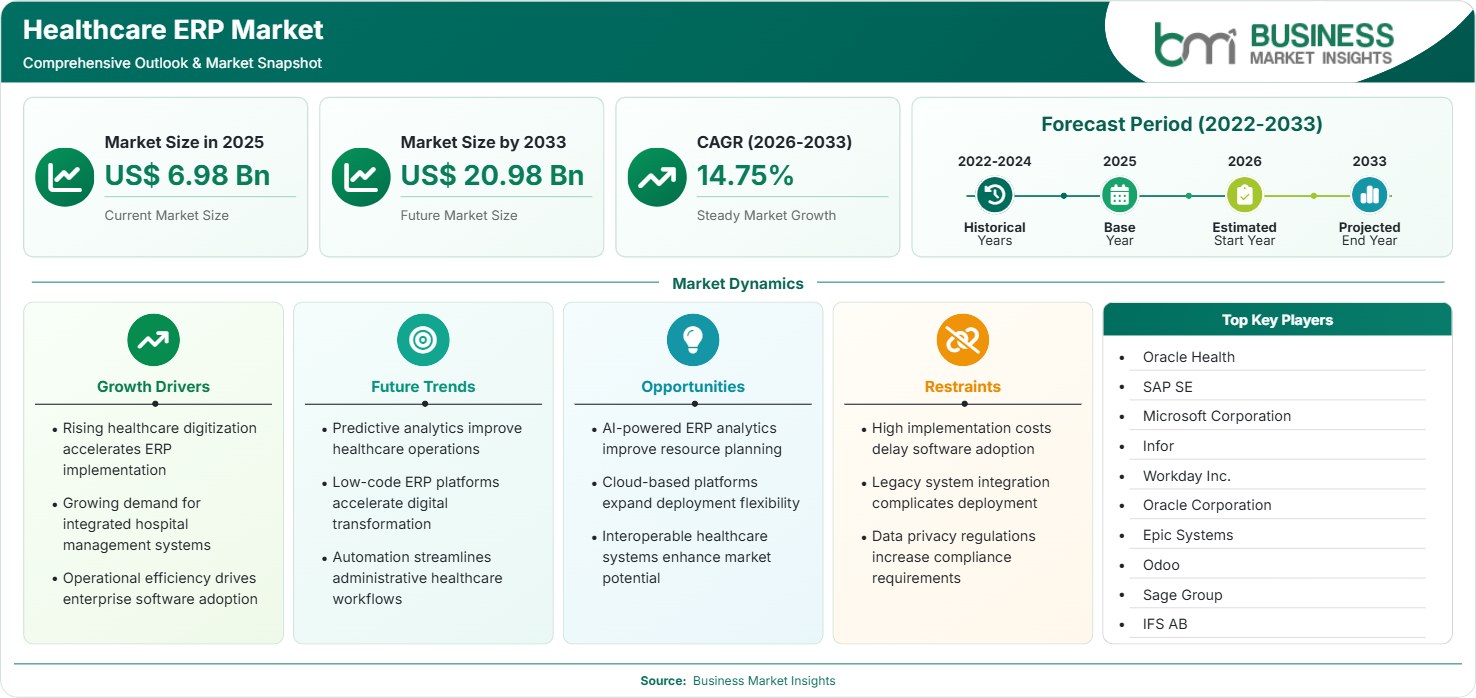
The Healthcare ERP Market size was valued at US$ 6.98 billion in 2025 and is projected to reach US$ 20.98 billion by 2033, growing at a CAGR of 14.75% during 2026–2033. Rising healthcare digitization, increasing demand for integrated hospital management platforms, and expanding investments in enterprise automation continue creating strong opportunities for ERP solution providers across the global healthcare sector.

Report Coverage
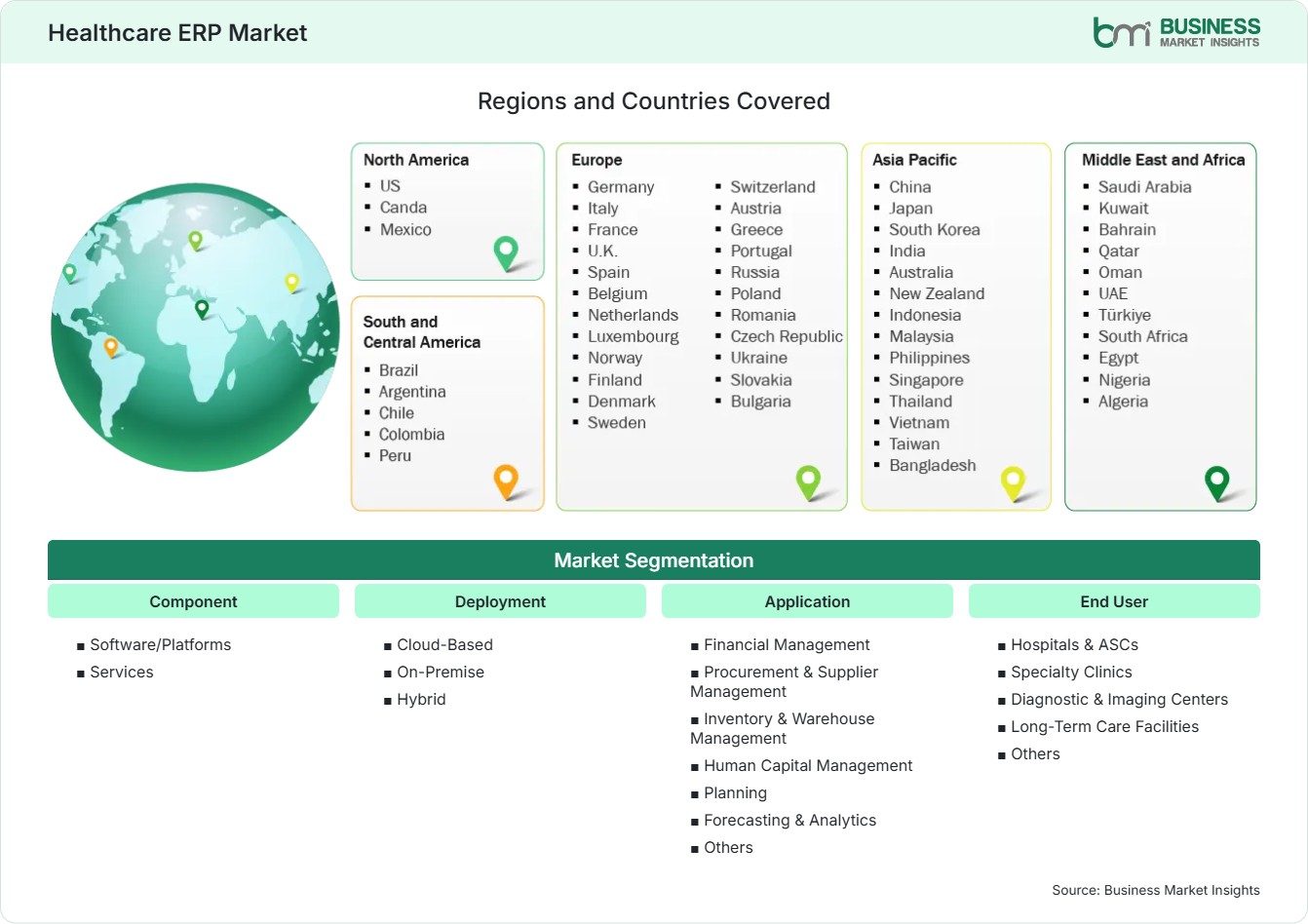
  • Component: Software/Platforms, Services
  • Deployment: Cloud-Based, On-Premise, Hybrid
  • Application: Financial Management, Procurement & Supplier Management, Inventory & Warehouse Management, Human Capital Management, Planning, Forecasting & Analytics, Others
  • End User: Hospitals & ASCs, Specialty Clinics, Diagnostic & Imaging Centers, Long-Term Care Facilities, Others
US$ 6.98 Bn Market size in 2025
US$ 20.98 Bn Market Size by 2033
14.75% CAGR, 2026 - 2033
2026-2033 Forecast Period

AI Overview

Healthcare ERP Market Summary

  • North America Region: North America holds 37%–40% market share in 2025 and is expected to expand at a CAGR of 13.9%–14.5% during 2026–2033. Strong digital health infrastructure, increasing cloud adoption, and regulatory compliance requirements continue driving ERP implementation across healthcare organizations. The U.S. remains the largest contributor, advancing at a CAGR of 14.0%–14.6% through investments in enterprise modernization and integrated healthcare management.
  • Fastest Growing Region: Asia Pacific accounts for 23%–26% market share in 2025 and is projected to register the fastest CAGR of 16.1%–16.8%, supported by hospital digital transformation, healthcare infrastructure expansion, and growing investments in cloud-based enterprise software.
  • Leading Segment: Software/Platforms represents 67%–70% market share in 2025 and is anticipated to grow at a CAGR of 14.8%–15.4%, driven by increasing adoption of integrated enterprise management solutions across healthcare providers.
  • High Growth Segment: Cloud-Based Deployment captures 46%–49% market share in 2025 and is expected to expand at a CAGR of 16.4%–17.1%, supported by scalability, lower infrastructure costs, remote accessibility, and continuous software upgrades.
  • Key Market Opportunity: Increasing investments in AI-enabled healthcare enterprise platforms, cloud migration strategies, and interoperable digital ecosystems continue creating substantial opportunities for ERP software vendors worldwide.
  • Major Market Players: Oracle Health, SAP SE, Microsoft Corporation, Infor, Workday Inc., Oracle Corporation, Epic Systems Corporation, Odoo S.A., The Sage Group plc, and IFS AB.
Strategic Insights

Healthcare ERP Market: Strategic Insights

Healthcare ERP Market Strategic Framework
FREE PDF
Request your free sample
Request free sample
Stakeholder View

Key Takeaways

  • Enterprise resource planning platforms are evolving from administrative systems into strategic digital infrastructure supporting finance, procurement, workforce planning, inventory management, and operational analytics across healthcare organizations.
  • Cloud deployment continues generating the strongest investment opportunities as healthcare providers prioritize scalable, subscription-based platforms that reduce infrastructure costs while supporting secure remote access.
  • Artificial intelligence, predictive analytics, and workflow automation are improving enterprise decision-making, helping healthcare providers optimize staffing, procurement, budgeting, and operational performance.
  • Asia Pacific offers significant long-term investment potential due to expanding healthcare infrastructure, increasing hospital digitization, and government initiatives supporting digital healthcare transformation.
  • Technology partnerships, cloud migration projects, and ERP modernization programs continue driving mergers, acquisitions, and strategic collaborations among enterprise software providers and healthcare organizations.
  • Vendors investing in interoperability, cybersecurity, regulatory compliance, and modular ERP architectures are expected to strengthen their competitive position as enterprise healthcare ecosystems become increasingly connected.
Geographic Outlook

Healthcare ERP Market Regional Highlights

North America Healthcare ERP Market

North America accounts for 37%–40% Healthcare ERP Market share in 2025 and is projected to expand at a CAGR of 13.9%–14.5% during 2026–2033. Mature healthcare IT infrastructure, widespread electronic health record adoption, and increasing investments in enterprise software modernization continue supporting regional demand. Healthcare providers are prioritizing integrated ERP solutions that improve operational efficiency, compliance, financial management, and enterprise-wide data visibility.

  • Large hospital networks continue replacing legacy enterprise systems with cloud-native ERP platforms supporting integrated operations.
  • Regulatory compliance requirements encourage healthcare organizations to strengthen enterprise governance, financial transparency, and reporting capabilities.
  • AI-enabled automation improves workforce scheduling, procurement optimization, and inventory planning across healthcare institutions.
  • Strategic partnerships between healthcare providers and enterprise software vendors continue accelerating digital transformation initiatives.

US Healthcare ERP Market

The United States contributes 84%–87% of North American revenue and is expected to register a CAGR of 14.0%–14.6% during the forecast period. Continuous investments in digital health infrastructure, cloud migration, and healthcare analytics support long-term enterprise software adoption across public and private healthcare organizations.

  • Hospital systems increasingly integrate ERP platforms with electronic health records and clinical management applications.
  • Growing demand for operational efficiency accelerates enterprise software modernization initiatives.
  • AI-powered analytics strengthen financial planning, procurement management, and workforce optimization.
  • Healthcare providers continue investing in cybersecurity and interoperable enterprise software ecosystems.

Europe Healthcare ERP Market

Europe represents 27%–30% healthcare ERP market share in 2025 and is projected to grow at a CAGR of 13.5%–14.2% during 2026–2033. Digital healthcare strategies, public health modernization programs, and regulatory compliance initiatives continue supporting ERP deployment across hospitals and healthcare networks. Germany leads regional implementation, while Poland records the fastest growth owing to increasing healthcare technology investments and expanding digital infrastructure.

  • Government-supported healthcare digitalization programs continue accelerating ERP adoption.
  • Integrated enterprise platforms improve procurement efficiency and financial management across hospital systems.
  • Healthcare organizations increasingly prioritize cloud deployment and interoperable software architectures.
  • Growing demand for operational transparency supports investments in enterprise analytics platforms.

Asia Pacific Healthcare ERP Market

Asia Pacific accounts for 23%–26% healthcare ERP market share in 2025 and is expected to register the fastest CAGR of 16.1%–16.8% through 2026–2033. Expanding healthcare infrastructure, rising healthcare expenditure, and government-led digital transformation initiatives continue strengthening enterprise software demand. China remains the largest regional market, while India records the fastest expansion through increasing private hospital investments and cloud adoption.

  • Hospital modernization programs continue expanding ERP implementation across healthcare networks.
  • Rising investments in cloud infrastructure improve enterprise software accessibility and scalability.
  • Healthcare providers increasingly adopt AI-enabled platforms for operational optimization.
  • Growing private healthcare investments strengthen long-term enterprise software demand.

Rest of World Healthcare ERP Market

The Rest of World region represents 8%–10% market share in 2025 and is anticipated to expand at a CAGR of 14.2%–14.8% during the forecast period. Healthcare infrastructure development, digital health initiatives, and expanding private healthcare investments continue supporting ERP adoption across Latin America, the Middle East, and Africa.

  • Brazil remains the leading market through continued healthcare digitization and enterprise software investments.
  • GCC countries expand cloud-based healthcare platforms to improve operational efficiency.
  • Private healthcare providers increasingly deploy ERP systems to strengthen financial and resource management.
  • Healthcare modernization initiatives continue creating new opportunities for enterprise software vendors.

Top of Form

Bottom of Form
Global Market Geography
FREE PDF
Request your free sample
Request free sample
Segment Analysis

Healthcare ERP Market Segmentation

Component

The component segment represents the foundation of enterprise resource planning adoption across healthcare organizations as providers increasingly invest in integrated digital platforms and implementation services. It accounted for 67%–70% market share in 2025 and is projected to register a CAGR of 14.8%–15.4% during 2026–2033. Expanding digital transformation initiatives and demand for enterprise-wide automation continue broadening the Healthcare ERP Market scope across hospitals, clinics, and diagnostic centers.

  • Software/Platforms: Account for the largest revenue contribution owing to increasing demand for integrated financial, procurement, inventory, workforce, and operational management platforms that improve enterprise visibility, automation, and regulatory compliance.
  • Services: Continue expanding steadily as healthcare providers require consulting, implementation, integration, customization, migration, maintenance, training, and technical support for successful ERP deployment and long-term operational performance.

Deployment

Deployment preferences continue evolving as healthcare organizations prioritize scalable, secure, and cost-efficient enterprise software environments. The segment accounted for 46%–49% market share in 2025 and is expected to grow at a CAGR of 16.4%–17.1% during the forecast period. Current Healthcare ERP Market trends indicate increasing migration toward cloud infrastructure while hybrid deployment gains traction among organizations requiring flexible digital transformation strategies.

  • Cloud-Based: Leads adoption because of lower infrastructure investment, automatic software updates, improved scalability, remote accessibility, subscription-based pricing, and simplified deployment across multi-location healthcare organizations.
  • On-Premise: Remains relevant among large healthcare providers requiring greater control over enterprise infrastructure, customized deployment environments, internal data governance, and compliance with organization-specific security requirements.
  • Hybrid: Gains momentum by combining cloud scalability with on-premise security, enabling healthcare organizations to modernize enterprise systems while maintaining control over sensitive operational and patient-related information.

Application

Application-specific ERP modules continue expanding as healthcare organizations seek centralized management of financial operations, procurement, inventory, workforce planning, and enterprise analytics. This segment represents a significant share of overall market demand and is projected to grow steadily through 2033 as digital transformation initiatives accelerate across healthcare institutions.

  • Financial Management: Enables hospitals to improve budgeting, accounting, revenue cycle management, regulatory reporting, and financial transparency while strengthening enterprise-wide cost control and operational efficiency.
  • Procurement & Supplier Management: Supports centralized purchasing, supplier performance monitoring, contract administration, inventory optimization, and cost-effective sourcing across healthcare supply chains.
  • Inventory & Warehouse Management: Improves stock visibility, medical supply tracking, warehouse operations, demand forecasting, and inventory utilization to reduce shortages and operational waste.
  • Human Capital Management: Streamlines workforce scheduling, payroll administration, recruitment, credential management, performance evaluation, and employee lifecycle management across healthcare organizations.
  • Planning, Forecasting & Analytics: Supports predictive decision-making through enterprise reporting, financial forecasting, operational analytics, capacity planning, and business intelligence capabilities that improve strategic resource allocation.

End User

End-user adoption continues expanding as healthcare providers modernize enterprise operations to improve efficiency, compliance, and resource utilization. Hospitals remain the largest adopters, while specialty healthcare facilities increasingly implement ERP platforms to support integrated business management and long-term operational sustainability.

  • Hospitals & ASCs: Represent the largest user group because of complex administrative operations, high patient volumes, integrated financial management requirements, and continuous investments in digital healthcare infrastructure.
  • Specialty Clinics: Increasingly implement ERP systems to automate administrative workflows, optimize scheduling, improve financial management, and enhance operational coordination across specialized healthcare services.
  • Diagnostic & Imaging Centers: Adopt ERP platforms to strengthen inventory management, equipment utilization, appointment scheduling, procurement processes, and financial reporting while improving service efficiency.
  • Long-Term Care Facilities: Continue investing in enterprise software to improve workforce planning, inventory control, resident administration, compliance management, and long-term operational performance across care facilities.
Market Forces

Healthcare ERP Market Dynamics

Key Market Drivers

Rising healthcare digitization accelerates ERP implementation

Healthcare organizations are rapidly replacing fragmented administrative systems with integrated ERP platforms to improve operational visibility and streamline enterprise-wide processes. Initiatives around digital transformation are motivating organizations to integrate their procurement, finance, inventory management, and HR processes into a single software platform. The increasing use of electronic health record systems and e-billing systems is adding even more momentum to the requirement for enterprise software platforms that support complex organizational processes. In an effort to modernize hospitals' IT environments, ERP software vendors have begun incorporating features such as automation and artificial intelligence into their solutions.

Growing demand for integrated hospital management systems

Hospitals and healthcare networks increasingly require centralized enterprise solutions that connect financial management, procurement, supply chain operations, human resources, and analytics within a single platform. Integrated ERP systems minimize administrative redundancies, improve resource allocation, and facilitate greater cooperation across divisions. Software that is able to help healthcare facilities meet the regulations, provide reports, and monitor performance within the entire organization has become a priority for many healthcare providers as well. Integrated management solutions keep on gaining importance as healthcare organizations grow.

Operational efficiency drives enterprise software adoption

Healthcare providers continue focusing on operational excellence to reduce administrative workloads, improve financial performance, and optimize resource utilization. Enterprise resource planning applications streamline repetitive business operations, enhance procurement precision, increase inventory visibility, and facilitate workforce planning through centralized data management. Through cloud computing, workflow automation, and business intelligence, organizations can improve performance efficiency while eliminating operational inefficiencies. Such advancements continue to contribute to the wider use of enterprise software by various healthcare institutions in both the public and private sectors.

Key Market Opportunities

AI-powered ERP analytics improve resource planning

Artificial intelligence is transforming enterprise planning by enabling healthcare organizations to forecast staffing requirements, optimize procurement activities, improve financial planning, and automate operational decision-making. Intelligent analytics support proactive resource allocation while identifying inefficiencies across enterprise workflows. Healthcare ERP Market Forecasts indicate that continued investment in AI-driven ERP capabilities will create significant opportunities for software vendors developing advanced decision-support platforms for hospitals, specialty clinics, and integrated healthcare networks.

Cloud-based platforms expand deployment flexibility

Cloud deployment continues creating new opportunities by allowing healthcare organizations to modernize enterprise infrastructure without major capital investment. Subscription-based ERP systems enable greater scalability, simplified software management, and secure remote connectivity across the various branches of the healthcare organization. In addition, using cloud computing infrastructure helps shorten implementation times and enables auto-updating and business continuity. With an increasing number of digital health care ecosystems worldwide, cloud-based ERP applications are likely to continue being a primary focus for healthcare companies.

Interoperable healthcare systems enhance market potential

Healthcare enterprises are requiring the need for enterprise software which can integrate with electronic medical records systems, laboratory management systems, pharmaceutical management systems, and many more healthcare applications. The advantage of interoperability includes better exchange of information, effective administrative coordination, and better decision making at the enterprise level without replacing the clinical applications that are in use currently. ERP software providers are constantly investing in integration solutions which use standards and APIs that make implementation easy in various healthcare settings.

Market Restraints and Challenges

High implementation costs delay software adoption

Factor: The implementation of an enterprise ERP involves substantial expenditure on software licensing, infrastructure upgrades, system customization, employee training, and technical support. Such expenses pose serious challenges for small hospitals, specialty clinics, and other healthcare organizations operating under tight technology budgets. Impact: Long return-on-investment times and budget limitations often result in postponing the decision to purchase and slow down implementation in enterprises needing to modernize technologically yet lacking sufficient funds.

Legacy system integration complicates deployment

Factor: Many healthcare providers continue operating multiple legacy applications that were developed independently over several years, making integration with modern ERP platforms technically complex. Differences in data formats, software architecture, and operational workflows often require extensive customization and migration planning. Impact: Longer implementation timelines, increased project costs, operational disruption, and additional testing requirements can delay ERP deployment, creating challenges for organizations seeking seamless enterprise transformation while maintaining uninterrupted healthcare services.

Company Analysis

Competitive Landscape

The competitive landscape is characterized by continuous investment in cloud computing, artificial intelligence, interoperability, and enterprise automation. Healthcare ERP Market analysis indicates that leading vendors are expanding industry-specific ERP capabilities, strengthening cybersecurity frameworks, and integrating advanced analytics to improve financial management, workforce planning, procurement efficiency, and operational performance across healthcare organizations.

Company Name

Overview

Products and Services Relevant to this Market

Oracle Health

Provides integrated healthcare information technology solutions focused on clinical, financial, and operational transformation for hospitals and healthcare networks.

Healthcare ERP platforms, revenue cycle management, financial management, supply chain solutions, analytics, cloud healthcare applications, and interoperability services.

SAP SE

Global enterprise software provider delivering industry-specific ERP solutions for healthcare organizations and life sciences companies.

ERP software, procurement management, finance, supply chain management, human capital management, cloud ERP, and business analytics.

Microsoft Corporation

Develops cloud technologies and enterprise software supporting healthcare digital transformation and intelligent business operations.

Microsoft Dynamics 365, Azure cloud services, AI solutions, enterprise analytics, productivity software, and healthcare integration platforms.

Infor

Offers cloud-based enterprise software tailored for hospitals, healthcare providers, and complex operational environments.

Cloud ERP, financial management, workforce management, supply chain software, asset management, and healthcare enterprise solutions.

Workday Inc.

Delivers enterprise cloud applications supporting workforce, finance, and planning functions across healthcare organizations.

Human capital management, financial management, workforce planning, analytics, cloud ERP applications, and enterprise reporting tools.

Oracle Corporation

Global technology company providing enterprise database, cloud infrastructure, and ERP software for healthcare enterprises.

Oracle Fusion Cloud ERP, procurement, finance, analytics, cloud infrastructure, database management, and enterprise integration solutions.

Epic Systems Corporation

Leading healthcare software company supporting integrated clinical and operational management across healthcare providers.

Enterprise management tools, electronic health records integration, scheduling, billing, analytics, and interoperability solutions.

Odoo S.A.

Open-source ERP software provider serving organizations with flexible and customizable enterprise management platforms.

ERP applications, accounting, procurement, inventory management, HR, CRM, project management, and business process automation.

The Sage Group plc

Develops enterprise accounting and business management software supporting healthcare financial operations and administration.

Financial management software, accounting platforms, payroll, procurement, business intelligence, and cloud business solutions.

IFS AB

Enterprise software company specializing in asset-intensive industries, including healthcare infrastructure management.

ERP software, enterprise asset management, field service management, finance, procurement, and operational planning solutions.

Trust & Transparency

Research Methodology

The market analysis combines proprietary research with secondary data from government agencies, company disclosures, regulatory filings, industry databases and expert interviews. Market estimates are validated through data triangulation, cross-market benchmarking and analyst review.

View Full Research Methodology

Questions Answered

Frequently Asked Questions

What does the Healthcare ERP Market Report cover?

The Market Report provides detailed insights into market size, segmentation, competitive landscape, regional outlook, technological developments, investment opportunities, growth strategies, and future industry prospects.

How is artificial intelligence influencing ERP platforms in healthcare?

Artificial intelligence improves forecasting, workforce scheduling, procurement optimization, financial planning, predictive analytics, and enterprise automation, enabling healthcare organizations to make faster and more informed operational decisions.

Which end users generate the highest demand for healthcare ERP solutions?

Hospitals and ambulatory surgery centers remain the largest end users due to their complex administrative operations, high patient volumes, regulatory compliance requirements, and continuous investment in enterprise digital transformation.

Which deployment model is expected to grow the fastest?

Cloud-based deployment is expected to witness the strongest growth because it offers scalability, lower infrastructure costs, faster implementation, automatic software updates, and secure remote access for healthcare organizations.

What is driving demand in the Healthcare ERP Market?

Growing healthcare digitalization, increasing adoption of cloud-based enterprise platforms, demand for integrated hospital management systems, and the need to improve financial, procurement, and workforce efficiency are driving market expansion.

Access the Full Healthcare ERP Market Report

Get segment-level forecasts, regional estimates, competitive benchmarking, company profiles and downloadable Excel datasets.

Access the full Healthcare ERP Market Report
350 pages PDF & Excel | 2026-08-21
Similar Research

Related Market Reports