
Healthcare Interoperability Market Outlook: Size, Share, Trends, Growth Analysis, Competitive Landscape & Forecast, 2026-2033

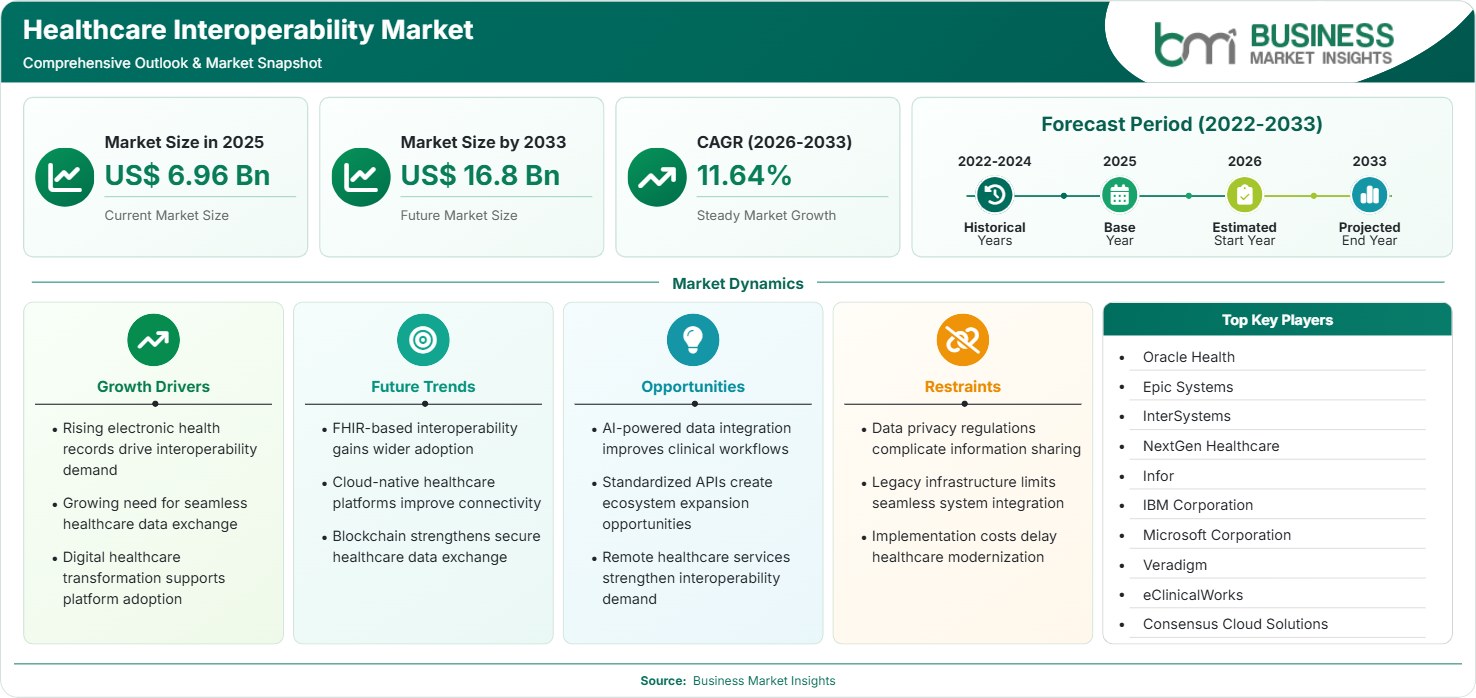
The Healthcare Interoperability Market size was valued at US$ 6.96 billion in 2025 and is projected to reach US$ 16.80 billion by 2033, growing at a CAGR of 11.64% during 2026–2033. Rising adoption of electronic health records, expanding digital healthcare infrastructure, and increasing demand for secure healthcare data exchange continue creating new opportunities across global healthcare ecosystems.

Report Coverage
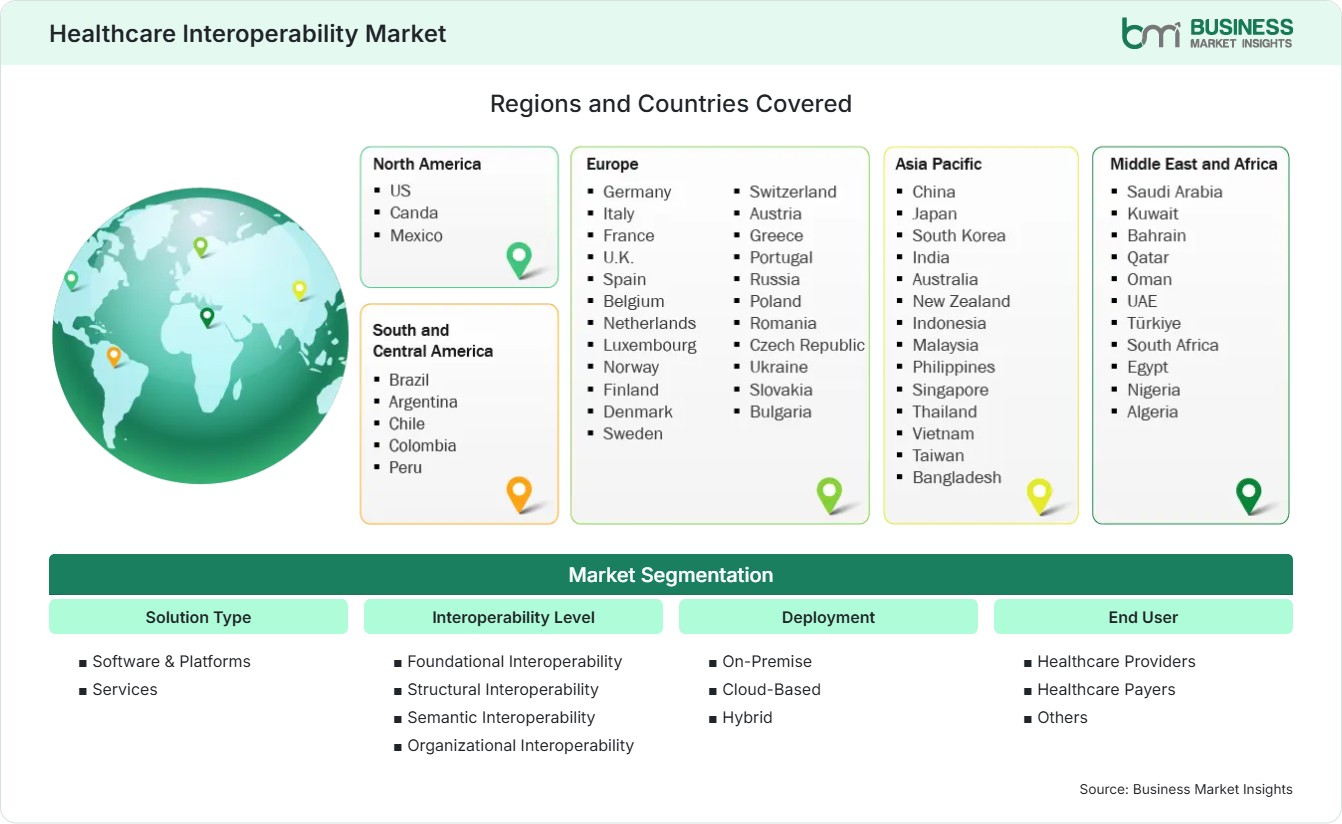
  • Solution Type: Software & Platforms, Services
  • Interoperability Level: Foundational Interoperability, Structural Interoperability, Semantic Interoperability, Organizational Interoperability
  • Deployment: On-Premise, Cloud-Based, Hybrid
  • End User: Healthcare Providers, Healthcare Payers, Others
US$ 6.96 Bn Market size in 2025
US$ 16.8 Bn Market Size by 2033
11.64% CAGR, 2026 - 2033
2026-2033 Forecast Period

AI Overview

Healthcare Interoperability Market Summary

  • North America Region: North America accounts for 41%–44% market share in 2025 and is projected to grow at a CAGR of 10.9%–11.4% during 2026–2033. Mature healthcare IT infrastructure, widespread electronic health record adoption, and supportive interoperability regulations continue strengthening market expansion. The U.S. remains the largest regional market, expanding at a CAGR of 11.0%–11.5%, supported by cloud-based healthcare platforms, standardized data exchange initiatives, and digital transformation programs.
  • Fastest Growing Region: Asia Pacific holds 22%–25% market share in 2025 and is anticipated to register the fastest CAGR of 13.0%–13.6% through 2033. Rapid healthcare digitization, increasing investments in hospital information systems, expanding telehealth services, and government-backed digital health initiatives continue supporting regional adoption.
  • Leading Segment: Software & Platforms account for 61%–64% market share in 2025 and are expected to expand at a CAGR of 11.8%–12.3%, driven by increasing deployment of interoperability platforms, health information exchanges, and cloud-based clinical data management solutions.
  • High Growth Segment: Cloud-Based deployment represents 39%–42% market share in 2025 and is projected to grow at a CAGR of 13.2%–13.8%, supported by scalable infrastructure, remote accessibility, lower implementation costs, and continuous healthcare digitalization.
  • Key Market Opportunity: Growing adoption of AI-enabled interoperability platforms, standardized healthcare APIs, and cloud-native clinical data exchange solutions continues creating long-term opportunities for healthcare technology providers.
  • Major Market Players: Oracle Health, Epic Systems Corporation, InterSystems Corporation, NextGen Healthcare, Inc., Infor Inc., IBM Corporation, Microsoft Corporation, Veradigm Inc., eClinicalWorks LLC, and Consensus Cloud Solutions, Inc.
Strategic Insights

Healthcare Interoperability Market: Strategic Insights

Healthcare Interoperability Market Strategic Framework
FREE PDF
Request your free sample
Request free sample
Stakeholder View

Key Takeaways

  • Software platforms remain the primary revenue contributor as healthcare organizations increasingly modernize data exchange infrastructure and integrate clinical, administrative, and financial information systems.
  • Cloud-based interoperability solutions present the strongest long-term growth opportunity by improving scalability, lowering implementation costs, and enabling secure healthcare information exchange across distributed care networks.
  • Artificial intelligence, standardized APIs, and semantic interoperability are reshaping healthcare data integration, improving clinical workflows and supporting better patient outcomes through real-time information availability.
  • Asia Pacific offers the most attractive investment opportunity due to expanding healthcare digitization, rising public health expenditure, and increasing implementation of national digital health initiatives.
  • Strategic collaborations among healthcare technology providers, electronic health record vendors, and cloud service companies continue accelerating interoperability innovation and integrated healthcare delivery.
  • Regulatory emphasis on secure patient data exchange and value-based healthcare models continues encouraging long-term investment in advanced interoperability platforms.
Geographic Outlook

Healthcare Interoperability Market Regional Highlights

North America Healthcare Interoperability Market

North America accounts for 41%–44% Healthcare Interoperability Market share in 2025 and is expected to expand at a CAGR of 10.9%–11.4% during 2026–2033. Strong healthcare IT infrastructure, high electronic health record adoption, and favorable interoperability regulations continue supporting regional leadership. Healthcare organizations increasingly invest in integrated cloud platforms, standardized APIs, and advanced data exchange technologies to improve patient care coordination and operational efficiency.

  • Federal digital health initiatives continue encouraging secure interoperability across hospitals, physician networks, laboratories, and payer organizations.
  • Healthcare providers increasingly implement cloud-native interoperability platforms to improve scalability, cybersecurity, and clinical collaboration.
  • Artificial intelligence enhances clinical decision support through real-time access to integrated healthcare information.
  • Strategic partnerships between healthcare software vendors and cloud providers continue strengthening regional innovation capabilities.

US Healthcare Interoperability Market

The United States contributes 84%–87% of North American revenue and is projected to register a CAGR of 11.0%–11.5% throughout the forecast period. Large healthcare networks, supportive regulatory frameworks, and continuous investment in digital healthcare transformation continue driving adoption.

  • Electronic health record modernization remains a major investment priority among hospitals and integrated delivery networks.
  • Cloud-based interoperability platforms continue replacing fragmented legacy healthcare information systems.
  • Expanding telehealth services strengthen demand for secure patient data exchange infrastructure.
  • Healthcare providers increasingly utilize AI-enabled interoperability tools to improve workflow efficiency and clinical outcomes.

Europe Healthcare Interoperability Market

Europe represents 26%–29% market share in 2025 and is projected to expand at a CAGR of 11.2%–11.7% through 2033. Digital healthcare modernization, cross-border healthcare initiatives, and standardized health information exchange continue supporting market expansion. Germany leads regional adoption, while Spain records the fastest growth through healthcare IT investments and national digital health programs.

  • Cross-border healthcare initiatives continue improving interoperability standards across European healthcare systems.
  • Hospitals increasingly invest in standardized data exchange platforms supporting integrated patient care.
  • Regulatory compliance strengthens implementation of secure health information management systems.
  • Public funding continues accelerating modernization of healthcare IT infrastructure across major European economies.

Asia Pacific Healthcare Interoperability Market

Asia Pacific accounts for 22%–25% market share in 2025 and is expected to register the fastest 13.0%–13.6% CAGR during the forecast period. Expanding healthcare infrastructure, government-backed digital health strategies, rising cloud adoption, and increasing healthcare IT expenditure continue supporting rapid market development. China remains the largest regional market, while India records the fastest growth due to accelerated healthcare digitization.

  • National digital health initiatives continue expanding interoperability implementation across hospitals and primary care facilities.
  • Growing healthcare investments increase deployment of cloud-based clinical information systems.
  • Private healthcare providers strengthen adoption of integrated patient data management platforms.
  • Expanding telemedicine services continue increasing demand for secure healthcare information exchange.

Rest of World Healthcare Interoperability Market

The Rest of World region holds 7%–9% market share in 2025 and is projected to grow at a CAGR of 11.4%–12.0% through 2033. Healthcare modernization, expanding digital infrastructure, and increasing investment in electronic medical records continue supporting adoption across Latin America, the Middle East, and Africa.

  • Brazil leads regional implementation through continued investment in healthcare information technology modernization.
  • GCC countries continue strengthening digital healthcare infrastructure under national transformation strategies.
  • Healthcare providers increasingly adopt interoperable systems to improve patient care coordination.
  • International partnerships support technology transfer and implementation of standardized healthcare information exchange platforms.
Global Market Geography
FREE PDF
Request your free sample
Request free sample
Segment Analysis

Healthcare Interoperability Market Segmentation

Solution Type

The solution type segment represents the largest revenue contributor as healthcare organizations continue investing in interoperable digital ecosystems that improve patient care, operational efficiency, and regulatory compliance. The segment accounted for 61%–64% market share in 2025 and is projected to expand at a CAGR of 11.8%–12.3% during 2026–2033. The growing Healthcare Interoperability Market scope is supported by increasing adoption of integrated software platforms and specialized implementation services across healthcare systems.

  • Software & Platforms: Continue dominating adoption by enabling secure clinical data exchange, health information integration, patient identity management, and interoperability across electronic health record systems.
  • Services: Experience steady demand as healthcare organizations require consulting, deployment, optimization, and long-term operational support for interoperability initiatives.

Interoperability Level

Healthcare organizations increasingly implement multiple interoperability levels to enable standardized information exchange while improving clinical collaboration and patient outcomes. This segment accounted for 29%–32% market share in 2025 and is expected to register a CAGR of 12.0%–12.5% during the forecast period. Current Healthcare Interoperability Market trends emphasize semantic data exchange, standardized communication protocols, and enterprise-wide healthcare integration.

  • Foundational Interoperability: Enables secure transmission of healthcare information between connected systems without requiring interpretation of underlying clinical content.
  • Structural Interoperability: Standardizes healthcare data formats and messaging structures to ensure accurate information exchange across electronic health record platforms.
  • Semantic Interoperability: Supports consistent interpretation of exchanged clinical information using standardized medical terminology, coding systems, and structured healthcare data models.
  • Organizational Interoperability: Facilitates governance, policy alignment, security, regulatory compliance, and collaborative information sharing among multiple healthcare organizations.

Deployment

Deployment models continue evolving as healthcare providers seek flexible, secure, and scalable interoperability infrastructure. This segment captured 39%–42% market share in 2025 and is anticipated to expand at a CAGR of 13.2%–13.8% through 2033. Cloud adoption, cybersecurity enhancements, and hybrid IT environments continue influencing technology selection across healthcare organizations.

  • On-Premise: Preferred by organizations requiring direct infrastructure control, customized deployment, and strict internal governance for highly sensitive healthcare information.
  • Cloud-Based: Experiences the fastest adoption through scalable infrastructure, lower capital investment, simplified software updates, and improved remote accessibility across healthcare networks.
  • Hybrid: Combines on-premise infrastructure with cloud capabilities, allowing healthcare organizations to balance operational flexibility, regulatory compliance, and data security requirements.

End User

End-user demand continues expanding as digital healthcare transformation accelerates worldwide. The segment accounted for 58%–61% market share in 2025 and is projected to grow at a CAGR of 11.7%–12.2% throughout the forecast period. Increasing healthcare digitization, coordinated patient care initiatives, and value-based healthcare models continue supporting broader interoperability implementation.

  • Healthcare Providers: Represent the largest user group by deploying interoperable platforms across hospitals, clinics, physician practices, diagnostic centers, and integrated healthcare networks to improve patient care coordination.
  • Healthcare Payers: Utilize interoperability solutions to streamline claims management, member information exchange, care coordination, fraud detection, and administrative workflow optimization across insurance operations.
Market Forces

Healthcare Interoperability Market Dynamics

Key Market Drivers

Rising electronic health records drive interoperability demand

The widespread use of electronic health records has revolutionized the manner in which healthcare facilities record, store and communicate patient information. As more hospitals and physician networks embrace the digitalization of their clinical records, the demand for platforms that can communicate across multiple interfaces has grown. Platforms that facilitate interoperability make it possible to get rid of fragmentation of patient information, and make healthcare service provision more efficient. Some vendors have developed platforms that incorporate all kinds of health records. These developments continue supporting Healthcare Interoperability Market growth by enabling healthcare organizations to improve information accessibility and enhance clinical decision-making.

Growing need for seamless healthcare data exchange

Healthcare providers increasingly require uninterrupted exchange of patient information between hospitals, laboratories, pharmacies, insurers, and diagnostic centers. Seamless connectivity allows healthcare professionals to have access to the complete history of their patients, saving them time by avoiding duplicate tests and helping them provide precise treatment. The adoption of value-based healthcare is another factor driving the requirement for seamless integration within the healthcare system. With organizations increasingly switching to interoperable solutions from disparate systems, solution vendors are enhancing their features to make the workflow faster and more efficient.

Digital healthcare transformation supports platform adoption

Healthcare systems worldwide continue investing in digital transformation initiatives to modernize patient care delivery and improve operational performance. Healthcare information produced daily by cloud computing, mobile health applications, artificial intelligence, and connected healthcare devices is constantly rising. Interoperability platforms offer the necessary backbone for linking these technological innovations, enabling smooth information flow between various healthcare settings. As healthcare institutions focus on their technological upgrade in the future, the demand for interoperability solutions will remain high.

Key Market Opportunities

AI-powered data integration improves clinical workflows

AI is opening new possibilities of interoperability within the healthcare sector through automating the integration of clinical data, improving patient matching of records, and increasing the functionality of decision support systems. The AI-powered platform enables faster analysis of structured and unstructured data from different systems. This makes it easier to pinpoint any gaps in care and optimize care paths. Healthcare Interoperability Market Forecasts indicate that continued investment in AI-enabled interoperability solutions will support broader adoption across hospitals, integrated healthcare networks, and digital health platforms.

Standardized APIs create ecosystem expansion opportunities

The growing adoption of standardized application programming interfaces enables healthcare applications to exchange information more efficiently while reducing integration complexity. Standardized APIs allow for the safe connection of electronic health record systems, laboratory information systems, pharmacy systems, insurance software, and patient engagement tools. The software vendors are building ecosystems through APIs to foster innovation from healthcare software providers while ensuring interoperability. This presents good prospects for health care institutions looking to build a technology architecture that can be extended in the future.

Remote healthcare services strengthen interoperability demand

The expansion of remote healthcare services continues increasing demand for interoperable digital platforms capable of connecting patients, clinicians, and healthcare institutions. Telemedicine visits, remote patient monitoring, and home health care generate substantial clinical data that should be safely incorporated into centralized medical records. Interoperable systems ensure ongoing data transfer between telemedicine systems and existing hospital information systems, helping coordinate treatment processes and increase access to care.

Market Restraints and Challenges

Data privacy regulations complicate information sharing

Healthcare organizations operate within strict regulatory environments governing patient privacy, consent management, and confidential medical information. Factor: The need to comply with ever-changing data protection laws requires implementing numerous security features, encryption techniques, governance structures, and monitoring of healthcare data exchanges. Impact: Increased compliance needs complicate the process of implementation, prolong the timelines of deployment, and increase the costs of implementation. Organizations have to find a way to combine compliance needs with the increasing need for interoperability.

Legacy infrastructure limits seamless system integration

Many healthcare organizations continue relying on outdated clinical information systems that were not designed for modern interoperability requirements. Factor: The use of legacy systems, proprietary architecture, and non-standardized data standards makes it difficult to integrate with new digital health systems. Impact: The difficulty in integration makes digital transformation initiatives costly and difficult, requiring customized interfaces. Modernizing legacy systems is necessary to ensure efficient data communication and interoperability.

Company Analysis

Competitive Landscape

The competitive landscape is characterized by continuous innovation in cloud-based interoperability platforms, AI-enabled clinical integration, and standardized healthcare data exchange technologies. Healthcare Interoperability Market analysis indicates that leading vendors are expanding their software portfolios, strengthening strategic partnerships, and investing in interoperable digital health ecosystems to improve patient care coordination and healthcare operational efficiency.

Company Name

Overview

Products and Services Relevant to this Market

Oracle Health

Global healthcare technology provider offering integrated clinical information systems and digital health platforms for hospitals and healthcare networks.

Electronic health records, interoperability platforms, clinical data exchange solutions, healthcare analytics, cloud infrastructure, and patient engagement solutions.

Epic Systems

Leading electronic health record vendor providing interoperable healthcare software for hospitals, clinics, and integrated delivery networks worldwide.

Electronic health records, interoperability solutions, patient portals, health information exchange, revenue cycle management, and clinical workflow applications.

InterSystems

Healthcare information technology company specializing in data integration and interoperability technologies for connected healthcare ecosystems.

Health information exchange platforms, interoperability software, data integration solutions, healthcare analytics, and cloud-based healthcare technologies.

NextGen Healthcare

Provider of ambulatory healthcare technology solutions supporting clinical, financial, and administrative healthcare operations.

Electronic health records, interoperability software, practice management solutions, healthcare analytics, patient engagement, and cloud services.

Infor

Enterprise software company delivering cloud-based healthcare applications supporting operational efficiency and clinical collaboration.

Healthcare ERP solutions, interoperability software, cloud applications, healthcare analytics, workforce management, and clinical integration platforms.

IBM Corporation

Global technology company delivering artificial intelligence, cloud computing, and healthcare data integration solutions.

AI-powered healthcare analytics, cloud platforms, interoperability technologies, cybersecurity solutions, and healthcare consulting services.

Microsoft Corporation

Technology leader providing secure cloud infrastructure and healthcare interoperability solutions for digital healthcare transformation.

Microsoft Cloud for Healthcare, Azure healthcare services, AI technologies, interoperability APIs, data analytics, and cybersecurity solutions.

Veradigm

Healthcare technology company focused on connected clinical, financial, and life sciences information solutions.

Health information exchange, interoperability software, analytics platforms, clinical data solutions, and healthcare connectivity services.

eClinicalWorks

Healthcare software provider offering integrated ambulatory care solutions with advanced interoperability capabilities.

Electronic health records, interoperability platforms, telehealth solutions, patient engagement applications, and clinical workflow software.

Consensus Cloud Solutions

Cloud-based digital information exchange company supporting secure healthcare communication and document interoperability.

Secure messaging, cloud fax, digital document exchange, interoperability services, healthcare communication platforms, and compliance solutions.

Trust & Transparency

Research Methodology

The market analysis combines proprietary research with secondary data from government agencies, company disclosures, regulatory filings, industry databases and expert interviews. Market estimates are validated through data triangulation, cross-market benchmarking and analyst review.

View Full Research Methodology

Questions Answered

Frequently Asked Questions

What does the Healthcare Interoperability Market Report include?

The Market Report provides detailed insights into market size, competitive landscape, segmentation, regional outlook, technology developments, investment opportunities, regulatory trends, and long-term industry forecasts.

Why is AI becoming important in healthcare interoperability?

Artificial intelligence automates healthcare data integration, improves patient record matching, enhances predictive analytics, and supports clinical decision-making while reducing manual administrative processes across healthcare organizations.

Which end users generate the highest demand?

Healthcare providers remain the largest end-user segment as hospitals, physician networks, specialty clinics, and diagnostic centers continue investing in interoperable digital platforms that improve clinical workflows and patient care coordination.

Which deployment model is growing the fastest?

Cloud-based deployment is witnessing the fastest adoption because it offers scalability, lower infrastructure costs, improved accessibility, simplified software updates, and efficient integration across geographically distributed healthcare organizations.

What is driving demand in the Healthcare Interoperability Market?

Growing adoption of electronic health records, increasing healthcare digitalization, expanding cloud deployment, regulatory support for health information exchange, and rising demand for coordinated patient care continue driving market expansion.

Access the Full Healthcare Interoperability Market Report

Get segment-level forecasts, regional estimates, competitive benchmarking, company profiles and downloadable Excel datasets.

Access the full Healthcare Interoperability Market Report
350 pages PDF & Excel | 2026-08-21
Similar Research

Related Market Reports