
Healthcare Supply Chain Management Market Outlook: Size, Share, Trends, Growth Analysis, Competitive Landscape & Forecast, 2026-2033

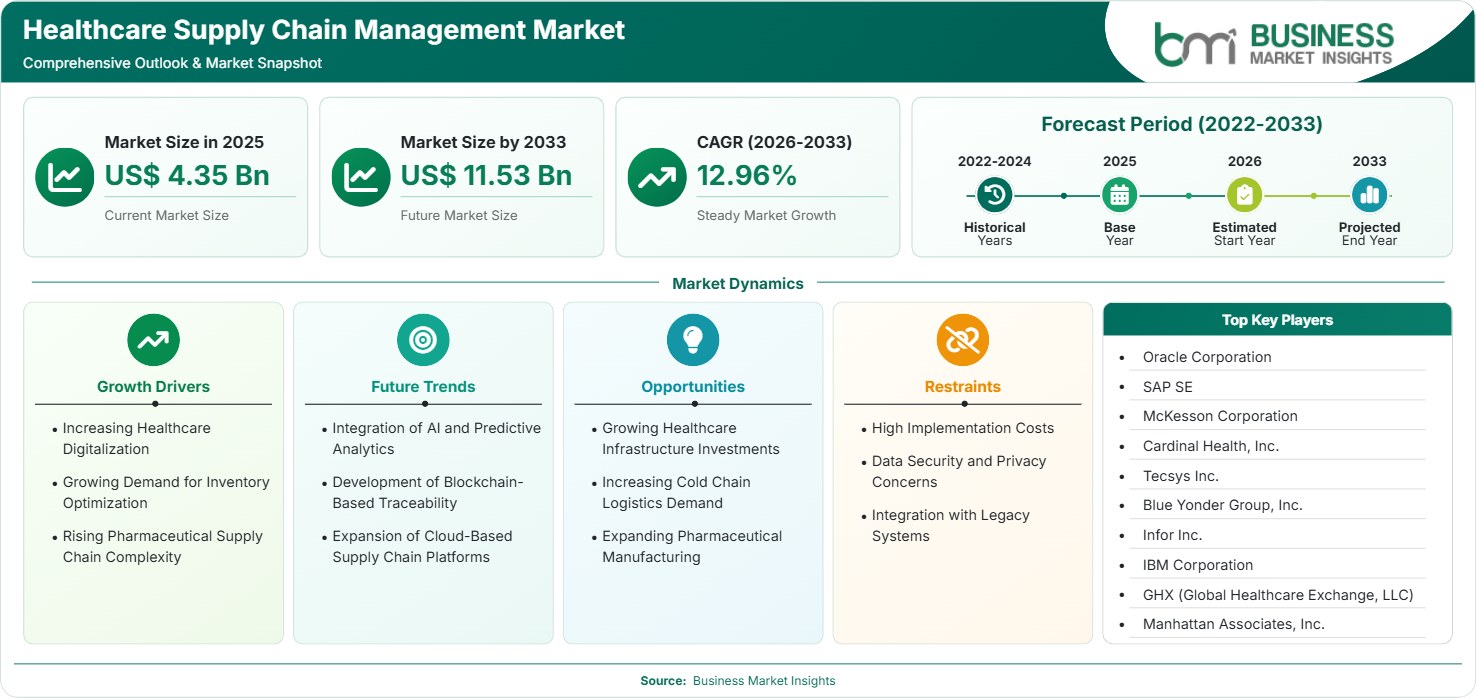
The Healthcare Supply Chain Management Market size was valued at US$ 4.35 Billion in 2025 and is projected to reach US$ 11.53 Billion by 2033, growing at a CAGR of 12.96% during 2026–2033, driven by healthcare digitalization, inventory optimization, pharmaceutical complexity management, and expanding cloud-based supply chain solutions.

Report Coverage
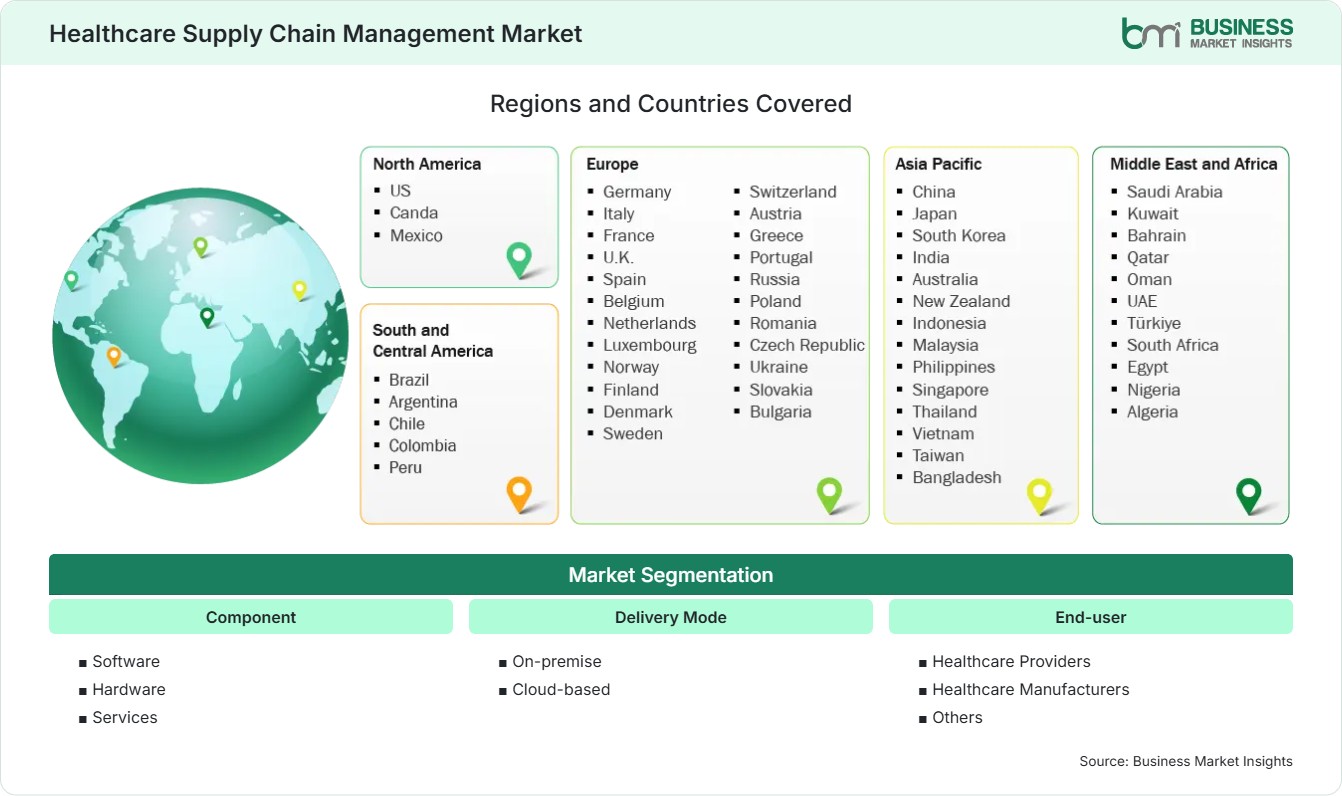
  • Component: Software, Hardware, Services
  • Delivery Mode: On-premise, Cloud-based
  • End-user: Healthcare Providers, Healthcare Manufacturers, Others
US$ 4.35 Bn Market size in 2025
US$ 11.53 Bn Market Size by 2033
12.96% CAGR, 2026 - 2033
2026-2033 Forecast Period

01 AI Overview

Healthcare Supply Chain Management Market Summary

  • North America Region: North America holds a 38%–42% share in 2025, growing with a CAGR of 12%–14% due to healthcare IT adoption, automation investments, advanced analytics deployment, and strong provider networks. The US market demonstrates steady adoption through hospital digitization, pharmaceutical logistics improvements, and cloud supply chain platforms, expanding at a CAGR of 13%–15% during 2026–2033.
  • Fastest Growing Region: Asia Pacific accounts for a 28%–32% share in 2025, expanding with a CAGR of 14%–16% due to healthcare infrastructure development, increasing medical manufacturing capacity, digital transformation initiatives, and rising demand for efficient distribution networks across emerging economies.
  • Leading Segment: Software represents a 45%–49% share in 2025, growing at a CAGR of 13%–15% due to predictive analytics, automated inventory management, enterprise resource planning integration, and real-time visibility solutions improving healthcare supply chain performance.
  • High Growth Segment: Cloud-based delivery solutions capture a 40%–44% share in 2025, advancing at a CAGR of 15%–17% because healthcare organizations seek scalable platforms, remote accessibility, interoperability, and lower infrastructure requirements for supply chain operations.
  • Key Market Opportunity: Healthcare supply chain providers can capitalize on artificial intelligence, predictive analytics, blockchain-enabled traceability, and automated logistics solutions to improve resilience, reduce waste, and enhance healthcare delivery efficiency.
  • Major Market Players: Oracle Corporation, SAP SE, McKesson Corporation, Cardinal Health, Inc., Tecsys Inc., Blue Yonder Group, Inc., Infor Inc., IBM Corporation, GHX (Global Healthcare Exchange, LLC), Manhattan Associates, Inc.
02 Strategic Insights

Healthcare Supply Chain Management Market: Strategic Insights

Healthcare Supply Chain Management Market Strategic Framework
FREE PDF
Request your free sample
Request free sample
03 Stakeholder View

Key Takeaways

  • Healthcare supply chain ecosystems are shifting from fragmented procurement structures toward integrated digital networks connecting manufacturers, distributors, providers, and technology platforms. This transition creates opportunities for companies offering interoperability, analytics, and automation capabilities.
  • Software solutions represent the strongest growth opportunity as healthcare organizations prioritize predictive inventory management, demand forecasting, and operational visibility. Advanced analytics platforms are becoming essential tools for reducing inefficiencies and improving resource allocation.
  • Artificial intelligence, machine learning, and cloud computing are reshaping supply chain management by enabling automated decision-making, risk prediction, and real-time monitoring of healthcare inventory movements.
  • Asia Pacific presents a compelling investment opportunity due to expanding healthcare infrastructure, increasing pharmaceutical production, and government-backed digital healthcare initiatives across countries such as China and India.
  • Strategic partnerships, acquisitions, and technology collaborations are increasing as established healthcare technology providers strengthen capabilities in analytics, cloud solutions, and integrated supply chain platforms.
  • Growing emphasis on healthcare resilience following global supply disruptions is encouraging organizations to invest in diversified sourcing strategies, advanced forecasting systems, and transparent logistics networks.
04 Geographic Outlook

Healthcare Supply Chain Management Market Regional Highlights

North America Healthcare Supply Chain Management Market

North America maintains a leading position with a 38%–42% share in 2025 and expands at a CAGR of 12%–14% through 2026–2033. The region benefits from mature healthcare infrastructure, strong digital adoption, and increasing investments in supply chain automation. The Healthcare Supply Chain Management Market share reflects strong participation from hospitals, pharmaceutical companies, and technology providers. The United States contributes significantly through advanced healthcare networks and enterprise technology adoption.

  • Healthcare providers are implementing cloud-based platforms to improve inventory visibility, automate procurement processes, and enhance operational efficiency across complex healthcare networks.
  • Pharmaceutical manufacturers are adopting advanced tracking systems to strengthen compliance, improve distribution accuracy, and reduce risks associated with supply chain disruptions.
  • Integration of artificial intelligence and predictive analytics is supporting demand forecasting, inventory optimization, and proactive management of medical product availability.
  • Strong healthcare IT investments and regulatory requirements are encouraging organizations to adopt connected supply chain management solutions.

US Healthcare Supply Chain Management Market

The US market represents a significant portion of North America with a 32%–36% share in 2025 and grows at a CAGR of 13%–15% during 2026–2033. Advanced hospital networks, pharmaceutical innovation, and established technology infrastructure support adoption. The country demonstrates strong demand for automation, analytics, and integrated healthcare logistics platforms. Healthcare organizations are focusing on improving resilience, reducing operational costs, and enhancing supply chain transparency through digital transformation initiatives.

  • Large hospital systems are investing in enterprise supply chain platforms to improve purchasing efficiency and optimize medical inventory management.
  • Pharmaceutical companies are implementing advanced analytics solutions to monitor demand patterns and maintain consistent product availability.
  • Healthcare providers are increasing cloud adoption to improve collaboration between suppliers, distributors, and internal operational teams.
  • Regulatory focus on healthcare product traceability is supporting adoption of advanced supply chain technologies.

Europe Healthcare Supply Chain Management Market

Europe accounts for a 22%–26% share in 2025 and records a CAGR of 11%–13% during 2026–2033. The region benefits from healthcare modernization programs, pharmaceutical manufacturing capabilities, and increasing emphasis on sustainable logistics. Germany, the UK, France, and Nordic countries are advancing adoption through digital healthcare initiatives. The region’s supply chain transformation is influenced by regulatory compliance requirements and demand for efficient healthcare resource management.

  • Germany is strengthening healthcare logistics through automation, digital procurement systems, and advanced inventory optimization technologies.
  • The UK is increasing adoption of healthcare analytics platforms to improve operational efficiency across public and private healthcare systems.
  • France is investing in pharmaceutical supply chain modernization to enhance traceability and distribution management.
  • European healthcare organizations are prioritizing sustainable logistics and transparent supplier networks to improve resilience.
  • Increasing interoperability requirements are encouraging adoption of integrated healthcare supply chain platforms.

Asia Pacific Healthcare Supply Chain Management Market

Asia Pacific represents a 28%–32% share in 2025 and expands at a CAGR of 14%–16% from 2026–2033, making it the fastest-growing regional market. The Healthcare Supply Chain Management Market growth in this region is supported by healthcare infrastructure expansion, increasing pharmaceutical production, and digital transformation initiatives. China, India, Japan, South Korea, and Southeast Asian economies are investing in technology-enabled healthcare distribution networks to improve accessibility and efficiency.

  • China is advancing healthcare supply chain modernization through artificial intelligence adoption, pharmaceutical manufacturing expansion, and large-scale digital healthcare investments.
  • India is increasing demand for cloud-based supply chain platforms as hospitals and pharmaceutical companies improve procurement and distribution capabilities.
  • Japan and South Korea are adopting automation technologies to enhance healthcare logistics efficiency and address workforce-related operational challenges.
  • Southeast Asian countries are investing in healthcare infrastructure development, creating opportunities for advanced inventory management and logistics solutions.
  • Rising medical device manufacturing capabilities across Asia Pacific are strengthening demand for integrated supply chain management systems.

Rest of World Healthcare Supply Chain Management Market

Rest of World contributes a 6%–10% share in 2025 and grows at a CAGR of 10%–12% during 2026–2033. South and Central American countries are improving healthcare infrastructure, while Middle Eastern and African economies are investing in healthcare modernization programs. The Healthcare Supply Chain Management Market share in these regions is influenced by increasing pharmaceutical accessibility requirements, hospital expansion, and digital healthcare initiatives.

Countries including Brazil, Mexico, Saudi Arabia, and the UAE are developing technology-supported healthcare distribution networks. Government initiatives focused on healthcare accessibility and supply chain resilience are creating opportunities for technology providers.

  • Brazil is improving healthcare logistics through digital transformation programs supporting hospitals, distributors, and pharmaceutical suppliers.
  • Mexico is increasing adoption of healthcare management technologies to strengthen medical product distribution and inventory control.
  • Saudi Arabia is investing in healthcare modernization initiatives aligned with digital transformation strategies and advanced logistics infrastructure.
  • The UAE is developing technology-driven healthcare ecosystems with emphasis on automation, analytics, and supply chain efficiency.
  • African healthcare markets are exploring scalable cloud solutions to improve healthcare resource management and distribution capabilities.
Global Market Geography
FREE PDF
Request your free sample
Request free sample
05 Segment Analysis

Healthcare Supply Chain Management Market Segmentation

Component

The component segment demonstrates strong adoption as healthcare organizations require integrated technology platforms, infrastructure, and professional support services. Software leads with a 45%–49% share in 2025, expanding at a CAGR of 13%–15% through 2026–2034 due to analytics, automation, and real-time visibility requirements. The Healthcare Supply Chain Management Market scope is expanding as organizations combine digital solutions with operational expertise.

  • Software: Software solutions enable inventory optimization, demand forecasting, procurement automation, and analytics-driven decision-making across healthcare supply networks.
  • Hardware: Hardware components support tracking, monitoring, automation, and data collection through scanners, sensors, and connected logistics equipment.
  • Services: Services provide consulting, implementation, integration, maintenance, and operational support required for successful supply chain technology deployment.

Delivery Mode

Delivery mode segmentation reflects increasing preference for flexible and scalable technology deployment approaches. Cloud-based solutions hold a 40%–44% share in 2025 and grow at a CAGR of 15%–17% as healthcare organizations prioritize accessibility, reduced infrastructure costs, and faster implementation. The Healthcare Supply Chain Management Market trends indicate continued migration toward cloud-enabled platforms supporting collaboration among healthcare stakeholders.

  • On-premise: On-premise solutions remain relevant for organizations requiring direct infrastructure control, customized configurations, and internal data management capabilities.
  • Cloud-based: Cloud platforms provide scalability, remote access, automatic updates, and improved collaboration across healthcare supply chain participants.

End-user

The end-user segment includes healthcare providers, healthcare manufacturers, and other organizations requiring efficient supply chain coordination. Healthcare providers represent the leading category with a 48%–52% share in 2025 due to increasing demand for inventory control and operational optimization. Growth is supported by hospitals adopting digital systems to improve resource utilization and patient service efficiency.

  • Healthcare Providers: Hospitals and healthcare networks utilize supply chain platforms for procurement management, inventory optimization, and operational efficiency improvement.
  • Healthcare Manufacturers: Manufacturers adopt solutions for production planning, supplier coordination, compliance management, and pharmaceutical distribution visibility.
  • Others: Other users include distributors, logistics companies, and healthcare service organizations requiring connected supply chain management capabilities.
06 Market Forces

Healthcare Supply Chain Management Market Dynamics

Key Market Drivers

Increasing Healthcare Digitalization

The rapid advancement in technology through digitalizing healthcare is encouraging greater use of advanced technology in healthcare supply chains because of the integration of digital technology such as computerized systems, analytical software, and automation technology. The Healthcare Supply Chain Management Market growth is being driven by high demand for connected healthcare environments to increase visibility and control. Technologies such as artificial intelligence, cloud technology, and predictive analytics are making inventory planning and demand prediction easier.

Growing Demand for Inventory Optimization

Optimizing the inventory has become an important matter for healthcare institutions facing a growing number of products, cost issues, and demand changes. Sophisticated supply chain technologies allow tracking the inventory in real time, replenish it automatically and predict its future needs. This is what hospitals do in order to avoid any shortages and wastage and increase the effectiveness of their medical supply use. The growing complexity of healthcare procurement process requires precise forecasts and better supplier coordination. Digital inventory management allows combining the need for availability with the necessity of cost effectiveness in the proper way.

Rising Pharmaceutical Supply Chain Complexity

The pharmaceutical supply chain is growing increasingly complex due to the need for specialized treatment options, global procurement networks, regulations, and products that are temperature sensitive. There is a need for sophisticated technology on the part of the manufacturers and healthcare facilities to keep track of the movement of the product and ensure compliance and traceability. The Healthcare Supply Chain Management Market trends are shaped by the need for technology which helps with visibility and risk management for the pharmaceuticals. Growth in biologic products, adoption of personalized medicine, and global procurement networks are posing new challenges for companies.

Key Market Opportunities

Growing Healthcare Infrastructure Investments

Infrastructure developments within the healthcare industry in developed and developing nations offer many opportunities in terms of supply chain management systems. The need for expansion of hospitals and specialized centers is coupled with the requirement for efficient purchasing and distribution systems. Both the government and the private sector are investing in healthcare to increase access and enhance performance. According to the Healthcare Supply Chain Management Market Forecast, more opportunities are likely to arise as healthcare service providers enhance their infrastructure using the aid of technology. Scalable supply chain systems are increasingly being implemented in new healthcare facilities as part of the planning process.

Increasing Cold Chain Logistics Demand

Cold chain logistics demand is increasing due to the growing distribution of vaccines, biologics, specialty medicines, and temperature-sensitive healthcare products. Healthcare organizations require advanced monitoring systems to maintain product quality throughout transportation and storage processes. The use of digital supply chain platforms that combine sensors and analytics in addition to automatic alerts can assist companies to achieve better temperature control and regulation. The growth of pharmaceutical production and distribution channels in the healthcare industry is leading to more focus on developing capabilities related to cold chain.

Expanding Pharmaceutical Manufacturing

Expansion of pharmaceutical manufacturing capacity is creating demand for sophisticated supply chain management solutions that support production planning, supplier coordination, and distribution efficiency. Growing capital expenditure in generics, biological drugs, and advanced therapy medications necessitates the need for companies to develop effective supply chains and logistics. Drug companies are incorporating digital technologies to aid in accurate prediction, track the availability of raw materials, and ensure that regulations are adhered to. The Healthcare Supply Chain Management Market will benefit from decentralization of manufacturing processes and regional manufacturing. Technology vendors providing analytics and visibility solutions will help pharmaceutical companies increase efficiency and coordinate their global supply chains.

Market Restraints and Challenges

High Implementation Costs

Factor: High implementation costs associated with software deployment, system integration, infrastructure upgrades, and employee training increase financial requirements for healthcare organizations. Impact: These expenses can delay adoption among smaller providers and organizations with limited technology budgets. Healthcare supply chain platforms often require customization, data migration, and interoperability adjustments before achieving full operational benefits. Smaller hospitals may face challenges allocating resources for advanced digital solutions despite long-term efficiency improvements. Vendors must develop cost-effective deployment models, modular platforms, and flexible pricing structures to encourage broader adoption. The complexity of integrating existing healthcare systems with new supply chain technologies remains a major consideration affecting investment decisions across healthcare organizations.

Data Security and Privacy Concerns

Factor: Data security and privacy risks associated with healthcare supply chain platforms create concerns regarding sensitive operational and patient-related information protection. Impact: These risks can restrict technology adoption and increase compliance requirements for organizations implementing digital solutions. Healthcare supply chain systems manage large volumes of procurement data, supplier information, inventory records, and connected device information. Cybersecurity threats, unauthorized access, and regulatory compliance obligations require continuous investment in security frameworks. Organizations must implement encryption, access controls, and monitoring mechanisms to protect critical information. As cloud-based solutions expand, maintaining strong cybersecurity standards becomes essential for ensuring trust and supporting wider adoption of healthcare supply chain technologies.

07 Company Analysis

Competitive Landscape

The Healthcare Supply Chain Management Market analysis highlights increasing competition among enterprise software providers, healthcare technology specialists, and logistics solution companies. Leading organizations are focusing on cloud platforms, artificial intelligence capabilities, interoperability, and automation features to strengthen their market position. Companies are developing integrated solutions that address procurement optimization, inventory visibility, supplier collaboration, and healthcare logistics management.

Company Name

Overview

Products and Services relevant to this market

Oracle Corporation

Oracle provides enterprise technology solutions supporting healthcare organizations with integrated data management and operational platforms.

Healthcare supply chain software, cloud infrastructure, analytics platforms, procurement management, and inventory optimization solutions.

SAP SE

SAP develops enterprise software solutions enabling healthcare organizations to improve operational visibility and supply chain coordination.

Healthcare supply chain platforms, enterprise resource planning, procurement solutions, analytics, and cloud-based management systems.

McKesson Corporation

McKesson is a healthcare distribution company supporting pharmaceutical and medical product supply chain operations.

Pharmaceutical distribution services, inventory management solutions, healthcare logistics, and supply chain optimization technologies.

Cardinal Health, Inc.

Cardinal Health provides healthcare products and services focused on improving medical supply distribution efficiency.

Medical product distribution, inventory management services, pharmaceutical supply chain solutions, and logistics support.

Tecsys Inc.

Tecsys specializes in supply chain management software designed for healthcare and complex distribution environments.

Healthcare supply chain software, warehouse management, inventory control, analytics, and logistics optimization platforms.

Blue Yonder Group, Inc.

Blue Yonder develops artificial intelligence-powered supply chain solutions for enterprise organizations across industries.

Demand forecasting, inventory optimization, warehouse management, and AI-driven supply chain planning technologies.

Infor Inc.

Infor provides industry-specific cloud software solutions supporting healthcare operational management requirements.

Healthcare supply chain management software, enterprise applications, analytics, and cloud-based operational platforms.

IBM Corporation

IBM delivers technology solutions combining artificial intelligence, cloud computing, and analytics capabilities.

AI-powered supply chain solutions, data analytics, cloud platforms, blockchain applications, and automation services.

GHX (Global Healthcare Exchange, LLC)

GHX operates healthcare commerce platforms connecting suppliers, providers, and manufacturers through digital networks.

Healthcare procurement automation, supplier connectivity, transaction management, and supply chain visibility solutions.

Manhattan Associates, Inc.

Manhattan Associates develops supply chain execution software for healthcare and enterprise logistics operations.

Warehouse management systems, inventory optimization, order management, and supply chain execution platforms.

10 Trust & Transparency

Research Methodology

The market analysis combines proprietary research with secondary data from government agencies, company disclosures, regulatory filings, industry databases and expert interviews. Market estimates are validated through data triangulation, cross-market benchmarking and analyst review.

View Full Research Methodology

11 Questions Answered

Frequently Asked Questions

What factors influence adoption of Healthcare Supply Chain Management Market solutions?

The report adoption is influenced by healthcare digitalization, operational efficiency requirements, regulatory compliance needs, cybersecurity capabilities, and demand for advanced analytics. Organizations increasingly evaluate solutions based on scalability, integration capabilities, and measurable cost improvements.

Why is interoperability important in healthcare supply chain systems?

Interoperability allows healthcare providers, manufacturers, suppliers, and logistics partners to exchange information efficiently. Connected systems improve transparency, reduce manual processes, support compliance requirements, and enable coordinated decision-making across complex healthcare ecosystems.

How can healthcare organizations improve supply chain resilience?

Organizations can improve resilience through diversified sourcing strategies, digital visibility platforms, predictive analytics, automated inventory management, and stronger supplier collaboration. These approaches help reduce disruptions and maintain consistent availability of essential healthcare products.

What role do cloud platforms play in healthcare supply chain transformation?

Cloud platforms enable healthcare organizations to access scalable supply chain solutions without extensive infrastructure investments. They support real-time collaboration, remote monitoring, data integration, and faster deployment across hospitals, manufacturers, and distribution networks.

How does artificial intelligence improve healthcare supply chain operations?

Artificial intelligence improves healthcare supply chain operations by enabling predictive demand forecasting, automated inventory decisions, supplier risk monitoring, and optimized procurement planning. AI-based systems analyze large datasets to identify inefficiencies and support faster operational decisions.

Access the Full Healthcare Supply Chain Management Market Report

Get segment-level forecasts, regional estimates, competitive benchmarking, company profiles and downloadable Excel datasets.

Access the full Healthcare Supply Chain Management Market Report
350 pages PDF & Excel | 2026-08-12