
Healthcare Payer Services Market Outlook: Size, Share, Trends, Growth Analysis, Competitive Landscape & Forecast, 2026-2033

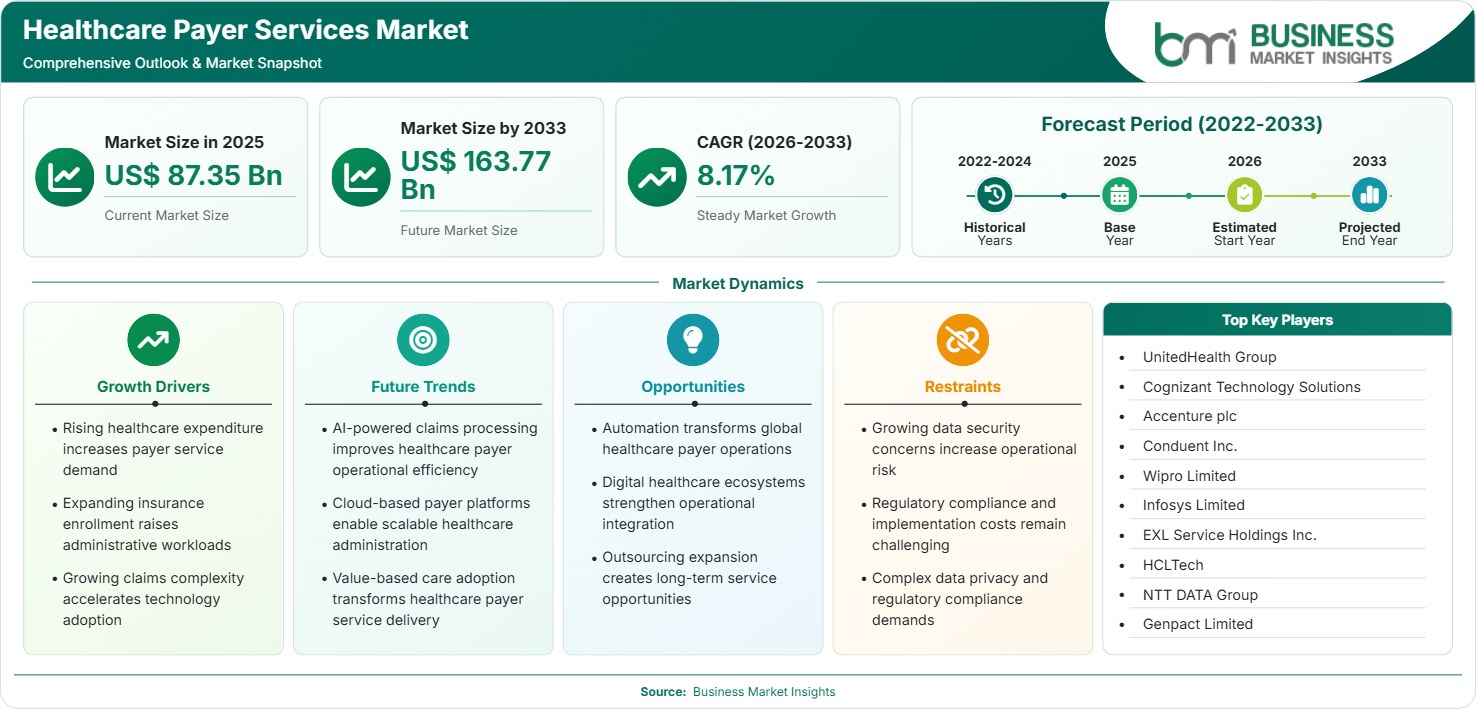
The Healthcare Payer Services Market size was valued at US$ 87.35 billion in 2025 and is projected to reach US$ 163.77 billion by 2033, growing at a CAGR of 8.17% during 2026–2033. Rising healthcare expenditure, expanding health insurance enrolment, and increasing claims complexity continue to accelerate demand for outsourcing and digital payer solutions. Growing adoption of intelligent automation, cloud-based platforms, and analytics-driven operations is creating new opportunities for healthcare payers to improve operational efficiency, regulatory compliance, and member experience.

Report Coverage
  • Service Type: Business Process Outsourcing Services, Information Technology Outsourcing Services, Knowledge Process Outsourcing Services
  • Application: Claims Management Services, Member Management Services, Provider Management Services, Billing & Accounts Management Services, Payment Management Services, Analytics & Fraud Management Services, Integrated Front-office & Back-office Operations, Audit & Compliance Management Services
  • Provider: Private, Public
US$ 87.35 Bn Market size in 2025
US$ 163.77 Bn Market Size by 2033
8.17% CAGR, 2026 - 2033
2026-2033 Forecast Period

01 AI Overview

Healthcare Payer Services Market Summary

  • North America Region: North America accounted for 38%–41% of global revenue in 2025 and is projected to register a CAGR of 7.6%–8.0% during 2026–2033. Strong insurance penetration, mature healthcare infrastructure, widespread outsourcing adoption, and continuous investment in digital claims processing support market leadership. The United States contributes nearly 83%–86% of regional revenue and is expected to expand at a CAGR of 7.7%–8.1%, driven by increasing Medicare Advantage enrolment and value-based healthcare initiatives.
  • Fastest Growing Region: Asia Pacific represented 23%–26% of revenue in 2025 and is anticipated to grow at a CAGR of 10.1%–10.7% through expanding private health insurance coverage, digital healthcare transformation, increasing outsourcing capabilities, and supportive government initiatives across emerging economies.
  • Leading Segment: Business Process Outsourcing (BPO) Services held 44%–47% of market revenue in 2025 and is forecast to expand at a CAGR of 8.2%–8.7%, supported by increasing outsourcing of claims administration, member support, and back-office operations.
  • High Growth Segment: Analytics & Fraud Management Services accounted for 12%–15% of total revenue in 2025 and is expected to witness the highest CAGR of 11.8%–12.5% owing to increasing AI adoption, fraud detection requirements, predictive analytics, and regulatory compliance initiatives.
  • Key Market Opportunity: Expansion of AI-enabled payer platforms, intelligent claims automation, digital member engagement, and cloud-based healthcare administration is creating substantial opportunities for technology providers and outsourcing partners globally.
  • Major Market Players: UnitedHealth Group, Cognizant Technology Solutions, Accenture plc, Conduent Inc., Wipro Limited, Infosys Limited, EXL Service Holdings Inc., HCLTech, NTT DATA Group, and Genpact Limited.
02 Strategic Insights

Healthcare Payer Services Market: Strategic Insights

Healthcare Payer Services Market Strategic Framework
FREE PDF
Request your free sample
Request free sample
03 Stakeholder View

Key Takeaways

  • Healthcare payer organizations are increasingly shifting from fragmented administrative workflows toward integrated digital operating models that combine outsourcing, automation, analytics, and cloud-based service delivery to improve operational efficiency and member satisfaction.
  • The strongest Healthcare Payer Services Market Growth opportunities are emerging within AI-powered claims management, fraud analytics, payment integrity solutions, and intelligent member engagement platforms as insurers pursue greater operational accuracy and lower administrative costs.
  • Investments in the fields of robotic process automation, machine learning, and predictive analytics have enabled healthcare payers to minimize processing mistakes, increase reimbursement accuracy, improve compliance, and streamline decision-making in their administrative activities.
  • Asia Pacific offers the most attractive long-term investment potential due to expanding insurance coverage, rapid healthcare digitalization, growing outsourcing capabilities, and increasing adoption of cloud-based payer administration platforms across developing healthcare systems.
  • Participants in the industry continue to pursue acquisition, technology partnerships, and platform integration as a means of developing their digital capabilities and service offerings to remain competitive in a technologically advanced payer environment.
  • Growing demand for value-based healthcare, real-time claims adjudication, cybersecurity, and interoperable healthcare information systems will continue shaping innovation priorities and capital investment decisions throughout the forecast period.
04 Geographic Outlook

Healthcare Payer Services Market Regional Highlights

North America Healthcare Payer Services Market

North America represented 38%–41% of global revenue in 2025 and is anticipated to register a CAGR of 7.6%–8.0% during 2026–2033. The Healthcare Payer Services Market Share remains the highest globally due to widespread insurance coverage, advanced digital healthcare infrastructure, mature outsourcing ecosystems, and continuous investments in artificial intelligence and cloud-based payer administration platforms. Growing value-based reimbursement models and increasing demand for operational efficiency continue encouraging insurers to modernize claims processing and member engagement capabilities.

  • The United States dominates regional demand through strong Medicare Advantage enrollment, expanding commercial insurance participation, and increasing adoption of intelligent claims processing platforms that improve administrative efficiency while reducing operational expenses.
  • Canada continues investing in healthcare digitization and provincial healthcare modernization initiatives, encouraging insurers and third-party administrators to implement cloud-enabled payer solutions and advanced analytics platforms.
  • Artificial intelligence and robotic process automation are increasingly utilized to improve claims adjudication accuracy, reduce processing timelines, strengthen fraud detection, and optimize member communication across healthcare insurance organizations.
  • Growing partnerships between insurers, technology vendors, and outsourcing providers continue supporting integrated payer ecosystems capable of delivering scalable, secure, and data-driven healthcare administration services.
  • Regulatory emphasis on healthcare interoperability and secure patient information management continues accelerating investment in digital transformation initiatives throughout the regional payer landscape.

US Healthcare Payer Services Market

The United States accounted for approximately 83%–86% of North American revenue in 2025 and is projected to expand at a CAGR of 7.7%–8.1% during the forecast period. Continued growth in government-sponsored healthcare programs, increasing digital claims volumes, and strong adoption of outsourced payer operations are supporting sustained investment in administrative automation and advanced healthcare technology platforms.

  • Medicare Advantage and managed care programs continue increasing demand for scalable claims administration, provider management, and member engagement solutions capable of supporting expanding beneficiary populations in healthcare payer services market.
  • Healthcare organizations increasingly deploy predictive analytics and intelligent automation to strengthen payment integrity, improve fraud detection capabilities, and enhance reimbursement accuracy.
  • Cloud-native payer platforms enable insurers to improve operational agility while supporting regulatory compliance, cybersecurity, and secure integration with healthcare provider networks.
  • Growing investment in customer experience technologies, self-service portals, and digital communication channels continues improving member satisfaction while lowering administrative workloads.

Europe Healthcare Payer Services Market

Europe accounted for 27%–30% of global revenue in 2025 and is expected to register a CAGR of 7.9%–8.4% through 2033. Expanding digital healthcare initiatives, increasing private health insurance participation, and modernization of reimbursement systems continue strengthening regional demand. Germany leads the regional market due to advanced healthcare infrastructure, while the United Kingdom is projected to record the fastest growth at 8.5%–9.0% CAGR owing to digital transformation programs and growing outsourcing adoption.

  • Germany benefits from extensive healthcare digitization investments, advanced insurance administration systems, and strong adoption of healthcare information technologies supporting efficient payer operations.
  • The United Kingdom continues expanding outsourcing partnerships and cloud-enabled healthcare administration solutions to improve claims processing efficiency and member service delivery.
  • France strengthens demand through increasing digital health investments, reimbursement modernization initiatives, and greater integration of healthcare analytics within insurance operations in healthcare payer services market.
  • Nordic countries increasingly deploy artificial intelligence and automation technologies to optimize healthcare administration while supporting value-based healthcare delivery models.
  • Regional technology providers continue introducing interoperable payer platforms designed to improve regulatory compliance, operational transparency, and cross-organizational data exchange.

Asia Pacific Healthcare Payer Services Market

Asia Pacific represented 23%–26% of global revenue in 2025 and is forecast to achieve the highest CAGR of 10.1%–10.7% through 2033. Expanding healthcare insurance coverage, government-backed digital health initiatives, increasing healthcare outsourcing capabilities, and rapid adoption of cloud technologies continue supporting long-term market expansion. China remains the largest regional market, while India records the fastest growth with an estimated 11.2%–11.8% CAGR.

  • China continues investing heavily in healthcare digitalization, insurance modernization, and artificial intelligence technologies supporting large-scale healthcare administration.
  • India experiences rapid expansion of third-party healthcare administration, private health insurance enrollment, and digital claims processing supported by growing healthcare infrastructure investments.
  • Japan focuses on advanced analytics, robotic process automation, and intelligent healthcare administration systems to improve operational efficiency across public and private insurance organizations in healthcare payer services market.
  • Australia continues strengthening cloud adoption and digital healthcare interoperability, encouraging insurers to modernize payer workflows and member engagement platforms.
  • Regional outsourcing providers are expanding service delivery centers and AI-enabled operational capabilities to address growing international demand for healthcare administration services.

Rest of World Healthcare Payer Services Market

The Rest of World accounted for 7%–9% of global revenue in 2025 and is projected to expand at a CAGR of 8.6%–9.1% during the forecast period. South & Central America benefits from increasing insurance penetration and healthcare reforms, while the Middle East & Africa continues investing in digital healthcare infrastructure and public healthcare modernization initiatives supporting payer service adoption.

In healthcare payer services market, growing healthcare expenditure, expanding insurance accessibility, and digital transformation programs are encouraging healthcare organizations across emerging economies to modernize administrative operations and improve claims management capabilities.

  • Brazil leads South & Central America through expanding private insurance markets, increasing healthcare digitization, and rising adoption of outsourced healthcare administration services.
  • The United Arab Emirates records the fastest regional expansion with an estimated 9.5%–10.0% CAGR, supported by smart healthcare initiatives, digital insurance platforms, and public healthcare investments.
  • Saudi Arabia continues modernizing healthcare administration through Vision 2030 initiatives emphasizing digital transformation, healthcare efficiency, and expanded insurance coverage.
  • South Africa demonstrates stable demand driven by gradual insurance market development, healthcare digitization, and increasing deployment of secure claims processing technologies.
  • International technology providers continue strengthening regional partnerships to support healthcare modernization through scalable cloud platforms, automation solutions, and cybersecurity-enhanced payer administration systems.
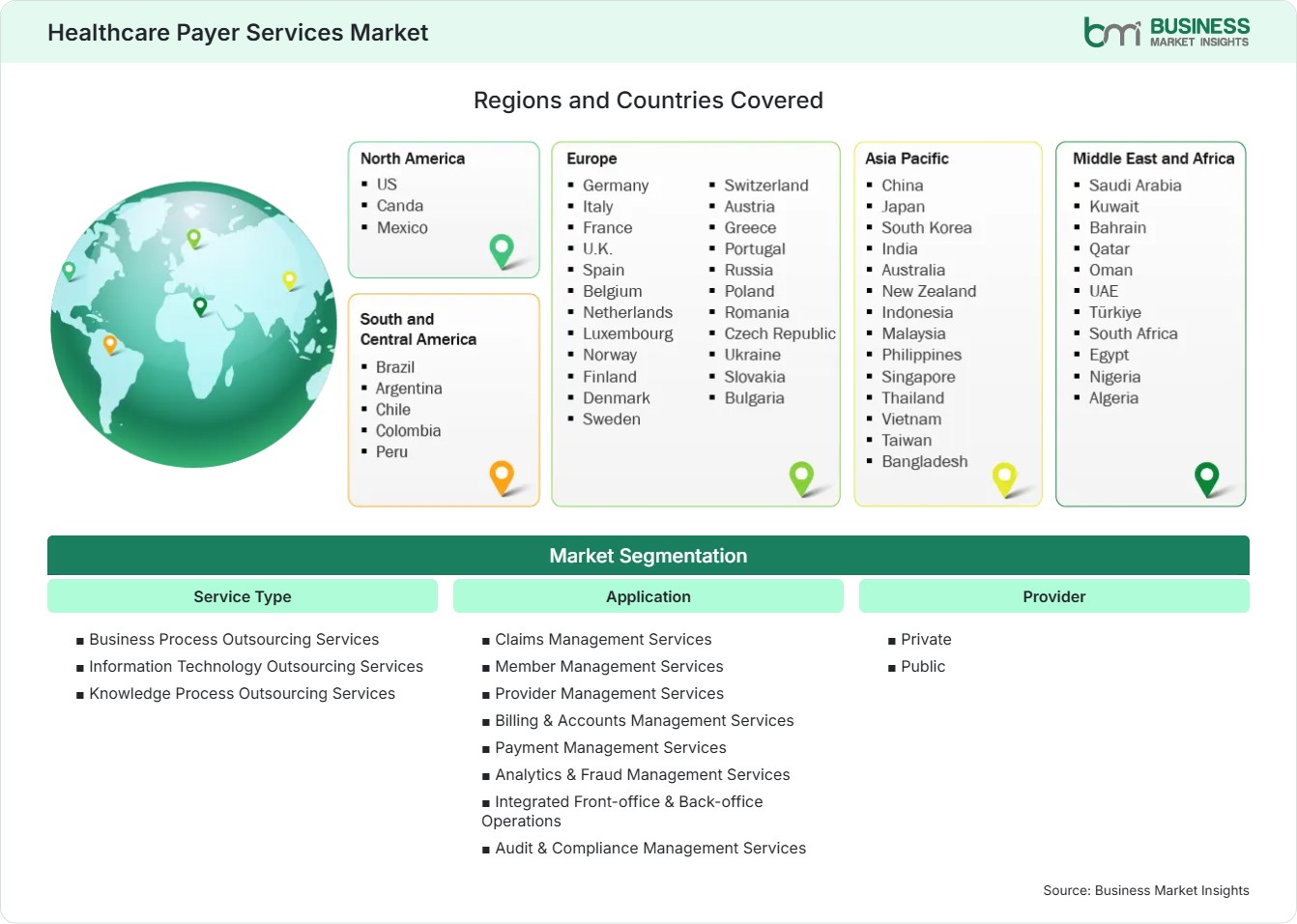
Global Market Geography
FREE PDF
Request your free sample
Request free sample
05 Segment Analysis

Healthcare Payer Services Market Segmentation

Service Type

Service Type represented the largest revenue contribution, accounting for 48%–51% of the market in 2025 and is projected to register a CAGR of 8.3%–8.8% during 2026–2033. Healthcare organizations increasingly outsource administrative functions to improve efficiency, reduce operating costs, and strengthen regulatory compliance. The Healthcare Payer Services Market Scope continues to expand as insurers seek scalable service models supported by automation, analytics, and cloud-based healthcare platforms.

  • Business Process Outsourcing (BPO) Services: BPO services maintain the largest demand owing to increasing outsourcing of claims processing, customer support, enrollment management, and administrative workflows that improve operational efficiency while reducing healthcare payer costs.
  • Information Technology Outsourcing (ITO) Services: ITO services continue expanding as insurers modernize legacy infrastructure through cloud migration, cybersecurity enhancement, application management, and digital platform integration supporting secure healthcare administration.
  • Knowledge Process Outsourcing (KPO) Services: KPO services gain momentum through increasing demand for actuarial analytics, healthcare data intelligence, risk assessment, compliance advisory, and specialized consulting supporting strategic payer decision-making.

Application

Application-based services accounted for 41%–44% of total market revenue in 2025 and are expected to grow at a CAGR of 8.7%–9.2% during the forecast period. Digital transformation, AI-enabled workflow automation, and increasing healthcare data complexity continue driving demand across diverse payer functions. The Healthcare Payer Services Market Trends indicate growing investment in integrated operational platforms capable of improving administrative efficiency and member experience.

  • Claims Management Services: Claims management remains the largest application as insurers increasingly automate claims adjudication, validation, documentation, and reimbursement workflows to improve processing speed and operational accuracy.
  • Member Management Services: Member management solutions continue expanding through personalized digital engagement, enrollment support, omnichannel communication, and self-service platforms improving customer satisfaction and retention.
  • Provider Management Services: Provider management services strengthen operational coordination through credential verification, contract administration, network optimization, and digital collaboration between insurers and healthcare providers.
  • Billing & Accounts Management Services: Billing and account management solutions improve payment accuracy, premium administration, financial reconciliation, and revenue management through automated financial workflows.
  • Payment Management Services: Payment management platforms optimize reimbursement processing, electronic fund transfers, payment reconciliation, and financial transparency while supporting regulatory compliance requirements.
  • Analytics & Fraud Management Services: Analytics and fraud management capabilities expand rapidly through artificial intelligence, predictive modeling, anomaly detection, and real-time monitoring that reduce fraudulent claims and financial losses.
  • Integrated Front-office & Back-office Operations: Integrated operational platforms enhance workflow coordination by connecting customer support, claims administration, billing, analytics, and provider management within unified digital environments.
  • Audit & Compliance Management Services: Audit and compliance solutions continue growing as insurers strengthen governance frameworks, regulatory reporting, documentation management, and risk monitoring across increasingly complex healthcare environments.

Provider

Provider-based services accounted for 27%–30% of market revenue in 2025 and are anticipated to register a CAGR of 8.0%–8.5% through 2033. Increasing healthcare coverage, reimbursement modernization, and digital administration continue supporting demand across both public and private payer organizations.

  • Private: Private healthcare payers continue leading demand through extensive investments in digital claims management, AI-driven customer engagement, advanced analytics, and outsourced administrative services supporting operational competitiveness.
  • Public: Public healthcare organizations increasingly modernize payer operations through cloud adoption, workflow automation, regulatory compliance platforms, and integrated digital healthcare administration supporting expanding beneficiary populations.
06 Market Forces

Healthcare Payer Services Market Dynamics

Key Market Drivers

Rising healthcare expenditure increases payer service demand

Healthcare spending around the world keeps on rising owing to an increase in the number of aged people, prevalence of chronic diseases, advanced healthcare technology, and increased accessibility to healthcare services. There is, therefore, a huge volume of claim processes, reimbursement, and member engagement by the healthcare insurers, which makes the use of payers' services more attractive. It becomes possible for organizations to achieve efficient operation while still being able to provide high-quality services through outsourcing administrative functions.

Expanding insurance enrollment raises administrative workloads

An increase in the number of individuals enrolled in public and private insurance plans in both developed and developing nations further enhances the need for an efficient claims process, provider network administration, premium payment processes, and other administrative functions. The healthcare organizations need to have an administrative function that can scale up and be able to handle more members without incurring higher operating costs. Technology-driven outsourcing companies offer an integrated solution for such tasks.

Growing claims complexity accelerates technology adoption

The healthcare reimbursement systems continue evolving owing to value-based care, bundled payment, personalized treatment, and stringent regulatory requirements. Insurance firms utilize technologies such as intelligent automation, predictive analytics, artificial intelligence, and automated workflows to increase accuracy in processing claims, cut down on manual efforts, and enhance fraud detection processes. The technologies help healthcare payers become more resilient and manage growing administrative tasks effectively.

Key Market Opportunities

Automation transforms global healthcare payer operations

AI, robotics, and machine learning have continued to create more opportunities in the healthcare industry for efficiency. Intelligent automation decreases repetitive activities in administration, speeds up claims processing time, increases accuracy in payments, and allows staff members to concentrate on higher value activities. Technology firms that can deliver scalable automation platforms are likely to capitalize on increased demand from public and private payers.

Digital healthcare ecosystems strengthen operational integration

Healthcare ecosystems are now incorporating insurers, hospitals, physicians, pharmacies, labs, and technology vendors through digital interoperability platforms. Interoperable healthcare management increases information flow, speeds up payments processes, improves the patient experience, and helps drive data-led decisions. Organizations that invest in interoperable payer technology solutions stand well-positioned to benefit from ongoing digital transformations within global healthcare systems.

Outsourcing expansion creates long-term service opportunities

Health insurance payers will keep relying on external parties for various specialized administrative services in order to enhance organizational flexibility and minimize costs, among other benefits. The organizations providing claims management, analysis, cybersecurity, compliance, and cloud-based administration are predicted to have an increased demand in the future due to the focus on efficiency and scalability.

Market Restraints and Challenges

Growing data security concerns increase operational risk

Factor: Information processed by healthcare payer organizations is highly sensitive in nature and includes data related to patients, providers, finances, and insurance that need strong cybersecurity measures and an encrypted digital infrastructure.

Impact: The loss of sensitive data through data breach and ransomware attack, and any other unauthorized access to this information, may lead to fines, negative reputation, and increased operating costs for the company.

Regulatory compliance and implementation costs remain challenging

Factor: The laws and regulations regarding healthcare are constantly changing, along with the need for significant funding and organization change management in order to implement new digital payers' platforms.

Impact: Compliance makes operations more complicated and leads to delays in technology introduction. Small health care facilities will likely postpone their plans to introduce new technology due to financial restrictions.

07 Company Analysis

Competitive Landscape

The competitive environment is evolving rapidly as insurers prioritize digital transformation, intelligent automation, cloud-native administration, and analytics-driven decision-making. The Healthcare Payer Services Market Analysis indicates that leading service providers are expanding AI capabilities, strengthening healthcare consulting expertise, and forming strategic partnerships to deliver end-to-end payer transformation solutions that improve operational efficiency, regulatory compliance, and member experience.

Company Name

Overview

Products and Services Relevant to this Market

UnitedHealth Group

Global healthcare enterprise offering insurance, healthcare technology, and integrated payer solutions across commercial and government healthcare programs.

Claims administration, member services, payment integrity, provider management, analytics, healthcare technology platforms, and managed care solutions.

Cognizant Technology Solutions

Technology consulting and digital transformation company serving healthcare payers through outsourcing and intelligent automation services.

Claims processing, digital payer platforms, healthcare analytics, cloud migration, AI solutions, and business process outsourcing services.

Accenture plc

Global professional services company delivering healthcare consulting, digital transformation, cloud, and AI-enabled payer solutions.

Healthcare consulting, claims modernization, automation, cloud transformation, cybersecurity, analytics, and operational outsourcing services.

Conduent Inc.

Business process services provider supporting healthcare organizations through digital operations and administrative outsourcing.

Claims management, customer engagement, payment processing, healthcare administration, business process outsourcing, and workflow automation.

Wipro Limited

Information technology company providing digital transformation and outsourcing services for healthcare insurers worldwide.

Healthcare IT services, cloud solutions, analytics, claims processing, automation, cybersecurity, and managed services.

Infosys Limited

Global technology services company supporting healthcare payers through digital modernization and enterprise platform implementation.

Digital transformation, healthcare administration, AI solutions, cloud services, business process management, and application modernization.

EXL Service Holdings Inc.

Analytics-driven operations management company specializing in healthcare payer transformation and intelligent process optimization.

Healthcare analytics, claims management, payment integrity, predictive analytics, digital operations, and consulting services.

HCLTech

Global technology company delivering cloud, engineering, cybersecurity, and digital healthcare transformation services.

Healthcare platforms, cloud migration, cybersecurity, application modernization, automation, and IT outsourcing solutions.

NTT DATA Group

International IT services provider supporting healthcare organizations with integrated digital transformation and managed services.

Healthcare consulting, payer administration, digital platforms, cloud services, analytics, and enterprise IT modernization.

Genpact Limited

Professional services company focused on intelligent operations, AI-driven business transformation, and healthcare process optimization.

Claims processing, finance operations, healthcare analytics, AI-enabled automation, regulatory support, and outsourcing services.


10 Trust & Transparency

Research Methodology

The market analysis combines proprietary research with secondary data from government agencies, company disclosures, regulatory filings, industry databases and expert interviews. Market estimates are validated through data triangulation, cross-market benchmarking and analyst review.

View Full Research Methodology

11 Questions Answered

Frequently Asked Questions

How do Healthcare Payer Services Market Forecasts support business decisions?

Healthcare Payer Services Forecasts help insurers, technology providers, investors, and outsourcing companies evaluate future demand, identify high-growth opportunities, assess competitive positioning, prioritize investments, and develop long-term expansion strategies.

Which region is expected to record the fastest expansion?

Asia Pacific is projected to experience the highest growth owing to increasing insurance penetration, rapid healthcare digitalization, expanding outsourcing capabilities, and supportive government investments in healthcare modernization.

Which service segment currently dominates the market?

Business Process Outsourcing (BPO) services hold the largest market share because insurers increasingly outsource claims administration, member services, provider support, and back-office operations to improve efficiency and reduce administrative costs.

What does a Healthcare Payer Services Market Report typically include?

A comprehensive report evaluates market size, competitive landscape, technology developments, regional performance, segmentation, regulatory environment, investment opportunities, and strategic initiatives influencing the future evolution of the healthcare payer services industry.

What factors are accelerating demand for healthcare payer services?

Growing health insurance enrollment, increasing healthcare expenditure, expanding claims volumes, digital transformation initiatives, and the need to improve operational efficiency are driving demand for outsourced and technology-enabled healthcare payer services globally.

Access the Full Healthcare Payer Services Market Report

Get segment-level forecasts, regional estimates, competitive benchmarking, company profiles and downloadable Excel datasets.

Access the full Healthcare Payer Services Market Report
350 pages PDF & Excel | 2026-08-04