
Healthcare Claims Management Market Outlook: Size, Share, Trends, Growth Analysis, Competitive Landscape & Forecast, 2026-2033

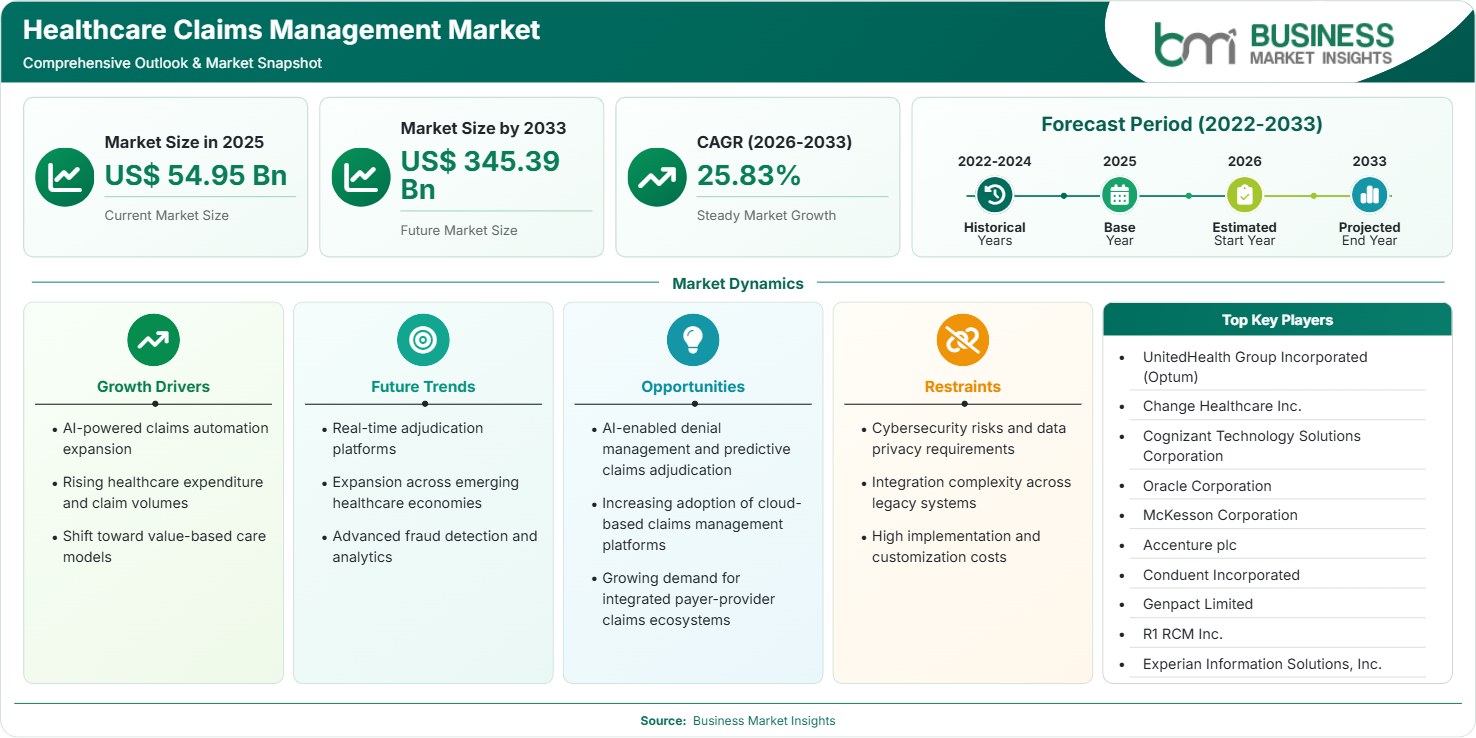
The Healthcare Claims Management Market size was valued at US$ 54.95 Billion in 2025 and is projected to reach US$ 345.39 Billion by 2033, growing at a CAGR of 25.83% during 2026–2033. Key drivers include AI-enabled claims automation, denial management optimization, cloud migration, payer-provider digitization, regulatory compliance modernization, and expanding demand for real-time adjudication and revenue cycle efficiency.

Report Coverage
  • Component: Software, Services
  • Delivery Mode: On-premise, Cloud Based
  • End-user: Healthcare Providers, Payers
US$ 54.95 Bn Market size in 2025
US$ 345.39 Bn Market Size by 2033
25.83% CAGR, 2026 - 2033
2026-2033 Forecast Period

01 AI Overview

Healthcare Claims Management Market Summary

  • North America Region: North America holds a market share of 38%–42% in 2025, growing at a CAGR of 24%–27%. Growth is supported by advanced payer infrastructure, AI deployment, interoperability mandates, automation investments, value-based reimbursement expansion, claims accuracy enhancement, revenue cycle modernization, and fraud detection improvements. The U.S. market benefits from widespread digital claims adoption and is expected to expand at a CAGR of 24%–27%.
  • Fastest Growing Region: Asia Pacific accounts for 24%–28% share in 2025 and is projected to grow at 28%–31% CAGR. Drivers include healthcare digitalization, insurance penetration expansion, cloud adoption, government e-health initiatives, outsourcing opportunities, provider modernization, analytics adoption, and increasing healthcare expenditure across emerging economies.
  • Leading Segment: Software represents 58%–62% share in 2025 and advances at 26%–29% CAGR. Adoption is supported by workflow automation, predictive analytics, denial prevention, coding accuracy enhancement, interoperability capabilities, operational efficiency gains, compliance management requirements, and scalable digital infrastructure.
  • High Growth Segment: Cloud Based deployment accounts for 45%–49% share in 2025 and grows at 29%–32% CAGR. Growth stems from scalability, lower implementation costs, remote accessibility, cybersecurity improvements, AI integration capabilities, faster upgrades, data management efficiency, and enterprise-wide deployment flexibility.
  • Key Market Opportunity: Emerging AI-driven claims adjudication platforms create opportunities to reduce processing costs, improve reimbursement accuracy, accelerate payer-provider collaboration, strengthen fraud detection, optimize workflows, and expand value-based healthcare administration capabilities globally.
  • Major Market Players: UnitedHealth Group Incorporated (Optum), Change Healthcare Inc., Cognizant Technology Solutions Corporation, Oracle Corporation, McKesson Corporation, Accenture plc, Conduent Incorporated, Genpact Limited, R1 RCM Inc., Experian Information Solutions, Inc.
02 Strategic Insights

Healthcare Claims Management Market: Strategic Insights

Healthcare Claims Management Market Strategic Framework
FREE PDF
Request your free sample
Request free sample
03 Stakeholder View

Key Takeaways

  • The ecosystem increasingly integrates hospitals, physician groups, clearinghouses, payers, and technology vendors through digitally connected claims processing networks.
  • Cloud-based deployments and provider-focused automation solutions offer the strongest commercial upside due to rapid scalability requirements.
  • AI-enabled denial management, predictive coding validation, and intelligent workflow orchestration are becoming core innovation priorities.
  • Asia Pacific presents the most compelling investment case as digital insurance adoption and healthcare infrastructure spending accelerate.
  • M&A activity continues to focus on revenue cycle management, healthcare analytics, and claims automation capabilities.
  • Cybersecurity, interoperability, and regulatory compliance remain essential competitive differentiators across solution providers.
04 Geographic Outlook

Healthcare Claims Management Market Regional Highlights

North America Healthcare Claims Management Market

North America commands 38%–42% market share in 2025 and is projected to expand at 24%–27% CAGR through 2033. Strong insurance coverage, advanced healthcare IT infrastructure, and widespread adoption of automated revenue cycle technologies support leadership. The region benefits from increasing payer-provider collaboration, value-based reimbursement models, and AI adoption. Healthcare Claims Management Market share remains highest in the region due to mature digital claims ecosystems.

  • Growing adoption of AI-based denial prevention platforms across payer and provider networks.
  • Regulatory emphasis on interoperability improves claims transparency and processing speed.
  • Large healthcare spending base supports continuous technology upgrades.
  • Fraud analytics and compliance management investments remain priorities.

US Healthcare Claims Management Market

The U.S. represents 80%–84% of North American revenue and advances at 24%–27% CAGR. Complex reimbursement structures, extensive private insurance participation, and high healthcare expenditure create strong demand for advanced claims technologies. Healthcare Claims Management Market analysis indicates continued migration toward AI-enabled adjudication and automation platforms.

  • Strong investment in revenue cycle optimization solutions.
  • Increasing claim denial rates encourage predictive analytics adoption.
  • Large provider networks require scalable cloud-based systems.
  • Cybersecurity modernization influences platform procurement decisions.

Europe Healthcare Claims Management Market

Europe accounts for 27%–31% share in 2025 and grows at 23%–26% CAGR. Digital health initiatives, reimbursement modernization, and electronic claims processing expansion support regional adoption. Germany leads regional revenue generation, while Central and Eastern European markets display faster adoption rates.

  • Germany remains the largest regional market.
  • Spain and Poland exhibit high digital healthcare investment momentum.
  • Public healthcare digitization supports workflow modernization.
  • Regulatory compliance and data governance drive software demand.

Asia Pacific Healthcare Claims Management Market

Asia Pacific holds 24%–28% share and records the fastest CAGR of 28%–31%. National healthcare digitization programs, rising insurance penetration, and expanding hospital infrastructure create strong demand. China leads regional revenue while India demonstrates the highest growth trajectory due to digital health ecosystem expansion.

  • Insurance enrollment growth increases claims processing volumes.
  • Cloud deployment adoption accelerates among healthcare providers.
  • India benefits from healthcare IT modernization initiatives.
  • Outsourcing capabilities strengthen operational efficiency.

Rest of World Healthcare Claims Management Market

Rest of World contributes 8%–12% share and expands at 25%–28% CAGR. South and Central America benefit from insurance modernization, while Middle East and Africa markets leverage national digital health strategies. Brazil leads regional revenue generation, while Saudi Arabia demonstrates strong growth potential.

  • Public-private healthcare digitization initiatives support market expansion.
  • Cloud-first strategies improve accessibility and scalability.
  • Insurance reforms increase claims administration requirements.
  • Healthcare infrastructure investments enhance technology adoption.
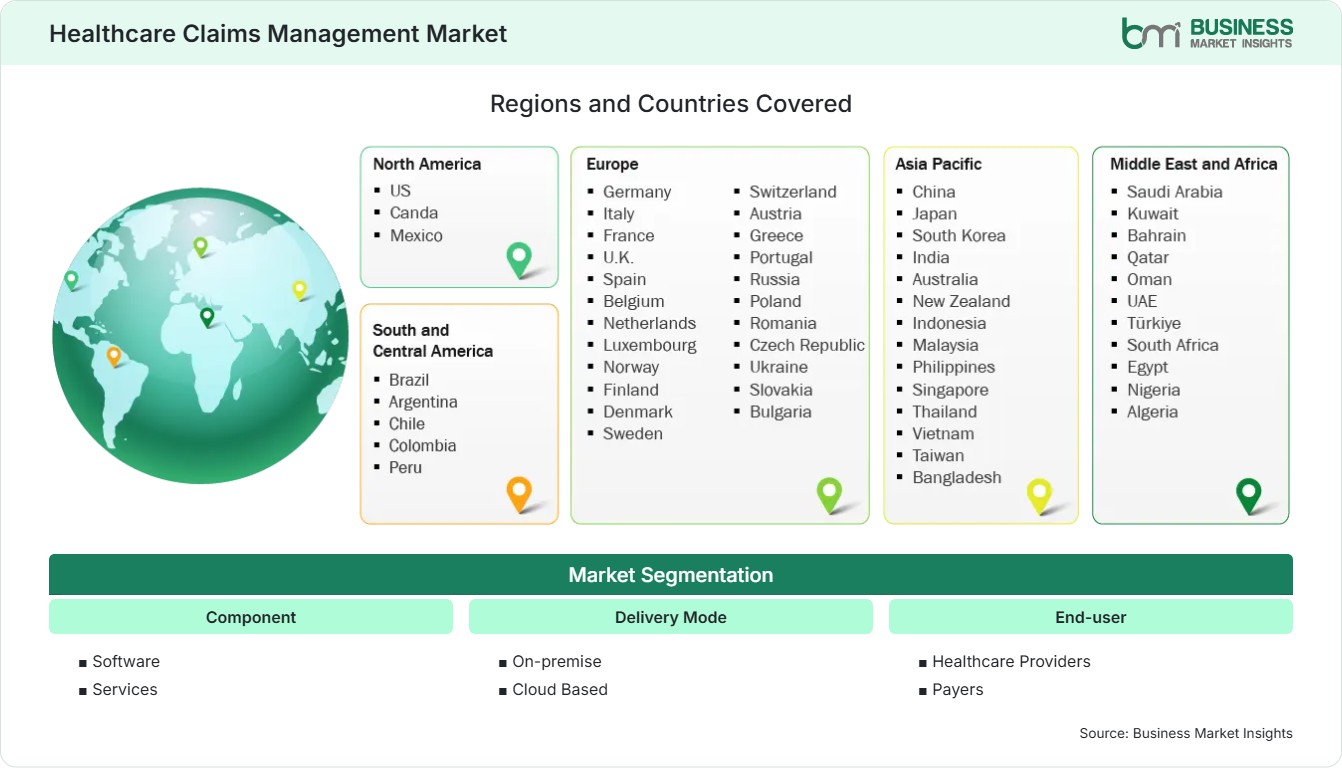
Global Market Geography
FREE PDF
Request your free sample
Request free sample
05 Segment Analysis

Healthcare Claims Management Market Segmentation

Component

Software represents 58%–62% share in 2025 and advances at 26%–29% CAGR, supported by automation, analytics, and interoperability requirements. The Healthcare Claims Management Market scope continues expanding as organizations seek end-to-end claims visibility and reimbursement optimization.

  • Software: Supports automation, denial management, predictive analytics, coding validation, compliance management, and seamless integration across payer-provider workflows.
  • Services: Includes implementation, consulting, support, training, and managed services that enhance platform effectiveness and operational efficiency.

Delivery Mode

Cloud-based solutions gain momentum due to flexibility, lower infrastructure requirements, and rapid deployment capabilities. The segment benefits from enterprise-scale digital transformation initiatives and increasing demand for secure remote accessibility.

  • On-premise: Preferred by organizations requiring extensive customization, direct system control, and internal data governance capabilities.
  • Cloud Based: The Healthcare Claims Management Market trends increasingly favor cloud architectures because of scalability, AI integration potential, and subscription-based cost structures.

End-User

Healthcare providers remain significant adopters due to reimbursement optimization needs, while payers invest heavily in adjudication efficiency, fraud detection, and operational automation technologies.

  • Healthcare Providers: Focus on reducing denials, accelerating reimbursements, improving coding accuracy, and strengthening revenue cycle performance.
  • Payers: Deploy claims solutions to streamline adjudication, control costs, detect fraud, and improve member service quality.
06 Market Forces

Healthcare Claims Management Market Dynamics

Key Market Drivers

AI-Powered Claims Automation Expansion

Healthcare organizations have to contend with more complex claims, higher denial rates, and increased administrative costs; thus, the need for automation is critical. AI-driven claims management technology will enable healthcare organizations to automate processes such as coding validation, document extraction, eligibility checking, denial management, and payment optimization, leading to a reduction in manual effort. Machine learning algorithms continuously analyze claim patterns to identify potential errors before submission, reducing rework and revenue leakage. As healthcare providers and payers seek to improve financial performance while addressing workforce shortages, investment in AI-driven claims platforms continues to accelerate globally.

Rising Healthcare Expenditure and Claim Volumes

Expanding healthcare expenditure, aging populations, and broader insurance coverage are generating substantial increases in healthcare claim volumes worldwide. Public and private healthcare systems are processing larger numbers of reimbursement requests, placing pressure on traditional administrative workflows. Advanced claims management platforms provide scalable infrastructure capable of handling growing transaction volumes while maintaining compliance and accuracy. Automation, analytics, and workflow optimization tools enable organizations to reduce processing bottlenecks and improve visibility across the claims lifecycle. As healthcare utilization continues to rise across both developed and emerging economies, demand for modern claims administration technologies is expected to strengthen considerably.

Shift Toward Value-Based Care Models

The transition from fee-for-service reimbursement to value-based care models is creating new requirements for claims processing and payment management. Value-based frameworks rely on accurate clinical data exchange, outcome measurement, quality reporting, and reimbursement transparency among stakeholders. Modern claims systems are critical components that connect healthcare providers, payers, and healthcare systems to facilitate value-based payment. Analytics capabilities enable organizations to track results of care, control costs, and ensure proper reimbursement. With modern healthcare systems focusing on outcomes and cost efficiency as well as care coordination, claims management systems become vital components of a value-based care approach.

Key Market Opportunities

Real-Time Adjudication Platforms

The Healthcare Claims Management Market Forecasts highlight significant opportunities for real-time adjudication platforms that enable instant claim validation, eligibility verification, and reimbursement decisions. These will help health organizations manage cash flow because they reduce the payment cycle and minimize claim revisions. The payers will enjoy increased efficiency, greater accuracy, and reduced administrative costs. The rise in the use of value-based and digital health care has increased the demand for automated adjudication systems to facilitate smooth payer and provider collaboration and billing processes for patients.

Expansion Across Emerging Healthcare Economies

Emerging healthcare economies present substantial growth opportunities as governments and private healthcare organizations increase investments in digital health infrastructure, insurance expansion, and healthcare IT modernization. Electronic claims processing systems have been adopted by nations in the Asia Pacific region, Latin America, the Middle East, and Africa to enhance the claims settlement process. There is room for solution providers to take advantage of this trend with cloud solutions, managed services, and compliance solutions. The increasing expenditure on healthcare, insurance, and hospitals is paving the way for advanced claims management systems.

Advanced Fraud Detection and Analytics

Advanced fraud detection and analytics solutions are becoming a major opportunity area as healthcare claim volumes and transaction complexity continue to increase. Artificial intelligence, machine learning, and behavioral analytics enable organizations to identify suspicious patterns, billing anomalies, and fraudulent activities with greater accuracy than traditional methods. These capabilities help healthcare providers, payers, and government agencies reduce financial losses while strengthening compliance and risk management practices. Increased regulatory scrutiny and pressure to control healthcare costs are driving investment in intelligent monitoring platforms that improve claim integrity and operational performance

Market Restraints and Challenges

Cybersecurity Risks and Data Privacy Requirements

Factor: Growing digitalization increases exposure to cyber threats as healthcare organizations process vast volumes of sensitive patient and claims data across connected platforms. Impact: The increase in cybersecurity events means more money will be spent on compliance, more investments in encryption and surveillance technologies, more delay in implementation processes, and an increase in the risk involved. Data privacy legislation requires that there must be continuous governance and audits. The occurrence of security violations may disrupt billing processes, harm the reputation of stakeholders, and incur fines.

Integration Complexity Across Legacy Systems

Factor: Many healthcare organizations continue to operate fragmented legacy systems that were not designed for modern interoperability requirements. Impact: Adding new claim processing systems to electronic health record systems, billing systems, and insurance payers can raise the level of complexity and cost of implementing these projects. Delayed implementation periods can lead to the inability to gain the anticipated level of efficiency and profitability from the use of such systems. Migration of data and non-standard workflows can pose more difficulties for implementation.

07 Company Analysis

Competitive Landscape

Healthcare Claims Management Market analysis indicates competition centered on automation, analytics, interoperability, and revenue cycle optimization capabilities.

Company Name

Overview

Products and Services relevant to this market

UnitedHealth Group Incorporated (Optum)

Major healthcare technology and services provider with extensive payer-provider connectivity.

Claims processing, analytics, payment integrity, revenue cycle management solutions.

Change Healthcare Inc.

Healthcare payments and information technology specialist.

Claims management, clearinghouse services, adjudication, payment solutions.

Cognizant Technology Solutions Corporation

Global IT and healthcare operations provider.

TriZetto platforms, claims administration, automation, managed services.

Oracle Corporation

Enterprise healthcare technology supplier.

Healthcare data platforms, claims administration, analytics capabilities.

McKesson Corporation

Diversified healthcare services organization.

Revenue cycle management and workflow optimization offerings.

Accenture plc

Consulting and digital transformation leader.

Healthcare operations, claims modernization, analytics implementation.

Conduent Incorporated

Business process and transaction services provider.

Claims processing, eligibility verification, administrative solutions.

Genpact Limited

Digital transformation and process management company.

Claims operations outsourcing, analytics, automation services.

R1 RCM Inc.

Revenue cycle management specialist.

End-to-end claims optimization and reimbursement solutions.

Experian Information Solutions, Inc.

Data and analytics organization serving healthcare institutions.

Claims management, denial prevention, eligibility and revenue cycle tools.

10 Trust & Transparency

Research Methodology

The market analysis combines proprietary research with secondary data from government agencies, company disclosures, regulatory filings, industry databases and expert interviews. Market estimates are validated through data triangulation, cross-market benchmarking and analyst review.

View Full Research Methodology

11 Questions Answered

Frequently Asked Questions

What does the Healthcare Claims Management Market Report emphasize for investors?

It highlights cloud technology adoption, AI-enabled automation, emerging-market expansion, cybersecurity investments, and revenue cycle optimization as major value creation themes.

How does AI improve claims management performance?

AI improves coding accuracy, predicts denials, automates documentation review, detects fraud patterns, and reduces processing times while enhancing reimbursement outcomes.

Which region offers the strongest growth potential?

Asia Pacific presents the strongest growth opportunity due to healthcare digitalization, increasing insurance coverage, expanding hospital networks, and supportive government initiatives.

Which deployment model is growing the fastest?

Cloud-based deployment is the fastest-growing model because it offers scalability, lower upfront costs, easier upgrades, and stronger support for AI-enabled workflows.

What factors are accelerating adoption of claims management platforms?

AI automation, cloud deployment, reimbursement complexity, denial reduction initiatives, and digital health modernization programs are driving adoption across healthcare providers and payers.

Access the Full Healthcare Claims Management Market Report

Get segment-level forecasts, regional estimates, competitive benchmarking, company profiles and downloadable Excel datasets.

Access the full Healthcare Claims Management Market Report
350 pages PDF & Excel | 2026-08-26