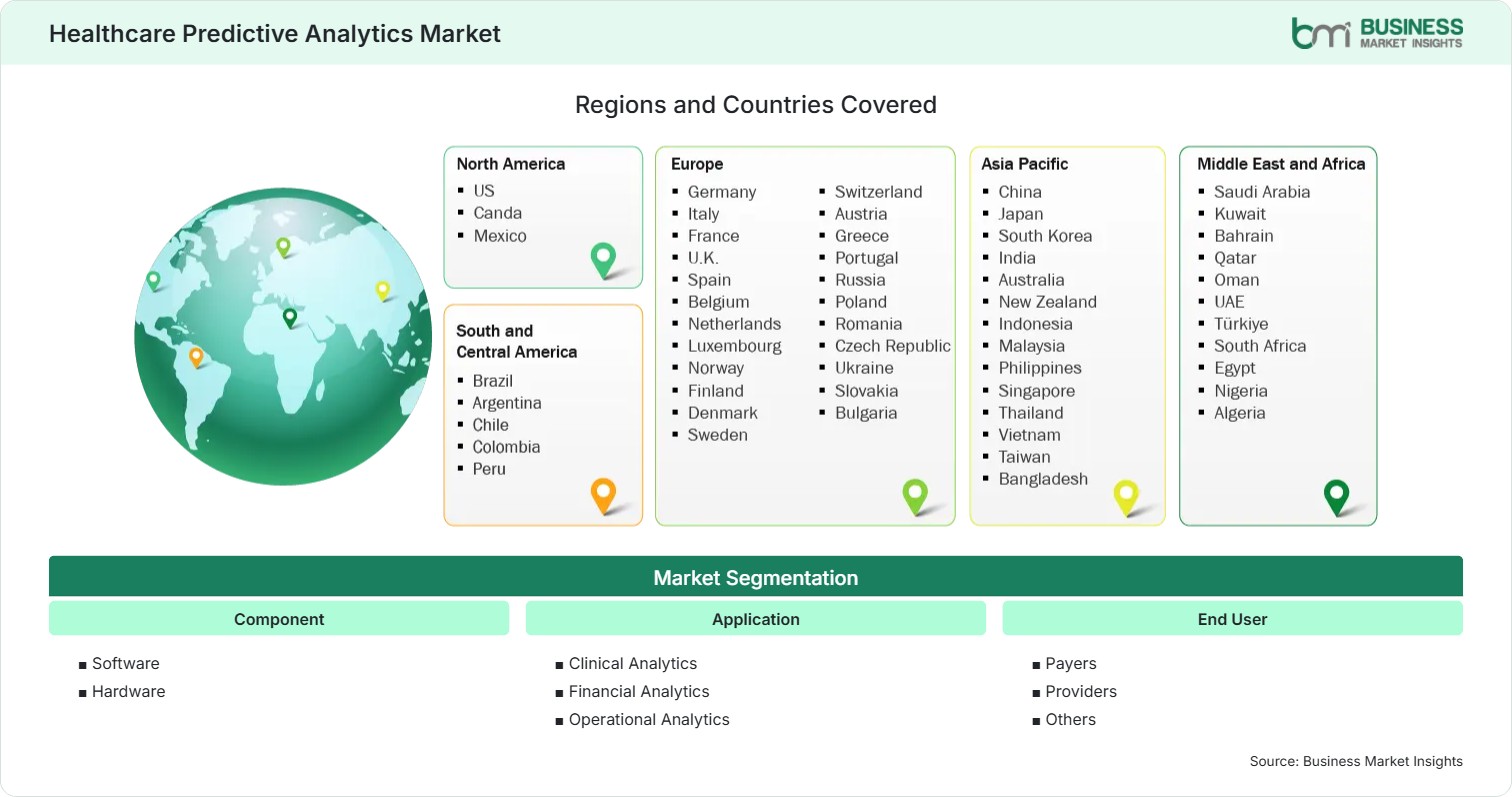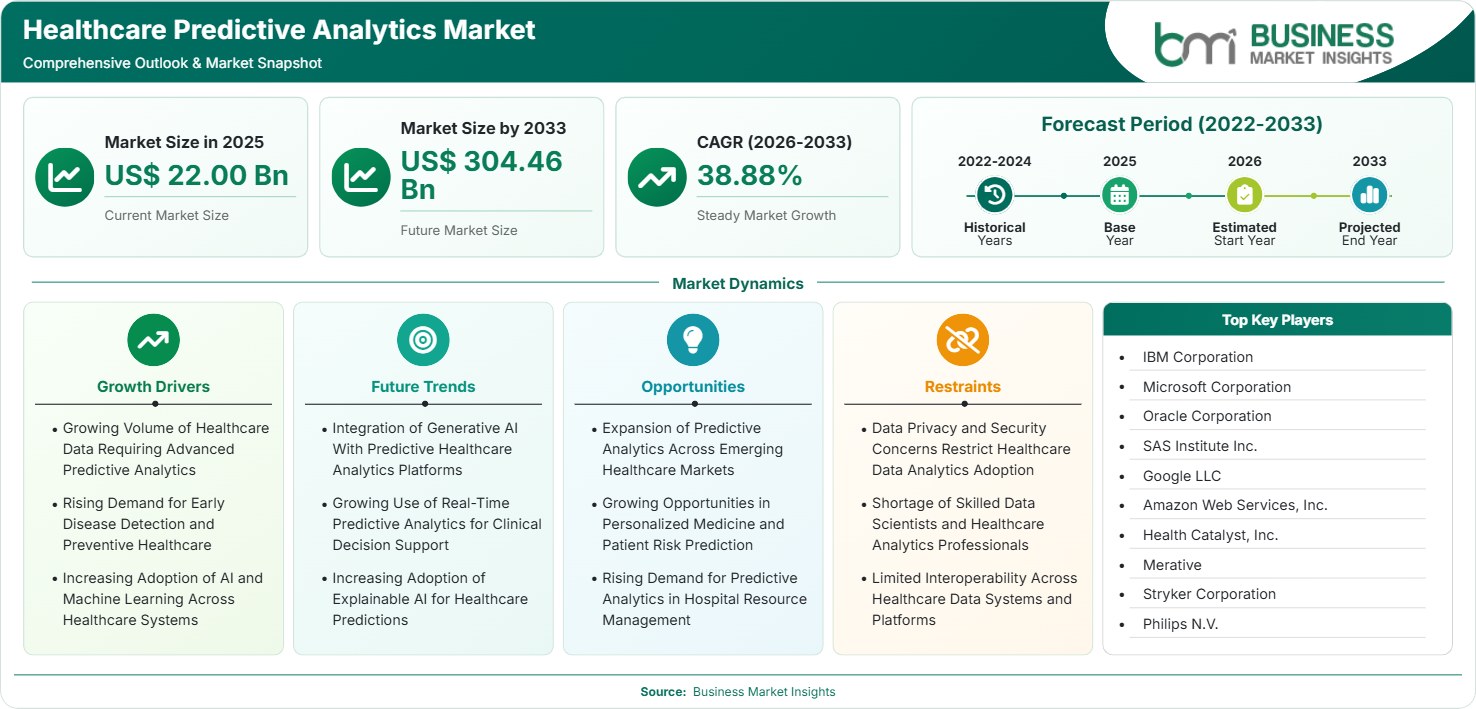
Healthcare Predictive Analytics Market Regional Highlights
North America Healthcare Predictive Analytics Market
North America held a 39%–43% share in 2025 and is projected to grow at a CAGR of 35.5%–37.5% during 2026–2033. The region benefits from mature EHR adoption, established healthcare data infrastructure, high cloud spending, and strong investment by providers and payers. The US dominates regional demand, while Canada is expanding digital health capabilities.
- The US accounts for the majority of regional demand because hospitals, health plans, and technology companies have established large-scale data environments suitable for predictive analytics deployment.
- Healthcare providers are applying predictive models to readmission risk, patient deterioration, population health, fraud detection, staffing, and hospital capacity management.
- Cloud adoption is supporting scalable analytics deployment, allowing healthcare organizations to process larger datasets without building equivalent on-premises computing infrastructure.
- Data governance and model explainability remain important purchasing criteria as healthcare organizations manage HIPAA obligations, cybersecurity requirements, and increasing regulatory scrutiny.
US Healthcare Predictive Analytics Market
The US healthcare predictive analytics market held a 36%–40% share of the global market in 2025 and is projected to grow at a CAGR of 35.0%–37.0% during 2026–2033. Demand is supported by extensive EHR usage, healthcare spending, payer analytics, hospital digitization, and strong technology investment.
- Hospitals and health systems use predictive analytics to identify high-risk patients, anticipate readmissions, improve resource allocation, and support clinical decision-making.
- Payers are applying models to claims analysis, population risk stratification, fraud detection, cost forecasting, and member engagement, creating demand beyond provider organizations.
- Cloud and AI investments are expanding the addressable market, while privacy, cybersecurity, interoperability, and model governance remain key barriers to deployment.
Europe Healthcare Predictive Analytics Market
Europe healthcare predictive analytics market accounted for a 24%–28% share in 2025 and is projected to grow at a CAGR of 36.5%–38.5% during 2026–2033. Germany, the UK, France, and the Netherlands are leading markets, while Spain and Italy provide additional opportunities.
- Germany benefits from healthcare digitization and increasing investment in data-driven clinical and operational systems across hospitals and healthcare networks.
- The UK offers strong opportunities through NHS digital transformation, population health management, clinical analytics, and increasing interest in AI-supported healthcare delivery.
- France is expanding digital health capabilities, creating opportunities for predictive analytics in clinical decision support, disease management, and healthcare resource planning.
- The Netherlands provides a higher-growth opportunity through advanced healthcare infrastructure, strong digital adoption, and increasing use of data-driven care management.
- European vendors must address GDPR, data sovereignty, interoperability, and emerging AI governance requirements when deploying predictive analytics across healthcare environments.
Asia Pacific Healthcare Predictive Analytics Market
Asia Pacific held a 22%–26% share in 2025 and APAC healthcare predictive analytics market forecast to grow at a CAGR of 42.0%–44.5% during 2026–2033. China, Japan, India, and Australia are leading markets, while India and China provide major growth opportunities.
- India offers strong potential as hospitals digitize records, healthcare technology investment increases, and providers seek analytics for patient risk, diagnostics, and operational efficiency.
- China benefits from extensive technology investment and healthcare digitization, with predictive analytics supporting population health, clinical decision support, and hospital management.
- Japan provides opportunities through an aging population, established healthcare infrastructure, and demand for predictive models supporting chronic disease and resource management.
- Australia benefits from advanced digital health infrastructure and increasing use of analytics across hospitals, population health programs, and healthcare administration.
- Southeast Asian healthcare systems represent additional opportunities as cloud infrastructure, electronic records, and digital health platforms expand across private and public providers.
Rest of World Healthcare Predictive Analytics Market
Rest of World accounted for a 9%–13% share in 2025 and is projected to grow at a CAGR of 37.5%–40.0% during 2026–2033. Latin America and the Middle East healthcare predictive analytics market represent the principal opportunities, supported by digital health investment and increasing healthcare data generation. Brazil is projected to grow at 38.0%–40.0%, Mexico at 37.0%–39.0%, and the UAE at 40.0%–42.0%.
- Brazil represents the largest Latin American opportunity, supported by a large healthcare system, expanding digital records, private healthcare investment, and demand for cost and population analytics.
- Mexico offers opportunities as hospitals and payers increase technology investment and adopt analytics for clinical management, operational efficiency, and healthcare cost control.
- The UAE is a high-growth market supported by government digital transformation programs, advanced healthcare infrastructure, and investment in AI-enabled healthcare services.
- Saudi Arabia is investing in healthcare digitization and national transformation initiatives, creating demand for predictive tools supporting population health and hospital resource management.
- South Africa provides a regional entry point for healthcare analytics, although data fragmentation, infrastructure differences, and skilled workforce shortages can constrain deployment.