
Retail Logistics Market Outlook: Size, Share, Trends, Growth Analysis, Competitive Landscape & Forecast, 2026-2033

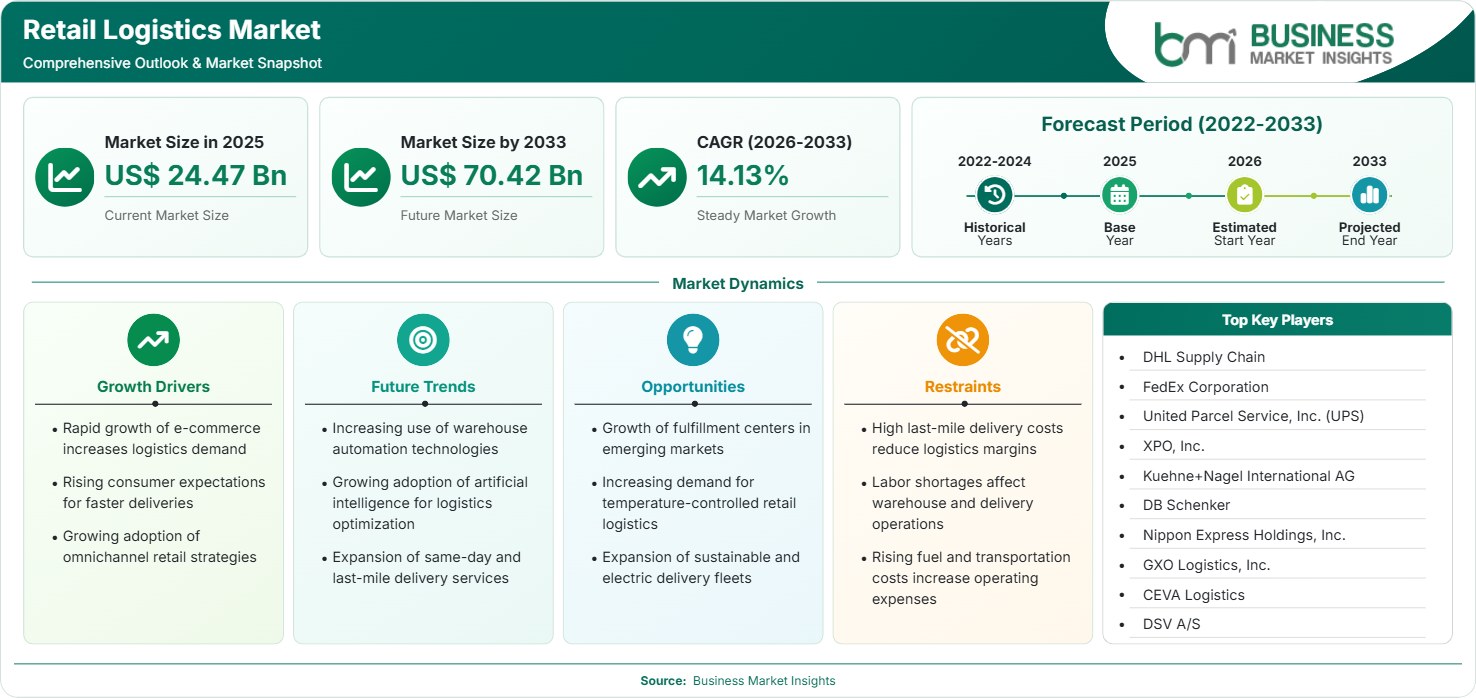
The Retail Logistics Market size was valued at US$ 24.47 Billion in 2025 and is projected to reach US$ 70.42 Billion by 2033, growing at a CAGR of 14.13% during 2026–2033. Rising e-commerce penetration, increasing consumer expectations for rapid delivery, expanding omnichannel retail strategies, growing warehouse automation adoption, and advancements in supply chain visibility technologies are driving market growth globally.

Report Coverage
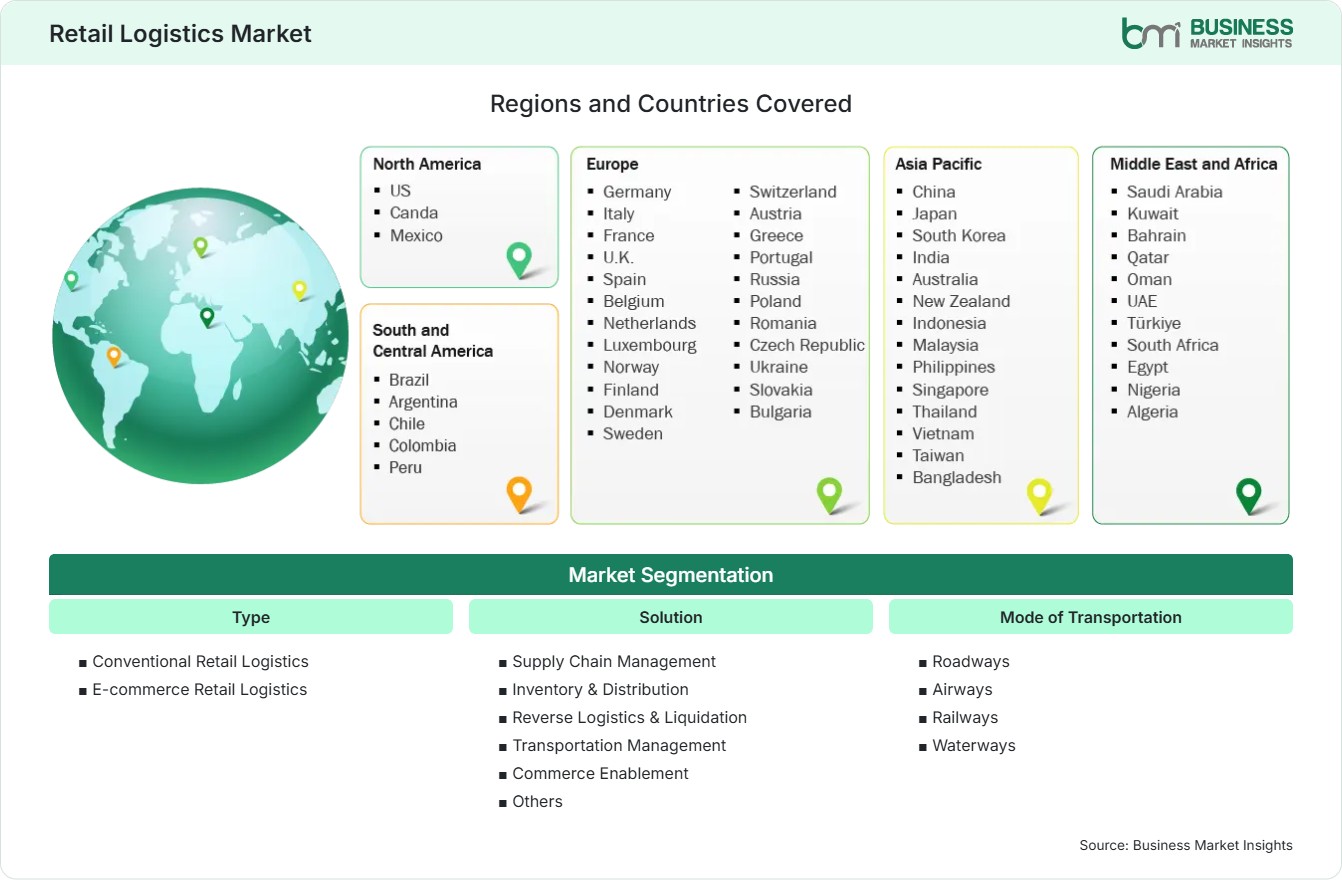
  • Type: Conventional Retail Logistics, E-commerce Retail Logistics
  • Solution: Supply Chain Management, Inventory & Distribution, Reverse Logistics & Liquidation, Transportation Management, Commerce Enablement, Others
  • Mode of Transportation: Roadways, Airways, Railways, Waterways
US$ 24.47 Bn Market size in 2025
US$ 70.42 Bn Market Size by 2033
14.13% CAGR, 2026 - 2033
2026-2033 Forecast Period

AI Overview

Retail Logistics Market Summary

  • North America Region: North America holds a Retail Logistics Market share of 33%–37% in 2025 and is projected to grow at a CAGR of 13.2%–13.9% during 2026–2033. Growth is supported by strong e-commerce adoption, advanced logistics infrastructure, widespread warehouse automation, and increasing demand for same-day and next-day delivery services. The U.S. remains the dominant market, advancing at a CAGR of 13.4%–14.0%.
  • Fastest Growing Region: Asia Pacific accounts for 27%–31% share in 2025 and is expected to register a CAGR of 15.6%–16.4% through 2033. Growth is fueled by expanding online retail activity, rapid urbanization, increasing smartphone penetration, and rising investments in logistics and fulfillment infrastructure.
  • Leading Segment: E-commerce Retail Logistics accounts for 56%–60% share in 2025 and is anticipated to grow at a CAGR of 14.8%–15.5% through 2033. Demand is supported by rapid growth in online shopping, increasing direct-to-consumer sales models, and expanding cross-border e-commerce operations.
  • High Growth Segment: Transportation Management captures 20%–24% share in 2025 and is forecast to expand at a CAGR of 15.2%–16.0% during 2026–2033. Growth is driven by increasing demand for route optimization, real-time shipment tracking, last-mile delivery efficiency, and logistics cost reduction.
  • Key Market Opportunity: Growing adoption of AI-enabled supply chains, automated fulfillment centers, predictive logistics analytics, and sustainable delivery networks is creating significant opportunities across the market.
  • Major Market Players: DHL Supply Chain, FedEx Corporation, United Parcel Service, Inc. (UPS), XPO, Inc., Kuehne+Nagel International AG, DB Schenker, Nippon Express Holdings, Inc., GXO Logistics, Inc., CEVA Logistics, and DSV A/S.
Strategic Insights

Retail Logistics Market: Strategic Insights

Retail Logistics Market Strategic Framework
FREE PDF
Request your free sample
Request free sample
Stakeholder View

Key Takeaways

  • The Retail Logistics Market is expanding rapidly due to increasing e-commerce penetration, rising consumer expectations for faster deliveries, and growing adoption of omnichannel retail strategies.
  • E-commerce Retail Logistics remains the dominant segment as online shopping continues to transform global retail supply chains and fulfillment operations.
  • Transportation Management is the fastest-growing solution segment owing to increasing focus on route optimization, shipment visibility, and last-mile delivery efficiency.
  • Asia Pacific is the fastest-growing regional market driven by growing digital commerce activity, urbanization, and investments in logistics infrastructure.
  • Warehouse automation, AI-based logistics platforms, and predictive analytics are emerging as critical tools for improving operational efficiency.
  • Retailers are increasingly partnering with third-party logistics providers to improve scalability, reduce costs, and enhance customer satisfaction.
Geographic Outlook

Retail Logistics Market Regional Highlights

North America Retail Logistics Market

North America accounted for 33%–37% of global revenue in 2025 and is projected to grow at a CAGR of 13.2%–13.9% through 2033. The region benefits from advanced logistics infrastructure, widespread e-commerce adoption, robust transportation networks, and strong investments in supply chain modernization. The Retail Logistics Market share remains dominant due to extensive retail activity and growing demand for rapid fulfillment services.

  • Retailers continue investing in automated fulfillment centers, robotics, and warehouse optimization technologies to improve efficiency and meet growing consumer delivery expectations.
  • E-commerce companies are expanding distribution networks and micro-fulfillment centers to support same-day and next-day delivery services across urban and suburban markets.
  • Transportation providers increasingly utilize artificial intelligence and route optimization tools to improve operational performance and reduce logistics costs.
  • Omnichannel retail strategies are driving demand for integrated inventory management systems capable of supporting seamless online and offline shopping experiences.
  • Growing customer expectations regarding delivery speed, order visibility, and fulfillment accuracy continue encouraging logistics modernization across retail supply chains.

US Retail Logistics Market

The United States represents 84%–88% of North American demand and is expected to grow at a CAGR of 13.4%–14.0% through 2033. Growth is supported by strong e-commerce activity, large-scale retail operations, technological innovation, and increasing demand for efficient fulfillment services.

  • Leading retailers continue expanding fulfillment infrastructures to improve inventory availability, accelerate delivery timelines, and support growing digital commerce volumes.
  • Logistics providers are investing in advanced tracking systems, analytics platforms, and automated operations to improve transportation efficiency and customer satisfaction.
  • Last-mile delivery innovations are gaining importance as retailers seek to improve convenience and reduce operational complexities.
  • Continued growth in online retailing is generating substantial demand for warehousing, transportation, and integrated supply chain management services.

Europe Retail Logistics Market

Europe held 24%–28% of global revenue in 2025 and is expected to register a CAGR of 13.5%–14.2% through 2033. Growing digital commerce adoption, expanding cross-border retail activity, and increasing warehouse automation continue supporting regional growth. Germany remains the leading market, while the Netherlands represents a strong growth market with a CAGR of 14.3%–15.0%.

  • Retailers increasingly utilize integrated logistics solutions to manage complex distribution requirements across multiple countries and regulatory environments.
  • Sustainability initiatives are encouraging adoption of electric delivery vehicles, optimized transportation routes, and environmentally responsible logistics practices.
  • Warehouse automation investments continue improving productivity, inventory accuracy, and fulfillment efficiency throughout retail supply chains.
  • Rising cross-border e-commerce activity is generating demand for flexible logistics services and advanced transportation management capabilities.
  • Companies continue enhancing supply chain visibility and resilience through digital transformation and advanced analytics deployment.

Asia Pacific Retail Logistics Market

Asia Pacific accounted for 27%–31% of global revenue in 2025 and is expected to record the fastest CAGR of 15.6%–16.4% through 2033. Expanding e-commerce ecosystems, increasing smartphone penetration, urbanization, and logistics infrastructure development are driving regional growth. China, India, Japan, and Southeast Asian countries remain key markets.

  • Rapid growth in online retail activity is increasing demand for sophisticated warehousing, transportation, and fulfillment management solutions across the region.
  • Logistics companies are investing heavily in distribution centers, delivery networks, and digital platforms to manage expanding order volumes.
  • Rising consumer demand for fast deliveries is encouraging retailers to adopt advanced supply chain optimization technologies and fulfillment strategies.
  • Government investments in transportation and logistics infrastructure continue supporting long-term market development and operational efficiency improvements.
  • Growing adoption of mobile commerce and digital payment platforms is generating additional demand for scalable logistics operations.

Rest of World Retail Logistics Market

Rest of World accounted for 5%–9% of global revenue in 2025 and is forecast to grow at a CAGR of 12.8%–13.5% through 2033. Market growth is supported by expanding retail sectors, increasing internet penetration, and ongoing investments in logistics infrastructure across emerging economies.

  • Retailers are increasingly modernizing supply chains to improve service levels, inventory visibility, and operational efficiency across diverse geographic markets.
  • Growing e-commerce activity is creating demand for warehousing, transportation, and fulfillment services throughout emerging regions.
  • International logistics providers continue strengthening regional networks through partnerships, acquisitions, and infrastructure investments to support market expansion.
  • Governments are supporting transportation modernization initiatives designed to improve trade connectivity and domestic distribution capabilities.
  • Rising consumer expectations regarding delivery performance and convenience continue creating opportunities for logistics service providers.
Global Market Geography
FREE PDF
Request your free sample
Request free sample
Segment Analysis

Retail Logistics Market Segmentation

Type

E-commerce Retail Logistics accounts for 56%–60% share in 2025 and is expected to grow at a CAGR of 14.8%–15.5% through 2033. The segment dominates due to the rapid growth of online shopping, increasing direct-to-consumer business models, rising demand for home delivery services, and expansion of cross-border e-commerce activities. The Retail Logistics Market scope continues to expand as retailers increasingly adopt integrated fulfillment networks, automated warehouses, and real-time order management systems to enhance customer experience and operational efficiency.

  • Conventional Retail Logistics: Continues supporting inventory movement, store replenishment, distribution operations, and physical retail networks across multiple regions.
  • E-commerce Retail Logistics: Leads the market owing to higher order volumes, growing online transactions, and increasing consumer expectations for rapid deliveries.

Solution

Transportation Management accounts for 20%–24% share in 2025 and is projected to grow at a CAGR of 15.2%–16.0% through 2033. Growth is driven by increasing demand for shipment visibility, delivery optimization, route planning, fleet management, and last-mile logistics efficiency.

  • Supply Chain Management: Helps retailers improve sourcing, procurement, planning, and end-to-end operational visibility.
  • Inventory & Distribution: Supports efficient inventory allocation, order fulfillment, warehouse operations, and stock optimization.
  • Reverse Logistics & Liquidation: Addresses growing return volumes and facilitates product recovery, refurbishment, and disposal processes.
  • Transportation Management: Leads due to its critical role in delivery performance, cost control, shipment tracking, and network optimization.
  • Commerce Enablement: Supports omnichannel operations, order orchestration, and customer fulfillment capabilities.
  • Others: Include analytics, warehouse management, packaging optimization, and value-added logistics services.

Mode of Transportation

Roadways account for 54%–58% share in 2025 and are expected to grow at a CAGR of 14.1%–14.8% through 2033. The segment dominates because of extensive accessibility, flexibility, support for last-mile delivery operations, and widespread adoption across retail distribution networks. Current Retail Logistics Market trends indicate increasing investments in route optimization, electric delivery fleets, and digitally connected transportation systems to improve operational efficiency and sustainability.

  • Roadways: Lead the market due to versatility, extensive infrastructure networks, and suitability for regional and last-mile deliveries.
  • Airways: Witness strong growth through expedited delivery services, international e-commerce shipments, and premium retail logistics operations.
  • Railways: Support cost-effective transportation of bulk goods across long distances while improving supply chain efficiency.
  • Waterways: Continue serving international trade and cross-border logistics through large-scale cargo transportation capabilities.
Market Forces

Retail Logistics Market Dynamics

Key Market Drivers

Rapid Expansion of Global E-Commerce Industry

The rise of e-commerce is radically reshaping the logistics operations of retailers across the globe. Shoppers have become more inclined towards making purchases through the Internet because of the convenience, greater choice, and affordable prices that they offer. This trend has resulted in increased requirements for warehousing, order processing, and transport and delivery services. The retail industry players and logistics companies are making large-scale investments in fulfillment facilities, logistics systems, and delivery solutions to accommodate growing order volumes. The growing adoption of e-commerce should drive industry growth for years to come.

Growing Consumer Demand for Faster Deliveries

Modern consumers increasingly expect same-day, next-day, and time-definite delivery services. Meeting these expectations requires retailers and logistics providers to optimize transportation networks, improve inventory placement strategies, and invest in local fulfillment capabilities. Companies are deploying advanced route planning systems, micro-fulfillment centers, and real-time tracking technologies to improve delivery performance. Faster fulfillment not only enhances customer satisfaction but also strengthens competitive differentiation. As delivery speed becomes a critical purchasing factor, investments in retail logistics infrastructure and innovation are expected to accelerate significantly.

Increasing Adoption of Omnichannel Retail Strategies

Retailers are increasingly integrating online and offline sales channels to create seamless customer experiences. Omnichannel fulfillment models require sophisticated logistics operations capable of managing inventory visibility, order synchronization, store fulfillment, and cross-channel returns. Retail logistics providers play an essential role in ensuring efficient movement of products across distribution centers, retail stores, and customer locations. Growing adoption of buy-online-pick-up-in-store, ship-from-store, and hybrid fulfillment approaches continues driving demand for advanced logistics solutions. This transformation is creating significant opportunities for technology-enabled logistics service providers globally.

Key Market Opportunities

Growth of Automated Fulfillment Centers

Warehouse automation presents major opportunities across the retail logistics value chain. Robotics, automated storage systems, artificial intelligence, and smart warehouse technologies improve inventory accuracy, reduce labor dependency, and accelerate order processing. Retailers increasingly invest in automated fulfillment infrastructure to manage rising order volumes and improve service quality. These technologies also support scalability while reducing operational costs over time. As labor shortages and fulfillment complexity continue increasing, adoption of automation solutions is expected to create substantial opportunities for logistics providers and technology vendors.

Expansion of AI and Predictive Logistics Solutions

Artificial intelligence is enhancing logistics efficiency through predictive demand forecasting, route optimization, capacity planning, and operational analytics. Retailers are increasingly utilizing AI-driven systems to improve supply chain visibility and reduce delivery costs. Advanced analytics allow organizations to anticipate demand fluctuations, optimize warehouse operations, and improve transportation utilization. Service providers integrating AI capabilities into logistics platforms can offer enhanced decision-making and operational performance. As digital transformation accelerates, AI-powered logistics solutions are expected to become a major source of competitive advantage.

Increasing Demand for Sustainable Logistics Operations

Environmental sustainability is becoming a strategic priority across the retail sector. Companies are investing in low-emission transportation, electric delivery vehicles, sustainable packaging, and optimized delivery networks to reduce environmental impact. Consumers are also showing greater preference for environmentally responsible brands and supply chains. Retail Logistics Market Forecast analysis indicates that increasing adoption of green logistics practices and sustainable fulfillment solutions will create substantial opportunities for logistics providers throughout the forecast period.

Market Restraints and Challenges

Rising Transportation and Fuel Costs

Factor: Retail logistics operations are highly dependent on transportation networks that are influenced by fuel price fluctuations, driver shortages, vehicle maintenance expenses, and broader economic conditions. Increasing costs across transportation ecosystems can significantly affect logistics planning and operational efficiency, particularly for large-scale delivery networks.

Impact: Higher transportation costs can reduce profit margins for retailers and logistics providers while increasing delivery expenses for end customers. Organizations may face challenges maintaining competitive pricing structures and service levels, potentially affecting overall market growth and operational scalability.

Supply Chain Disruptions and Infrastructure Constraints

Factor: Global supply chains frequently face disruptions caused by port congestion, labor shortages, geopolitical uncertainties, trade restrictions, and infrastructure limitations. These challenges can affect inventory movement, transportation schedules, and overall logistics performance across retail networks.

Impact: Supply chain disruptions can result in delayed deliveries, inventory shortages, increased operating costs, and reduced customer satisfaction. Companies may need to invest in additional inventory buffers, diversified supplier networks, and contingency planning measures, increasing operational complexity and expense.

Company Analysis

Competitive Landscape

The Retail Logistics Market analysis highlights intense competition among global logistics providers, supply chain management companies, transportation specialists, and fulfillment service operators. Market participants are focusing on warehouse automation, AI-driven logistics optimization, integrated omnichannel fulfillment solutions, last-mile delivery innovation, and sustainable transportation networks to strengthen their market positions and meet evolving retail requirements.

Company Name

Overview

Products and Services Relevant to this Market

DHL Supply Chain

Global contract logistics and supply chain management provider.

Retail fulfillment, warehousing, transportation management, inventory management, and e-commerce logistics services.

FedEx Corporation

International transportation and logistics company.

Parcel delivery, freight transportation, last-mile logistics, e-commerce fulfillment, and supply chain solutions.

United Parcel Service, Inc. (UPS)

Global package delivery and logistics services provider.

Transportation management, warehousing, cross-border logistics, retail distribution, and fulfillment solutions.

XPO, Inc.

Transportation and logistics services company.

Freight transportation, distribution services, warehousing, and retail supply chain solutions.

Kuehne+Nagel International AG

Global logistics and supply chain specialist.

Retail logistics, transportation management, inventory solutions, and omnichannel fulfillment services.

DB Schenker

Integrated logistics and transportation provider.

Contract logistics, warehousing, retail distribution, freight management, and e-commerce logistics.

Nippon Express Holdings, Inc.

International logistics and transportation company.

Supply chain management, warehouse operations, transportation services, and retail logistics solutions.

GXO Logistics, Inc.

Contract logistics and warehouse automation specialist.

Automated fulfillment, inventory management, reverse logistics, and retail distribution services.

CEVA Logistics

Global logistics company serving multiple industries.

Transportation management, e-commerce logistics, warehousing, and integrated retail supply chain solutions.

DSV A/S

Transport and logistics service provider.

Freight forwarding, supply chain services, warehousing, distribution management, and retail fulfillment operations.

Trust & Transparency

Research Methodology

The market analysis combines proprietary research with secondary data from government agencies, company disclosures, regulatory filings, industry databases and expert interviews. Market estimates are validated through data triangulation, cross-market benchmarking and analyst review.

View Full Research Methodology

Questions Answered

Frequently Asked Questions

What does this Retail Logistics Market Report evaluate?

The market report evaluates type trends, solution analysis, transportation mode developments, regional opportunities, competitive dynamics, growth drivers, market opportunities, and industry challenges through 2033.

Which solution segment is growing the fastest?

Transportation Management is the fastest-growing solution segment due to increasing emphasis on route optimization, shipment visibility, last-mile delivery efficiency, and logistics cost reduction.

Why is Asia Pacific the fastest-growing region?

Asia Pacific benefits from expanding e-commerce ecosystems, increasing smartphone penetration, rapid urbanization, growing middle-class populations, and significant investments in logistics infrastructure.

Which type segment dominates the market?

E-commerce Retail Logistics dominates the market due to rapid growth in online shopping, direct-to-consumer sales models, increasing order volumes, and rising demand for efficient fulfillment services.

What is driving growth in the Retail Logistics Market?

Growth is driven by rising e-commerce penetration, increasing consumer demand for faster deliveries, expansion of omnichannel retail models, warehouse automation adoption, and advancements in supply chain technologies.

Access the Full Retail Logistics Market Report

Get segment-level forecasts, regional estimates, competitive benchmarking, company profiles and downloadable Excel datasets.

Access the full Retail Logistics Market Report
350 pages PDF & Excel | 2026-09-20
Similar Research

Related Market Reports