
E Commerce Logistics Market Outlook: Size, Share, Trends, Growth Analysis, Competitive Landscape & Forecast, 2026-2033

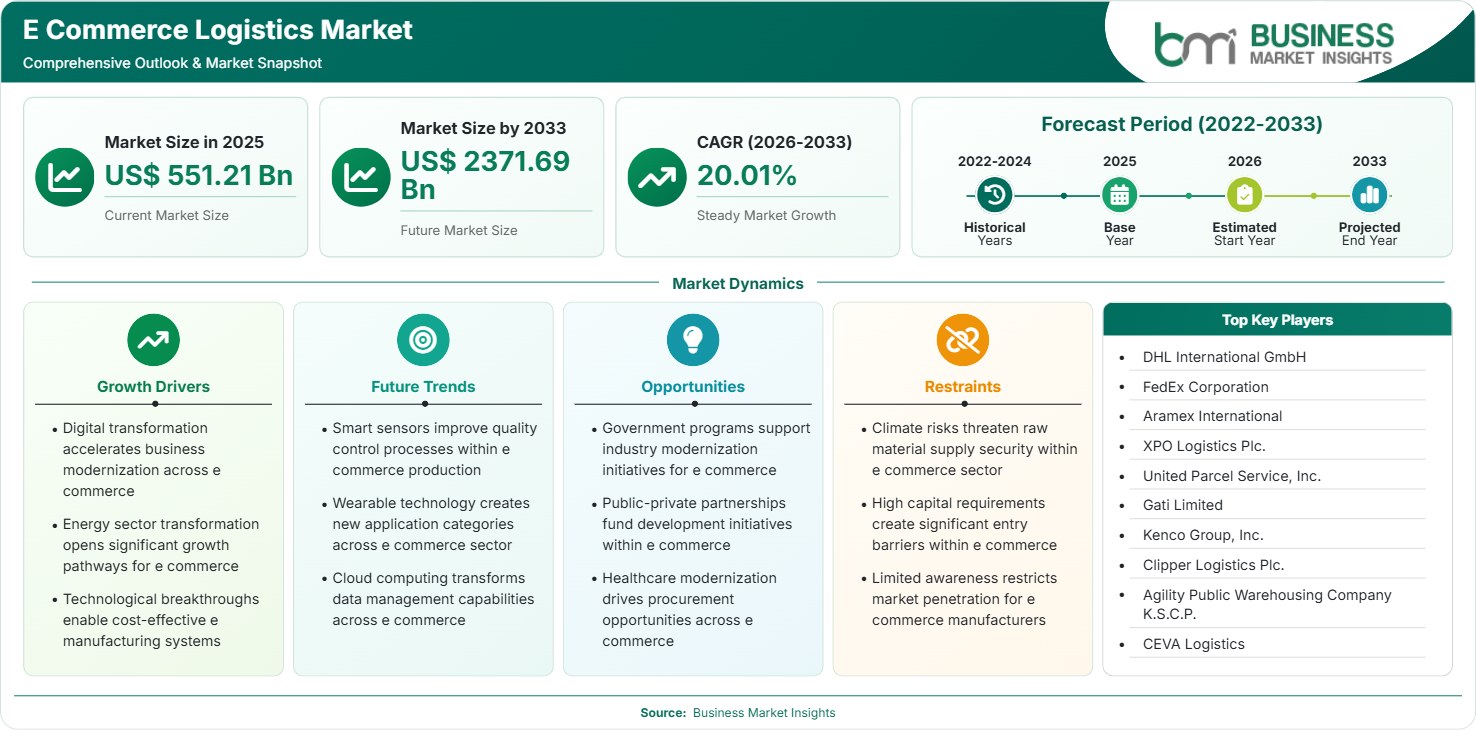
The E Commerce Logistics Market size was valued at US$ 551.21 Billion in 2025 and is projected to reach US$ 2371.69 Billion by 2033, growing at a CAGR of 20.01% during 2026–2033, driven by cross-border online retail, warehouse automation, same-day delivery demand, digital freight platforms, and expanding reverse-logistics ecosystems.

Report Coverage
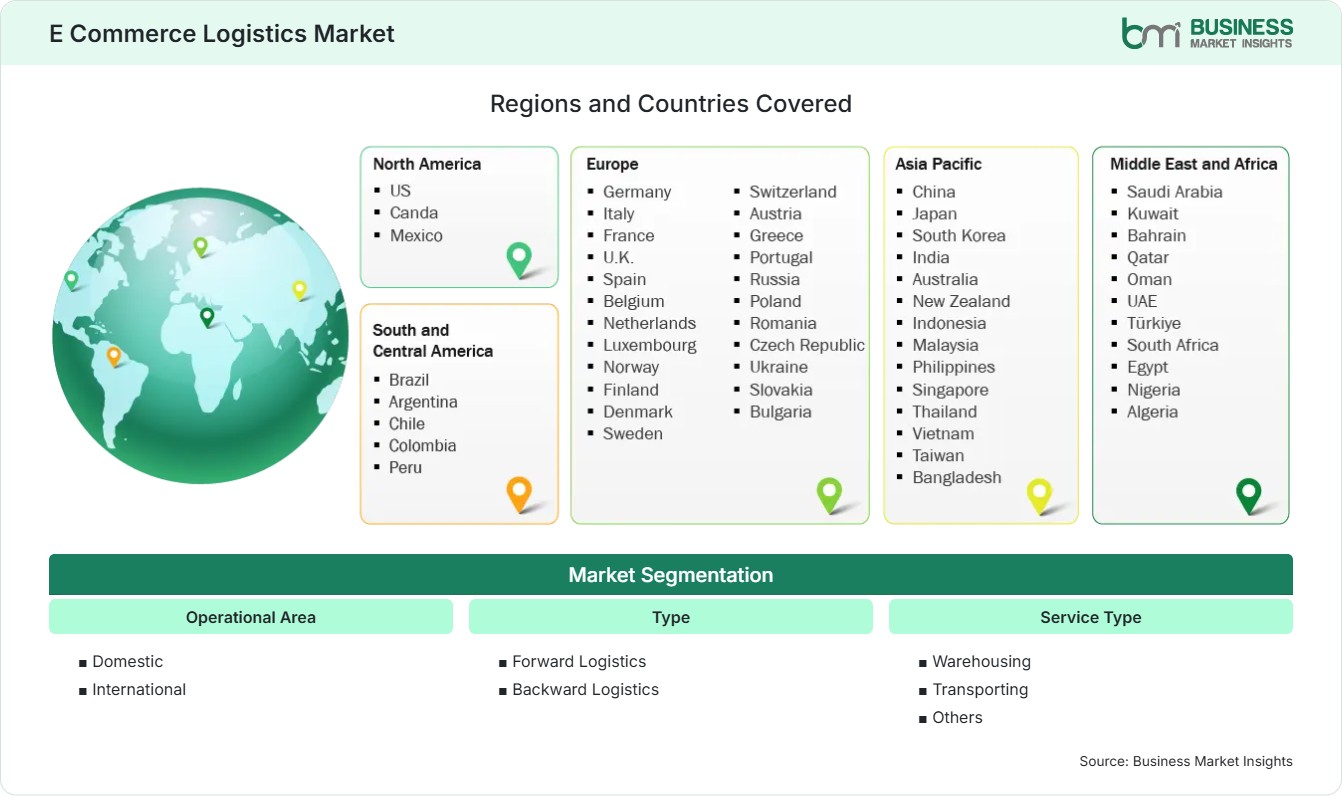
  • Operational Area: Domestic, International
  • Type: Forward Logistics, Backward Logistics
  • Service Type: Warehousing, Transporting, Others
US$ 551.21 Bn Market size in 2025
US$ 2371.69 Bn Market Size by 2033
20.01% CAGR, 2026 - 2033
2026-2033 Forecast Period

AI Overview

E Commerce Logistics Market Summary

  • North America Region: North America holds a market share of 34%–37% in 2025, growing with a CAGR of 18%–20% during 2026–2033. Growth is supported by mature fulfillment networks, parcel density, automation investment, integrated transportation systems, rising omnichannel retail adoption, advanced warehouse robotics, increasing returns management requirements, and demand for premium delivery services. Brief U.S. analysis: The U.S. remains the regional anchor, supported by large online retail volumes and a CAGR of 18.5%–20.5%.
  • Fastest Growing Region: Asia Pacific holds a E Commerce Logistics Market share of 28%–31% in 2025, growing with a CAGR of 22%–24% during 2026–2033. Expansion is fueled by digital commerce penetration, urban consumer growth, cross-border trade activity, mobile shopping ecosystems, fulfillment center investments, logistics digitization programs, broader internet access, and rising regional manufacturing output.
  • Leading Segment: Domestic operational area holds a market share of 68%–72% in 2025, growing with a CAGR of 19%–21% during 2026–2033. Growth reflects high parcel volumes, same-day delivery expectations, dense distribution infrastructure, local merchant participation, route optimization technologies, scalable warehousing operations, customer convenience preferences, and growing omnichannel fulfillment requirements.
  • High Growth Segment: Backward Logistics holds a market share of 28%–32% in 2025, growing with a CAGR of 23%–25% during 2026–2033. Expansion reflects increasing product returns, sustainability initiatives, refurbishment programs, resale marketplaces, automated returns processing, consumer-friendly policies, circular economy practices, and greater retailer focus on customer retention.
  • Key Market Opportunity: Major opportunity exists in AI-enabled fulfillment orchestration combining inventory visibility, predictive demand planning, dynamic routing, automated returns, and cross-border compliance management to improve delivery speed, network utilization, and profitability.
  • Major Market Players: DHL Group, United Parcel Service, Inc., FedEx Corporation, Amazon Logistics, SF Holding Co., Ltd., JD Logistics, Inc., GXO Logistics, Inc., CEVA Logistics, DSV A/S, DB Schenker.
Strategic Insights

E Commerce Logistics Market: Strategic Insights

E Commerce Logistics Market Strategic Framework
FREE PDF
Request your free sample
Request free sample
Stakeholder View

Key Takeaways

  • The industry value chain is increasingly integrated, with warehousing, fulfillment, transportation, and reverse logistics converging into unified service platforms capable of supporting omnichannel retail models.
  • Returns management and value-added fulfillment services present higher-margin opportunities as merchants seek differentiated customer experiences and more efficient inventory recovery programs.
  • AI-powered demand forecasting, autonomous warehouse technologies, and digital twin logistics planning are becoming central investment areas across large-scale network operators.
  • Asia Pacific offers a particularly attractive expansion pathway due to strong e-commerce adoption rates, manufacturing concentration, and infrastructure investments supporting regional distribution.
  • Strategic acquisitions continue reshaping competitive positioning, enabling providers to expand international reach, technology capabilities, and end-to-end logistics service portfolios.
  • Sustainability-focused logistics solutions, including electric last-mile fleets and optimized transportation networks, are increasingly influencing procurement and vendor-selection decisions.
Geographic Outlook

E Commerce Logistics Market Regional Highlights

North America E Commerce Logistics Market

North America has 34%-37% of sales in 2025 and is anticipated to register a CAGR of 18%-20% from 2025 to 2033. North America boasts an established system of order fulfillment, automated warehouses, and customers with a high demand for rapid delivery. Investments made in same-day fulfillment further justify the E Commerce Logistics Market share leadership. Parcel carriers constantly improve their efficiency through digitized routing and advanced tracking mechanisms. Increasing requirements for effective order return processing will positively impact future growth opportunities.

  • Large-scale fulfillment centers support rapid order processing and improved delivery accuracy across major metropolitan markets.
  • Warehouse robotics deployment accelerates productivity improvements while reducing labor dependency during seasonal demand fluctuations.
  • Retailers increasingly deploy distributed inventory models to shorten delivery distances and improve customer satisfaction levels.
  • Cross-border trade flows between the United States, Canada, and Mexico strengthen regional logistics network utilization.
  • Sustainability programs encourage fleet modernization and operational optimization across transportation providers.

US E Commerce Logistics Market

The United States contributes around 76%–80% of the region's revenue and is expected to grow at a CAGR of 18.5%–20.5% through 2033. The high penetration rate of digital retailing in the U.S., robust transport networks, and substantial warehouse facilities facilitate growth. Major logistics players have been continuously focusing on automation technologies, last-mile operations, and returns management technologies. Strong marketplace activity and consumer demand for fast shipping continue driving network expansion and fulfillment innovation across the country.

  • Large online retail ecosystems generate substantial parcel volumes and support extensive fulfillment infrastructure investments.
  • Same-day and next-day delivery expectations drive continuous upgrades in distribution and transportation capabilities.
  • AI-enabled routing systems are improving last-mile efficiency and reducing delivery costs for providers.
  • Reverse logistics networks continue expanding as retailers focus on improving returns convenience.

Europe E Commerce Logistics Market

Europe captured 23% – 26% of global revenues in 2025 and is projected to show a CAGR of 17% – 19% during the forecast period of the E Commerce Logistics Market. Harmonization of regulatory policies across major markets encourages uniformity in cross-border cargo transportation and logistics. Germany dominates the market among all national markets, whereas Poland displays substantial growth, having a CAGR of 20% – 22%. Investment in automated storage facilities, eco-friendly cargo transportation fleets, and digital freight services continues to improve competitiveness.

  • Germany leads regional demand due to strong retail infrastructure and extensive logistics connectivity.
  • Poland records among the fastest expansion rates, supported by fulfillment investments and strategic geographic positioning.
  • Sustainability regulations accelerate adoption of alternative-fuel vehicles and greener distribution operations.
  • Cross-border parcel shipments continue rising due to integrated digital commerce ecosystems.
  • Advanced warehouse technologies enhance storage density and processing efficiency.

Asia Pacific E Commerce Logistics Market

The Asia Pacific region contributed around 28% to 31% of revenue in 2025 and is expected to have a CAGR of 22% to 24%, making it the fastest-growing regional market. China continues to be the largest contributor, while India has the highest growth rate, at around 24%-26%. Growth in smartphones, digital payments, and online shopping further drives growth in the region. The market share in Asia Pacific continues to increase as fulfillment infrastructure expands and cross-border commerce becomes more accessible.

  • China maintains leadership through extensive fulfillment networks and large-volume online retail activity.
  • India benefits from rapid digital commerce adoption and growing investments in logistics modernization.
  • Southeast Asian economies attract fulfillment center developments supporting regional distribution networks.
  • Mobile commerce expansion increases parcel shipment volumes across urban and semi-urban populations.
  • Government infrastructure programs enhance transportation efficiency and network connectivity.

Rest of World E Commerce Logistics Market

The Rest of World region accounted for about 11%–13% of the world’s revenue in 2025 and is expected to grow at a CAGR of 19%–21% till 2033. South & Central America enjoy improved adoption of digital payments and increasing retail participation. In the Middle East & Africa region, investments are growing in logistics routes, warehouses, and trading infrastructure. Brazil is leading Latin America, while the UAE is showing promising growth due to its distribution and re-export advantages.

  • Brazil remains a primary logistics market supported by expanding online retail demand.
  • Gulf countries invest heavily in logistics parks and technology-enabled fulfillment infrastructure.
  • Trade corridor development improves regional connectivity and transportation efficiency.
  • Cross-border e-commerce participation continues strengthening parcel delivery requirements.
  • Digitalization initiatives support inventory visibility and customer experience improvements.
Global Market Geography
FREE PDF
Request your free sample
Request free sample
Segment Analysis

E Commerce Logistics Market Segmentation

Operational Area

The domestic operations market holds 68%-72% market share and is expected to have a CAGR of 19%-21%. The scope of the E Commerce Logistics Market in this sector is driven by high local fulfillment density, fast delivery, retailers' proximity policies, and urban demand. International operations still benefit from the growth of cross-border trade and customs digitalization.

  • Domestic: Dominates shipment volumes through dense distribution networks, fast delivery commitments, extensive retailer participation, and technology-enabled routing systems that improve shipment visibility and service reliability.
  • International: Benefits from expanding cross-border online purchases, customs modernization initiatives, integrated freight services, and increasing merchant demand for global fulfillment capabilities.

Type

Forward Logistics holds the biggest share at about 66%–70% in 2025 with a CAGR of 19%–21%. Backward Logistics is expected to demonstrate stronger growth prospects due to rising product returns and sustainability initiatives. The E Commerce Logistics Market trends are becoming more similar to retailers’ efforts to simplify return procedures and maximize customer satisfaction.

  • Forward Logistics: Supports order fulfillment, inventory movement, transportation management, and last-mile delivery functions essential for maintaining delivery speed and customer experience standards.
  • Backward Logistics: Gains momentum from rising return rates, refurbishment initiatives, product recovery programs, and consumer-friendly policies encouraging efficient returns management capabilities.

Service Type

Transportation is the largest service sector, with a market share ranging from 43% to 47% and a CAGR of 19%- 21%. On the other hand, the warehouse sector will continue expanding due to automation and micro-fulfillment innovations. Increasing parcel volumes, omnichannel requirements, and decentralized inventory drive the adoption of continuous services.

  • Warehousing: Increasingly incorporates robotics, inventory analytics, and automated storage systems to improve throughput, accuracy, and operational scalability.
  • Transporting: Remains critical for delivery performance, utilizing route optimization, fleet visibility tools, and multimodal capabilities to meet customer expectations.
Market Forces

E Commerce Logistics Market Dynamics

Key Market Drivers

Growth of Global Online Retail Participation

Global e-commerce sales continue to grow in both developed and emerging markets, thereby driving strong demand for warehouse, transportation, and fulfillment services. Retailers are demanding a logistics infrastructure capable of handling large volumes of parcels and enabling them to operate on an omnichannel basis. Increased use of electronic payments, internet penetration, and m-commerce participation fuel shipment growth. The growth in the market still depends on increases in order volumes and on customers' expectations for delivery speed. Providers that invest in the automated fulfillment infrastructure benefit from greater efficiency and cost savings. Continuous growth in cross-border transactions further increases demand for integrated logistics solutions supporting customs, tracking, and delivery visibility.

Acceleration of Warehouse Automation Technologies

Logistics fulfillment processes have been undergoing tremendous change through technological automation. The use of automated guided vehicles, robotic picking technologies, intelligent sorting equipment, and artificial intelligence-driven logistics warehouse systems helps operators handle more parcels without a corresponding increase in labor costs. Efficiency has become a priority in places facing labor shortages. Improved accuracy in inventory management will ensure that there are no errors made in the delivery process. Information from leading logistics firms indicates that more funding is being allocated to logistics centers equipped with robotic technology. Amid increasing operational challenges, automated technologies have enabled logistics providers to scale and adapt to fluctuating demand.

Rising Demand for Fast and Flexible Delivery Models

Consumer demand continues to shift toward same-day, next-day, and scheduled delivery. The need for better coordination between inventory placement, transportation capabilities, and fulfillment is more important than ever before for retailers. Urban settings with high density offer better economics for fast delivery in large metropolitan regions. Providers of logistics services use route optimization, predictive analytics, and distributed fulfillment networks to reduce transit times. Enhanced delivery capability helps retain customers and increase purchases online. These trends are fueling investments in transport infrastructure, last-mile technology, and local fulfillment capabilities.

Key Market Opportunities

Expansion of Cross-Border Commerce Networks

The development of cross-border e-commerce is creating new opportunities for logistics firms to reduce the complexity of international business. Companies are demanding more partners who can provide solutions to meet their business needs, such as customs brokerage, international shipping, local fulfillment, and returns, through integrated technology platforms. Greater involvement of small and medium-sized enterprises is also increasing the customer base. The E Commerce Logistics Market Forecasts seem promising for international fulfillment ecosystems driven by digital technology that will connect sellers and consumers across countries. Investments in cross-border visibility systems, duty management tools, and regional distribution hubs can generate competitive differentiation. Providers that establish efficient transnational networks are well-positioned to capture growing merchant demand for global expansion.

AI-Driven Logistics Orchestration Platforms

Artificial intelligence offers many more possibilities beyond just warehouse automation. Logistics companies may implement predictive demand planning, smart inventory placement, dynamic pricing, and exception management to increase network efficiency. Artificial intelligence can minimize transportation inefficiencies and provide reliable services. Visibility across supply chain operations enables better decision-making and resource optimization. Companies developing their digital control systems will be better equipped to meet omnichannel retailing demands. Increased adoption of cloud logistics intelligence systems by enterprises will enable investment across all sectors.

Development of Sustainable Fulfillment Ecosystems

The environmental goals set by retailers and logistics companies are resulting in greater demand for sustainable fulfillment solutions. Green delivery fleets, environmentally friendly warehouses, reusable packaging solutions, and efficient route planning can all reduce the carbon footprint of logistics processes while enhancing their effectiveness. Services geared towards sustainability are becoming an increasingly important factor in procurement for major retailers. Pressure from regulators across several regions is creating strong incentives for sustainable logistics technologies. Logistics services that demonstrate positive sustainability results can create high-value partnerships and contracts.

Market Restraints and Challenges

Infrastructure Gaps and Delivery Network Constraints

Factor: Uneven transportation infrastructure, warehousing availability, and last-mile connectivity remain persistent challenges across several emerging markets. Impact: Service reliability declines, delivery costs increase, and scalability becomes more complex for logistics providers. Congestion, limited rural coverage, and inadequate multimodal integration can extend delivery timelines and reduce operating efficiency. Network operators often require significant capital expenditures to overcome infrastructure deficiencies. These challenges are particularly relevant where e-commerce participation is expanding faster than logistics capacity. As shipment volumes continue increasing, providers must balance growth ambitions with substantial infrastructure investment requirements needed to maintain customer satisfaction and operational performance.

High Reverse Logistics Costs and Complexity

Factor: Rising return volumes create substantial operational complexity across fulfillment networks. Impact: Profit margins can decline due to transportation expenses, inspection requirements, repackaging activities, and inventory recovery costs. Categories such as apparel and consumer products often experience elevated return rates, placing added pressure on logistics infrastructure. Efficient processing requires specialized facilities, technology integration, and coordinated transportation systems. While customer-friendly return policies support online sales growth, they also increase logistics burdens. Providers unable to optimize reverse logistics workflows may face lower profitability and reduced competitiveness in a market increasingly defined by service quality and convenience.

Company Analysis

Competitive Landscape

E Commerce Logistics Market analysis indicates competition is increasingly centered on automation, cross-border capabilities, fulfillment scale, and integrated transportation services.

Company Name

Overview

Products and Services relevant to this market

DHL Group

Global logistics leader with extensive warehousing, parcel delivery, and international distribution networks supporting merchants worldwide.

Fulfillment services, parcel delivery, cross-border shipping, warehousing, reverse logistics, supply chain management.

United Parcel Service, Inc.

Major parcel and logistics provider serving business and consumer delivery requirements across international markets.

Package transportation, e-commerce fulfillment, returns management, customs brokerage, warehousing solutions.

FedEx Corporation

Global transportation and logistics company operating integrated express, ground, and fulfillment capabilities.

Express delivery, last-mile services, fulfillment solutions, tracking technologies, transportation management.

Amazon Logistics

Large-scale logistics network supporting marketplace deliveries and rapid fulfillment operations.

Last-mile delivery, fulfillment centers, inventory handling, transportation orchestration, delivery services.

SF Holding Co., Ltd.

Leading Asian logistics provider with extensive domestic and cross-border parcel capabilities.

Express services, warehousing, supply chain management, e-commerce logistics, international shipping.

JD Logistics, Inc.

Technology-driven logistics company supporting extensive fulfillment and distribution operations.

Smart warehousing, transportation services, fulfillment management, cross-border logistics.

GXO Logistics, Inc.

Contract logistics specialist focused on advanced warehouse operations and automation.

Warehousing, fulfillment, returns management, inventory optimization, value-added logistics services.

CEVA Logistics

Global supply chain provider with broad logistics and transportation capabilities.

Contract logistics, transportation management, warehousing, e-commerce fulfillment solutions.

DSV A/S

International logistics company with strong freight forwarding and supply chain expertise.

Transportation, warehousing, fulfillment, customs services, integrated logistics solutions.

DB Schenker

Established logistics and supply chain provider serving global commercial customers.

Fulfillment services, freight management, warehousing, distribution, e-commerce logistics support.

Trust & Transparency

Research Methodology

The market analysis combines proprietary research with secondary data from government agencies, company disclosures, regulatory filings, industry databases and expert interviews. Market estimates are validated through data triangulation, cross-market benchmarking and analyst review.

View Full Research Methodology

Questions Answered

Frequently Asked Questions

Which service area is seeing the strongest innovation activity?

Warehouse automation is experiencing particularly strong innovation through robotics, AI-enabled inventory management, automated sorting, and predictive operational planning tools.

What does an E Commerce Logistics Market Report typically evaluate?

A market report generally assesses demand trends, competitive positioning, technology adoption, regional performance, segmentation dynamics, and long-term growth opportunities.

How are sustainability objectives influencing logistics decisions?

Retailers increasingly evaluate transportation emissions, packaging efficiency, and warehouse energy performance when selecting logistics partners, encouraging investment in greener operations.

What role does reverse logistics play in long-term profitability?

Efficient returns management helps recover inventory value, improve customer retention, reduce waste, and support circular-economy strategies, making it a critical operational function.

What factors are accelerating demand for specialized fulfillment services?

Growing omnichannel retail, customer expectations for rapid delivery, and increasing order complexity are encouraging retailers to outsource fulfillment to specialized logistics providers with automation and analytics capabilities.

Access the Full E Commerce Logistics Market Report

Get segment-level forecasts, regional estimates, competitive benchmarking, company profiles and downloadable Excel datasets.

Access the full E Commerce Logistics Market Report
350 pages PDF & Excel | 2026-08-17