
Logistics Automation Market Outlook: Size, Share, Trends, Growth Analysis, Competitive Landscape & Forecast, 2026-2033

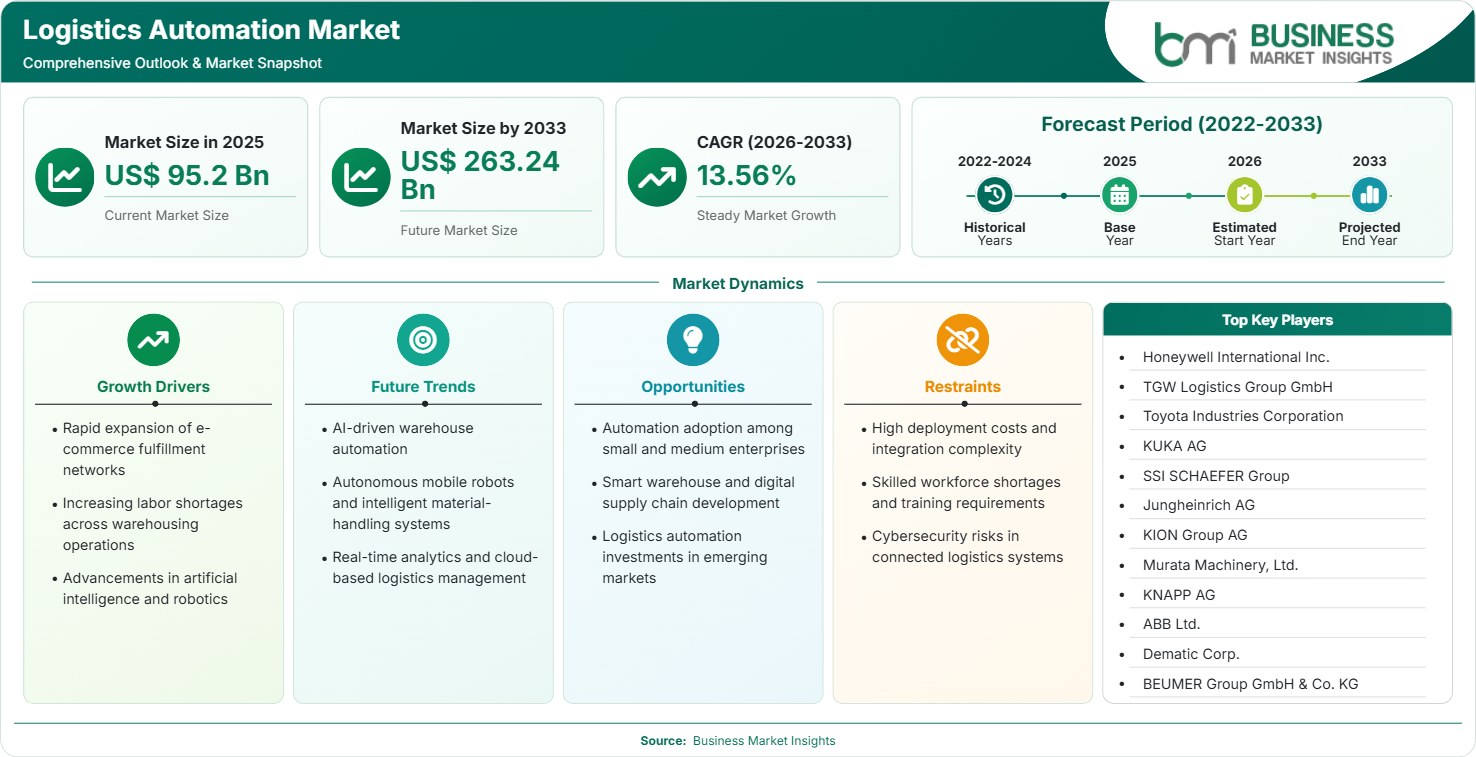
The Logistics Automation Market size was valued at US$ 95.2 Billion in 2025 and is projected to reach US$ 263.24 Billion by 2033, growing at a CAGR of 13.56% during 2026–2033, driven by warehouse digitalization, robotics deployment, e-commerce fulfillment expansion, labor optimization initiatives, and investments in AI-enabled supply chain orchestration platforms across industries.

Report Coverage
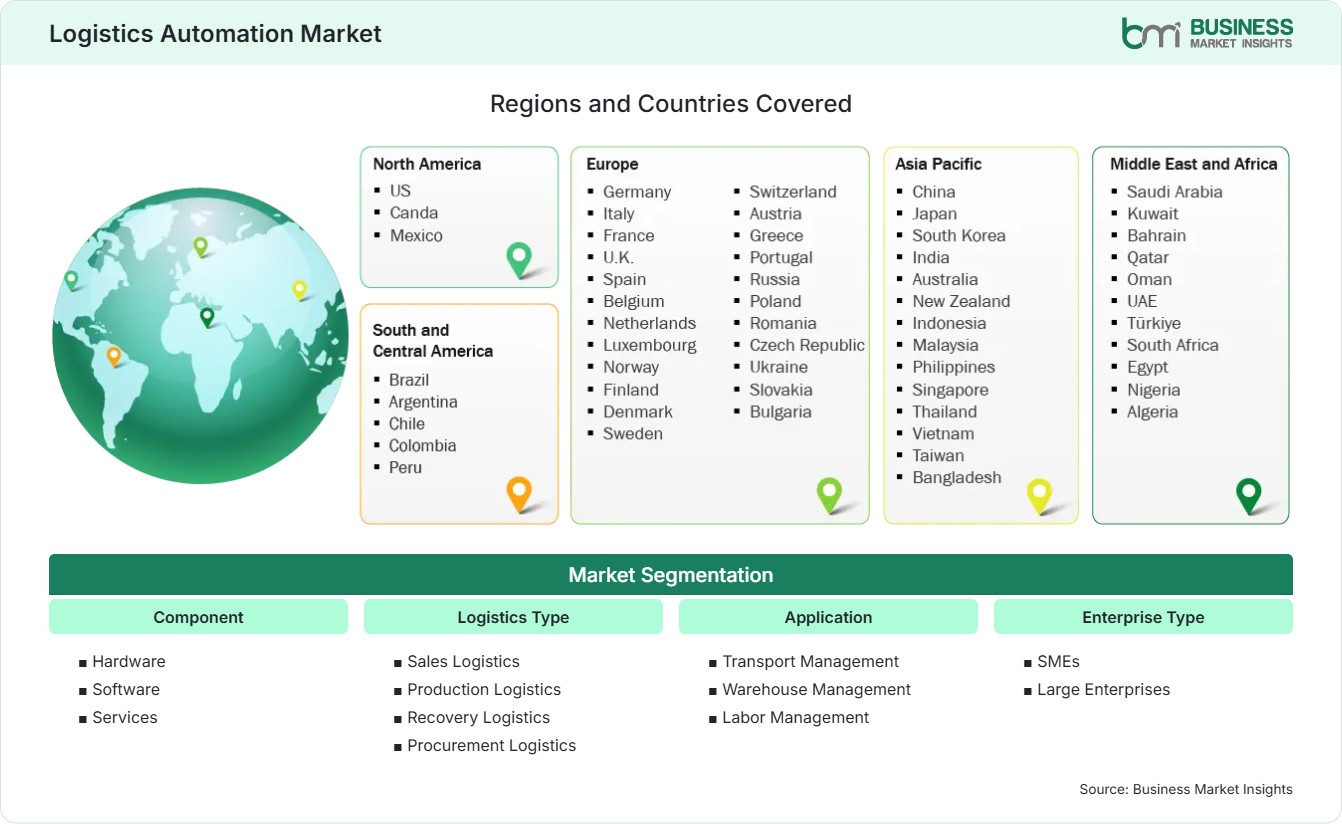
  • Component: Hardware, Software, Services
  • Logistics Type: Sales Logistics, Production Logistics, Recovery Logistics, Procurement Logistics
  • Application: Transport Management, Warehouse Management, Labor Management
  • Enterprise Type: SMEs, Large Enterprises
  • Industry: Retail & E-Commerce, Healthcare & Pharma, Food & Beverages, Aerospace & Defense, Energy & Utility, Automotive
US$ 95.2 Bn Market size in 2025
US$ 263.24 Bn Market Size by 2033
13.56% CAGR, 2026 - 2033
2026-2033 Forecast Period

AI Overview

Logistics Automation Market Summary

  • North America Region: North America holds a market share of 34%–37% in 2025, growing at a CAGR of 12.8%–13.8% during 2026–2033. Growth is supported by advanced warehouse robotics adoption, omnichannel retail expansion, labor shortages, autonomous material handling investments, cloud logistics platforms, and strong fulfillment infrastructure modernization across industries. The U.S. dominates regional demand, supported by large-scale fulfillment investments and projected CAGR of 13.0%–14.0% through 2033.
  • Fastest Growing Region: Asia Pacific holds a market share of 28%–31% in 2025, expanding at a CAGR of 15.0%–16.5% during 2026–2033. Rapid industrialization, manufacturing automation, cross-border e-commerce growth, smart warehousing initiatives, government-backed digital transformation programs, and expanding logistics infrastructure continue accelerating adoption throughout regional economies.
  • Leading Segment: Hardware accounts for 48%–52% share in 2025 and advances at a CAGR of 13.0%–14.0% during 2026–2033. Demand is fueled by robotic systems, automated storage technologies, conveyor equipment deployment, warehouse modernization projects, and increasing requirements for scalable material handling efficiency.
  • High Growth Segment: Software represents 20%–24% share in 2025 and grows at a CAGR of 15.5%–17.0% during 2026–2033. Organizations increasingly implement AI-enabled warehouse management, transportation optimization, predictive analytics, digital twins, and real-time visibility solutions to improve operational decision-making.
  • Key Market Opportunity: Expanding adoption of AI-powered warehouse orchestration, autonomous mobile robots, predictive inventory management, and integrated transportation visibility platforms presents substantial opportunities for vendors supporting digital supply chain transformation initiatives globally.
  • Major Market Players: Honeywell International Inc.; TGW Logistics Group GmbH; Toyota Industries Corporation; KUKA AG; SSI SCHAEFER Group; Jungheinrich AG; KION GROUP AG; Murata Machinery, Ltd.; KNAPP AG; ABB Ltd.; Dematic Corp.; BEUMER Group GmbH & Co. KG; WITRON Logistik + Informatik GmbH; One Network Enterprises, Inc.; Toshiba Corporation.
Strategic Insights

Logistics Automation Market: Strategic Insights

Logistics Automation Market Strategic Framework
FREE PDF
Request your free sample
Request free sample
Stakeholder View

Key Takeaways

  • The value chain is increasingly integrated through software-controlled automation ecosystems that connect warehouse operations, transportation management, inventory control, and fulfillment processes into a unified digital environment.
  • Warehouse management and automated fulfillment applications offer substantial upside as retailers and manufacturers prioritize operational efficiency, inventory visibility, and rapid order processing capabilities.
  • Innovation is shifting toward AI-enabled orchestration platforms, digital twins, machine vision systems, autonomous mobile robots, and predictive maintenance solutions that enhance operational intelligence.
  • Asia Pacific presents a compelling investment case due to rapid industrial expansion, increasing e-commerce penetration, infrastructure development programs, and rising adoption of smart logistics technologies.
  • Strategic acquisitions and partnerships among robotics providers, software vendors, and warehouse automation specialists are accelerating technology integration and expanding end-to-end solution portfolios.
  • Organizations implementing scalable automation architectures gain stronger flexibility in handling demand fluctuations, labor constraints, and evolving customer fulfillment expectations.
Geographic Outlook

Logistics Automation Market Regional Highlights

North America Logistics Automation Market

North America accounts for approximately 34%–37% share in 2025 and is projected to expand at a 12.8%–13.8% CAGR through 2033. Strong technology adoption, mature fulfillment infrastructure, and significant investments by retail, manufacturing, and logistics companies continue supporting regional leadership. The region benefits from widespread deployment of autonomous mobile robots, warehouse management software, automated storage systems, and intelligent sorting technologies. Logistics Automation Market share remains highest in North America due to advanced digital transformation strategies and increasing pressure for faster fulfillment performance.

  • Major retailers and third-party logistics providers continue investing in robotic fulfillment networks to improve throughput, reduce labor dependence, and enhance delivery performance across expanding omnichannel operations.
  • Demand for warehouse execution software and AI-powered orchestration platforms is increasing as enterprises seek greater visibility, inventory optimization, and operational agility throughout supply chain networks.
  • Labor shortages across distribution facilities encourage accelerated adoption of autonomous mobile robots, automated picking systems, and machine vision technologies supporting productivity improvements.
  • Sustainability initiatives are encouraging deployment of energy-efficient automation equipment, intelligent routing technologies, and data-driven operational models that reduce logistics-related emissions and resource consumption.
  • Increasing investment in micro-fulfillment centers supports urban delivery strategies and strengthens adoption of compact automated storage and retrieval technologies.

US Logistics Automation Market

The United States represents approximately 78%–82% of North American demand in 2025 and is anticipated to grow at a 13.0%–14.0% CAGR through 2033. Large-scale e-commerce activity, advanced logistics infrastructure, and continuous warehouse modernization investments support market expansion. The country hosts major automation innovators and solution integrators, accelerating technology deployment across retail, manufacturing, healthcare, and transportation sectors. Logistics Automation Market growth remains strongly influenced by fulfillment automation initiatives among leading enterprises.

  • E-commerce operators continue expanding automated fulfillment facilities equipped with robotics, intelligent sorting systems, and advanced warehouse management software to manage increasing order volumes.
  • Manufacturing industries are integrating logistics automation into production environments to synchronize inventory movement, reduce downtime, and improve material flow efficiency.
  • Rising demand for same-day and next-day delivery services drives investment in automated distribution hubs and transportation optimization platforms.
  • Growing adoption of cloud-based logistics management solutions improves scalability, operational visibility, and coordination across complex supply chain ecosystems.

Europe Logistics Automation Market

Europe captures approximately 25%–28% Logistics Automation Market share in 2025 and is forecast to register a 12.5%–13.5% CAGR during 2026–2033. Strong industrial automation capabilities, advanced manufacturing sectors, and sustainability-focused logistics strategies support growth. Germany leads regional deployment due to its industrial base and automation expertise, while Eastern European countries emerge as high-growth investment destinations. Companies increasingly implement robotics, warehouse optimization software, and automated transport systems to address efficiency requirements and labor constraints.

  • Germany remains the largest regional market supported by advanced engineering capabilities, extensive manufacturing activity, and widespread implementation of intelligent warehouse technologies.
  • Poland and the Czech Republic demonstrate strong expansion due to logistics infrastructure development and increasing foreign direct investment in distribution facilities.
  • Sustainability regulations encourage adoption of efficient automation technologies that improve resource utilization and reduce transportation-related emissions.
  • Retail and grocery sectors increasingly deploy automated picking, sorting, and inventory management solutions to strengthen fulfillment performance.
  • Cross-border trade activities support investment in automated logistics hubs and integrated transportation management platforms throughout Europe.

Asia Pacific Logistics Automation Market

Asia Pacific accounts for approximately 28%–31% Logistics Automation Market share in 2025 and records the fastest expansion with a 15.0%–16.5% CAGR through 2033. Rapid industrialization, expanding manufacturing output, and substantial e-commerce growth continue accelerating automation adoption. China remains the leading market due to extensive warehouse modernization, while India demonstrates strong momentum supported by digital transformation initiatives. Regional enterprises increasingly invest in robotics, intelligent storage systems, and AI-driven logistics technologies to improve operational scalability and competitiveness.

  • China leads deployment of automated warehousing infrastructure supported by manufacturing strength, advanced logistics investments, and strong domestic technology ecosystems.
  • India exhibits high growth potential driven by rapid e-commerce expansion, infrastructure development programs, and increasing automation adoption among logistics providers.
  • Japan and South Korea continue investing in sophisticated robotics and warehouse automation technologies to address workforce challenges and productivity requirements.
  • Regional governments promote smart manufacturing and digital economy initiatives that support widespread automation implementation across logistics networks.
  • Cross-border commerce growth encourages deployment of scalable fulfillment infrastructure and intelligent transportation management systems.

Rest of World Logistics Automation Market

Rest of World contributes approximately 9%–12% share in 2025 and is expected to achieve a 13.5%–14.5% CAGR through 2033. Growing investments in logistics infrastructure, industrial diversification, and digital transformation initiatives support adoption across South & Central America and the Middle East & Africa.

Brazil and Mexico lead demand within South & Central America, while the United Arab Emirates and Saudi Arabia emerge as major automation investment hubs in the Middle East. Expanding trade activities and fulfillment requirements continue supporting regional automation deployment.

  • Large logistics infrastructure projects across Gulf economies accelerate implementation of intelligent warehousing and automated material handling technologies.
  • Brazil experiences growing automation demand from retail, manufacturing, and transportation sectors seeking improved operational efficiency.
  • Regional e-commerce expansion encourages investments in fulfillment centers equipped with robotics and advanced warehouse management platforms.
  • Governments increasingly support industrial diversification strategies that promote automation adoption and digital supply chain development.
  • International logistics providers continue establishing technologically advanced distribution facilities to improve service quality and network efficiency.
Global Market Geography
FREE PDF
Request your free sample
Request free sample
Segment Analysis

Logistics Automation Market Segmentation

Component

The component segment accounted for approximately 34%–37% market share in 2025 and is projected to grow at a CAGR of 13.8%–15.8% through 2033. Hardware solutions remain fundamental for automation deployments, while software platforms increasingly enable intelligent orchestration and analytics. Services continue gaining importance as enterprises seek integration, maintenance, and optimization expertise. The Logistics Automation Market scope continues expanding through convergence of robotics, AI, and cloud-based logistics technologies.

  • Hardware: Includes robotic systems, conveyors, sensors, automated storage and retrieval systems, and material handling equipment that improve warehouse efficiency, operational accuracy, and throughput performance.
  • Software: Encompasses warehouse management, warehouse execution, transportation management, and analytics platforms supporting real-time visibility, process optimization, and decision-making capabilities.
  • Services: Covers consulting, deployment, integration, maintenance, and support activities helping organizations maximize automation performance and accelerate digital transformation initiatives.

Logistics Type

The logistics type segment represented approximately 21%–24% market share in 2025 and is forecast to expand at a CAGR of 13.2%–15.2% through 2033. Growing supply chain complexity and demand for operational efficiency are encouraging organizations to automate multiple logistics functions. Logistics Automation Market trends increasingly emphasize integrated workflows connecting procurement, production, sales, and recovery logistics activities through centralized digital platforms.

  • Sales Logistics: Supports order fulfillment, inventory distribution, customer delivery coordination, and omnichannel operations through automated warehouse and transportation technologies.
  • Production Logistics: Focuses on efficient movement of materials and components within manufacturing environments to improve productivity and minimize operational disruptions.
  • Recovery Logistics: Enables management of returns, recycling, refurbishment, and reverse supply chain processes through automated tracking and handling systems.
  • Procurement Logistics: Optimizes inbound material flows, supplier coordination, inventory replenishment, and receiving operations using intelligent automation technologies.

Application

The application segment accounted for approximately 28%–31% market share in 2025 and is expected to grow at a CAGR of 14.0%–16.0% through 2033. Warehouse management remains the largest application area due to rising fulfillment requirements, while transportation and labor management solutions continue gaining traction. Enterprises increasingly prioritize integrated logistics platforms that improve visibility, efficiency, and scalability across supply chain operations.

  • Transport Management: Enhances route planning, fleet utilization, shipment visibility, and delivery performance through advanced automation and analytics capabilities.
  • Warehouse Management: Supports inventory control, order processing, picking optimization, and storage efficiency within increasingly complex fulfillment environments.
  • Labor Management: Improves workforce scheduling, productivity monitoring, task allocation, and operational performance through intelligent digital tools.

Enterprise Type

The enterprise type segment held approximately 18%–21% market share in 2025 and is projected to grow at a CAGR of 13.5%–15.5% through 2033. Large organizations continue leading adoption due to greater capital availability and operational scale, while SMEs increasingly leverage cloud-based and subscription-driven automation models to improve competitiveness and efficiency.

  • SMEs: Adopting flexible automation solutions that reduce operational costs, improve inventory accuracy, and support business growth without substantial infrastructure investments.
  • Large Enterprises: Deploying integrated automation ecosystems across multiple facilities to enhance productivity, visibility, and supply chain resilience.

Industry

The industry segment accounted for approximately 32%–35% market share in 2025 and is anticipated to grow at a CAGR of 14.2%–16.2% through 2033. Retail and e-commerce remain dominant adopters due to fulfillment intensity, while healthcare, food, automotive, and industrial sectors increasingly automate logistics operations to improve speed, compliance, and efficiency.

  • Retail & E-Commerce: Driven by growing online shopping activity, high order volumes, rapid fulfillment expectations, and expanding omnichannel distribution strategies.
  • Healthcare & Pharma: Requires automated handling systems supporting regulatory compliance, inventory traceability, and efficient management of sensitive products.
  • Food & Beverages: Benefits from automated storage, picking, and cold-chain operations that improve product quality and distribution efficiency.
  • Aerospace & Defense: Utilizes automation technologies to manage complex inventory requirements, component traceability, and mission-critical logistics operations.
  • Energy & Utility: Increasingly adopts intelligent logistics systems supporting asset management, maintenance activities, and infrastructure development projects.
  • Automotive: Leverages automation to optimize parts movement, production support logistics, inventory control, and manufacturing efficiency.
Market Forces

Logistics Automation Market Dynamics

Key Market Drivers

Rapid Expansion of E-Commerce Fulfillment Networks

The total amount of global e-commerce sales is continually rising, and the need for logistics automation is very high. From various retailing statistics, there has been an increase in the number of orders fulfilled and also the number of orders placed recently. To meet these requirements, logistics providers have resorted to the use of automated storage and retrieval systems, robotic picking, and intelligent sortation systems. Logistics Automation Market growth is increasingly linked to same-day and next-day delivery expectations, which require scalable warehouse operations. Automation reduces fulfillment costs, minimizes errors, and improves throughput, enabling retailers and third-party logistics providers to maintain service quality while handling higher transaction volumes.

Increasing Labor Shortages Across Warehousing Operations

Warehousing and distribution facilities worldwide face persistent workforce shortages, particularly in repetitive and physically demanding roles. Increasing labor costs and high employee turnover are prompting organizations to implement robotics, autonomous mobile robots, and automated material handling. This is not only because they increase efficiency but also because they reduce the dependency on manual operations. Logistic providers now prefer those solutions that have the ability to work consistently without any compromise in their performance. The problem of labor shortage becomes more prominent in those logistics providers that have reached maturity. This is due to demographic changes and changes in labor preference.

Advancements in Artificial Intelligence and Robotics

Artificial intelligence, machine vision, machine learning, and robotics innovations are transforming warehouse operations and supply chain decision-making. Modern automation systems can identify inventory, optimize picking routes, predict maintenance requirements, and coordinate material movement with minimal human intervention. Logistics Automation Market trends are becoming evident through the increasing use of artificial intelligence analysis in warehouse management software and transportation management software. The advantages gained include better inventory precision, increased visibility, and operational predictions. With the reduction of hardware prices and advancements in software, companies have started to automate operations to become more efficient.

Key Market Opportunities

Automation Adoption Among Small and Medium Enterprises

Historically, large enterprises dominated automation investments due to substantial capital requirements. However, cloud-based software, robotics-as-a-service models, and modular automation platforms are making advanced logistics technologies more accessible to SMEs. These businesses increasingly require efficient inventory management and fulfillment capabilities to compete with larger organizations. Logistics Automation Market Forecasts indicate strong market acceptance among regional distributors, e-commerce merchants, and manufacturers seeking scalable solutions. Companies that offer adaptable deployment, subscription-based pricing, and fast implementation can benefit from increased demand. Increasing participation of SMEs is a huge revenue potential for the future in both mature and developing logistics markets.

Development of Smart Warehouses and Digital Supply Chains

Organizations are increasingly pursuing end-to-end supply chain visibility through interconnected digital ecosystems. A smart warehouse makes use of sensors, robots, AI, cloud technology, and real-time analytics to build highly reactive logistics environments. The smart warehouse optimizes inventory management, decreases operational delays, and increases forecasting accuracy. Government institutions and industrial associations are promoting digital transformation efforts that foster investments in state-of-the-art logistics solutions. Increasing use of industrial IoT and predictive analytics solutions paves the way for software vendors, robot makers, and integrators. The implementation of smart warehouses is poised to be the key competitive advantage in logistics systems worldwide.

Emerging Logistics Infrastructure Investments in Developing Regions

Rapid urbanization, industrial growth, and expanding trade activities are encouraging large-scale logistics infrastructure investments across the Asia Pacific, Latin America, and the Middle East. New distribution centers, industrial parks, and transport corridors need effective automation solutions in order to achieve high levels of efficiency. Governments are adopting policies that favor digitalization, supply chain modernization, and industrial competitiveness. This opens up new possibilities for automation companies to forge long-term alliances with logistics service providers and manufacturing firms. As logistics ecosystems evolve in developing countries, there will be increasing demand for warehouse automation systems, transportation management systems, and intelligent material handling systems.

Market Restraints and Challenges

High Initial Capital Requirements and Integration Complexity

Factor: Advanced automation systems require significant upfront investment in robotics, software platforms, sensors, infrastructure upgrades, and implementation services. Impact: Many firms find it hard to adopt such technologies due to budgetary considerations and the inability to measure ROI. The integration process also poses additional risk factors in that it is challenging to integrate modern automation technologies with warehouse management and enterprise resource planning systems. It is also necessary for businesses to carry out proper planning, employee training, and process re-engineering before they can benefit from these processes. This makes it difficult to adopt automation technologies in many markets despite their future benefits.

Cybersecurity Risks and Technology Dependence

Factor: Increasing reliance on interconnected software platforms, cloud environments, and autonomous systems exposes logistics operations to cybersecurity threats and technology disruptions. Impact: Data breaches, ransomware attacks, and network malfunctions can disrupt the operations within the warehouses, result in delayed delivery, and impact the performance of customer service. As companies continue to integrate their digital supply chains, the process of ensuring the security of infrastructure becomes more challenging. Compliance requirements relating to data protection and resiliency raise additional concerns for the companies. Suppliers and end-users need to make continuous efforts in terms of cybersecurity, monitoring, and risk management.

Company Analysis

Competitive Landscape

The competitive environment remains characterized by technology innovation, strategic partnerships, robotics development, and software integration capabilities. Logistics Automation Market analysis indicates that leading participants are focusing on intelligent warehousing, AI-enabled logistics platforms, autonomous material handling systems, and end-to-end supply chain optimization solutions.

Company Name

Overview

Products and Services Relevant to this Market

Honeywell International Inc.

Global industrial technology company with extensive expertise in warehouse automation, productivity solutions, and supply chain optimization technologies.

Warehouse execution software, automated material handling systems, voice-directed solutions, robotics integration, and intelligent fulfillment technologies.

TGW Logistics Group GmbH

Austrian logistics automation specialist delivering highly automated fulfillment and warehouse solutions for global enterprises.

Conveyor systems, robotic picking technologies, warehouse software, automated storage systems, and distribution center solutions.

Toyota Industries Corporation

Major material handling and industrial automation provider serving manufacturing and logistics sectors worldwide.

Automated guided vehicles, warehouse equipment, logistics systems, and advanced material handling technologies.

KUKA AG

Leading robotics and automation company supporting industrial and logistics transformation initiatives.

Industrial robots, autonomous mobile robots, warehouse automation systems, and intelligent software platforms.

SSI SCHAEFER Group

Global provider of logistics and warehouse automation technologies with strong distribution infrastructure expertise.

Storage systems, warehouse software, picking solutions, automated conveyors, and integrated logistics platforms.

Jungheinrich AG

European intralogistics specialist focused on warehouse efficiency and digital material handling solutions.

Automated forklifts, warehouse management software, storage systems, and automation services.

KION Group AG

International supply chain solutions provider operating through multiple automation and material handling brands.

Automated warehouse technologies, industrial trucks, robotics, and software-driven logistics solutions.

Murata Machinery, Ltd.

Japanese automation manufacturer supporting advanced warehousing and industrial logistics operations.

Automated storage systems, material handling equipment, warehouse control software, and sorting technologies.

KNAPP AG

Automation company specializing in intelligent fulfillment systems for retail, healthcare, and logistics sectors.

Robotic picking systems, shuttle technologies, warehouse software, and order fulfillment solutions.

ABB Ltd.

Global technology leader delivering robotics, electrification, and industrial automation capabilities.

Robotics solutions, autonomous mobile robots, warehouse automation technologies, and digital control systems.

Dematic Corp.

Major warehouse automation provider serving distribution, retail, and manufacturing customers globally.

Automated storage systems, sorting technologies, software platforms, and integrated fulfillment solutions.

BEUMER Group GmbH & Co. KG

Logistics technology company focused on material handling and automated transportation solutions.

Conveyor systems, baggage handling technologies, sorting solutions, and warehouse automation equipment.

WITRON Logistik + Informatik GmbH

German automation specialist known for large-scale distribution center automation expertise.

Automated picking systems, warehouse software, distribution technologies, and logistics optimization solutions.

One Network Enterprises, Inc.

Supply chain software provider enabling digital logistics visibility and network optimization.

Real-time supply chain platforms, logistics collaboration software, predictive analytics, and network management solutions.

Toshiba Corporation

Diversified technology company supporting digital transformation and industrial automation initiatives.

Warehouse management systems, IoT solutions, logistics analytics, and industrial automation technologies.

Trust & Transparency

Research Methodology

The market analysis combines proprietary research with secondary data from government agencies, company disclosures, regulatory filings, industry databases and expert interviews. Market estimates are validated through data triangulation, cross-market benchmarking and analyst review.

View Full Research Methodology

Questions Answered

Frequently Asked Questions

Which technology areas are expected to attract future investments?

Artificial intelligence, warehouse orchestration platforms, autonomous robotics, predictive analytics, industrial internet of things solutions, digital twins, and cloud-based logistics management systems are expected to attract significant investment.

What does the Logistics Automation Market Report typically evaluate?

The Logistics Automation Market Report generally examines technology adoption patterns, competitive positioning, investment trends, regional developments, industry demand dynamics, and emerging opportunities influencing future market performance.

How do autonomous mobile robots benefit warehouse operators?

Autonomous mobile robots streamline material movement, reduce manual handling requirements, improve worker productivity, increase warehouse throughput, and support flexible operational layouts without extensive infrastructure modifications.

Which industries are leading adoption of logistics automation technologies?

Retail and e-commerce remain the largest adopters, followed by healthcare, food and beverages, automotive, aerospace and defense, and industrial manufacturing sectors requiring efficient supply chain operations.

What is driving automation adoption in logistics operations?

Organizations are investing in automation to address labor shortages, improve fulfillment speed, increase inventory accuracy, reduce operating costs, and support growing e-commerce volumes. Advanced robotics and AI technologies further enhance operational efficiency and scalability.

Access the Full Logistics Automation Market Report

Get segment-level forecasts, regional estimates, competitive benchmarking, company profiles and downloadable Excel datasets.

Access the full Logistics Automation Market Report
350 pages PDF & Excel | 2026-08-27