
Third-Party Logistics Market Outlook: Size, Share, Trends, Growth Analysis, Competitive Landscape & Forecast, 2026-2033

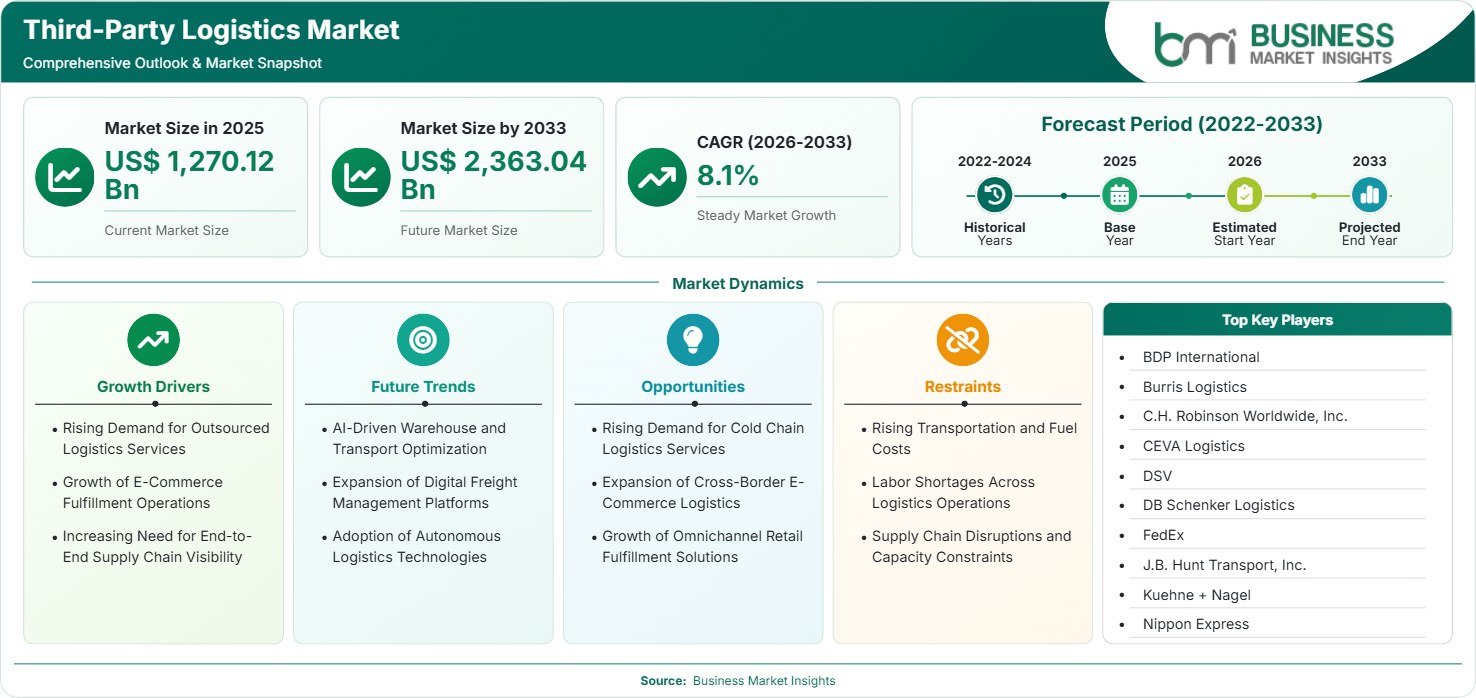
The Third-Party Logistics Market size was valued at USD 1,270.12 Billion in 2025 and is projected to reach USD 2,363.04 Billion by 2033, growing at a CAGR of 8.1% during 2026–2033. Growth is driven by increasing globalization of supply chains, rising e-commerce activities, growing demand for efficient transportation and warehousing services, expanding outsourcing of logistics operations, and increasing adoption of digital supply chain technologies.

Report Coverage
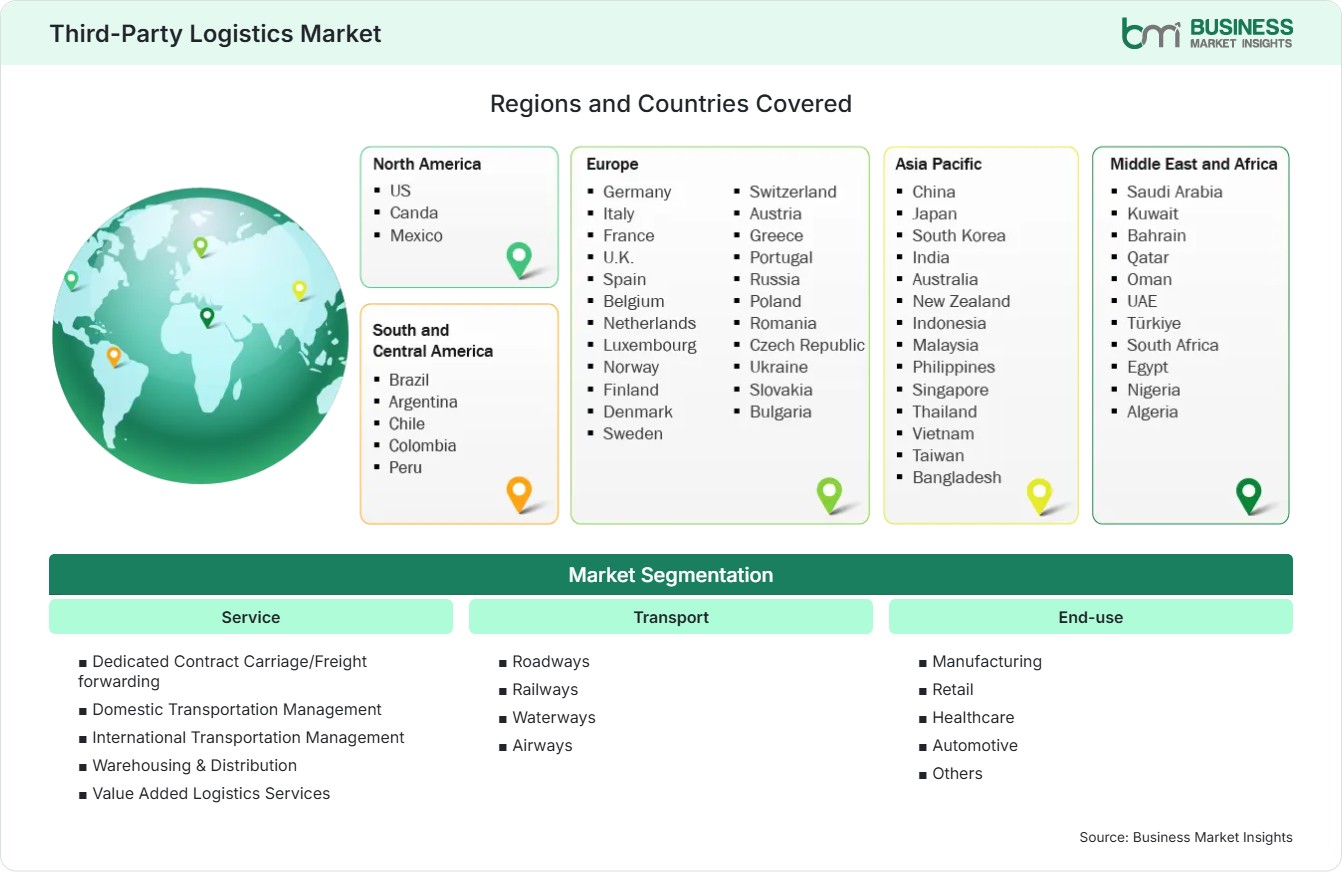
  • Service: Dedicated Contract Carriage/Freight forwarding, Domestic Transportation Management, International Transportation Management, Warehousing & Distribution, Value Added Logistics Services
  • Transport: Roadways, Railways, Waterways, Airways
  • End-use: Manufacturing, Retail, Healthcare, Automotive, Others
US$ 1,270.12 Bn Market size in 2025
US$ 2,363.04 Bn Market Size by 2033
8.1% CAGR, 2026 - 2033
2026-2033 Forecast Period

01 AI Overview

Third-Party Logistics Market Summary

North America Region: North America holds a market share of 31%–34% in 2025, growing at a CAGR of 7.5%–8.1% during 2026–2033. Demand is supported by mature logistics infrastructure, strong e-commerce penetration, and growing demand for integrated supply chain services. The U.S. remains the dominant market, advancing at a CAGR of 7.7%–8.3%.

Fastest Growing Region: Asia Pacific accounts for 36%–39% of revenue in 2025 and is projected to register a CAGR of 9.0%–9.7% through 2033. Rapid industrialization, increasing cross-border trade, and expanding online retail activity continue supporting third-party logistics market development.

Leading Segment: Warehousing & Distribution (W&D) holds a market share of 30%–34% in 2025 and is expected to grow at a CAGR of 8.4%–9.0%. Demand is driven by expanding e-commerce fulfillment requirements and growing need for inventory management solutions.

High Growth Segment: International Transportation Management (ITM) accounts for 18%–22% of market revenue in 2025 and is projected to register a CAGR of 9.2%–9.9% during the forecast period. Increasing international trade and global supply chain integration continue supporting expansion.

Key Market Opportunity: Growing demand for digital logistics solutions, omnichannel fulfillment networks, and integrated supply chain management services is creating significant opportunities for logistics providers.

Major Market Players: BDP International, Burris Logistics, C.H. Robinson Worldwide, Inc., CEVA Logistics, DSV, DB Schenker Logistics, FedEx, J.B. Hunt Transport, Inc., Kuehne + Nagel, and Nippon Express.

02 Strategic Insights

Third-Party Logistics Market: Strategic Insights

third-party-logistics-market-market-strategic-framework
FREE PDF
Request your free sample
Request free sample
03 Stakeholder View

Key Takeaways

  • The market ecosystem includes logistics service providers, transportation companies, warehouse operators, freight forwarders, retailers, manufacturers, and supply chain technology providers.
  • Warehousing and distribution services remain a major revenue contributor due to increasing inventory management complexity and growing e-commerce fulfillment requirements.
  • Logistics providers are increasingly investing in automation, warehouse robotics, transportation visibility platforms, and artificial intelligence-driven supply chain optimization.
  • Asia Pacific presents substantial growth opportunities due to expanding manufacturing activity, rising international trade volumes, and increasing online retail penetration.
  • Retail, manufacturing, healthcare, automotive, and industrial sectors continue generating strong demand for outsourced logistics services.
  • Integrated logistics solutions combining transportation, warehousing, inventory management, and value-added services are expected to act as a future third-party logistics market trend.
04 Geographic Outlook

Third-Party Logistics Market Regional Highlights

North America Third-Party Logistics Market

North America accounted for 31%–34% of global revenue in 2025 and is projected to expand at a CAGR of 7.5%–8.1% through 2033. Growth is supported by advanced transportation infrastructure, expanding e-commerce fulfillment requirements, increasing warehouse automation, and rising demand for integrated supply chain solutions. The Third-Party Logistics Market share in the region continues benefiting from strong outsourcing trends and growing adoption of technology-enabled logistics services.

  • E-commerce retailers continue increasing demand for warehousing, fulfillment, and last-mile delivery services.
  • Logistics providers are investing heavily in warehouse automation, robotics, and transportation management systems to improve operational efficiency.
  • Manufacturers increasingly outsource logistics operations to reduce costs and enhance supply chain flexibility.
  • Growing demand for real-time shipment visibility and predictive supply chain analytics continues driving technology adoption.
  • Cross-border trade activities and omnichannel distribution networks remain important growth catalysts across the region.

US Third-Party Logistics Market

The United States represented 27%–30% of global revenue in 2025 and is anticipated to register a CAGR of 7.7%–8.3% during the forecast period. Demand is driven by expanding e-commerce activities, growing freight transportation requirements, and increasing utilization of outsourced logistics services. Continued investment in digital supply chain technologies supports Third-Party Logistics Market growth.

  • Retailers continue expanding distribution networks to support faster delivery expectations.
  • Logistics providers are integrating AI, automation, and real-time tracking capabilities into operations.
  • Growing demand for temperature-controlled and specialized logistics services is supporting market expansion.
  • Businesses increasingly seek integrated transportation and warehousing solutions to improve supply chain resilience.

Europe Third-Party Logistics Market

Europe held 25%–28% of global revenue in 2025 and is projected to grow at a CAGR of 7.8%–8.4% through 2033. Increasing international trade, growing e-commerce adoption, and strong demand for efficient transportation networks continue supporting third-party logistics market expansion. Germany remains the leading market with a CAGR of 7.9%–8.5%, while Poland is the fastest-growing country, expanding at a CAGR of 8.5%–9.1%.

  • International transportation and freight forwarding services continue to witness strong demand.
  • Warehouse modernization and automation initiatives are improving logistics efficiency across the region.
  • Germany maintains leadership through its robust manufacturing sector and extensive transportation infrastructure.
  • Growing cross-border e-commerce activity is creating new opportunities for logistics service providers.
  • Sustainability initiatives are encouraging investments in efficient transportation and distribution networks.

Asia Pacific Third-Party Logistics Market

Asia Pacific accounted for 36%–39% of global revenue in 2025 and is expected to remain the fastest-growing region, registering a CAGR of 9.0%–9.7% through 2033. Rapid industrialization, expanding manufacturing activity, increasing online retail penetration, and growing international trade continue driving market growth. China remains the largest regional market with a CAGR of 8.8%–9.5%, while India records the highest growth at 9.5%–10.2%.

  • Manufacturing expansion continues generating strong demand for transportation, warehousing, and value-added logistics services.
  • China benefits from extensive export activity, large-scale logistics infrastructure, and strong e-commerce growth.
  • India is witnessing increasing adoption of organized logistics services driven by retail expansion and infrastructure development.
  • Growing investments in logistics parks, fulfillment centers, and transportation networks continue supporting the third-party logistics market forecast.
  • Supply chain digitization and increasing demand for faster delivery services are creating significant opportunities across the region.

Rest of World Third-Party Logistics Market

The Rest of World region accounted for 7%–10% of global revenue in 2025 and is expected to register a CAGR of 7.6%–8.2% through 2033. Market growth is supported by increasing industrial activity, expanding trade volumes, and rising investment in transportation and logistics infrastructure. Demand remains particularly strong across manufacturing, retail, and energy sectors.

Brazil is the leading market in South & Central America and is forecast to grow at a CAGR of 7.8%–8.4%. In the Middle East & Africa, Saudi Arabia is expected to be the fastest-growing country with a CAGR of 8.1%–8.7%.

  • Brazil continues benefiting from increasing demand for integrated logistics and transportation solutions.
  • Saudi Arabia is witnessing substantial investment in logistics hubs and supply chain modernization initiatives.
  • Growing international trade is supporting demand for freight forwarding and transportation management services.
  • Expansion of warehousing and distribution infrastructure continues creating growth opportunities.
  • Increasing outsourcing of logistics functions is supporting long-term market development.
global-market-geography
FREE PDF
Request your free sample
Request free sample
05 Segment Analysis

Third-Party Logistics Market Segmentation

Service

Service offerings continue evolving as businesses increasingly seek comprehensive logistics solutions that improve efficiency, visibility, and supply chain performance. Warehousing & Distribution (W&D) holds 30%–34% share in 2025 and is projected to grow at a CAGR of 8.4%–9.0% through 2033. The Third-Party Logistics Market scope continues expanding as organizations outsource logistics functions to improve flexibility, reduce operational costs, and focus on core business activities.

  • Dedicated Contract Carriage (DCC)/Freight Forwarding: Supports customized transportation management and freight coordination for global supply chains.
  • Domestic Transportation Management (DTM): Remains essential for regional distribution, last-mile delivery, and domestic freight movement.
  • International Transportation Management (ITM): Benefits from growing international trade volumes and increasing cross-border supply chain activities.
  • Warehousing & Distribution (W&D): Leads demand due to expanding e-commerce fulfillment requirements, inventory management needs, and omnichannel retail operations.
  • Value Added Logistics Services (VALs): Includes packaging, labeling, kitting, inventory optimization, and supply chain support services.

Transport

Transportation modes remain critical to logistics operations, with businesses selecting solutions based on speed, cost, capacity, and geographic coverage requirements.

  • Roadways: Represent the dominant transportation mode due to flexibility, accessibility, and extensive utilization in regional distribution networks.
  • Railways: Offer cost-efficient freight movement for large volumes across long distances.
  • Waterways: Support international trade and bulk cargo transportation activities.
  • Airways: Serve time-sensitive and high-value shipments requiring rapid delivery capabilities.

End-use

End-user demand continues diversifying as industries increasingly rely on specialized logistics expertise and integrated supply chain solutions.

  • Manufacturing: Remains a leading sector due to complex procurement, inventory, and distribution requirements.
  • Retail: Benefits from warehousing, fulfillment, inventory management, and omnichannel distribution services.
  • Healthcare: Requires temperature-controlled transportation, regulatory compliance, and specialized handling capabilities.
  • Automotive: Utilizes advanced logistics networks to support production efficiency and component availability.
  • Others: Include technology, consumer goods, energy, industrial equipment, and food industries.
06 Market Forces

Third-Party Logistics Market Dynamics

Key Market Drivers

Rising Demand for Outsourced Logistics Services

Organizations increasingly outsource logistics operations to improve efficiency, reduce capital expenditure, and access specialized expertise. Third-party logistics providers enable businesses to streamline transportation, warehousing, and inventory management activities while focusing on their core operations. The growing complexity of global supply chains is encouraging manufacturers, retailers, and industrial companies to rely on external logistics partners capable of delivering scalable and flexible solutions. As competitiveness and operational efficiency become more critical, outsourced logistics services continue to witness strong demand across multiple industries.

Growth of E-Commerce Fulfillment Operations

The rapid growth of e-commerce has significantly increased demand for fulfillment, warehousing, transportation, and last-mile delivery services. Consumers increasingly expect faster deliveries, order visibility, and seamless purchasing experiences. Retailers are therefore expanding fulfillment networks and partnering with logistics providers to improve delivery performance and customer satisfaction. Third-party logistics companies play a central role in managing inventory, order processing, and distribution activities. Continued growth in online retail is expected to remain a major contributor to market expansion throughout the forecast period.

Increasing Need for End-to-End Supply Chain Visibility

Businesses are placing greater emphasis on gaining real-time visibility across supply chain operations to improve efficiency and resilience. Advanced logistics technologies provide shipment tracking, inventory monitoring, predictive analytics, and risk management capabilities that support better decision-making. Organizations increasingly seek logistics providers capable of delivering integrated visibility solutions and enhanced operational transparency. The growing importance of supply chain resilience and performance optimization continues driving demand for technology-enabled logistics services.

Key Market Opportunities

Rising Demand for Cold Chain Logistics Services

Cold chain logistics services are experiencing strong growth due to increasing demand from healthcare, pharmaceutical, food, and beverage industries. Temperature-sensitive products require specialized storage, transportation, and monitoring systems to maintain product quality and regulatory compliance. Expanding biologics production, vaccine distribution, fresh food consumption, and global trade in perishable products are creating significant opportunities for logistics providers. Companies are investing in refrigerated warehouses, advanced monitoring technologies, and specialized transportation fleets. As demand for temperature-controlled logistics continues increasing, cold chain services are expected to generate substantial growth opportunities.

Expansion of Cross-Border E-Commerce Logistics

Cross-border e-commerce continues expanding as consumers increasingly purchase products from international sellers through digital marketplaces. This trend is creating demand for efficient international transportation, customs management, order fulfillment, and last-mile delivery services. Logistics providers are strengthening global networks, improving shipment visibility, and enhancing customs clearance capabilities to support international trade flows. The growing adoption of digital commerce platforms and international online shopping is expected to accelerate logistics demand. As cross-border retail activity increases, third-party logistics providers are positioned to benefit from expanding service requirements.

Growth of Omnichannel Retail Fulfillment Solutions

Retailers are increasingly adopting omnichannel strategies that integrate online platforms, physical stores, distribution centers, and fulfillment networks. These strategies require advanced logistics capabilities capable of supporting inventory visibility, flexible order fulfillment, and rapid delivery services. Third-party logistics providers are expanding warehousing infrastructure and technology platforms to support these evolving retail requirements. Growing consumer expectations regarding convenience, speed, and seamless shopping experiences continue encouraging investment in omnichannel fulfillment systems. This trend is expected to create long-term opportunities for logistics companies globally.

Market Restraints and Challenges

Rising Transportation and Fuel Costs

Factor: Logistics operations depend heavily on transportation networks that are affected by fluctuations in fuel prices, vehicle maintenance expenses, toll charges, insurance costs, regulatory requirements, and changing market conditions. Rising diesel and gasoline prices directly influence transportation budgets, while higher repair and maintenance costs add additional financial pressure. Infrastructure congestion, evolving environmental regulations, and unexpected disruptions further contribute to cost uncertainty. Since transportation represents a significant portion of logistics spending, even small increases in operating costs can have a substantial impact on overall supply chain efficiency and business profitability.

Impact: Rising transportation and fuel costs can significantly increase operating expenses across the logistics value chain, affecting manufacturers, distributors, retailers, and third-party logistics providers. Service providers may experience pressure on profit margins and may need to adjust pricing strategies or introduce fuel surcharges to remain financially sustainable. Persistent cost volatility can also influence transportation network planning, route optimization, fleet utilization, and carrier selection. Organizations increasingly invest in fuel-efficient vehicles, advanced transportation management systems, and data-driven logistics planning to improve operational efficiency, reduce unnecessary mileage, and maintain service quality while controlling long-term transportation costs.

Labor Shortages Across Logistics Operations

Factor: The logistics industry continues to experience workforce challenges related to recruiting and retaining qualified drivers, warehouse personnel, equipment operators, technicians, and supply chain professionals. An aging workforce, changing employee expectations, high turnover rates, demanding work environments, and increasing competition for skilled labor contribute to persistent staffing shortages. Seasonal demand fluctuations and the rapid growth of e-commerce further intensify workforce requirements. Additionally, organizations require employees with digital and technical skills to operate automated warehouses and advanced logistics technologies, making talent acquisition and retention increasingly complex.

Impact: Labor shortages can negatively affect service reliability, warehouse productivity, order fulfillment accuracy, delivery performance, and overall operational scalability. Companies may experience delays, reduced capacity, and increased overtime expenses as existing employees handle heavier workloads. To address staffing constraints, organizations often increase wages, improve employee benefits, invest in workforce development and training programs, and accelerate warehouse automation and robotics adoption. These initiatives help improve efficiency but also increase short-term operating costs. Over the long term, workforce shortages encourage logistics providers to redesign operational strategies, strengthen employee retention efforts, and adopt technology-driven solutions to maintain competitiveness.

07 Company Analysis

Competitive Landscape

The market remains highly competitive with the presence of global logistics service providers, freight forwarders, transportation companies, warehousing operators, and supply chain management specialists. Companies are focusing on digital logistics platforms, warehouse automation, transportation visibility solutions, omnichannel fulfillment services, and integrated supply chain management capabilities. Rising demand for outsourced logistics operations, e-commerce fulfillment, and cross-border transportation continues shaping Third-Party Logistics Market analysis and competitive strategies across the global logistics industry.

Company Name

Overview

Products and Services Relevant to this Market

BDP International

Global logistics and transportation management company serving multiple industries.

Freight forwarding, supply chain management, transportation services, logistics solutions.

Burris Logistics

Logistics provider specializing in warehousing, distribution, and supply chain services.

Warehousing, cold chain logistics, fulfillment services, transportation management.

C.H. Robinson Worldwide, Inc.

Global third-party logistics and freight transportation company.

Freight brokerage, transportation management, supply chain solutions, logistics services.

CEVA Logistics

Supply chain and logistics company serving global commercial customers.

Contract logistics, freight forwarding, transportation services, warehousing solutions.

DSV

International transport and logistics company with an extensive global network.

Air freight, sea freight, road transport, warehousing and distribution services.

DB Schenker Logistics

Global logistics provider supporting integrated supply chain operations.

Freight transportation, warehousing, contract logistics, supply chain management.

FedEx

Transportation and logistics company offering domestic and international delivery services.

Express delivery, freight transportation, logistics services, fulfillment solutions.

J.B. Hunt Transport, Inc.

Transportation and logistics services provider serving North American markets.

Intermodal transportation, dedicated contract services, logistics management.

Kuehne + Nagel

Global logistics company focused on transportation and supply chain services.

Sea freight, air freight, contract logistics, warehousing and distribution solutions.

Nippon Express

Integrated logistics provider serving global trade and transportation markets.

Freight forwarding, transportation management, warehousing, supply chain services.

08 Industry Activity

Recent Developments

July 2026

Circle Logistics enhanced its specialized drayage, transloading, and warehousing capabilities to address rising port congestion, trade policy volatility, and increased demand for oversized cargo shipments across U.S. ports.

July 2026

RedStone Logistics was named an Inbound Logistics Top 100 Third-Party Logistics Provider for the sixth consecutive year, recognizing its customized transportation management, supply chain consulting expertise, operational excellence, and measurable customer value.

May 2026

Amazon launched Amazon Supply Chain Services (ASCS), opening its freight, warehousing, fulfillment, and delivery network to businesses of all sizes, enabling companies across industries to leverage Amazon’s logistics infrastructure and technology.

April 2026

3PL Systems, Inc. announced a new integration with Chain to embed AI-driven automation, real-time tracking, and booking workflows directly into its flagship BrokerWare TMS platform.

10 Trust & Transparency

Research Methodology

The market analysis combines proprietary research with secondary data from government agencies, company disclosures, regulatory filings, industry databases and expert interviews. Market estimates are validated through data triangulation, cross-market benchmarking and analyst review.

View Full Research Methodology

11 Questions Answered

Frequently Asked Questions

What challenge has the greatest long-term impact on the industry?

Rising transportation and fuel costs remain a significant challenge because they directly affect operating expenses, pricing strategies, supply chain efficiency, and overall profitability for logistics providers.

How is e-commerce influencing third-party logistics market growth?

E-commerce is increasing demand for warehousing, inventory management, fulfillment services, last-mile delivery, and integrated logistics solutions designed to support fast and reliable order fulfillment.

Why is Asia Pacific the fastest-growing region?

The region benefits from expanding manufacturing activity, rising international trade volumes, rapid e-commerce growth, increasing logistics infrastructure investments, and strong industrial development.

Which service segment leads the market?

Warehousing & Distribution (W&D) leads the market due to increasing inventory management requirements, growing e-commerce fulfillment activities, and rising demand for efficient distribution networks.

What is driving growth in the Third-Party Logistics Market report?

Rising demand for outsourced logistics services, growth of e-commerce fulfillment operations, increasing need for end-to-end supply chain visibility, and expanding international trade activities are the primary growth drivers.

Access the Full Third-Party Logistics Market Report

Get segment-level forecasts, regional estimates, competitive benchmarking, company profiles and downloadable Excel datasets.

Access the full Third-Party Logistics Market Report
350 pages PDF & Excel | 2026-08-03