
Cold Chain Logistics Market Outlook: Size, Share, Trends, Growth Analysis, Competitive Landscape & Forecast, 2026-2033

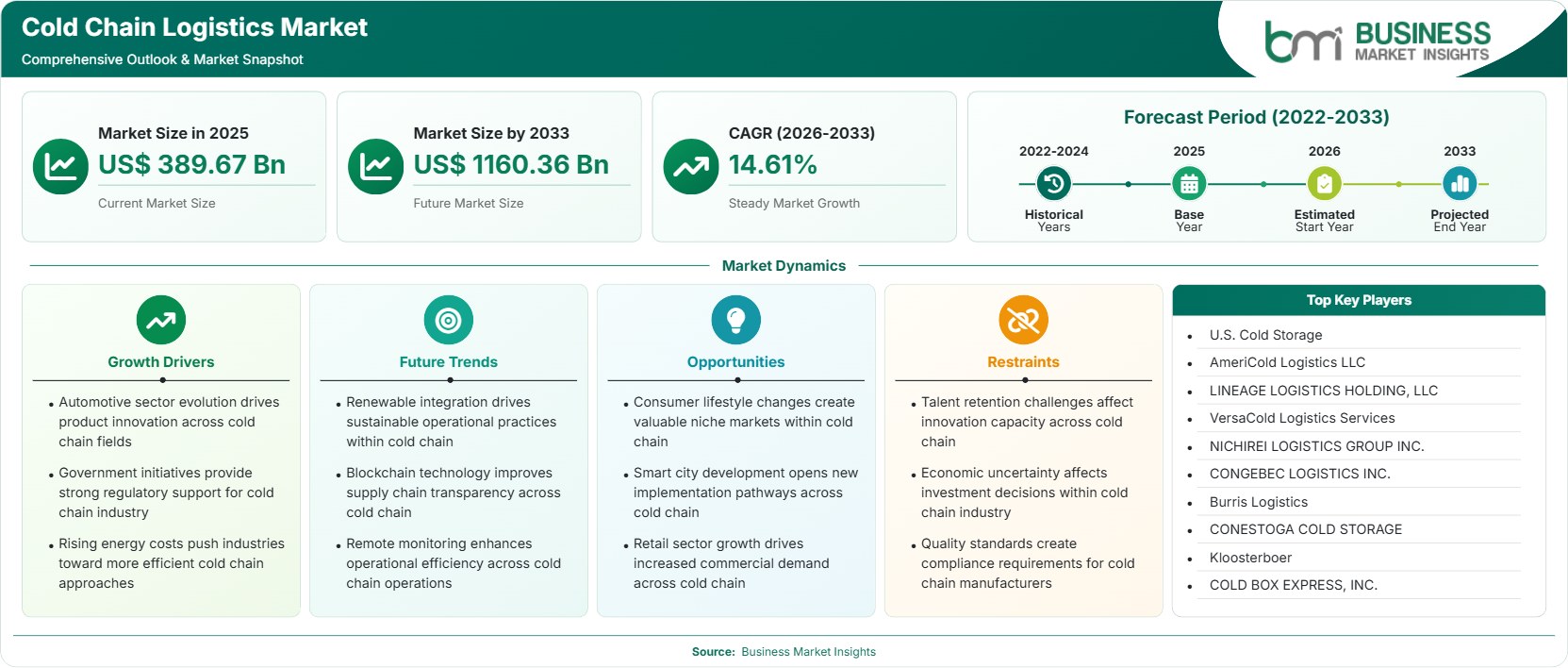
The Cold Chain Logistics Market size was valued at US$ 389.67 Billion in 2025 and is projected to reach US$ 1160.36 Billion by 2033, growing at a CAGR of 14.61% during 2026–2033, driven by pharmaceutical distribution, frozen food demand, e-commerce, automation, temperature monitoring, and emerging-market infrastructure investment.

Report Coverage
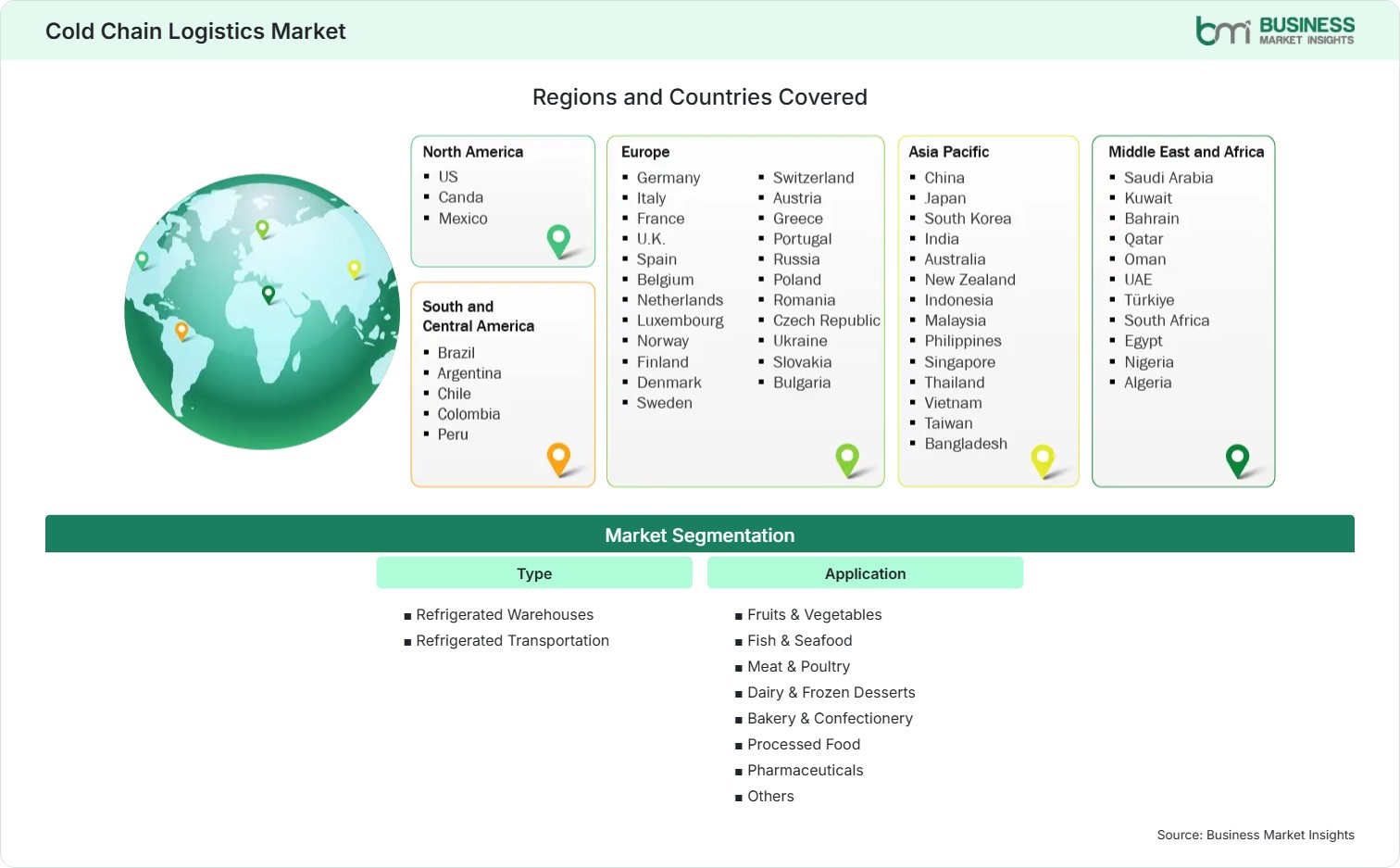
  • Type: Refrigerated Warehouses, Refrigerated Transportation
  • Application: Fruits & Vegetables, Fish & Seafood, Meat & Poultry, Dairy & Frozen Desserts, Bakery & Confectionery, Processed Food, Pharmaceuticals, Others
US$ 389.67 Bn Market size in 2025
US$ 1160.36 Bn Market Size by 2033
14.61% CAGR, 2026 - 2033
2026-2033 Forecast Period

AI Overview

Cold Chain Logistics Market Summary

  • North America Region: North America holds a 35%–39% share in 2025, growing at a CAGR of 12.80%–14.20%, supported by pharmaceutical distribution, frozen foods, automation, retail replenishment, and infrastructure modernization. The US benefits from dense refrigerated warehousing, sophisticated grocery networks, pharmaceutical demand, and automation investments, supporting a 12.90%–14.30% CAGR through 2033.
  • Fastest Growing Region: Asia Pacific holds a 19%–23% share in 2025, advancing at a CAGR of 16.80%–18.50%, driven by urbanization, food safety, pharmaceutical manufacturing, organized retail, e-commerce, and rapid investment in temperature-controlled warehousing and refrigerated transportation.
  • Leading Segment: Refrigerated Warehouses hold a 55%–59% share in 2025, expanding at a CAGR of 13.50%–15.00%, supported by frozen food inventories, pharmaceutical storage, automated facilities, multi-temperature operations, inventory consolidation, and rising demand for strategically located distribution capacity.
  • High Growth Segment: Pharmaceuticals hold an 8%–11% share in 2025, expanding at a CAGR of 17.50%–20.00%, supported by biologics, vaccines, specialty medicines, clinical trials, temperature-sensitive therapies, validated packaging, real-time monitoring, and increasingly complex international healthcare distribution networks.
  • Key Market Opportunity: Integrated temperature-controlled networks combining warehouses, reefer transportation, IoT monitoring, automation, renewable energy, and digital visibility create attractive opportunities for premium logistics providers serving food and pharmaceutical customers.
  • Major Market Players: U.S. Cold Storage; Americold Logistics, LLC; Lineage, Inc.; VersaCold Logistics Services; Nichirei Logistics Group Inc.; Congebec Inc.; Burris Logistics; Conestoga Cold Storage Limited; Kloosterboer; Cold Box Express, Inc.
Strategic Insights

Cold Chain Logistics Market: Strategic Insights

Cold Chain Logistics Market Strategic Framework
FREE PDF
Request your free sample
Request free sample
Stakeholder View

Key Takeaways

  • The supply chain is shifting from fragmented cold storage toward integrated ecosystems linking refrigerated warehouses, reefer transportation, digital tracking, customs coordination, and value-added services. Operators with network density and multi-temperature capabilities can improve utilization and customer retention.
  • Pharmaceuticals represent an attractive upside segment because biologics, specialty medicines, vaccines, and clinical-trial materials require controlled handling across increasingly complex international routes. Premium services can command stronger margins than conventional food logistics.
  • Automation is becoming a strategic differentiator as operators deploy robotics, automated storage, machine vision, predictive maintenance, and warehouse-management platforms. The strongest investment cases combine labor productivity with higher storage density and improved temperature consistency.
  • Southeast Asia offers a compelling expansion opportunity because rising urban populations, modern retail penetration, food imports, and pharmaceutical manufacturing are increasing requirements for professional cold-chain infrastructure. Malaysia, Indonesia, Thailand, and Vietnam are particularly attractive network-building markets.
  • Investment is increasingly targeting scale and network integration. Americold and EQT announced a US$ 1.3 billion North American cold-storage joint venture in May 2026, while Lineage committed more than US$ 740 million to two automated U.S. facilities in 2025.
  • Energy management is emerging as a competitive variable. Refrigeration remains a major operating expense, encouraging operators to deploy high-efficiency systems, renewable power, advanced insulation, and digital controls that improve lifecycle economics.
Geographic Outlook

Cold Chain Logistics Market Regional Highlights

North America Cold Chain Logistics Market

North America holds a 35%–39% Cold Chain Logistics Market share in 2025 and is projected to expand at a CAGR of 12.80%–14.20% through 2033. The region benefits from established refrigerated warehousing, integrated grocery distribution, pharmaceutical logistics, and strong investment in automation. The United States remains the principal contributor, while Canada supports cross-border food flows. Capacity expansion increasingly targets automated warehouses, retail replenishment, and strategically located facilities serving high-volume metropolitan consumption centers.

  • Infrastructure modernization: Operators are upgrading refrigeration, insulation, automation, and energy systems to improve throughput, lower operating costs, and accommodate increasingly complex multi-temperature inventory requirements across established distribution networks.
  • Pharmaceutical logistics: Expanding biologics and specialty medicine distribution is increasing demand for qualified storage, validated transportation, continuous monitoring, and documented chain-of-custody procedures across healthcare supply networks.
  • Retail integration: Grocery chains and foodservice customers increasingly seek centralized cold-chain partners capable of combining storage, inventory management, transportation, order fulfillment, and rapid replenishment.
  • Automation adoption: Labor availability constraints and high warehouse costs are accelerating automated storage, robotics, conveyor systems, and warehouse-management software investments across large distribution facilities.

US Cold Chain Logistics Market

The US represents a 31%–35% Cold Chain Logistics Market share of North America's 2025 activity and is expected to grow at a CAGR of 12.90%–14.30% through 2033. Demand is supported by frozen food consumption, pharmaceutical distribution, grocery consolidation, and e-commerce fulfillment. Investment is concentrating on automated warehouses and strategic capacity additions near major population centers, ports, food-processing clusters, and pharmaceutical hubs, improving network density and reducing transportation distances.

  • Capacity expansion: Large operators are adding automated and high-density facilities to address retail growth, frozen food volumes, and customer requirements for reliable inventory availability across major metropolitan corridors.
  • Healthcare demand: Biologics, specialty medicines, vaccines, and clinical materials are supporting demand for validated temperature-controlled storage and transportation with stronger monitoring and documentation requirements.
  • Retail logistics: Grocery and convenience channels are increasing demand for rapid replenishment, cross-docking, multi-temperature fulfillment, and integrated transportation services from specialized logistics providers.

Europe Cold Chain Logistics Market

Europe accounts for a 25%–29% share in 2025 and is projected to grow at a CAGR of 11.80%–13.50% through 2033. Germany, the United Kingdom, France, and the Netherlands remain leading markets, while Poland is among the faster-growing countries at approximately 13.50%–15.00%. Pharmaceutical exports, food safety requirements, cross-border trade, and energy-efficiency investments are strengthening demand for modern temperature-controlled infrastructure and integrated logistics services.

  • Leading countries: Germany, the United Kingdom, France, and the Netherlands maintain strong positions through established food manufacturing, pharmaceutical distribution, international trade, and sophisticated refrigerated logistics infrastructure.
  • High-growth opportunity: Poland is benefiting from manufacturing relocation, expanding food processing, pharmaceutical development, and its strategic position connecting Western and Eastern European distribution corridors.
  • Energy efficiency: High electricity costs are encouraging operators to invest in efficient refrigeration, insulation upgrades, renewable energy, heat recovery, and digital energy-management technologies.
  • Cross-border networks: European supply chains increasingly require synchronized warehousing and refrigerated transportation, particularly for processed foods, pharmaceuticals, seafood, and temperature-sensitive imports.

Asia Pacific Cold Chain Logistics Market

Asia Pacific represents a 19%–23% share in 2025 and is forecast to expand at a CAGR of 16.80%–18.50%, making it the fastest-growing regional opportunity. China and Japan remain the leading Cold Chain Logistics Market, while India, Indonesia, Vietnam, and Thailand show stronger expansion potential. Urbanization, organized retail, pharmaceutical manufacturing, food exports, and rising investment in modern warehouses are accelerating infrastructure development across diverse national supply chains.

  • Leading countries: China and Japan benefit from extensive food distribution systems, pharmaceutical capabilities, established refrigerated infrastructure, and large consumer bases requiring reliable temperature-controlled logistics.
  • High-growth countries: India, Indonesia, Vietnam, and Thailand are attracting investment as organized retail, food processing, pharmaceutical manufacturing, and cross-border trade increase demand for professional cold-chain networks.
  • Infrastructure modernization: New facilities increasingly combine multi-temperature storage, automated material handling, digital monitoring, and integrated transportation to address historically fragmented distribution systems.
  • E-commerce expansion: Online grocery and direct-to-consumer food delivery are increasing requirements for localized cold storage, last-mile refrigeration, rapid fulfillment, and temperature visibility.

Rest of World Cold Chain Logistics Market

South and Central America account for a 7%–10% Cold Chain Logistics Market share in 2025, with Brazil, Mexico, and Colombia supporting regional activity. Food exports, meat processing, seafood, and pharmaceuticals drive investment, while Colombia is among faster-growing markets at 13.00%–15.00% CAGR. Demand increasingly centers on export-grade storage and integrated refrigerated transport.

The Middle East and Africa represent a 5%–8% share in 2025, with the United Arab Emirates, Saudi Arabia, and South Africa leading infrastructure development. Food imports, healthcare distribution, and logistics-hub investments are supporting growth, while Saudi Arabia is expanding at approximately 14.00%–16.00% CAGR.

  • Export infrastructure: Brazil, Mexico, and Colombia are strengthening refrigerated capacity around food-processing and export corridors serving meat, seafood, fruit, and vegetable trade.
  • Healthcare opportunity: Middle Eastern logistics hubs are developing temperature-controlled infrastructure to support pharmaceutical imports, specialty medicines, vaccines, and regional healthcare distribution.
  • Food security: Gulf countries are investing in cold-chain capabilities to reduce food losses and strengthen reliable access to imported perishables across complex supply networks.
  • Emerging markets: South Africa, Colombia, and selected Middle Eastern economies offer opportunities for modern warehouses, reefer fleets, digital monitoring, and integrated third-party logistics services.
Global Market Geography
FREE PDF
Request your free sample
Request free sample
Segment Analysis

Cold Chain Logistics Market Segmentation

Type

Refrigerated Warehouses represent a 55%–59% share in 2025 and are projected to grow at a CAGR of 13.50%–15.00% between 2026–2033. Demand centers on inventory consolidation, frozen foods, pharmaceuticals, and automated storage. Refrigerated Transportation is expanding at 14.00%–16.00%, supported by cross-border distribution, last-mile delivery, reefer fleet modernization, and integrated logistics contracts. The Cold Chain Logistics Market scope increasingly favors providers combining storage and transportation under unified service agreements.

  • Refrigerated Warehouses: High-density facilities support frozen foods, pharmaceuticals, dairy, meat, and produce, while automation, multi-temperature zones, energy efficiency, and strategic locations improve utilization and service reliability.
  • Refrigerated Transportation: Reefer trucks, trailers, containers, and specialized delivery vehicles maintain product integrity across regional and international routes, with telematics and real-time monitoring improving visibility and compliance.

Application

Application demand is diversified across food and healthcare supply chains, with pharmaceuticals representing an 8%–11% share in 2025 and a CAGR of 17.50%–20.00% through 2033. Food applications remain volume-intensive, while healthcare applications generate premium demand for validated conditions, monitoring, documentation, and specialized handling. The Cold Chain Logistics Market trends increasingly reflect convergence between temperature-controlled food distribution and highly regulated pharmaceutical logistics networks.

  • Fruits & Vegetables: Perishable produce requires rapid cooling, controlled humidity, and efficient transportation, with export growth and reduced post-harvest losses supporting investments in modern refrigerated infrastructure.
  • Fish, Meat, and Seafood: International trade, food safety requirements, processing concentration, and frozen distribution networks sustain demand for reliable cold storage, reefer transportation, traceability, and temperature monitoring.
  • Dairy & Frozen Desserts: High-volume refrigerated distribution depends on consistent temperatures and rapid replenishment, while expanding frozen product portfolios increase demand for strategically located storage capacity.
  • Bakery & confectionery: Frozen dough, cakes, pastries, and temperature-sensitive ingredients require controlled storage and transportation, supporting specialized logistics solutions and flexible multi-temperature distribution networks.
  • Processed Food: Convenience foods and ready-to-eat products are increasing demand for integrated refrigerated warehousing, inventory management, transportation, and retail replenishment services.
  • Pharmaceuticals: Biologics, vaccines, specialty medicines, and clinical materials require validated temperature control, continuous monitoring, qualified handling procedures, and increasingly sophisticated international logistics coordination.
Market Forces

Cold Chain Logistics Market Dynamics

Key Market Drivers

Expansion of Temperature-Sensitive Food Distribution

The growing popularity of frozen foods, processed foods, seafood, dairy products, and fresh fruits and vegetables is resulting in an increase in the demand for dependable refrigeration logistics throughout the process from production through to storage and delivery of the product. Food processing companies are using more cold storage services from outside third parties to optimize their supply chain flexibility and decrease fixed infrastructure needs. These structural changes support Cold Chain Logistics Market growth by increasing shipment frequency and reducing tolerance for temperature excursions. Market trends are now moving toward integrated players who integrate warehousing and transport along with inventory management and order fulfillment. Players capable of offering multi-temperature capabilities will be able to serve more customers while maximizing their asset efficiency and securing long-term contracts in the food chain.

Rising Pharmaceutical and Biologics Distribution Requirements

Pharmaceutical supply chains are becoming more temperature-sensitive as biologics, vaccines, specialty medicines, and advanced therapies represent a larger proportion of healthcare innovation. As indicated by IATA, the value of pharmaceutical air logistics cargo alone is over US$ 1 trillion per year. The growing need for validation of facilities, calibration of equipment, documentation of processes, backup systems, and even transport logistics providers is becoming the norm. All these are geared towards high levels of customer compliance and retention. The market growth will thus not be from food only but the health sector too. The Cold Chain Logistics Market trends toward end-to-end visibility also reflect pharmaceutical customers' need to identify temperature deviations rapidly and protect product integrity throughout international distribution.

Automation and Digital Visibility Across Warehouses

Technology changes the economics of cold storage through solving labor problems, optimizing storage capacity and minimizing human interaction with the cold environment. Technologies such as storage and retrieval systems, robotics, conveyor systems, warehouse management system, machine vision, and prediction analytics are able to provide better throughput and consistency in managing inventories. The 2025 plans of Lineage to invest over US$ 740 million in building two fully automated cold storage warehouses in the United States that can accommodate more than 80 million cubic feet and 260,000 pallet spaces show the extent of investment into automation. These technologies strengthen Cold Chain Logistics Market trends by enabling operators to manage larger inventories with fewer manual processes. Digital monitoring additionally improves traceability, temperature visibility, exception management, and predictive maintenance across complex refrigerated networks.

Key Market Opportunities

Integrated Food and Pharmaceutical Logistics Platforms

Integrated platforms combining refrigerated warehouses, transportation, inventory management, customs coordination, fulfillment, and digital monitoring can create differentiated service propositions for customers managing complex temperature-sensitive supply chains. Food producers increasingly seek flexible third-party capacity, while pharmaceutical companies require qualified logistics partners capable of managing specialized handling and documentation. Those that have physical facilities along with the capability of data visibility will be able to enter into more profitable agreements and decrease the dependency of their customers on a scattered group of vendors. Additionally, those cold storage players will also be able to exploit the network density for offering services across borders. Investment potential will be highest when the existing infrastructures can be connected by technology without duplicating them one after the other.

ASEAN Network Expansion and Cross-Border Distribution

Southeast Asia offers an attractive investment opportunity because food imports, pharmaceutical manufacturing, organized retail, urbanization, and cross-border trade are expanding simultaneously. Malaysia, Indonesia, Thailand, and Vietnam have the potential to form an interconnected chain of refrigeration infrastructure rather than developing separate infrastructures in each country. The purchase of Malaysia’s ICCL Group by Nichirei in 2025 is indicative of the importance of combining multi-temperature warehousing, refrigerated transportation, forwarding services, and intermodal transportation. The acquisition of the company in Indonesia in 2026 is indicative of its focus on ASEAN networks. Cold Chain Logistics Market Forecasts increasingly point toward investment models that prioritize regional connectivity, strategic acquisitions, and integrated transportation corridors rather than standalone warehouse expansion.

Energy-Efficient and Low-Carbon Refrigeration Infrastructure

Refrigeration energy consumption creates a substantial cost burden for cold-storage operators, making efficiency improvements an important investment opportunity. Economics can be improved by facilities through the use of efficient compressors, insulation, heat recovery, green power sources, battery technology, control technologies, and predictive energy management systems. The use of optimized cooling cycles and scheduling of energy-intensive activities during hours when energy is less expensive can reduce exposure to power at peak hours. This provides opportunities for technology providers, engineering companies, infrastructure developers, and logistics firms building new facilities. Energy efficiency becomes especially attractive in areas where electricity costs are highly volatile or where there are strict environmental regulations. Investment in low carbon-emitting infrastructure will be beneficial to both the operators and their customers.

Market Restraints and Challenges

High Capital and Energy Costs

Factor: Cold-storage facilities require substantial upfront investment in refrigeration systems, insulated structures, backup power, automation, specialized vehicles, and temperature-monitoring infrastructure, while electricity remains a major recurring expense.

Impact: High capital intensity can delay capacity additions, especially in emerging markets where financing costs are elevated and utilization levels are uncertain. The operators have to maintain adequate occupancy and capacity to ensure justification for infrastructure investment, hence exposing themselves during times when demand becomes volatile. Price changes in the energy market may compound the problem in situations where the customers’ contracts do not permit quick passing through of costs. This is especially important in regard to old installations, which need significant retrofits. Operators unable to invest in automation or efficiency are likely to become less competitive in terms of service reliability and lower emissions.

Infrastructure Fragmentation and Temperature Excursion Risk

Factor: Many emerging cold chains remain fragmented across small warehouses, independent transport operators, inconsistent power infrastructure, and limited digital connectivity, creating weak handoffs between supply-chain stages.

Impact: Fragmentation increases temperature-excursion risk, product loss, compliance exposure, and operational complexity while making end-to-end visibility difficult. Temperature changes have severe implications for pharmaceutical clients since it affects product integrity. The food producers, on the other hand, may suffer spoilage and shelf-life issues if cooling or transport is irregular. It takes a certain level of investment to establish the necessary network in terms of standardization of processes, equipment, systems of monitoring and people. Companies entering new markets will have to be fast enough to set up the infrastructure while at the same time being disciplined enough to operate it.

Company Analysis

Competitive Landscape

The Cold Chain Logistics Market analysis indicates a competitive environment shaped by network density, warehouse scale, refrigerated transportation capabilities, automation, geographic reach, and specialized customer services. The competitive structure includes large temperature-controlled infrastructure operators alongside regional specialists serving food, pharmaceutical, retail, and industrial customers.

Company Name

Overview

Products and Services relevant to this market

U.S. Cold Storage

A major U.S. temperature-controlled warehousing provider with extensive food logistics capabilities and strategically positioned facilities serving processors, retailers, and distributors.

Refrigerated and frozen warehousing, blast freezing, food logistics, inventory management, cross-docking, distribution, and value-added temperature-controlled services.

Americold Logistics, LLC

A large temperature-controlled logistics operator with extensive international infrastructure and a strong focus on integrated supply-chain solutions and strategic facility development.

Cold storage, refrigerated logistics, transportation, distribution, value-added services, retail supply-chain solutions, and temperature-controlled warehousing.

Lineage, Inc.

A technology-focused temperature-controlled logistics company emphasizing automation, data science, network scale, and strategically located cold-storage infrastructure.

Refrigerated warehousing, transportation, automated storage, distribution, inventory management, food logistics, and digital supply-chain optimization.

VersaCold Logistics Services

A Canadian temperature-controlled logistics specialist supporting food manufacturers, retailers, distributors, and other customers requiring refrigerated supply-chain infrastructure.

Cold storage, refrigerated transportation, distribution, inventory management, food logistics, cross-docking, and value-added temperature-controlled services.

Nichirei Logistics Group Inc.

A Japanese cold-chain logistics specialist operating across international markets with strategic emphasis on integrated storage, transportation, and cross-border capabilities.

Refrigerated warehousing, frozen storage, transportation, distribution, international logistics, cross-border services, and temperature-controlled supply-chain management.

Congebec Inc.

A Canadian cold-storage provider serving food and distribution customers through strategically positioned temperature-controlled facilities and logistics services.

Refrigerated and frozen storage, warehousing, distribution, inventory management, transportation coordination, and value-added cold-chain services.

Burris Logistics

A U.S. logistics company with strong capabilities in food distribution and temperature-controlled supply-chain management across multiple customer segments.

Refrigerated warehousing, transportation, food distribution, contract logistics, inventory management, fulfillment, and integrated supply-chain services.

Conestoga Cold Storage Limited

A Canadian cold-storage specialist providing temperature-controlled warehousing and distribution services for food industry customers and supply-chain partners.

Frozen and refrigerated storage, distribution, blast freezing, inventory management, cross-docking, and specialized cold-chain logistics solutions.

Kloosterboer

A Netherlands-based temperature-controlled logistics specialist serving international food supply chains through strategically located European infrastructure and integrated services.

Cold storage, refrigerated logistics, automated warehousing, customs services, distribution, inventory management, and temperature-controlled supply-chain solutions.

Cold Box Express, Inc.

A U.S. temperature-controlled logistics provider focused on refrigerated transportation and distribution services supporting temperature-sensitive products and regional supply chains.

Refrigerated transportation, cold-chain distribution, temperature-controlled freight, logistics coordination, dedicated services, and specialized delivery solutions.

Trust & Transparency

Research Methodology

The market analysis combines proprietary research with secondary data from government agencies, company disclosures, regulatory filings, industry databases and expert interviews. Market estimates are validated through data triangulation, cross-market benchmarking and analyst review.

View Full Research Methodology

Questions Answered

Frequently Asked Questions

What should buyers evaluate when selecting a logistics provider?

Buyers should assess facility location, temperature capabilities, network density, monitoring technology, contingency planning, regulatory compliance, transportation integration, automation, scalability, and the provider's experience with specific product categories. These factors determine reliability beyond basic storage capacity.

How is Southeast Asia changing the competitive environment?

Southeast Asia is becoming a strategic expansion zone as organized retail, food processing, pharmaceutical manufacturing, urbanization, and cross-border trade increase. Operators are pursuing acquisitions and integrated networks to connect Malaysia, Indonesia, Thailand, and Vietnam.

Which applications offer the strongest premium-service potential?

Pharmaceuticals offer strong premium-service potential because biologics, vaccines, specialty medicines, and clinical materials require validated environments, continuous monitoring, qualified handling, and detailed documentation throughout distribution.

Why are automated cold-storage facilities gaining attention?

Automation improves storage density, throughput, labor productivity, and operational consistency while reducing human exposure to low-temperature environments. Large automated facilities can also support higher-volume customer contracts and improve long-term asset economics.

What is driving demand for temperature-controlled logistics?

As highlighted in the Cold Chain Logistics Market Demand report, the market is being driven by frozen and processed food consumption, pharmaceutical distribution, biologics, specialty medicines, grocery e-commerce, and cross-border trade. These applications require controlled temperatures, reliable infrastructure, traceability, and increasingly integrated storage and transportation services.

Access the Full Cold Chain Logistics Market Report

Get segment-level forecasts, regional estimates, competitive benchmarking, company profiles and downloadable Excel datasets.

Access the full Cold Chain Logistics Market Report
350 pages PDF & Excel | 2026-08-18
Similar Research

Related Market Reports