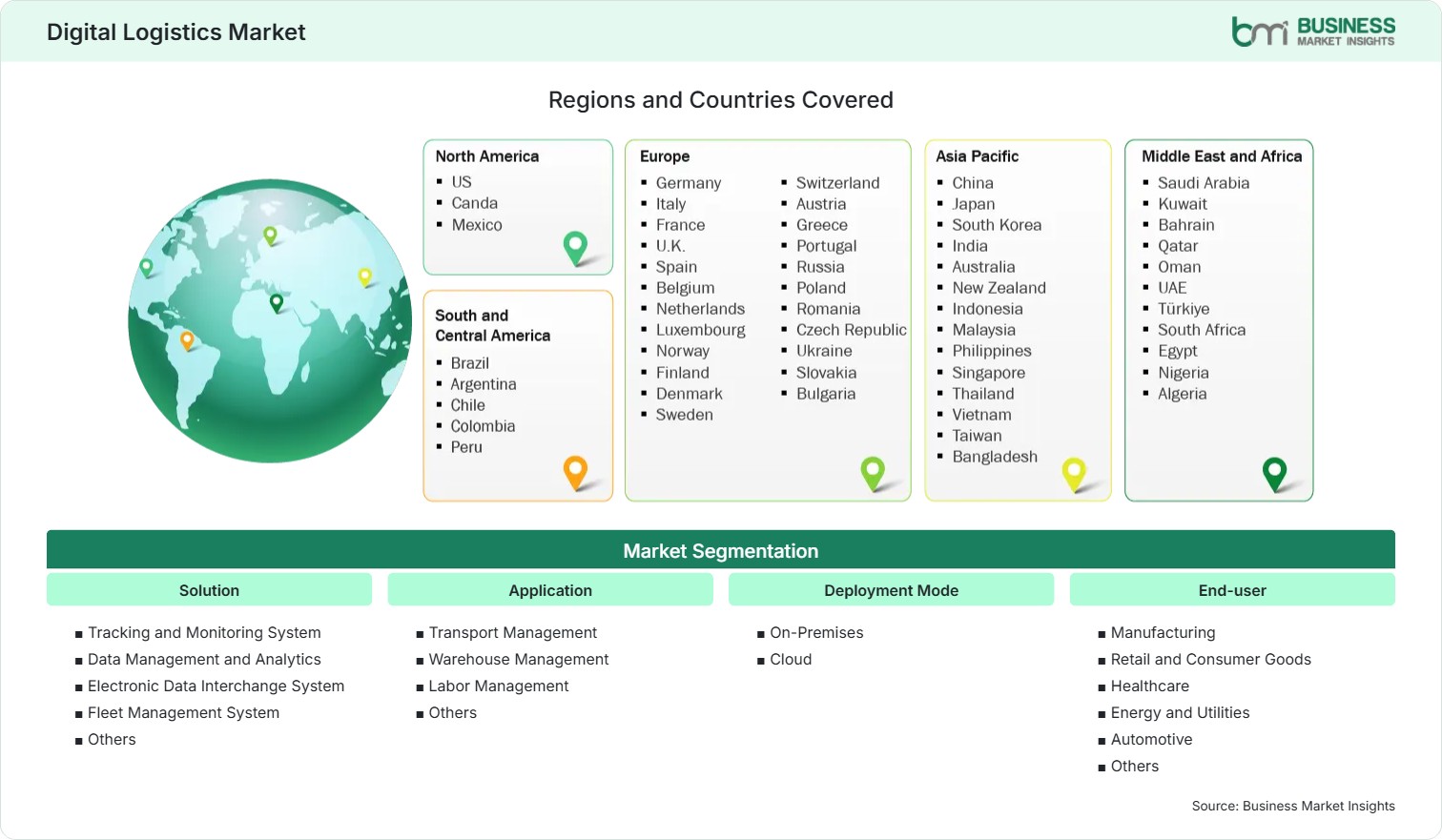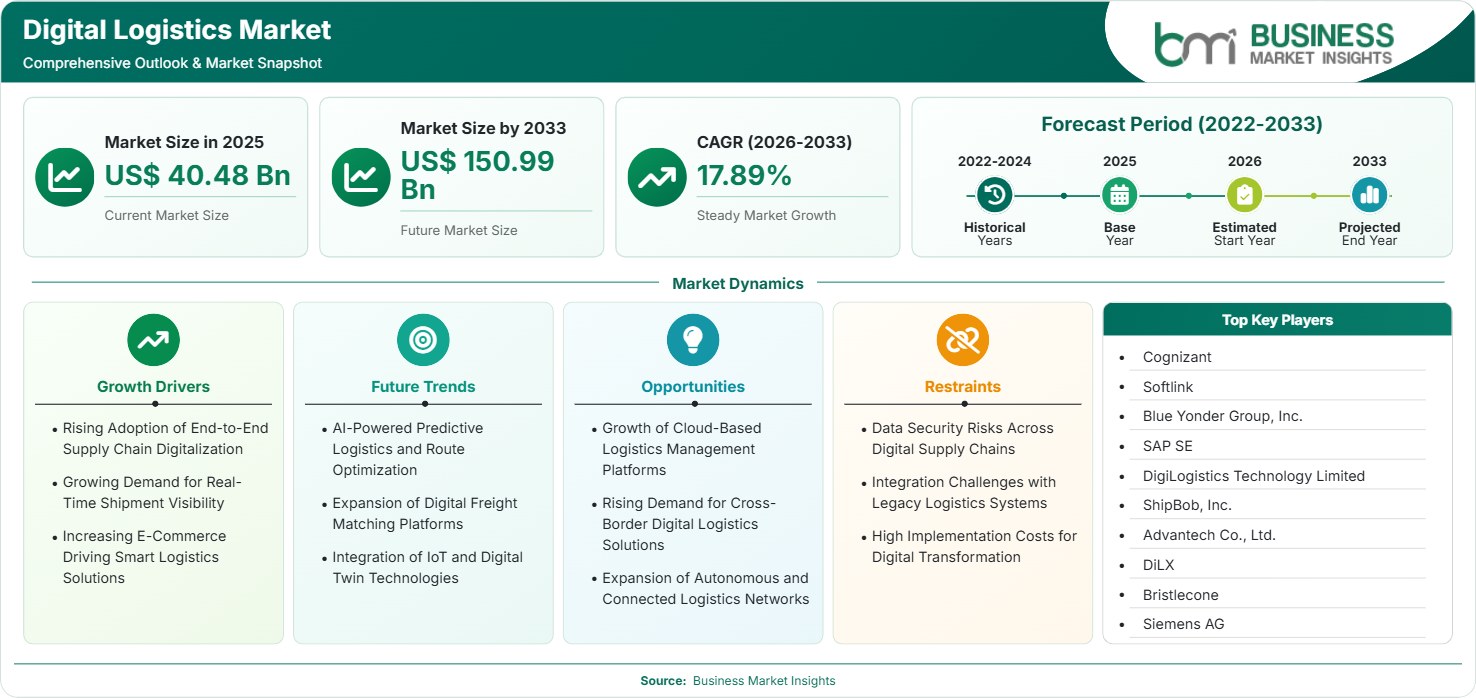
Digital Logistics Market Regional Highlights
North America Digital Logistics Market
North America accounted for digital logistics market share of 33%–36% in 2025 and is projected to expand at a CAGR of 17.2%–18.2% during 2026–2033. The region benefits from advanced supply chain infrastructure, widespread cloud adoption, and increasing investments in logistics automation technologies. Organizations are increasingly deploying digital logistics platforms to enhance visibility, improve delivery performance, and optimize transportation operations.
- Enterprises are investing in AI-powered logistics solutions to improve route planning and operational efficiency.
- E-commerce growth continues driving demand for real-time shipment tracking and transportation management systems.
- Supply chain resilience initiatives are encouraging greater adoption of analytics and monitoring technologies.
- Cloud-based logistics platforms are becoming increasingly popular due to scalability and ease of integration.
- Organizations are prioritizing end-to-end visibility across transportation and warehouse operations.
US Digital Logistics Market
The US represented a 29%–32% share in 2025 and is estimated to grow at a CAGR of 17.5%–18.5% through 2033. Strong technology adoption, sophisticated logistics networks, and growing demand for faster delivery services support market expansion.
- Businesses are increasingly utilizing predictive analytics to optimize transportation and inventory management.
- Logistics providers continue investing in automation technologies to improve operational productivity.
- Growing omnichannel retail operations are increasing demand for integrated logistics management platforms.
- Real-time visibility solutions are helping organizations improve customer service and supply chain performance.
Europe Digital Logistics Market
Europe held a 25%–28% share in 2025 and is expected to grow at a CAGR of 16.8%–17.8% from 2026–2033. Germany, the UK, and France represent major markets due to strong industrial activity, advanced transportation networks, and increasing focus on supply chain optimization. Germany is estimated to expand at 17.2%–18.2% CAGR.
- Manufacturers are increasingly adopting digital logistics solutions to improve operational visibility and resource efficiency.
- Germany continues investing in smart logistics and Industry 4.0 initiatives.
- Transportation operators are implementing digital platforms to support real-time shipment monitoring.
- Sustainability goals are encouraging optimization of logistics routes and resource utilization.
- Integration of warehouse automation technologies is improving fulfillment efficiency across the region.
Asia Pacific Digital Logistics Market
Asia Pacific accounted for a 28%–31% share in 2025 and is projected to register a CAGR of 19.0%–20.0% during 2026–2033. China, India, Japan, and South Korea are leading markets due to rapid e-commerce expansion, manufacturing growth, and increasing digital transformation initiatives. China is expected to grow at 19.5%–20.5% CAGR, while India demonstrates strong growth potential with a CAGR of 20.0%–21.0% during the forecast period.
- Rising online retail activity is accelerating demand for advanced transportation and warehouse management systems.
- China continues investing heavily in logistics digitization and smart supply chain infrastructure.
- India is experiencing strong adoption of cloud-based logistics solutions among enterprises and third-party logistics providers.
- Increasing cross-border trade activities are supporting deployment of digital logistics platforms.
- Businesses are utilizing analytics and automation technologies to improve supply chain responsiveness.
Rest of World Digital Logistics Market
Rest of World accounted for a 9%–12% share in 2025 and is expected to grow at a CAGR of 17.0%–18.0% through 2033. Latin America, the Middle East, and Africa are witnessing increasing investments in logistics modernization, transportation infrastructure, and supply chain digitization.
- Organizations are adopting digital logistics solutions to improve operational efficiency and visibility.
- E-commerce growth is encouraging logistics service providers to invest in advanced management platforms.
- Governments are supporting logistics infrastructure modernization initiatives.
- Transportation companies are deploying digital technologies to optimize routing and fleet utilization.
- Growing international trade activity is creating opportunities for supply chain technology providers.