
Automotive Digital Aftermarket Market Outlook: Size, Share, Trends, Growth Analysis, Competitive Landscape & Forecast, 2026-2033

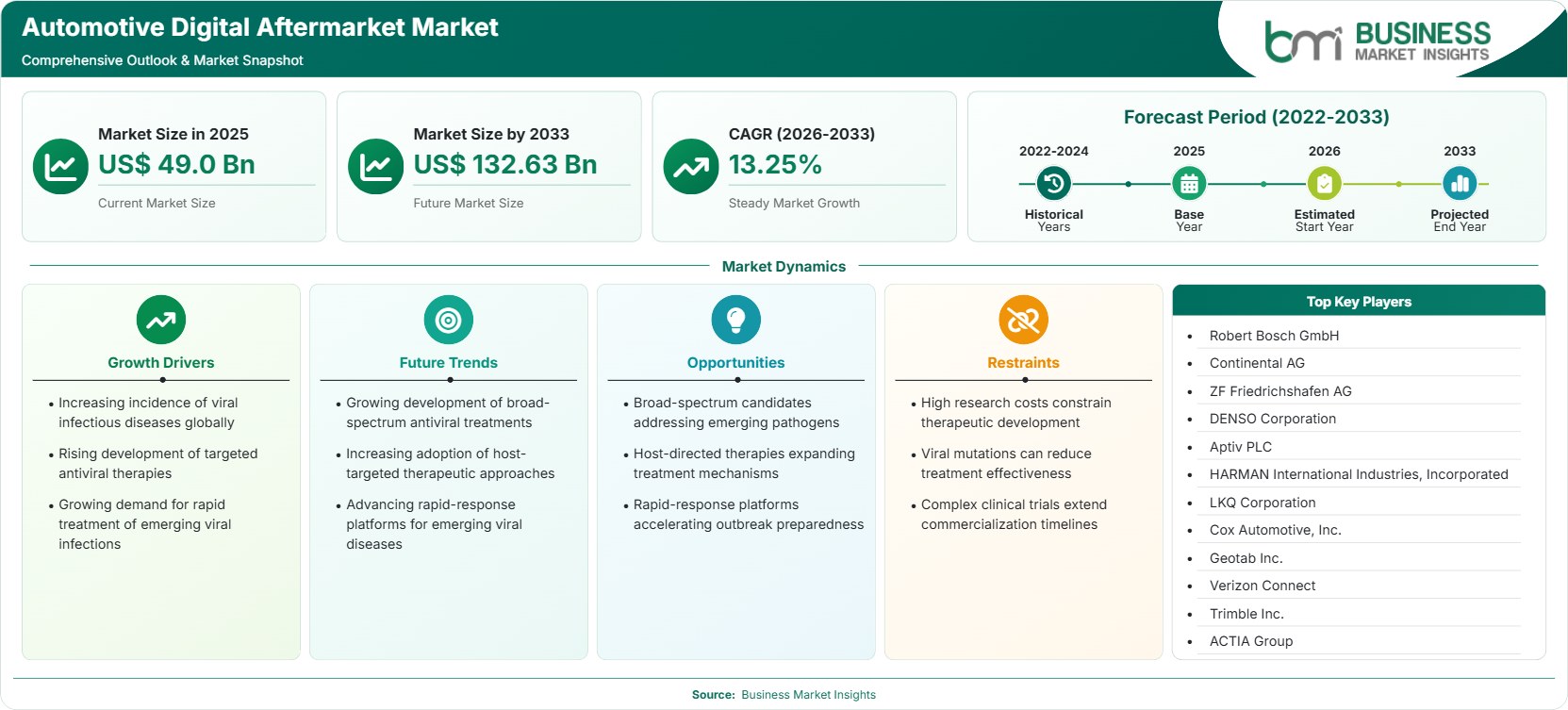
The Automotive Digital Aftermarket Industry size was valued at US$ 49.0 Billion in 2025 and is projected to reach US$ 132.63 Billion by 2033, growing at a CAGR of 13.25% during 2026–2033. Rising connected vehicle deployment, expanding OTA ecosystems, predictive maintenance adoption, telematics integration, digital commerce platforms, and fleet digitization programs are creating substantial opportunities across aftermarket service networks worldwide.

Report Coverage
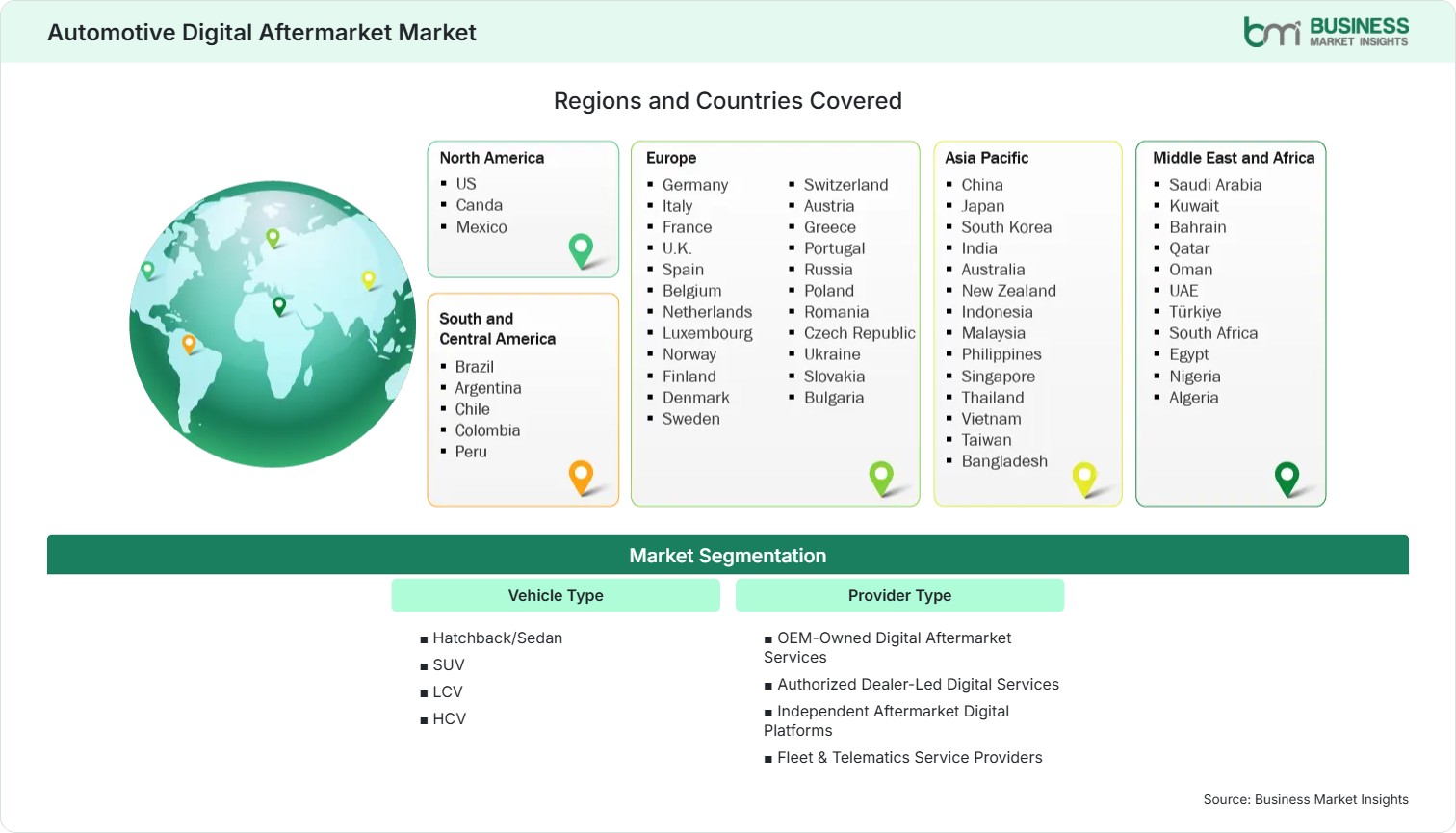
  • Vehicle Type: Hatchback/Sedan, SUV, LCV, HCV
  • Provider Type: OEM-Owned Digital Aftermarket Services, Authorized Dealer-Led Digital Services, Independent Aftermarket Digital Platforms, Fleet & Telematics Service Providers
US$ 49.0 Bn Market size in 2025
US$ 132.63 Bn Market Size by 2033
13.25% CAGR, 2026 - 2033
2026-2033 Forecast Period

AI Overview

Automotive Digital Aftermarket Market Summary

  • North America Region: North America holds a market share of 34%–37% in 2025, growing with a CAGR of 12.0%–13.0% during 2026–2033, supported by connected vehicle penetration, fleet telematics adoption, software-driven maintenance ecosystems, growing subscription services, predictive diagnostics deployment, digital parts commerce expansion, dealership digitization initiatives, advanced service platforms, rising repair automation investments, and expanding commercial fleet monitoring requirements. The U.S. benefits from strong telematics infrastructure and digital service adoption, advancing at a CAGR of 12.5%–13.5%.
  • Fastest Growing Region: Asia Pacific holds a market share of 26%–29% in 2025, growing with a CAGR of 15.0%–16.5% during 2026–2033, driven by rapid vehicle connectivity expansion, digital service platform investments, EV adoption, smartphone-based aftermarket engagement, expanding e-commerce channels, fleet modernization programs, cloud diagnostics, repair network digitization, rising mobility startups, and increasing connected vehicle subscriptions across emerging automotive markets.
  • Leading Segment: Digital Parts & E-Commerce Services accounts for 29%–32% share in 2025 and advances at a CAGR of 13.0%–14.0%, supported by increasing online automotive purchases, real-time inventory visibility, AI-based recommendations, digital payment integration, omnichannel spare parts distribution, service booking capabilities, marketplace expansion, customer convenience, supplier digitization, and rising demand for transparent pricing models.
  • High Growth Segment: Software & OTA-Enabled Aftermarket Services represents 18%–21% share in 2025 and is projected to expand at a CAGR of 16.0%–17.5%, fueled by software-defined vehicle architecture, remote upgrades, feature-on-demand models, cybersecurity updates, predictive maintenance integration, subscription services, connected diagnostics, reduced service downtime, enhanced customer retention, and continuously expanding digital vehicle functionality.
  • Key Market Opportunity: Fleet operators increasingly seek unified digital ecosystems combining diagnostics, maintenance scheduling, parts procurement, and predictive analytics, creating scalable recurring-revenue opportunities for platform providers, OEMs, service networks, telematics vendors, and software developers.
  • Major Market Players: Robert Bosch GmbH, Continental AG, ZF Friedrichshafen AG, DENSO Corporation, Aptiv PLC, HARMAN International Industries, Incorporated, LKQ Corporation, Cox Automotive, Inc., Geotab Inc., Verizon Connect, Trimble Inc., and ACTIA Group.
Strategic Insights

Automotive Digital Aftermarket Market: Strategic Insights

Automotive Digital Aftermarket Market Strategic Framework
FREE PDF
Request your free sample
Request free sample
Stakeholder View

Key Takeaways

  • The value chain is shifting from conventional parts distribution toward data-driven service ecosystems where OEMs, telematics providers, software developers, dealerships, and independent platforms collaborate to deliver recurring digital revenue streams.
  • Software-enabled services, predictive maintenance solutions, and integrated fleet management platforms offer the highest upside as commercial operators increasingly prioritize uptime optimization and lifecycle cost reduction.
  • Artificial intelligence, cloud diagnostics, digital twins, remote vehicle monitoring, and over-the-air software management are accelerating innovation across service delivery and customer engagement models.
  • Asia Pacific presents a compelling investment opportunity due to expanding connected vehicle fleets, rising smartphone penetration, growing EV adoption, and rapid digital commerce development across automotive services.
  • Strategic acquisitions increasingly target telematics firms, software providers, e-commerce platforms, and predictive maintenance specialists as major participants seek portfolio expansion and customer data capabilities.
  • Competitive differentiation is increasingly determined by platform interoperability, cybersecurity capabilities, customer experience management, and the ability to generate actionable insights from vehicle-generated data.
Geographic Outlook

Automotive Digital Aftermarket Market Regional Highlights

North America Automotive Digital Aftermarket Industry

North America accounted for approximately 34%–37% of total revenue in 2025 and is projected to record a CAGR of 12.0%–13.0% through 2033. Strong connected vehicle adoption, widespread telematics deployment, advanced dealer service networks, and high digital service awareness continue supporting regional leadership. The region benefits from mature cloud infrastructure and substantial investments in predictive maintenance technologies. Automotive Digital Aftermarket Industry share remains highest in this region due to strong OEM participation, integrated fleet platforms, expanding software monetization models, and increasing digital repair ecosystem adoption across passenger and commercial vehicles.

  • Connected vehicle subscriptions continue expanding as OEMs integrate remote diagnostics, vehicle health monitoring, and software-enabled service packages into ownership experiences, enhancing long-term customer engagement and recurring aftermarket revenue streams.
  • Fleet operators increasingly deploy digital maintenance platforms to optimize asset utilization, reduce unplanned downtime, improve maintenance scheduling, and support data-driven operational decision-making across logistics and transportation industries.
  • Advanced e-commerce platforms are transforming spare parts procurement through real-time inventory visibility, automated recommendations, transparent pricing mechanisms, and integrated service scheduling capabilities.
  • Artificial intelligence applications for diagnostics and predictive maintenance are creating measurable efficiencies across service operations, repair workflows, warranty management, and customer retention programs.
  • Software-defined vehicle architectures are accelerating demand for remote updates, cybersecurity services, platform maintenance solutions, and connected vehicle lifecycle management programs.

US Automotive Digital Aftermarket Industry

The United States represents approximately 73%–77% of North American Automotive Digital Aftermarket Industry revenue and is expected to grow at a CAGR of 12.5%–13.5% through 2033. Benefits for the market include widespread availability of connected vehicles, comprehensive digitization programs by original equipment manufacturers (OEMs), telematics systems in fleets, and an advanced automotive services ecosystem. Investments in maintenance systems, which are cloud-connected, have been growing continuously among passenger vehicles and commercial fleets. High consumer adoption rates of digital solutions are an additional growth driver.

  • OEMs increasingly deliver subscription-based vehicle capabilities, creating recurring service revenues and strengthening customer relationships beyond traditional maintenance models.
  • Commercial fleet operators continue investing in predictive maintenance tools and digital monitoring platforms that improve operational efficiency and vehicle uptime.
  • The country remains a global innovation center for automotive software, cloud analytics, connected vehicle platforms, and telematics ecosystem development.
  • Growing electric vehicle penetration is generating demand for digital battery monitoring, remote diagnostics, software lifecycle management, and specialized maintenance platforms.

Europe Automotive Digital Aftermarket Industry

Europe held approximately 25%–28% Automotive Digital Aftermarket Industry share in 2025 and is projected to expand at a CAGR of 12.5%–13.8% through 2033. Regulatory focus on vehicle safety, emission control, connected car, and cybersecurity will drive the uptake of digital services. Germany remains the most dominant regional market, growing by 12.0%–13.0%, while Eastern Europe presents an opportunity for growth at 14.5%–15.5%. Automotive manufacturing capacity and growing software integrations will fuel demand in regional markets through aftermarket service segments.

  • Vehicle connectivity regulations and cybersecurity requirements are encouraging investment in secure digital service architectures and vehicle lifecycle management solutions.
  • Germany continues leading adoption through strong OEM ecosystems, advanced engineering capabilities, and widespread connected vehicle deployment.
  • Digital maintenance management platforms are supporting workshop productivity improvements and customer engagement across independent service networks.
  • Growth in electric vehicle registrations is increasing demand for battery analytics, software support, and connected maintenance services.
  • E-commerce expansion continues transforming automotive parts procurement and omnichannel aftermarket engagement across European markets.

Asia Pacific Automotive Digital Aftermarket Industry

Asia Pacific captured approximately 26%–29% of global revenue in 2025 and is expected to register the fastest CAGR of 15.0%–16.5% through 2033. Rapid urbanization, connected mobility investments, rising vehicle ownership, expanding EV penetration, and growing digital commerce adoption support regional momentum. China remains the largest regional market with growth of 15.0%–16.0%, while India emerges among the fastest-growing countries with a CAGR of 16.5%–18.0%. Automotive Digital Aftermarket Industry growth in the region is supported by expanding technology ecosystems and accelerating digitization initiatives.

  • Smartphone-driven service engagement is enabling customers to access scheduling, diagnostics, maintenance tracking, and digital payment solutions seamlessly.
  • China continues strengthening leadership through connected vehicle technologies, software-defined vehicle development, and large-scale digital service ecosystems.
  • India benefits from growing internet penetration, expanding vehicle fleets, increasing telematics adoption, and supportive mobility digitization initiatives.
  • Regional e-commerce platforms are reshaping spare parts distribution while improving accessibility and procurement efficiency.
  • Increasing commercial fleet digitization is driving demand for predictive maintenance, route optimization, and vehicle monitoring services.

Rest of World Automotive Digital Aftermarket Industry

The Rest of World region accounted for approximately 10%–13% of Automotive Digital Aftermarket Industry revenue during 2025 and is projected to expand at a CAGR of 13.5%–14.5% through 2033. Both South and Central America continue to witness rising trends of connected vehicles and digital services platform usage. Brazil remains the region's main contributor, while Mexico shows great growth potential. In the Middle East and Africa, Gulf nations are aggressively working towards implementing intelligent mobility solutions, connected fleet management, and transportation digitization initiatives.

  • Brazil benefits from growing fleet telematics adoption, connected mobility investments, and increasing utilization of digital vehicle service platforms.
  • Mexico supports growth through automotive manufacturing expansion, service network modernization, and increasing adoption of connected vehicle technologies.
  • Gulf countries continue investing in mobility digitization initiatives, creating opportunities for digital service providers and fleet management vendors.
  • Logistics companies across emerging markets are prioritizing predictive maintenance and asset monitoring technologies to improve operational efficiency.
  • Expanding internet connectivity and smartphone usage continue supporting digital customer engagement across aftermarket ecosystems.
Global Market Geography
FREE PDF
Request your free sample
Request free sample
Segment Analysis

Automotive Digital Aftermarket Market Segmentation

Service Type

Service Type accounted for the entire market structure and reflects the increasing transition toward software-enabled service delivery models. Demand is being driven by connected vehicle adoption, data analytics deployment, workshop digitization, and remote support capabilities. The segment continues to benefit from growing consumer demand for convenience and predictive maintenance. This segment represents the core Automotive Digital Aftermarket Industry scope, with Digital Parts & E-Commerce Services leading at 29%–32% share in 2025 and growing at 13.0%–14.0% CAGR.

  • Digital Diagnostics & Remote Monitoring Services: These services enable real-time vehicle condition assessment through telematics, sensor integration, and cloud analytics, supporting preventive maintenance strategies while improving vehicle uptime and customer satisfaction.
  • Software & OTA-Enabled Aftermarket Services: Rapid adoption of software-defined vehicles is increasing demand for remote updates, cybersecurity patches, feature activation, and performance enhancements delivered digitally throughout vehicle lifecycles.
  • Digital Repair & Maintenance Management Services: Workshops increasingly utilize scheduling tools, digital inspections, workflow automation, customer portals, and predictive service models to improve operational efficiency and service quality.
  • Digital Parts & E-Commerce Services: Online platforms streamline spare parts procurement through inventory visibility, automated recommendations, integrated logistics support, transparent pricing mechanisms, and enhanced customer purchasing experiences.
  • Fleet & Commercial Digital Aftermarket Services: Fleet operators implement connected platforms for asset monitoring, maintenance scheduling, route optimization, diagnostics management, and operational performance improvement across commercial vehicles.

Vehicle Type

Vehicle Type segmentation reflects varying digital adoption levels across automotive categories. Passenger vehicles remain primary adopters due to extensive connectivity features and consumer-focused digital services. Commercial segments increasingly deploy fleet intelligence platforms to improve operational efficiency and maintenance outcomes. The Automotive Digital Aftermarket Industry continues benefiting from rising vehicle connectivity rates, expanding telematics penetration, and growing integration of software-centric maintenance and support solutions across diverse transportation applications.

  • Hatchback/Sedan: Strong deployment of connected vehicle technologies and digital maintenance applications supports adoption, particularly among urban consumers seeking convenience, transparency, and proactive vehicle management services.
  • SUV: SUV owners increasingly utilize digital diagnostics, preventive maintenance platforms, and connected service ecosystems that enhance ownership experiences and improve long-term vehicle performance.
  • LCV: Light commercial vehicles benefit from telematics integration, maintenance tracking solutions, and fleet optimization platforms aimed at maximizing utilization and reducing operational disruptions.
  • HCV: Heavy commercial vehicles increasingly rely on predictive maintenance, remote monitoring, digital fleet management, and real-time diagnostics to support reliability and cost control objectives.

Provider Type

Provider Type demonstrates the competitive diversity shaping aftermarket digital ecosystems. OEMs leverage embedded vehicle connectivity, while dealers build integrated service experiences and independent providers focus on platform flexibility. The segment reflects increasing collaboration among automotive, software, and telematics stakeholders. Automotive Digital Aftermarket Industry trends indicate that digital platform capabilities, data ownership strategies, and customer engagement models are becoming critical factors influencing provider competitiveness and long-term market positioning.

  • OEM-Owned Digital Aftermarket Services: Vehicle manufacturers deliver connected maintenance programs, software support, subscription services, and remote diagnostics using integrated vehicle data ecosystems.
  • Authorized Dealer-Led Digital Services: Dealers adopt digital engagement tools, maintenance management applications, and connected service platforms to strengthen customer retention and operational effectiveness.
  • Independent Aftermarket Digital Platforms: Independent providers emphasize interoperability, broad vehicle compatibility, competitive pricing, and scalable digital service offerings across multiple automotive brands.
  • Fleet & Telematics Service Providers: Specialized providers offer asset management, predictive maintenance, routing optimization, diagnostics monitoring, and operational intelligence solutions for commercial customers.
Market Forces

Automotive Digital Aftermarket Market Dynamics

Key Market Drivers

Connected Vehicle Penetration Expanding Digital Service Revenue Streams

The rollout of connected vehicles is driving steady demand for digital diagnostics, remote monitoring, software updates, and subscription-based aftermarket services. It is estimated that the number of connected vehicles is still growing around the world as the vehicle manufacturers incorporate telematics, cloud connectivity, and software-defined architectures into their new models. The data generated by vehicles enables service providers to predict failures, adjust their maintenance schedules, and enhance customer engagement. This new ecosystem leads to recurring revenue instead of single repair transactions. Since connectivity is becoming a standard feature in both passenger and commercial vehicles, digital aftermarket providers can obtain more actionable operational insights, which in turn strengthen their long-term service capabilities and increase value over the vehicle's lifetime.

Growth of Predictive Maintenance and AI-Driven Diagnostics

AI and analytics are changing maintenance practices from reactive repairs to predictive service methods. By means of connected sensors, the condition of vehicles is constantly monitored, which allows for earlier action and helps to avoid expensive breakdowns. More automotive service providers are using machine learning tools to detect maintenance needs before failures occur. As a result, workshops become more productive, warranty costs decrease, and customer satisfaction improves. Predictive diagnostics is especially beneficial in the case of fleet operators since the availability of their vehicles has a direct effect on their revenue. The increasing demand for efficiency, reliability, and improved maintenance planning continues to encourage investment in digital platforms across the global automotive industry.

Expansion of Automotive E-Commerce and Digital Service Ecosystems

Digital commerce platforms are changing the way in which people obtain vehicle parts, book services, and interact with repair providers. The greater transparency available regarding prices, inventory levels, and fulfilment options has led to higher customer confidence in buying after-market items online. More retailers, distributors, and service networks are combining their digital platforms with logistics systems and customer relationship management tools. This integration simplifies the process of sourcing parts and cuts down on delays in servicing. The rising use of smartphones and the growing availability of digital payment methods are also accelerating the adoption of these platforms. Since online buying is now being used for a wider range of automotive services, digital ecosystems remain a basic component of competitiveness in the after-market sector.

Key Market Opportunities

Integrated Fleet Intelligence Platforms Creating Recurring Revenue Potential

Commercial vehicle operators increasingly demand unified platforms that combine diagnostics, maintenance scheduling, dispatch optimization, compliance management, and asset performance analytics within a single environment. Fleet digitization initiatives are expanding across logistics, construction, public transportation, and delivery industries. Automotive Digital Aftermarket Industry Forecasts indicate that more investment will be made in cloud-native technology that provides predictive insights and operational visibility on a massive scale. The companies that offer ecosystems generate income through recurring subscriptions, have high retention rates, and gain useful operational data. With the fleets seeking to reduce downtime and maximize the utilization rate, there is great potential for platform companies to derive value from this approach.

Electric Vehicle Lifecycle Service Monetization

The increasing use of electric cars worldwide is opening new possibilities in battery condition testing, software services, battery charging, remote management, and predictive maintenance. Because electric cars are not the same as conventional ones, they require ongoing software support and digital performance monitoring. The service providers have begun developing platforms to manage these functions. Both original equipment manufacturers and independent service operators are becoming more aware of the revenue benefits linked to the long-term management of the vehicle's digital lifecycle. With more people and businesses adopting electric vehicles, digital aftermarket providers have the opportunity to build long-term relationships with their customers by offering subscription services and data-driven performance solutions.

Emerging Markets Accelerating Digital Aftermarket Adoption

In the automotive markets of Southeast Asia, Latin America, the Middle East, and certain areas of Africa, the proportion of connected vehicles is increasing, and awareness of digital services is rising. The development of telecommunications infrastructure, cloud services, mobile payment systems, and smart mobility systems helps to enable the rollout of digital aftermarket services. Since digital penetration is still relatively low, independent service providers and technology vendors have the opportunity to secure early positions in the market. The growing number of vehicles being owned, the expansion of fleet modernization initiatives, and the increasing use of smartphones all provide favorable conditions for digital diagnostic services, e-commerce, remote monitoring, and maintenance management solutions. The fact that these developing regions are becoming more data-driven and technology-based means that they offer major growth potential.

Market Restraints and Challenges

Restricted Vehicle Data Access and Ecosystem Fragmentation

Factor: Vehicle data ownership disputes among OEMs, independent repair providers, and technology companies continue to limit access to critical operational information.

Impact: When interoperability is limited, independent platforms find it harder to provide complete diagnostic services and a full range of service options. Since many digital providers rely on consistent access to telematics, maintenance records, and vehicle performance data to improve customer outcomes, the fragmentation of data systems complicates development and increases integration costs. The fact that regulatory approaches vary from one region to another also makes it more difficult to deploy services on a standardized basis. Such problems can hinder innovation, reduce platform scalability, and create obstacles for smaller companies trying to compete with vertically integrated automotive manufacturers and large technology companies.

Cybersecurity Risks and Growing Compliance Requirements

Factor: Increasing vehicle connectivity expands exposure to cyber threats targeting software platforms, telematics systems, connected applications, and cloud infrastructure.

Impact: Service providers must make significant investments in cybersecurity frameworks, monitoring technologies, and regulatory compliance programs; security breaches may disrupt vehicle operations, compromise sensitive customer data, and harm the company's brand reputation. Regulatory agencies are introducing more stringent cybersecurity standards for connected mobility ecosystems, thereby raising the level of compliance required. When dealing with changing security needs, small and mid-sized providers usually encounter resource limitations. These continuing challenges raise operational costs and add further complexity for companies that provide digitally connected automotive aftermarket services.

Company Analysis

Competitive Landscape

Automotive Digital Aftermarket Industry analysis indicates that competition is increasingly centered on software capabilities, connected service ecosystems, predictive analytics expertise, telematics integration, and digital commerce infrastructure.

Company Name

Overview

Products and Services Relevant to this Market

Robert Bosch GmbH

Global automotive technology leader with extensive connected mobility, diagnostics, and vehicle service capabilities supporting OEMs and independent workshops.

Connected diagnostics platforms, workshop software, telematics solutions, remote monitoring systems, predictive maintenance tools, and digital repair technologies.

Continental AG

Major automotive supplier focused on software-driven mobility, connectivity, intelligent services, and digital vehicle lifecycle management.

Telematics platforms, connected vehicle services, predictive diagnostics, fleet solutions, cybersecurity tools, and digital maintenance systems.

ZF Friedrichshafen AG

Technology provider emphasizing intelligent mobility, fleet connectivity, and next-generation digital transportation solutions.

Fleet management software, vehicle analytics platforms, telematics services, remote diagnostics, and predictive maintenance systems.

DENSO Corporation

Automotive technology company supporting connected service ecosystems, vehicle data utilization, and mobility innovation initiatives.

Connected vehicle technologies, diagnostics applications, maintenance analytics, monitoring systems, and software-enabled aftermarket tools.

Aptiv PLC

Developer of software-defined vehicle technologies, connectivity platforms, and advanced digital automotive solutions.

Connected services, vehicle software platforms, data analytics systems, cybersecurity technologies, and remote support applications.

HARMAN International Industries, Incorporated

Connected technology provider expanding digital mobility services and cloud-enabled automotive ecosystems.

Telematics systems, connected vehicle platforms, cloud analytics, digital monitoring solutions, and software management services.

LKQ Corporation

Major aftermarket distributor operating extensive automotive parts and service networks globally.

Digital parts marketplaces, procurement platforms, inventory management systems, and e-commerce aftermarket solutions.

Cox Automotive, Inc.

Automotive services organization providing digital retailing, data intelligence, and customer engagement capabilities.

Digital platforms, automotive analytics, service management tools, vehicle lifecycle solutions, and marketplace services.

Geotab Inc.

Leader in connected fleet technologies and telematics-based operational intelligence solutions.

Fleet telematics, predictive maintenance software, monitoring systems, analytics platforms, and optimization tools.

Verizon Connect

Provider of connected fleet management and vehicle intelligence solutions across commercial industries.

Fleet monitoring applications, telematics systems, driver analytics, maintenance management, and operational optimization services.

Trimble Inc.

Technology company specializing in transportation, logistics, and asset management digital solutions.

Fleet software, telematics integration, vehicle tracking, predictive analytics, and connected transportation services.

ACTIA Group

Automotive electronics and diagnostics specialist with strong expertise in connected service ecosystems.

Diagnostic tools, telematics systems, remote monitoring platforms, maintenance management solutions, and vehicle data services.

Trust & Transparency

Research Methodology

The market analysis combines proprietary research with secondary data from government agencies, company disclosures, regulatory filings, industry databases and expert interviews. Market estimates are validated through data triangulation, cross-market benchmarking and analyst review.

View Full Research Methodology

Questions Answered

Frequently Asked Questions

What does the Automotive Digital Aftermarket Industry Report suggest about future competition?

Future competition is expected to focus on software expertise, cybersecurity capabilities, platform interoperability, AI-driven analytics, customer experience management, and the ability to monetize vehicle-generated data effectively.

How do fleet operators benefit from digital aftermarket platforms?

Fleet operators gain better maintenance scheduling, real-time diagnostics, operational visibility, asset tracking, reduced downtime, and more efficient resource utilization through integrated digital service ecosystems.

Why are OTA-enabled services becoming important in automotive markets?

OTA technologies allow remote software upgrades, security improvements, feature activations, and performance enhancements without workshop visits, reducing costs while improving customer convenience and vehicle functionality.

Which vehicle category creates the strongest demand for digital aftermarket solutions?

Passenger vehicles currently generate substantial demand because of widespread connectivity adoption, while commercial vehicles increasingly invest in telematics, fleet intelligence, and predictive maintenance platforms to improve utilization and reduce downtime.

What is driving digital transformation in the automotive aftermarket?

Connected vehicles, telematics adoption, software-defined vehicle architectures, predictive maintenance solutions, digital commerce expansion, and increasing demand for real-time service experiences are accelerating digital transformation across aftermarket ecosystems.

Access the Full Automotive Digital Aftermarket Market Report

Get segment-level forecasts, regional estimates, competitive benchmarking, company profiles and downloadable Excel datasets.

Access the full Automotive Digital Aftermarket Market Report
350 pages PDF & Excel | 2026-09-10
Similar Research

Related Market Reports