
Automotive Aftermarket Market Outlook: Size, Share, Trends, Growth Analysis, Competitive Landscape & Forecast, 2026-2033

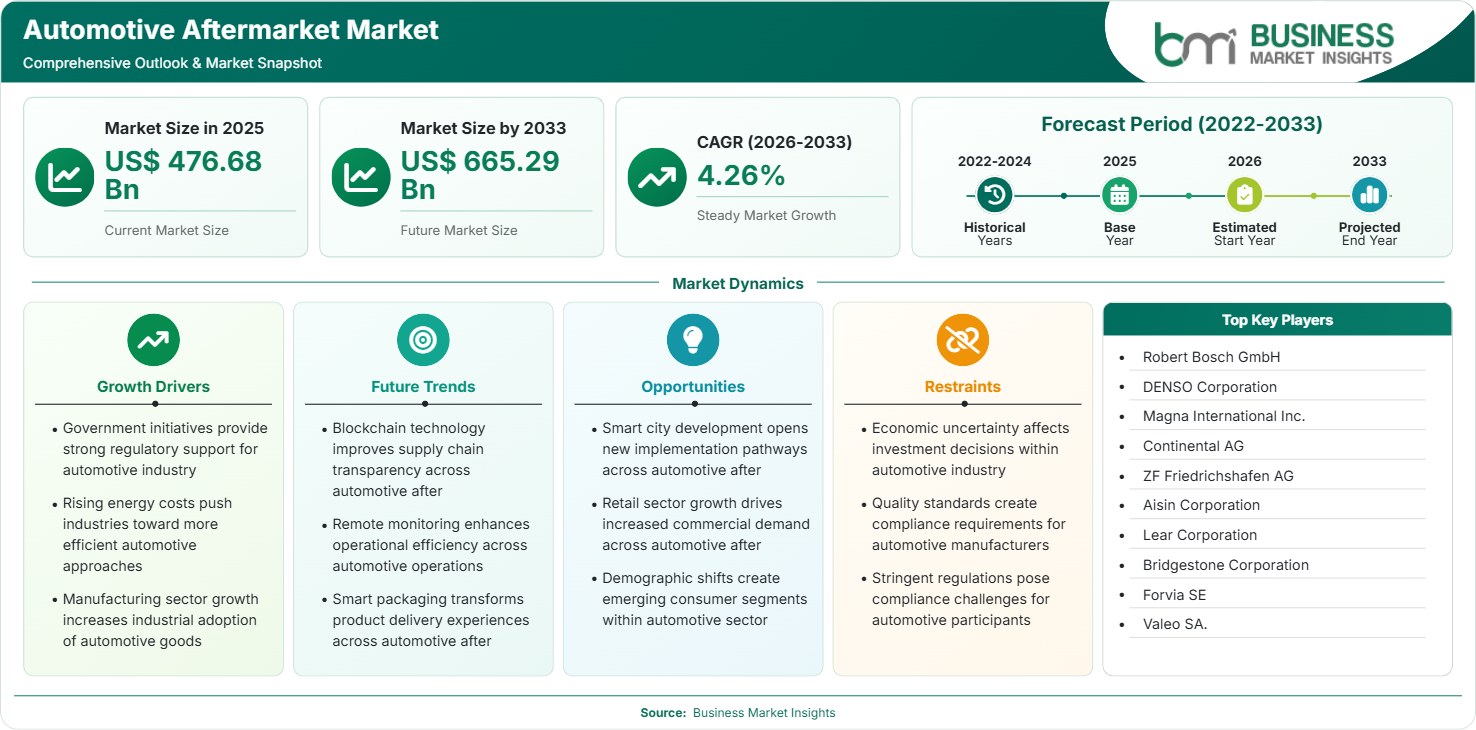
The Automotive Aftermarket Market size was valued at US$ 476.68 Billion in 2025 and is projected to reach US$ 665.29 Billion by 2033, growing at a CAGR of 4.26% during 2026–2033. Growth is supported by an aging vehicle fleet, rising repair frequency, digital parts distribution, predictive maintenance adoption, expanding e-commerce channels, and increasing demand for replacement components across passenger and commercial vehicles.

Report Coverage
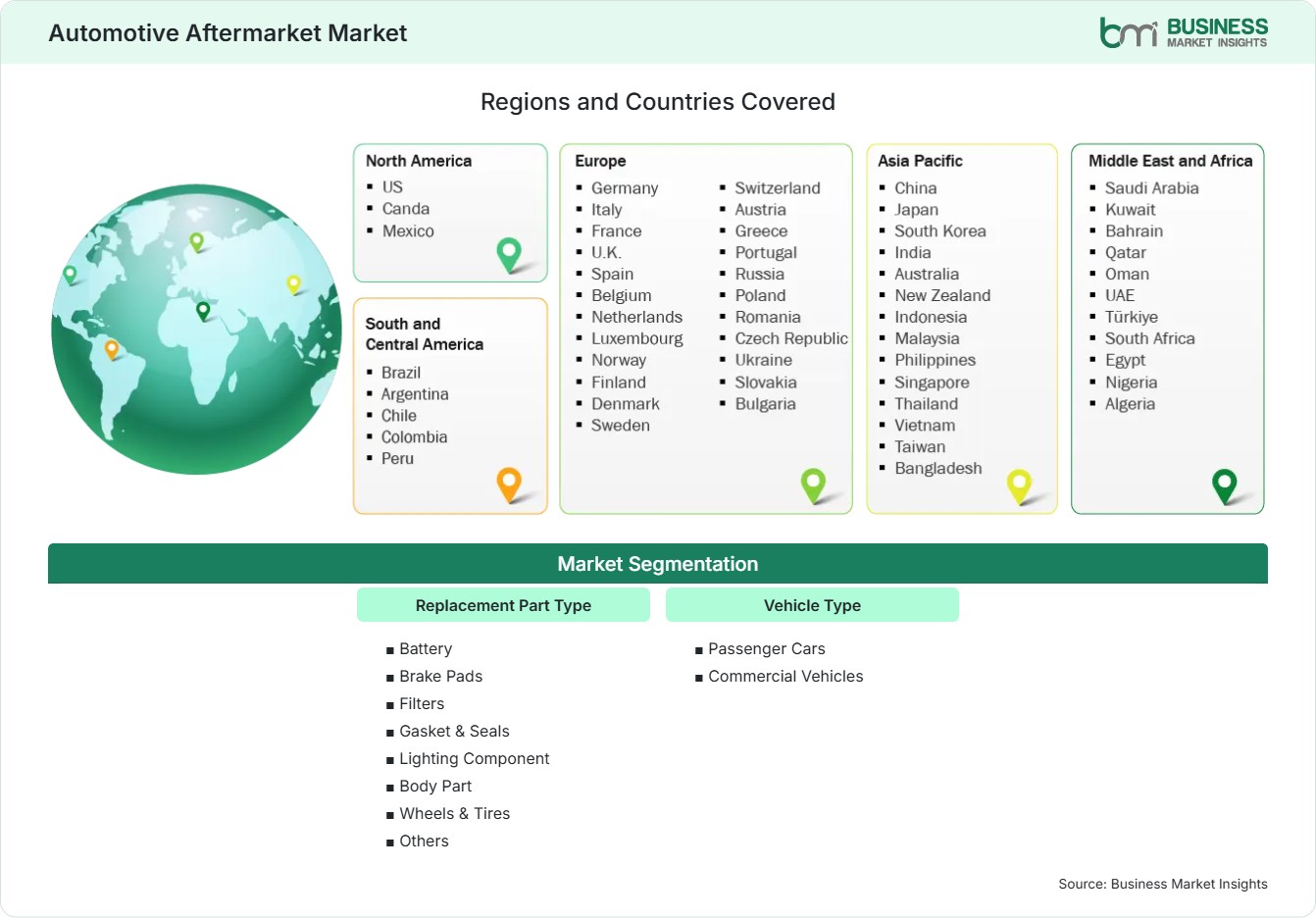
  • Replacement Part Type: Battery, Brake Pads, Filters, Gasket & Seals, Lighting Component, Body Part , Wheels & Tires, Others
  • Vehicle Type: Passenger Cars, Commercial Vehicles
US$ 476.68 Bn Market size in 2025
US$ 665.29 Bn Market Size by 2033
4.26% CAGR, 2026 - 2033
2026-2033 Forecast Period

AI Overview

Automotive Aftermarket Market Summary

  • North America Region: North America holds market share of 31%–33% in 2025, growing with a CAGR of 3.8%–4.2% during 2026–2033. Growth is supported by an aging vehicle parc, strong DIY culture, digital parts retailing, advanced repair networks, increasing vehicle miles traveled, fleet maintenance demand, connected diagnostics adoption, and replacement component consumption. U.S. market remains the regional anchor, supported by vehicle longevity and a CAGR of 3.9%–4.3%.
  • Fastest Growing Region: Asia Pacific holds market share of 27%–29% in 2025, growing with a CAGR of 5.2%–5.8% during 2026–2033. Expansion is driven by vehicle ownership growth, rising middle-class spending, expanding workshops, increasing road freight activity, e-commerce penetration, local manufacturing strength, replacement tire demand, and broader access to aftermarket distribution networks.
  • Leading Segment: Wheels & Tires accounts for 28%–31% share in 2025, advancing at 4.1%–4.7% CAGR. Demand benefits from recurring replacement cycles, road usage intensity, fleet maintenance requirements, premium tire adoption, safety regulations, seasonal tire changes, expanding logistics operations, and increasing consumer awareness regarding vehicle performance.
  • High Growth Segment: Battery represents 12%–15% share in 2025, expanding at 5.8%–6.4% CAGR. Growth is supported by start-stop systems, connected vehicles, hybridization trends, increasing electrical loads, replacement demand, extreme weather impacts, fleet electrification support requirements, and higher adoption of advanced battery technologies.
  • Key Market Opportunity: Digital aftermarket ecosystems integrating predictive maintenance, telematics, e-commerce fulfillment, workshop analytics, and connected diagnostics create opportunities for higher-margin services, recurring revenues, customer retention, inventory optimization, and cross-border distribution expansion.
  • Major Market Players: Robert Bosch GmbH, DENSO Corporation, Magna International Inc., Continental AG, ZF Friedrichshafen AG, Aisin Corporation, Lear Corporation, Bridgestone Corporation, Forvia SE, and Valeo SA.
Strategic Insights

Automotive Aftermarket Market: Strategic Insights

Automotive Aftermarket Market Strategic Framework
FREE PDF
Request your free sample
Request free sample
Stakeholder View

Key Takeaways

  • Supply chains are becoming increasingly data-centric, with distributors integrating inventory analytics, digital procurement, and workshop connectivity to improve service levels and reduce stock obsolescence.
  • Replacement batteries, premium tires, and electronically integrated components offer the strongest upside due to rising vehicle complexity and longer operational lifecycles.
  • Diagnostic software, predictive maintenance tools, and connected repair platforms are reshaping product differentiation strategies across manufacturers and service providers.
  • India, Southeast Asia, and selected Gulf economies present compelling investment opportunities due to vehicle parc expansion and improving aftermarket infrastructure.
  • Strategic partnerships, distribution acquisitions, and service-network expansion remain preferred growth approaches as companies seek customer proximity and recurring revenue streams.
  • Sustainability initiatives are encouraging remanufacturing, circular economy practices, and resource-efficient replacement products across multiple component categories.
Geographic Outlook

Automotive Aftermarket Market Regional Highlights

North America Automotive Aftermarket Market

North America accounted for approximately 31%–33% Automotive Aftermarket Market share in 2025 and is projected to expand at a CAGR of 3.8%–4.2% through 2033. Strong vehicle ownership, average fleet age exceeding twelve years in several markets, and mature repair infrastructure support replacement demand. Digital procurement platforms are improving distribution efficiency while fleet operators continue prioritizing preventive maintenance. The region benefits from established logistics networks, extensive workshop coverage, and rising adoption of predictive diagnostic technologies.

  • Vehicle aging trends continue increasing replacement frequency for braking systems, filters, batteries, and tire products across consumer and fleet applications.
  • E-commerce channels are strengthening component accessibility, improving delivery speed, and enhancing price transparency throughout independent repair networks.
  • Connected diagnostics are improving maintenance planning, reducing unexpected failures, and supporting workshop productivity enhancements.
  • Commercial fleet operators increasingly prioritize lifecycle optimization strategies, supporting recurring purchases of critical replacement components.

US Automotive Aftermarket Market

The United States represented roughly 76%–79% of North American Automotive Aftermarket Market revenue in 2025 and is expected to expand at 3.9%–4.3% CAGR through 2033. High vehicle utilization rates, large light-truck populations, and advanced distribution systems sustain demand. Independent repair chains continue expanding service capabilities while digital platforms improve customer engagement and inventory management. Strong freight activity also supports replacement requirements across commercial fleets.

  • Growth in telematics-enabled fleet management is creating additional demand for predictive maintenance services and replacement products.
  • Expanding electric and hybrid vehicle populations require specialized servicing capabilities and diagnostic tools.
  • Consumers increasingly favor preventive maintenance strategies to avoid expensive repairs and improve vehicle reliability.

Europe Automotive Aftermarket Market

Europe held approximately 24%–26% Automotive Aftermarket Market share in 2025 and is projected to grow at 3.7%–4.1% CAGR through 2033. Germany remains the leading regional market, while Poland and selected Eastern European countries demonstrate faster expansion. Regulatory requirements regarding vehicle inspections, emissions compliance, and road safety support replacement demand. Advanced workshop networks and strong parts manufacturing ecosystems enhance market resilience despite automotive production volatility.

  • Germany leads regional revenue generation, supported by extensive vehicle ownership and sophisticated repair infrastructure.
  • Poland demonstrates higher growth potential with estimated expansion around 4.8%–5.3% CAGR.
  • Sustainability initiatives encourage remanufacturing and circular economy practices across component categories.
  • Independent workshop digitization continues improving service efficiency and customer retention.

Asia Pacific Automotive Aftermarket Market

Asia Pacific accounted for approximately 27%–29% Automotive Aftermarket Market share in 2025 and is forecast to expand at 5.2%–5.8% CAGR, making it the fastest-growing region. China remains the largest contributor, while India records the strongest growth trajectory. Rising vehicle ownership, increasing disposable income, and expanding distribution infrastructure support demand. The region benefits from strong manufacturing ecosystems, growing repair networks, and increasing consumer awareness regarding vehicle maintenance.

  • China leads regional revenue generation through its extensive vehicle parc and repair ecosystem.
  • India records rapid expansion with estimated CAGR between 6.2%–6.8%, supported by vehicle ownership growth.
  • E-commerce penetration improves access to replacement components across urban and semi-urban markets.
  • Expanding commercial transportation activity drives recurring replacement demand for wear-and-tear components.

Rest of World Automotive Aftermarket Market

Rest of World accounted for approximately 15%–17% share in 2025 and is projected to grow at 4.4%–4.9% CAGR through 2033. South and Central America benefit from increasing vehicle retention periods and improving service infrastructure. In the Middle East and Africa, fleet expansion and infrastructure development support replacement demand. Brazil remains the leading Latin American market, while Saudi Arabia demonstrates strong growth prospects through transportation modernization initiatives.

  • Brazil remains the largest regional contributor, supported by vehicle ownership and maintenance activity.
  • Saudi Arabia demonstrates accelerating growth with expanding logistics and mobility investments.
  • Workshop modernization and digital inventory systems improve service quality across developing markets.
  • Infrastructure development increases commercial vehicle utilization and associated replacement requirements.
Global Market Geography
FREE PDF
Request your free sample
Request free sample
Segment Analysis

Automotive Aftermarket Market Segmentation

Replacement Part Type

Replacement Part Type accounted for approximately 68%–71% share in 2025 and is projected to expand at 4.3%–4.8% CAGR. The Automotive Aftermarket Market scope within this segment is shaped by vehicle aging, maintenance requirements, safety compliance, and increasing reliance on replacement cycles. Digital distribution and predictive maintenance are enhancing procurement efficiency and product accessibility.

  • Battery: Increasing electronic content, hybridization trends, and start-stop technologies are strengthening replacement demand across passenger and commercial vehicle applications.
  • Brake Pads: Safety requirements, mileage accumulation, and regulatory inspections continue supporting recurring replacement cycles across vehicle categories.
  • Filters: Engine efficiency needs and emissions compliance requirements sustain steady demand for air, oil, fuel, and cabin filters.
  • Gasket & Seals: Aging vehicles and maintenance activities support replacement requirements to improve reliability and operational performance.
  • Lighting Component: LED adoption, safety awareness, and visibility regulations encourage upgrades and replacement purchases.
  • Body Part (Interior and Exterior): Accident repairs, vehicle customization, and refurbishment activities support component demand across ownership segments.
  • Wheels & Tires: The largest revenue contributor benefits from routine replacement cycles, fleet operations, road conditions, and premium product adoption.

Vehicle Type

Vehicle Type represented approximately 29%–32% share in 2025 and is expected to grow at 4.0%–4.5% CAGR through the forecast period. The Automotive Aftermarket Market trends within vehicle categories are influenced by ownership duration, utilization intensity, maintenance patterns, and technology adoption. Passenger vehicles dominate demand while commercial fleets provide recurring replacement opportunities.

  • Passenger Cars: Large global vehicle populations, longer ownership cycles, and increasing preventive maintenance practices continue supporting aftermarket spending.
  • Commercial Vehicles: High mileage utilization, fleet maintenance programs, and operational reliability requirements create sustained replacement component demand.
Market Forces

Automotive Aftermarket Market Dynamics

Key Market Drivers

Growing Global Vehicle Parc and Aging Fleet Dynamics

Across North America, Europe, and several Asian markets, the average vehicle age continues rising, directly increasing replacement part consumption. The associations of industry demonstrate that there has been an improvement in the lifespan of vehicles because of improvements in the manufacturing quality, causing extended maintenance rather than replacing vehicles. This situation creates a need for continued supply of batteries, tires, filters, brake pads, and lights. The Automotive Aftermarket Market growth trajectory will continue to be connected with the expansion in the number of vehicles that are being put to active use. Consumers who own the vehicles will emphasize the need for maintenance spending in order to maintain dependability and resellability of their vehicles.

Expansion of Digital Distribution and E-Commerce Channels

Digital commerce is transforming component sourcing by improving product availability, pricing transparency, and fulfillment efficiency. Workshops increasingly rely on integrated procurement systems that connect distributors, warehouses, and manufacturers in real time. The sales channels available online can ensure access to a wider range of products and even allow the smaller facilities to become more competitive. Inventory visibility will ensure fewer stock outs while facilitating fast deliveries. These will contribute towards increased efficiency in operations within the value chain. Predictive replenishment, which is made possible by business-to-business digital platforms, can help the distribution businesses optimize their working capital.

Rising Adoption of Connected Diagnostics and Predictive Maintenance

Vehicle connectivity is generating new opportunities for proactive service scheduling and component replacement. Telematics systems increasingly monitor battery health, tire condition, engine performance, and maintenance intervals. Predictive analytics enable businesses to detect failure well ahead of time by using their workshop services and fleet managers. In doing so, this would contribute to increasing vehicle availability while fostering the demand for a more modern alternative. This particular development is important in commercial transportation owing to the heavy costs that are associated with the downtime.

Key Market Opportunities

Growth of Electrified Vehicle Service Ecosystems

There are specialized service possibilities being created by the rising use of hybrid cars and battery electric vehicles. There is a need for diagnostic tools for these cars, thermal components, high voltage security and advanced battery systems. Independent garages are equipping themselves with technicians and facilities to meet these demands. With growing numbers, there will be higher demand for component replacement. Companies that can develop an aftermarket specialization for the EV can tap into this growing area. Long-term Automotive Aftermarket Market Forecasts increasingly incorporate electrification-driven service revenues and technology-enabled maintenance models that differ substantially from traditional internal combustion vehicle requirements.

Emergence of Data-Driven Service Platforms

Connected vehicle data is enabling personalized maintenance recommendations, subscription services, and predictive repair scheduling. Service providers can leverage real-time operating information to improve customer engagement and optimize maintenance timing. Data integration will further aid in making plans for the inventory and enhancing the efficiency of the workshops. Companies who choose to invest in such systems as analysis and cloud computing and digital customers interactions have the potential of earning revenue that is of more value through services offered.

Expansion Opportunities Across Emerging Economies

Vehicle ownership growth across India, Southeast Asia, the Middle East, and Latin America is expanding addressable demand. Structural factors related to investments in distribution infrastructure, improvements in the workshops, and increased awareness among consumers about maintenance support the market development. These regions continue growing in terms of commercial transportation and logistic operations, thus driving further demand for replacements. Localized production, warehouse management, and distribution by suppliers allow for better reaction and cost-cutting.

Market Restraints and Challenges

Counterfeit Components and Quality and Safety Risks

Factor: Counterfeit and low-quality replacement parts remain a persistent challenge across numerous markets. These products often enter supply chains through unauthorized channels and compete aggressively on price.

Impact: Effects include lower consumer confidence, safety of the vehicle, disputes with warranties, and putting pressure on legal producers. Additionally, counterfeit parts can affect the image of repair shops if any problems arise in relation to these parts. People within the market are constantly making efforts to authenticate the genuineness of their products. Several governments from different parts of the world are toughening up their regulatory policies; nevertheless, supply chains remain vulnerable.

Supply Chain Volatility Cost and Availability Pressure

Factor: Global supply chains remain vulnerable to logistics disruptions, commodity price fluctuations, and geopolitical uncertainties.

Impact: The implications will be higher procurement costs, inventory imbalances, and delivery delays, impacting suppliers as well as repair shops. With rising shipping costs and the unpredictability of materials, the profit margin could be lower while also facing pressure on the entire chain regarding prices. Sourcing methods are diversified, and more warehousing space is available within certain regions to strengthen resilience. Despite this, however, longer disruptions may eventually harm services and customer satisfaction in the case of unique or advanced parts.

Company Analysis

Competitive Landscape

The Automotive Aftermarket Market analysis reflects competition centered on distribution reach, product breadth, diagnostics capability, technology integration, and service-network strength.

Company Name

Overview

Products and Services relevant to this market

Robert Bosch GmbH

Global mobility technology leader with extensive aftermarket distribution, diagnostics expertise, and repair network presence.

Batteries, braking systems, filters, diagnostics, workshop equipment, connected maintenance solutions, and replacement components.

DENSO Corporation

Major automotive supplier with strong replacement parts portfolio and global service support capabilities.

Filters, ignition systems, thermal products, sensors, starters, alternators, and aftermarket service solutions.

Magna International Inc.

Diversified automotive technology company supporting vehicle systems and replacement component demand.

Body systems, mirrors, electronics, structural components, and related aftermarket support services.

Continental AG

Leading mobility supplier with extensive tire and electronic systems expertise.

Tires, braking systems, sensors, diagnostics, and connected mobility aftermarket offerings.

ZF Friedrichshafen AG

Global driveline and chassis specialist serving commercial and passenger vehicle segments.

Transmission parts, steering systems, braking components, suspension products, and workshop services.

Aisin Corporation

Japanese supplier with broad automotive systems portfolio and global distribution presence.

Drivetrain components, pumps, thermal systems, replacement parts, and maintenance solutions.

Lear Corporation

Automotive seating and electrical systems specialist with aftermarket support activities.

Electrical components, connectivity products, seating-related replacement solutions, and service support.

Bridgestone Corporation

Global tire manufacturer with strong retail and fleet service footprint.

Tires, tire management services, fleet solutions, and maintenance support programs.

Forvia SE

Mobility technology company formed through Faurecia and HELLA integration strengths.

Lighting, interiors, electronics, emissions solutions, and aftermarket replacement products.

Valeo SA

Automotive technology company focused on electrification, visibility, and assistance systems.

Lighting systems, thermal products, wiper systems, electronics, and aftermarket service offerings.

Trust & Transparency

Research Methodology

The market analysis combines proprietary research with secondary data from government agencies, company disclosures, regulatory filings, industry databases and expert interviews. Market estimates are validated through data triangulation, cross-market benchmarking and analyst review.

View Full Research Methodology

Questions Answered

Frequently Asked Questions

What does an Automotive Aftermarket Market Report typically evaluate?

An Automotive Aftermarket Market Report generally assesses market structure, demand drivers, competitive positioning, technology trends, regional dynamics, segmentation performance, and future growth opportunities.

How are connected vehicles influencing service models?

Connected vehicles enable predictive maintenance, real-time diagnostics, proactive repair scheduling, and personalized service offerings that improve customer retention.

Which replacement component category offers the highest revenue contribution?

Wheels and tires remain the largest revenue-generating category because they require periodic replacement regardless of vehicle powertrain type.

What role does e-commerce play in the industry?

E-commerce improves product accessibility, inventory visibility, price transparency, and fulfillment efficiency while helping workshops source components faster and more accurately.

What factors are driving long-term aftermarket demand?

Vehicle aging, longer ownership cycles, increasing repair complexity, digital diagnostics adoption, and growing commercial fleet activity are creating sustained replacement component demand across major regions.

Access the Full Automotive Aftermarket Market Report

Get segment-level forecasts, regional estimates, competitive benchmarking, company profiles and downloadable Excel datasets.

Access the full Automotive Aftermarket Market Report
350 pages PDF & Excel | 2026-08-31
Similar Research

Related Market Reports