Market Summary
Executive Summary and Global Market Analysis
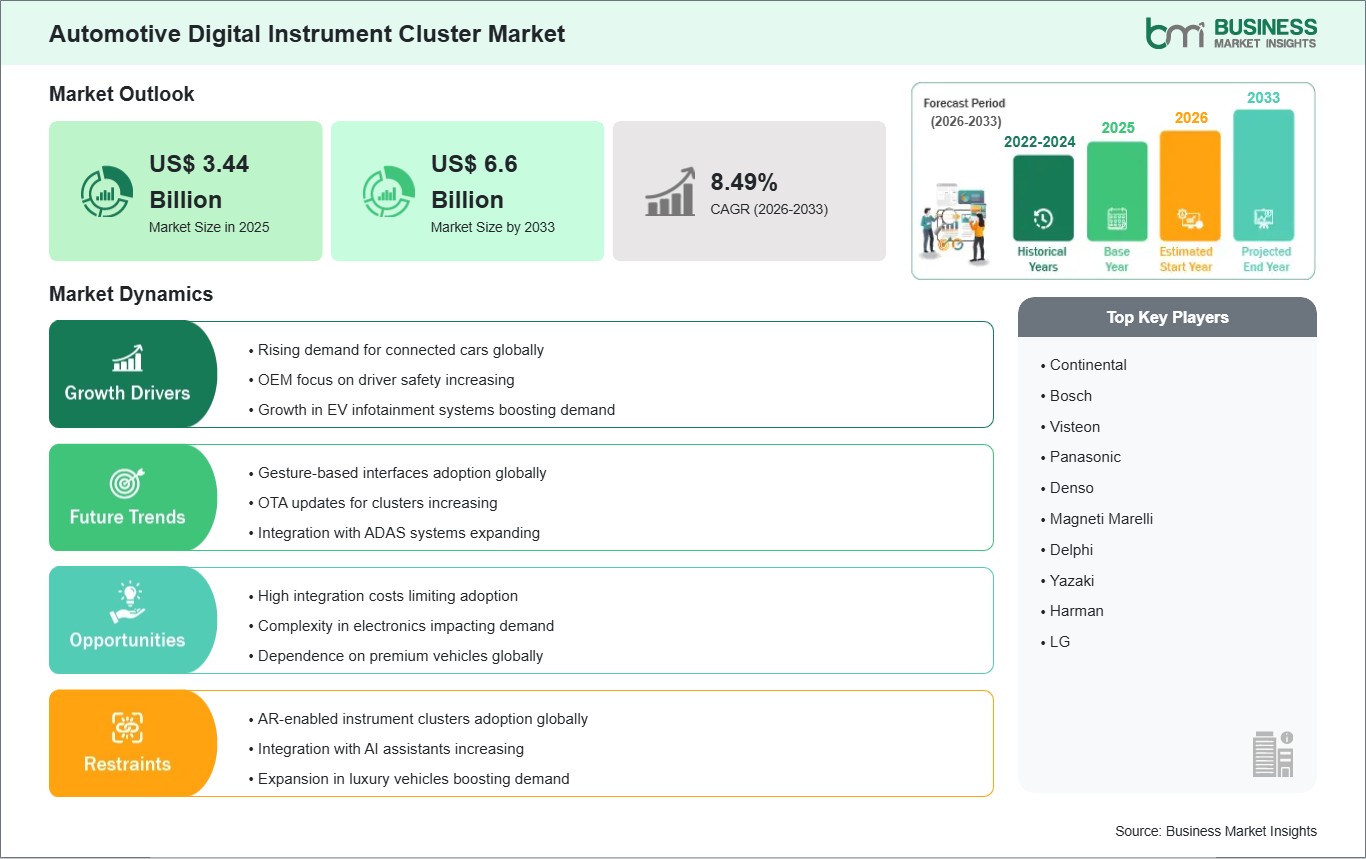
Automotive digital instrument clusters are advanced electronic display systems that replace traditional analog gauges with configurable digital interfaces. These systems provide drivers with real-time information related to vehicle speed, fuel status, battery performance, navigation, safety alerts, and connected vehicle functions. The Automotive Digital Instrument Cluster market is expanding as vehicle manufacturers increasingly focus on enhanced driver experience, vehicle connectivity, and intelligent cockpit technologies. Growing adoption of electric vehicles, increasing consumer preference for premium in-vehicle displays, and advancements in display technologies such as TFT-LCD and OLED are contributing to market growth.
Despite strong growth prospects, the market faces several challenges. The integration of advanced digital displays increases vehicle production costs, making adoption more difficult in entry-level vehicle segments. Manufacturers must also ensure long-term display reliability, cybersecurity protection, and compatibility with evolving vehicle software architectures. Supply chain constraints affecting semiconductor availability and display components can influence production schedules and pricing. Additionally, maintaining driver safety while providing large amounts of digital information remains a critical consideration. Automotive manufacturers continue to balance advanced functionality with user-friendly interfaces to prevent driver distraction and ensure compliance with safety standards.
The market continues to benefit from ongoing innovation in connected vehicle technologies and intelligent cockpit solutions. Opportunities are emerging through the development of larger displays, augmented reality interfaces, and integrated digital ecosystems that combine instrument clusters with infotainment systems. The growing adoption of electric and autonomous vehicles is further accelerating demand for advanced driver information systems. Improvements in display quality, energy efficiency, and software customization are enabling manufacturers to deliver enhanced user experiences. As automotive digitalization progresses, digital instrument clusters are expected to play an increasingly important role in next-generation vehicle interiors, supporting continued market expansion over the forecast period.
Segment Analysis
Automotive Digital Instrument Cluster Market Segmentation
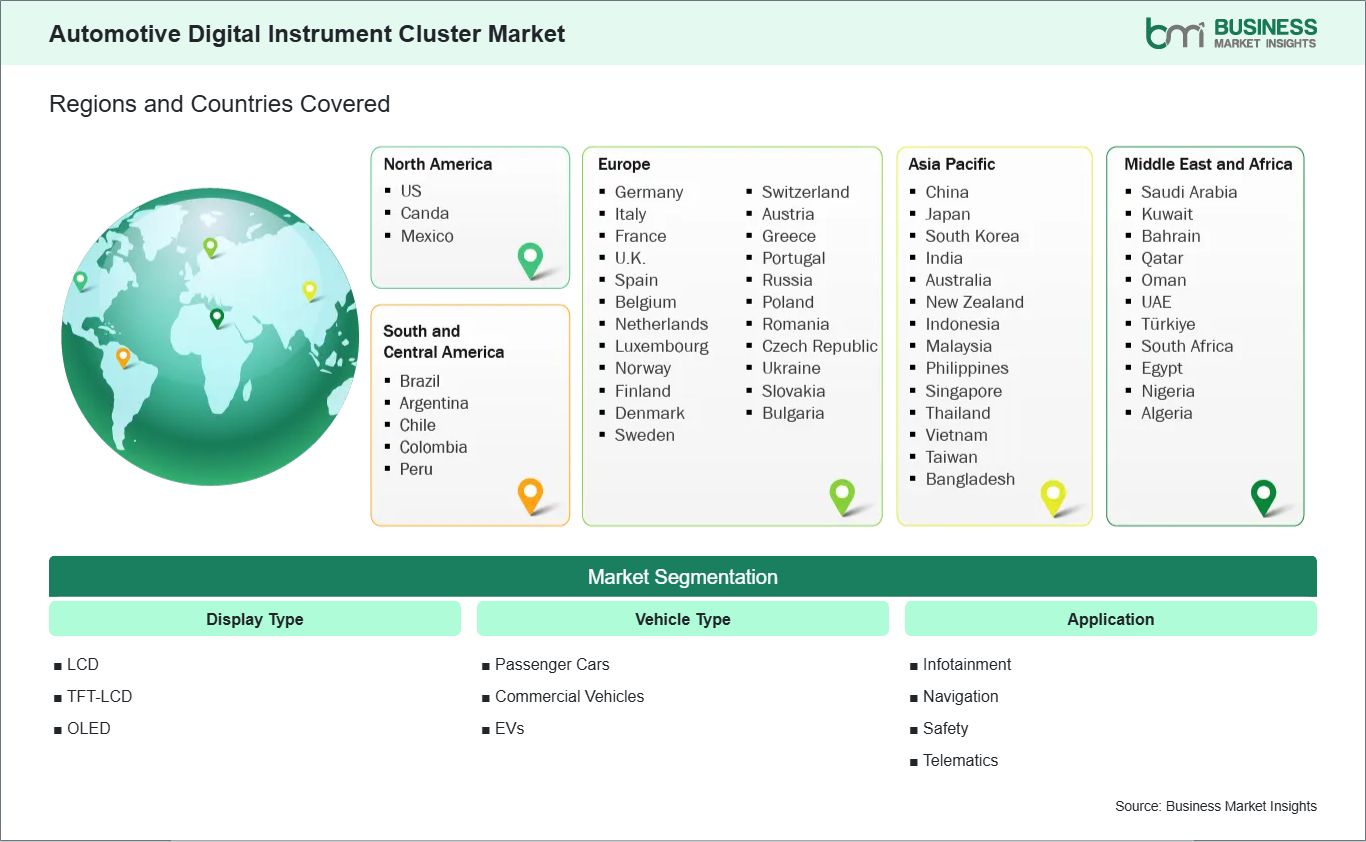
The Automotive Digital Instrument Cluster market is segmented based on display type, vehicle type, and application, reflecting evolving vehicle interior technologies and driver information requirements.
By Display Type
- LCD: Widely adopted due to affordability and reliable performance across vehicle categories
- TFT-LCD: Preferred for improved graphics quality, brightness, and customization capabilities
- OLED: Gaining popularity due to superior contrast, flexibility, and premium visual experience
By Vehicle Type
- Passenger Cars: Represents the largest segment driven by increasing consumer demand for digital cockpits
- Commercial Vehicles: Adoption supported by fleet management and driver information requirements
- EVs: Rapidly expanding due to integration of advanced digital interfaces and connected technologies
By Application
- Infotainment: Supports multimedia, connectivity, and vehicle information integration
- Navigation: Provides real-time route guidance and traffic-related information
- Safety: Displays driver assistance alerts and vehicle safety notifications
- Telematics: Enables connected vehicle monitoring and communication functions
Market Forces
Automotive Digital Instrument Cluster Market Drivers and Opportunities
Rising Demand for Connected and Intelligent Vehicle Cockpits
The automotive industry is undergoing a significant transformation toward connected, software-driven, and user-centric vehicle experiences. Digital instrument clusters have become a central component of modern vehicle interiors as manufacturers seek to improve driver engagement and provide seamless access to critical vehicle information. Consumers increasingly expect advanced digital displays that offer customization, intuitive interfaces, and integration with navigation, infotainment, and connected vehicle services.
The growing adoption of advanced driver assistance systems and connected vehicle technologies is further increasing demand for digital instrument clusters. These systems require sophisticated display platforms capable of presenting real-time information clearly and efficiently. Regulatory emphasis on vehicle safety and driver awareness also supports the use of advanced display technologies that improve visibility and communication of critical alerts. Furthermore, ongoing advancements in display technologies such as high-resolution TFT-LCD and OLED panels are enabling enhanced functionality and visual quality. As automotive manufacturers continue investing in intelligent cockpit solutions, digital instrument clusters are expected to become increasingly important across both premium and mass-market vehicle segments.
Growth Opportunities in Electric and Software-Defined Vehicles
The expansion of electric mobility and software-defined vehicle architectures is creating substantial opportunities for the Automotive Digital Instrument Cluster market. Electric vehicles rely heavily on digital interfaces to communicate battery performance, energy consumption, charging status, and vehicle diagnostics. As electric vehicle adoption increases globally, demand for advanced digital display solutions is expected to grow accordingly.
Software-defined vehicles are also reshaping automotive interior design by enabling over-the-air updates, personalized user experiences, and continuous feature enhancements. Digital instrument clusters provide a flexible platform that can evolve through software updates without requiring hardware modifications. This capability creates opportunities for manufacturers to introduce new services and functionality throughout a vehicle's lifecycle. In addition, emerging technologies such as augmented reality displays, artificial intelligence-driven interfaces, and integrated cockpit systems are expanding the role of digital instrument clusters. As vehicle automation and connectivity continue to advance, demand for intelligent display platforms capable of supporting complex information environments is expected to accelerate, creating new growth opportunities across the automotive ecosystem.
Size and Share Analysis
Automotive Digital Instrument Cluster Market Size and Share Analysis
The Automotive Digital Instrument Cluster market size is expected to reach US$ 6.6 billion by 2033 from US$ 3.44 billion in 2025. The market is estimated to record a CAGR of 8.49% from 2026 to 2033.
By display type, TFT-LCD accounts for a significant share due to its balance of performance, image quality, and cost efficiency. LCD displays continue to maintain widespread adoption across entry-level and mid-range vehicles, while OLED displays are gaining traction in premium vehicle segments owing to superior visual performance, flexibility, and advanced design capabilities.
By vehicle type, passenger cars dominate the market due to high production volumes and increasing consumer preference for connected vehicle experiences. Commercial vehicles are steadily adopting digital instrument clusters to improve operational efficiency and driver awareness. Electric vehicles are emerging as a major growth segment as manufacturers increasingly integrate advanced digital interfaces into next-generation mobility platforms.
Report Coverage
Automotive Digital Instrument Cluster Market Report Coverage and Deliverables
The "Automotive Digital Instrument Cluster Market Size and Forecast (2022-2033)" report provides a detailed analysis of the market covering below areas:
- Market size and forecast at global, regional, and country levels for all the key market segments covered under the scope
- Market trends, as well as market dynamics such as drivers, restraints, and key opportunities
- Market analysis covering key market trends, global and regional framework, major players, regulations, and recent market developments
- Industry landscape and competition analysis covering market concentration, heat map analysis, prominent players, and recent developments for the market
- Detailed company profiles, including SWOT analysis
Geographic Insights
Automotive Digital Instrument Cluster Market Geographic Insights
The Automotive Digital Instrument Cluster Market shows diverse regional adoption patterns influenced by advancements in vehicle electronics, growing consumer demand for connected mobility, and increasing integration of digital cockpit technologies.
North America, being a developed region, has a mature automotive industry and strong adoption of advanced vehicle technologies. The region comprises the United States and Canada, where automotive manufacturers increasingly integrate digital instrument clusters into both premium and mainstream vehicle models. Consumer preference for connected vehicles, advanced safety features, and intelligent cockpit systems continues to drive demand. The region benefits from established technology infrastructure, strong automotive research capabilities, and widespread adoption of electric and connected vehicles, supporting continued market development.
Asia Pacific is growing significantly, driven by expanding vehicle production and rapid adoption of automotive digital technologies. The region comprises countries such as China, India, and Japan, where automotive manufacturers are investing heavily in vehicle digitalization and smart mobility solutions. Rising disposable incomes, increasing demand for premium vehicle features, and strong growth in electric vehicle production are contributing to market expansion. Government support for automotive innovation and advanced manufacturing further strengthens the adoption of digital instrument cluster technologies across the region.
Both regions are contributing significantly to the growth of the Automotive Digital Instrument Cluster Market, focusing on vehicle digitalization, connected mobility solutions, and advanced driver information systems. Continued investments in automotive electronics and smart cockpit technologies are expected to support long-term market expansion across these regions.
Industry Activity
Recent Developments
The Automotive Digital Instrument Cluster Market is analyzed using a mix of primary and secondary research sources, including corporate publications, industry associations, and verified databases. This approach ensures accurate tracking of innovation trends and strategic developments influencing the market.
- In January 2026, Visteon Corporation announced advancements in its digital cockpit platform featuring next-generation digital instrument cluster technologies. The solution integrates driver information, infotainment functions, and connected vehicle services into a unified display environment. The development supports growing demand for intelligent and customizable vehicle interiors.
- In October 2025, Continental AG introduced enhanced display solutions for software-defined vehicles, including advanced digital instrument cluster systems with high-resolution visualization capabilities. The technology is designed to improve driver interaction, safety communication, and connected mobility experiences in future vehicle platforms.
Trust & Transparency
Research Methodology
The market analysis combines proprietary research with secondary data from government agencies, company disclosures, regulatory filings, industry databases and expert interviews. Market estimates are validated through data triangulation, cross-market benchmarking and analyst
review.
View Full Research Methodology
Key Sources Referred:
World Bank - Global Trade IndicatorsWorld Trade Organization (WTO)International Monetary Fund (IMF)International Trade Administration (ITA)Company WebsitesCompany Annual ReportsCompany Investor Presentations