Radar Detector Market Regional Highlights
North America Radar Detector Market
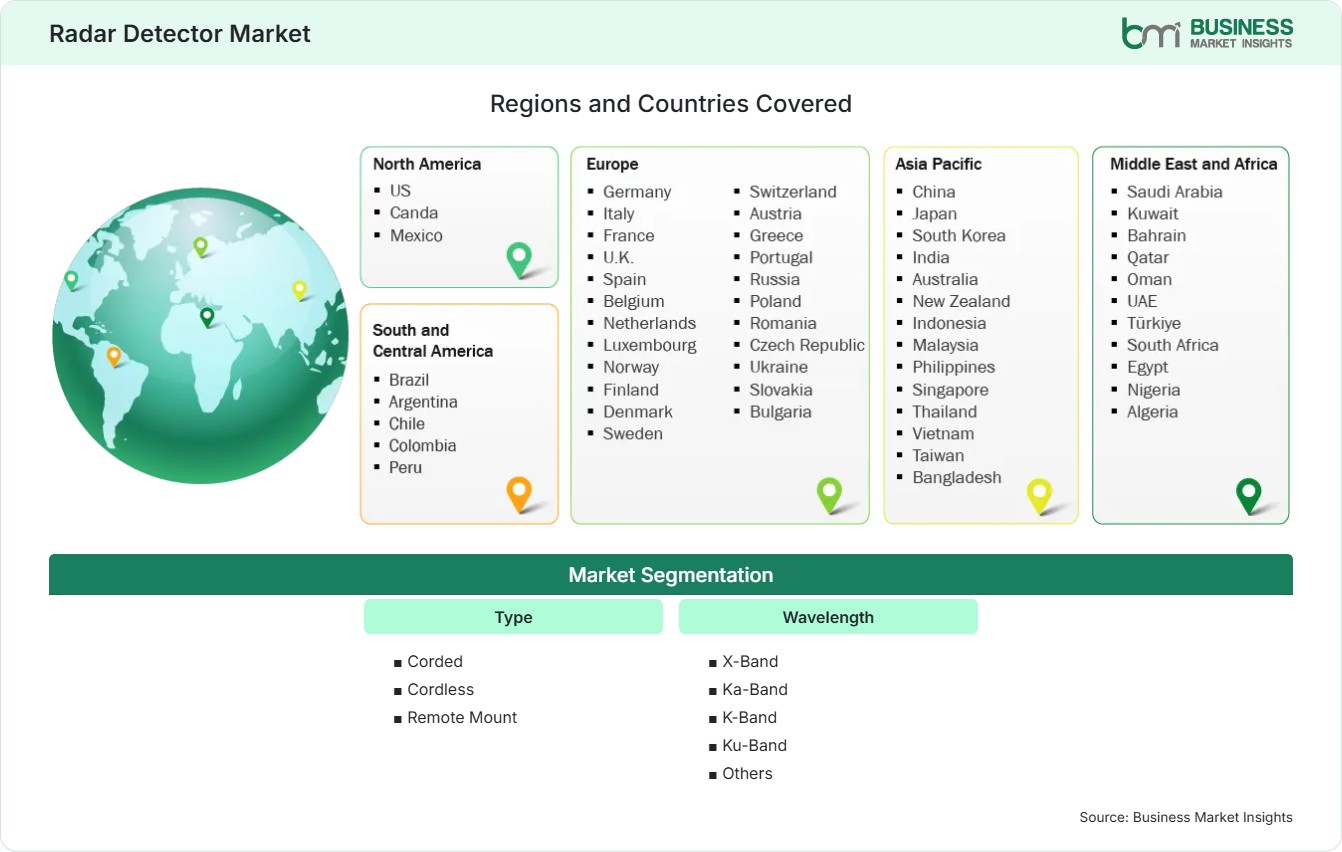
North America represented a 35%–38% Radar Detector Market share in 2025 and is projected to expand at a 5.0%–5.4% CAGR through 2033. The region benefits from mature aftermarket electronics channels, established consumer awareness, premium detector brands, and replacement demand. The United States remains the dominant national market, while Canada provides a smaller but established opportunity. Product differentiation increasingly centers on Ka-band sensitivity, false-alert filtering, connected applications, and compact hardware. Regulatory variation by jurisdiction continues to influence product positioning, distribution, and consumer education.
- The premium detectors enjoy the fact that consumers are very familiar with electronics mounted on windshields, and there are already established specialist brands.
- Increasingly, products that are connected make use of Bluetooth, Wi-Fi, smartphone applications, and downloadable firmware to add to their functionality after they have been purchased.
The performance in the Ka-band continues to be a major factor in determining competitiveness as manufacturers improve their sensitivity and ability to classify signals.
- Systems that are specially installed offer greater potential value to luxury and performance cars which want their hardware to be hidden and have cleaner interiors.
- The demand for replacement is backed by constant advances in filtering, displays, connectivity, and detection architecture.
US Radar Detector Market
The U.S. market accounts for 82%–86% of North American demand and is projected to grow at a 4.9%–5.3% CAGR during the Radar Detector Market Forecasts. Consumer demand is concentrated in technologically advanced portable detectors, while premium users increasingly consider remote-mounted configurations. Market development is supported by established specialty retailers, e-commerce distribution, automotive enthusiasts, and continuous product upgrades. Manufacturers compete on sensitivity, false-alert rejection, directional information, GPS databases, and smartphone integration. Product legality and restrictions vary across jurisdictions, making compliance-oriented marketing important.
- Those who buy premium products are placing greater importance on long-range Ka-band detection, directional awareness, and advanced filtering rather than on basic frequency coverage.
- Wireless updates reduce ownership friction since they enable databases and firmware to stay up to date without requiring complicated computer-based maintenance.
- The integration of smartphones provides opportunities for receiving alerts, adjusting settings, obtaining information from the community, and expanding the features of the software after the hardware has been purchased.
Europe Radar Detector Market
Europe captured a 28%–31% Radar Detector Market share in 2025 and is projected to grow at a 4.7%–5.1% CAGR through 2033. Germany, the United Kingdom, France, Italy, and Spain represent important demand centers, while Central European markets support specialist manufacturers. Regulatory differences strongly shape adoption because detector legality varies among countries. European suppliers increasingly differentiate through localized GPS databases, MultaRadar and GATSO detection, stealth features, and multilingual interfaces. GENEVO's product portfolio demonstrates this regional emphasis through European radar databases, multi-band detection, and regularly updated firmware.
- Germany and the United Kingdom are still important markets for premium products, even though the regulatory conditions in each country affect consumers' decisions about purchasing.
- Technology development based in the Czech Republic supports specialist innovation in European radar detection and in GPS-enabled warning systems.
- The growing compatibility between MultaRadar and GATSO is increasing product differentiation in those markets where conventional detection on its own gives only limited coverage.
- Increasingly, premium European products combine radar detection with GPS camera databases and hardware designed with stealth in mind.
- By providing software that is adapted for specific regions and offering multiple language interfaces, cross-border usability for drivers who travel across different European countries is improved.
Asia Pacific Radar Detector Market
Asia Pacific represented a 22%–25% Radar Detector Market share in 2025 and is projected to record the fastest regional expansion at a 6.0%–6.5% CAGR. Japan, Australia, South Korea, and selected Southeast Asian economies provide important opportunities, while China and India offer longer-term potential subject to regulatory conditions. Vehicle ownership growth, connected-car technologies, urban enforcement, and expanding electronics manufacturing support demand. Manufacturers can improve regional competitiveness through localized frequency profiles, compact designs, smartphone connectivity, and pricing strategies adapted to varying consumer purchasing power.
- Japan backs the demand for technologically advanced automotive electronics and prefers compact products that feature strong integration and reliable signal processing.
- In Australia there is a well-developed market of enthusiasts whose choice when buying is influenced by the detector's premium detection range, filtering capabilities, and portability.
- There is expansion potential in Southeast Asia since vehicle ownership, the development of highways, and the uptake of digital automotive accessories are all increasing.
- Regional electronics manufacturing can help with getting parts, cutting costs, and speeding up product changes for manufacturers.
- By combining the detector hardware with familiar digital interfaces and update services, smartphone-connected products can reduce the barriers to adoption.
Rest of World Radar Detector Market
Rest of World represented approximately a 9%–12% Radar Detector Market share in 2025 and is projected to expand at a 4.0%–4.6% CAGR. South and Central American opportunities are concentrated in markets with expanding automotive populations and specialist aftermarket channels. Brazil, Mexico, Chile, and Argentina provide differentiated opportunities, while adoption remains sensitive to local enforcement practices and regulations.
Demand in the Middle East and Africa is relatively specialized, with opportunities focusing on premium vehicles, vehicles that are popular among performance enthusiasts, imported automotive accessories, and consumers who are affluent and live in urban areas. Especially attractive are the premium after-market sectors in the United Arab Emirates and Saudi Arabia.
- Brazil and Mexico will be able to promote the expansion of the aftermarket due to their large number of vehicles and the increasing distribution of digital automotive accessories.
- In the Gulf region there are excellent opportunities for investment, since luxury cars and specialized automotive customization help to support higher-value electronics.
- Local distributors are still important since there are substantial differences between countries in terms of regulatory requirements and consumer awareness.
- E-commerce has the potential to increase the availability of products in areas where specialist physical automotive electronics retailers are limited.
- The degree of regional growth is determined not just by the availability of the product globally but by compliance that is tailored to the region, appropriate pricing, a suitable frequency configuration, and adequate after-sales support.