
Ground Penetrating Radar Market Outlook: Size, Share, Trends, Growth Analysis, Competitive Landscape & Forecast, 2026-2033

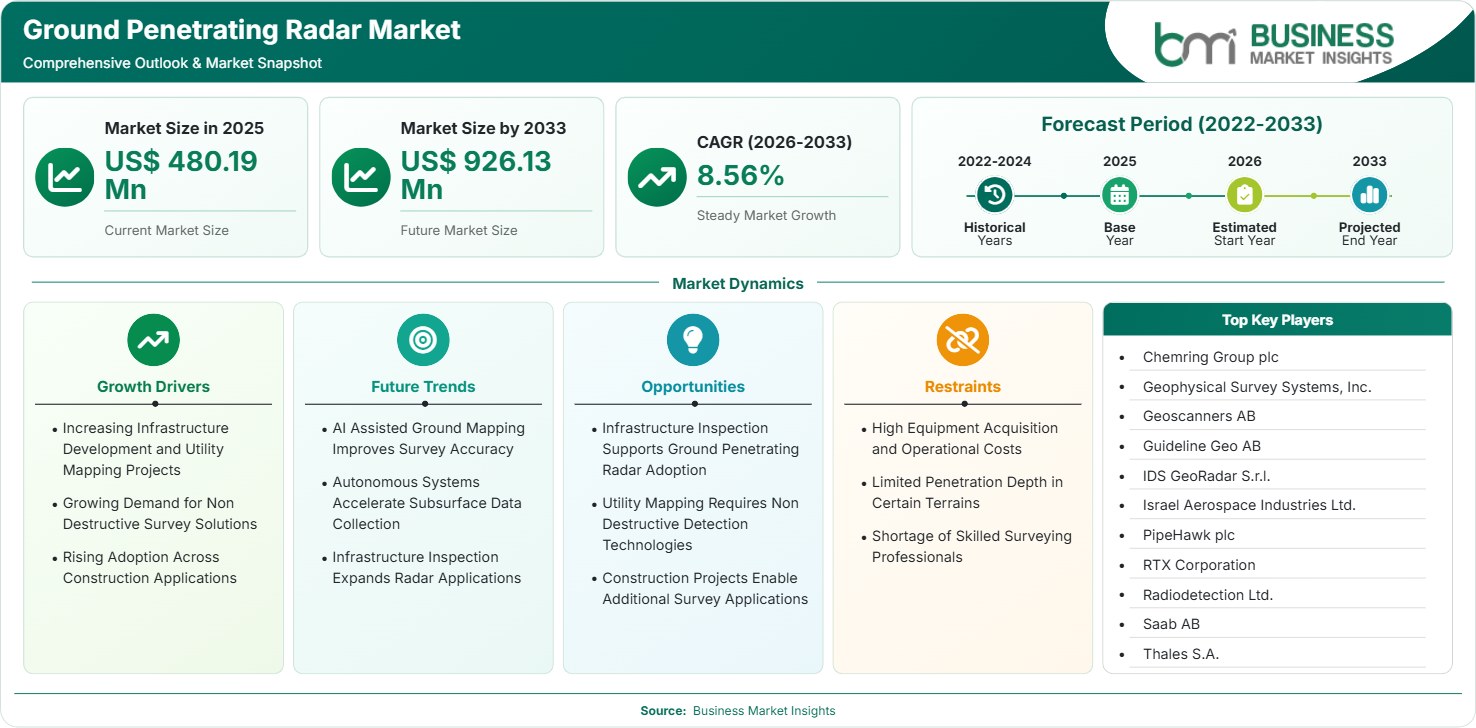
The Ground Penetrating Radar Market size was valued at US$ 480.19 Million in 2025 and is projected to reach US$ 926.13 Million by 2033, growing at a CAGR of 8.56% during 2026–2033. Key drivers include utility mapping modernization, transportation asset monitoring, military reconnaissance applications, and digital infrastructure expansion, while opportunities emerge from smart-city projects, autonomous surveying workflows, and AI-enabled subsurface analytics.

Report Coverage
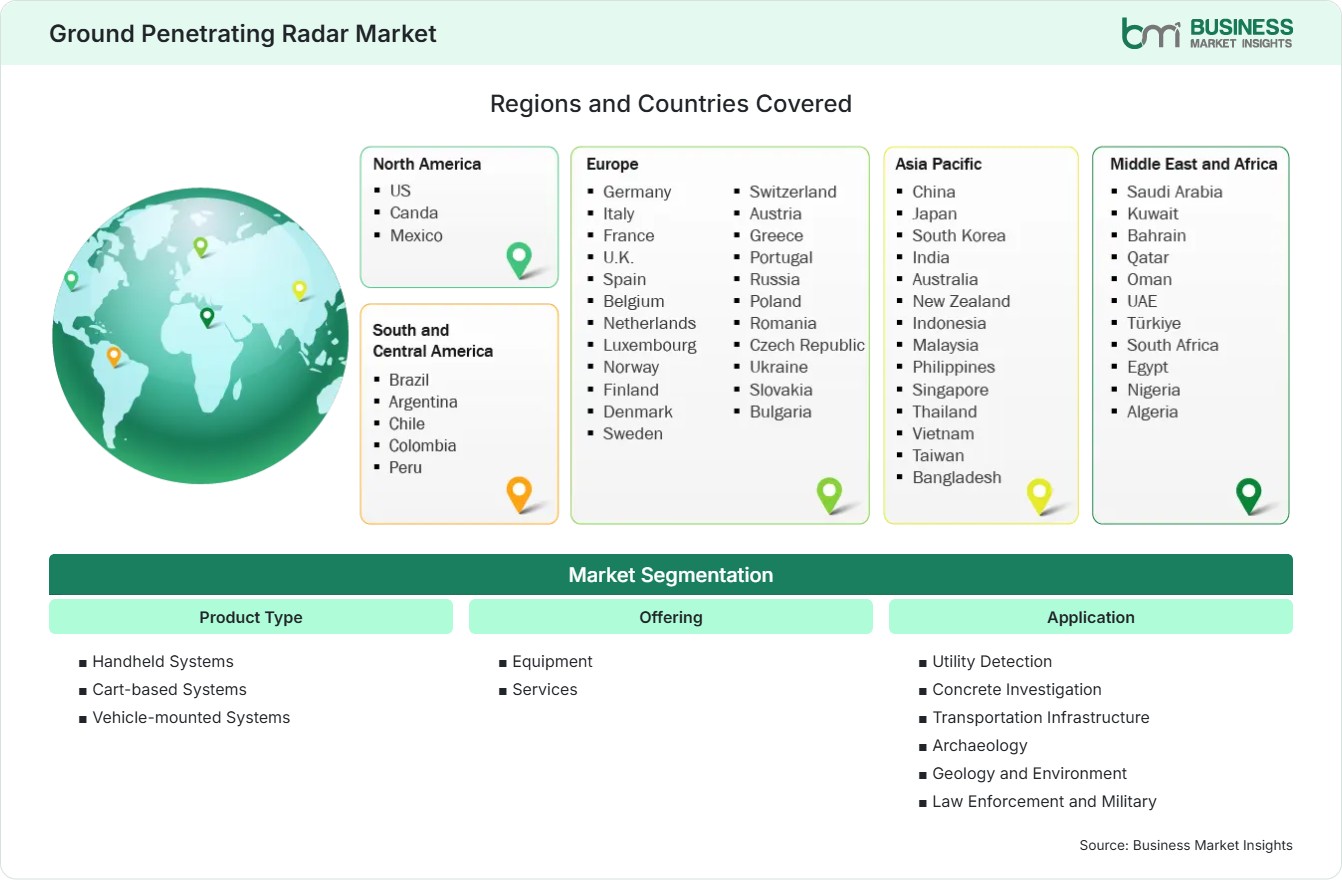
  • Product Type: Handheld Systems, Cart-based Systems, Vehicle-mounted Systems
  • Offering: Equipment, Services
  • Application: Utility Detection, Concrete Investigation, Transportation Infrastructure, Archaeology, Geology and Environment, Law Enforcement and Military
US$ 480.19 Mn Market size in 2025
US$ 926.13 Mn Market Size by 2033
8.56% CAGR, 2026 - 2033
2026-2033 Forecast Period

AI Overview

Ground Penetrating Radar Market Summary

  • North America Region: North America holds a market share of 34%–37% in 2025, growing with a CAGR of 7.8%–8.4% during 2026–2033. Aging infrastructure rehabilitation, utility mapping regulations, transportation asset monitoring programs, and defense modernization investments continue supporting demand. Opportunities arise from digital-twin deployment, predictive maintenance initiatives, and advanced geospatial data integration across public infrastructure networks. The U.S. remains the largest regional contributor, supported by federal infrastructure spending and utility asset digitization, advancing at a CAGR of 7.9%–8.5%.
  • Fastest Growing Region: Asia Pacific holds a market share of 25%–28% in 2025 and is projected to expand at a CAGR of 9.8%–10.6% during 2026–2033. Large-scale urbanization, railway expansion, underground utility mapping requirements, environmental assessment activities, and government infrastructure investments stimulate adoption. Opportunities emerge from smart-city deployment, metro construction projects, and increasing use of geophysical surveying technologies across developing economies.
  • Leading Segment: Equipment accounts for 68%–72% share in 2025 and is expected to grow at a CAGR of 8.1%–8.8% during 2026–2033. Demand is supported by technological upgrades, higher-resolution imaging capabilities, integrated positioning systems, and broader deployment across utility detection, transportation infrastructure assessment, and military reconnaissance operations worldwide.
  • High Growth Segment: Utility Detection represents 30%–34% share in 2025 and is anticipated to register a CAGR of 9.5%–10.2% during 2026–2033. Increasing underground utility congestion, excavation safety requirements, infrastructure modernization programs, and regulatory compliance needs continue accelerating deployment across municipal, industrial, and commercial construction environments.
  • Key Market Opportunity: Expanding digital infrastructure programs create opportunities for integrated subsurface intelligence platforms combining radar imaging, GIS databases, cloud analytics, and AI-assisted interpretation, enabling faster project execution, reduced excavation risks, and improved asset lifecycle management.
  • Major Market Players: Chemring Group plc, Geophysical Survey Systems, Inc., Geoscanners AB, Guideline Geo AB, IDS GeoRadar S.r.l., Israel Aerospace Industries Ltd., PipeHawk plc, RTX Corporation, Radiodetection Ltd., Saab AB, and Thales S.A.
Strategic Insights

Ground Penetrating Radar Market: Strategic Insights

Ground Penetrating Radar Market Strategic Framework
FREE PDF
Request your free sample
Request free sample
Stakeholder View

Key Takeaways

  • The value chain is increasingly evolving toward integrated hardware-software ecosystems where radar equipment manufacturers collaborate with geospatial analytics providers, engineering consultants, infrastructure owners, and surveying specialists to deliver complete subsurface intelligence solutions.
  • Utility detection applications offer substantial upside due to rising underground asset density, stricter excavation regulations, and growing demand for accurate mapping before transportation, energy, telecommunications, and urban development projects commence.
  • Product innovation is shifting toward multi-channel radar systems, AI-assisted signal interpretation, cloud-connected workflows, and integrated positioning technologies that improve operational productivity while reducing interpretation complexity for field operators.
  • Asia Pacific presents a compelling investment opportunity as governments expand railway networks, metro systems, smart-city infrastructure, and underground utility corridors requiring advanced subsurface investigation and asset verification capabilities.
  • Strategic partnerships, acquisitions, and technology integration initiatives are increasing as companies seek to strengthen software capabilities, enhance imaging performance, and broaden their presence in infrastructure, environmental, and defense applications.
  • Demand is becoming increasingly project-driven, encouraging service providers and equipment vendors to develop flexible deployment models, managed survey services, and subscription-based analytical platforms for recurring revenue generation.
Geographic Outlook

Ground Penetrating Radar Market Regional Highlights

North America Ground Penetrating Radar Market

North America accounted for approximately 34%–37% of the Ground Penetrating Radar Market share in 2025 and is projected to expand at a CAGR of 7.8%–8.4% through 2033. Rehabilitation costs, the need for underground utility mapping, inspections of transportation assets, and military applications still dominate the market. America and Canada are actively developing their digital infrastructure management systems and need accurate subsurface information for this purpose. More utilities are using radar technologies in order to avoid unnecessary excavation and manage assets' life cycles.

  • Federal infrastructure funding programs continue supporting bridge rehabilitation, roadway modernization, and underground utility verification projects requiring advanced subsurface imaging capabilities and integrated geospatial survey workflows across transportation and municipal sectors.
  • Telecommunications network expansion and broadband deployment initiatives increase demand for underground asset detection technologies that help contractors minimize service disruptions and improve project execution efficiency.
  • Energy transmission, pipeline maintenance, and environmental assessment activities encourage adoption of advanced radar systems capable of identifying buried infrastructure and subsurface anomalies across diverse terrain conditions.
  • Defense agencies continue investing in surveillance, route-clearance, and geophysical assessment technologies, creating opportunities for specialized radar solutions designed for mission-critical operational environments.
  • Growing use of digital twins and predictive infrastructure maintenance platforms is strengthening demand for accurate subsurface datasets integrated into long-term asset management strategies.

US Ground Penetrating Radar Market

The United States represented approximately 76%–80% Ground Penetrating Radar Market share within the North American market in 2025 and is anticipated to advance at a CAGR of 7.9%–8.5% during 2026–2033. Larger programs that rehabilitate transport, utility infrastructure modernization, and geospatial intelligence programs for defense purposes still continue to drive the adoption rate. The state transportation departments have increased the use of non-destructive testing in their bridge, pavement, and tunnel inspection programs. The utilities companies, too, continue to focus on the accurate underground mapping process.

  • Transportation agencies are increasingly integrating subsurface condition assessments into roadway and bridge maintenance programs, improving infrastructure planning accuracy and extending asset service life.
  • Rapid deployment of broadband networks and utility corridor expansions requires advanced underground mapping solutions that minimize project delays and support regulatory compliance obligations.
  • Municipal infrastructure modernization programs increasingly utilize radar-enabled surveying to identify aging underground assets and improve capital allocation decisions.
  • Defense and homeland security applications continue supporting specialized demand for terrain characterization, route assessment, and geophysical intelligence capabilities.

Europe Ground Penetrating Radar Market

Europe held approximately 27%–30% Ground Penetrating Radar Market share in 2025 and is forecast to grow at a CAGR of 7.6%–8.3% through 2033. The factors that fuel the demand for underground utility locator services include transportation systems modernization, environmental monitoring needs, heritage preservation schemes, and asset management programs for utilities. The largest regional market is Germany, whereas the fastest growth rates are seen in Eastern European economies, where several countries grow at a CAGR of 8.5%- 9.2%.

  • Railway modernization projects across Western Europe are increasing demand for advanced subsurface investigation technologies used in track assessment and corridor planning activities.
  • Heritage conservation authorities employ radar systems to evaluate archaeological sites and historical structures without causing physical disturbance to culturally significant assets.
  • Utility operators are increasingly adopting digital asset management frameworks requiring accurate underground infrastructure mapping and verification capabilities.
  • Environmental monitoring programs utilize radar technologies for groundwater studies, contamination assessment, and geotechnical investigations supporting regulatory compliance.
  • Eastern European infrastructure investment programs continue generating opportunities for advanced surveying technologies across transportation and energy sectors.

Asia Pacific Ground Penetrating Radar Market

Asia Pacific accounted for approximately 25%–28% share in 2025 and is expected to register the fastest Ground Penetrating Radar Market growth, advancing at a CAGR of 9.8%–10.6% through 2033. Urbanization, growth in transportation networks, utility corridor construction, and the development of smart cities are driving acceptance. China is the dominant market, whereas India and the economies of Southeast Asia are the fastest-growing, with adoption rates often surpassing 10%. Growing spending on metro railways, industries, and digital infrastructure planning is enhancing the fundamentals for future demand.

  • Large-scale metro and railway construction programs require accurate subsurface investigations to reduce engineering risks and improve project execution timelines.
  • Urban utility congestion is increasing demand for underground asset mapping technologies capable of supporting safe excavation and infrastructure expansion activities.
  • Government-backed smart-city initiatives encourage integration of digital geospatial technologies into planning, construction, and infrastructure management workflows.
  • Industrial corridor developments and energy infrastructure projects create opportunities for advanced geophysical surveying solutions across emerging economies.
  • Growing adoption of digital engineering practices is accelerating demand for integrated data collection and interpretation platforms.

Rest of World Ground Penetrating Radar Market

Rest of World represented approximately 9%–11% Ground Penetrating Radar Market share in 2025 and is anticipated to grow at a CAGR of 8.4%–9.1% through 2033. South and Central America are witnessing increased deployment across mining, transportation, and utility infrastructure projects. Brazil remains the leading regional market, while Chile demonstrates strong adoption linked to mining-related geophysical investigations.

Middle East and Africa markets continue benefiting from infrastructure diversification programs, energy investments, and urban development initiatives. Gulf Cooperation Council countries are increasingly incorporating advanced surveying technologies into transportation and smart-city developments, while South Africa remains a significant adopter for mining and infrastructure applications.

  • Mining exploration and geological assessment activities continue supporting demand for advanced subsurface imaging technologies across resource-rich economies.
  • Transportation and urban development investments are increasing adoption of non-destructive surveying methods that improve planning accuracy and reduce project risks.
  • Energy sector infrastructure expansion creates opportunities for underground asset mapping and route verification applications.
  • Smart-city development programs across Gulf economies encourage deployment of integrated geospatial technologies and digital infrastructure management systems.
  • Environmental assessment and groundwater investigation projects are contributing to broader adoption across public-sector and engineering applications.
Global Market Geography
FREE PDF
Request your free sample
Request free sample
Segment Analysis

Ground Penetrating Radar Market Segmentation

Product Type

Product Type accounted for approximately 44%–48% of the market contribution in 2025 and is projected to expand at a CAGR of 8.4%–9.0% through the forecast period. Demand is influenced by increasing infrastructure inspection requirements, utility mapping activities, transportation asset monitoring, and defense applications. Continuous improvements in antenna configurations, imaging resolution, portability, and data integration capabilities are enhancing deployment across commercial and public-sector projects. The Ground Penetrating Radar Market scope continues broadening as product innovation addresses increasingly complex subsurface investigation requirements.

  • Handheld Systems: Compact systems are increasingly adopted for rapid utility detection, concrete inspection, forensic investigations, and municipal surveying applications where portability, operational flexibility, and ease of deployment are essential requirements.
  • Cart-based Systems: These platforms remain widely utilized across transportation infrastructure inspections, utility corridor assessments, and environmental investigations due to enhanced coverage efficiency, imaging consistency, and operational productivity.
  • Vehicle-mounted Systems: Vehicle-mounted solutions support large-scale corridor mapping, highway inspections, airport assessments, and military reconnaissance missions by enabling high-speed data acquisition across extensive geographic areas.

Offering

Offering represents one of the most commercially significant segments, supported by expanding infrastructure investment and digital asset management initiatives. The Equipment category accounted for approximately 68%–72% Ground Penetrating Radar Market share in 2025 and is forecast to grow at a CAGR of 8.1%–8.8% through 2033. Demand is increasingly linked to advanced imaging systems, integrated positioning technologies, and cloud-enabled data workflows. Growing service requirements for interpretation, consulting, and specialized surveying continue complementing hardware adoption across multiple end-use sectors.

  • Equipment: Equipment purchases are driven by technology upgrades, improved detection performance, enhanced software functionality, and growing deployment requirements across infrastructure, environmental, archaeological, and defense applications worldwide.
  • Services: Professional services remain important for data interpretation, project execution, consulting support, training programs, and specialized investigations requiring advanced technical expertise and regulatory compliance knowledge.

Application

Application demand remains diversified across infrastructure, environmental, public safety, and defense sectors. Utility Detection represented approximately 30%–34% share in 2025 and is anticipated to achieve a CAGR of 9.5%–10.2% through 2033. Rising underground asset density, excavation safety requirements, and infrastructure modernization programs continue strengthening adoption. Evolving Ground Penetrating Radar Market trends indicate increasing reliance on integrated geospatial intelligence and predictive asset management strategies across both public and private infrastructure projects.

  • Utility Detection: Utility mapping remains the fastest-expanding application due to increasing underground infrastructure complexity, excavation safety requirements, regulatory compliance obligations, and digital asset management initiatives.
  • Concrete Investigation: Structural inspection activities utilize radar systems to identify reinforcement placement, voids, deterioration patterns, and embedded objects without damaging critical infrastructure components.
  • Transportation Infrastructure: Transportation agencies deploy radar technologies for pavement assessment, bridge inspections, tunnel evaluations, and railway corridor investigations supporting lifecycle management strategies.
  • Archaeology: Archaeological institutions employ non-destructive subsurface imaging to locate buried structures, cultural artifacts, and historical features while preserving sensitive excavation environments.
  • Geology and Environment: Environmental professionals use radar systems for groundwater studies, geotechnical assessments, contamination investigations, and subsurface characterization supporting regulatory and engineering objectives.
  • Law Enforcement and Military: Security organizations leverage radar technologies for route assessment, forensic investigations, unexploded ordnance detection, and geophysical intelligence gathering across mission-critical operations.
Market Forces

Ground Penetrating Radar Market Dynamics

Key Market Drivers

Infrastructure Rehabilitation and Asset Management Modernization

Governments in all leading economies are making huge investments in rehabilitation projects for transport infrastructure and utilities. Under the framework of infrastructure investment systems in use in North America, Europe, and the Asia Pacific, there is a growing demand for the application of non-invasive inspection tools in order to inspect bridges, tunnels, roads, and underground utility systems. The Ground Penetrating Radar Market growth is highly associated with the increase in the use of predictive maintenance techniques, digital infrastructure management solutions, and life cycle optimization of assets. Transportation departments, municipalities, and utility operators continue emphasizing the advanced sub-surface intelligence technologies.

Expansion of Underground Utility Networks and Excavation Safety Requirements

Urbanization and digital infrastructure deployment are accelerating the construction of underground utility networks worldwide. The growth of telecommunications, power distribution systems, water utility infrastructure, and smart cities has increased the density of subsurface utilities. The risks associated with utility strikes pose serious cost and safety issues for contractors and utility owners. Subsurface utility detection through radar technology ensures that utilities are identified accurately prior to any digging activity, thereby saving costs and limiting liability exposure. Safety-related regulations in place provide a greater incentive to adopt such detection systems. The reliance on underground utility infrastructures keeps fueling the need for these technologies.

Advancements in Imaging, Software, and Data Analytics Technologies

Technological innovation continues to be a vital determinant that influences competitive forces in the industry. The current systems use technologies such as multi-frequency antennas, real-time visualization, cloud-based connectivity, GPS connectivity, and artificial intelligence-based data analysis. This is important for increasing efficiency in operations while, at the same time, decreasing the skills needed in the data analysis process. Ground Penetrating Radar Market trends increasingly reflect customer preference for complete data ecosystems rather than standalone hardware. Vendors capable of delivering advanced analytics, automation features, and seamless workflow integration are positioned to capture expanding opportunities across infrastructure, environmental, and defense applications.

Key Market Opportunities

AI-Enabled Subsurface Intelligence and Digital Twin Integration

The merging of radar imaging and artificial intelligence holds immense business potential. There is increasing demand for automated tools that enable faster decision-making through quick survey analysis. The use of artificial intelligence in detecting anomalies, recognizing patterns, and using predictive analytics would help in increasing efficiency and improving accuracy as well. This also allows for asset management through digital twin technology. Ground Penetrating Radar Market Forecasts increasingly indicate stronger demand for software-driven value creation as organizations pursue digital transformation initiatives. Companies investing in machine learning capabilities, cloud-based analytics platforms, and integrated infrastructure intelligence solutions are likely to benefit from expanding enterprise adoption.

Smart-City Development and Urban Infrastructure Expansion

Governments worldwide continue prioritizing smart-city investments focused on transportation efficiency, utility modernization, environmental sustainability, and digital connectivity. All these initiatives require proper subsurface information for their planning, construction, and maintenance over time. Using radar technology, cities can detect underground assets, avoid construction clashes, and facilitate the implementation of capital projects. There is a new channel of demand coming through urban development initiatives currently being implemented in the Asia Pacific, the Middle East, and selected Latin American countries. Suppliers of scalable solutions that incorporate Geographical Information Systems will benefit from this trend.

Growth of Specialized Surveying Services and Managed Solutions

Many infrastructure owners lack in-house expertise required for advanced subsurface investigations. This is leading to new opportunities for service providers that specialize in surveying, analysis, consultancy, and asset intelligence. This is a managed service model that allows customers to leverage advanced technology without making heavy investments. Engineering consulting firms, utilities, and transportation organizations are increasingly outsourcing their complex projects to such experts. This model not only provides for recurring revenue but also improves the relationship with the customer base. Demand for such expertise is increasing with complex projects.

Market Restraints and Challenges

High Capital Costs and Budget Constraints

Factor: Advanced radar systems incorporating multi-channel antennas, integrated positioning technologies, sophisticated analytics software, and high-performance computing capabilities often require substantial upfront investment. Impact: Budget constraints faced by local governments, small engineering companies, and infrastructure development organizations in developing countries can delay procurement decision-making and limit implementation scale. In many areas, there is still a preference for traditional surveying techniques because of their relatively low cost, even though they are less accurate. The costs related to training, maintenance, licensing of the software, and data management affect purchasing decisions.

Data Interpretation Complexity and Skilled Workforce Limitations

Factor: Accurate interpretation of subsurface radar data frequently requires specialized expertise, extensive field experience, and a strong understanding of local geological conditions. Impact: The shortage of qualified professionals may lead to inefficiency, delay in project completion, and discrepancies in the quality of surveys. In the complex urban setting where utility infrastructure is highly networked, the resulting data sets are very complicated to interpret. Despite efforts to automate the interpretation process with software, many organizations still rely on specialists. Human resource development and training programs will continue to be very important for industry growth.

Company Analysis

Competitive Landscape

The competitive environment remains characterized by technological innovation, strategic partnerships, software integration, and expansion into infrastructure intelligence solutions. Ground Penetrating Radar Market analysis indicates that leading participants are focusing on higher-resolution imaging systems, AI-assisted interpretation capabilities, cloud-enabled workflows, and integrated geospatial platforms to strengthen differentiation and support long-term revenue growth.

Company Name

Overview

Products and Services relevant to this market

Chemring Group plc

Global defense and security technology company with expertise in advanced sensing, detection, and intelligence solutions serving military and government customers.

Detection technologies, security sensing systems, geospatial intelligence solutions, and specialized subsurface assessment capabilities supporting defense and infrastructure applications.

Geophysical Survey Systems, Inc.

Pioneer in commercial ground penetrating radar technologies with extensive deployment across engineering, utility, transportation, and environmental sectors.

Ground penetrating radar equipment, utility mapping systems, structural inspection solutions, training services, and advanced interpretation software platforms.

Geoscanners AB

Specialist geophysical technology provider focused on subsurface investigation and underground asset detection applications.

Radar surveying systems, underground mapping solutions, data interpretation services, and infrastructure assessment technologies.

Guideline Geo AB

Sweden-based geophysical technology company providing solutions for groundwater, environmental, and infrastructure investigations.

Ground penetrating radar systems, geophysical instruments, environmental surveying technologies, and integrated software platforms.

IDS GeoRadar S.r.l.

Advanced radar technology developer serving transportation, utility, mining, and security markets globally.

Multi-channel radar systems, railway inspection solutions, utility mapping platforms, and infrastructure monitoring technologies.

Israel Aerospace Industries Ltd.

Major aerospace and defense organization with expertise in intelligence, surveillance, and advanced sensing technologies.

Defense-focused radar solutions, geospatial intelligence systems, surveillance technologies, and specialized subsurface detection capabilities.

PipeHawk plc

Engineering and detection technology provider focused on infrastructure monitoring and asset inspection applications.

Utility detection equipment, railway monitoring systems, infrastructure inspection technologies, and surveying services.

RTX Corporation

Global aerospace and defense company with extensive capabilities in radar, sensing, and advanced technology systems.

Advanced radar technologies, intelligence solutions, defense sensing platforms, and security-oriented geophysical applications.

Radiodetection Ltd.

Leading provider of underground utility location and damage-prevention technologies serving construction and utility sectors.

Utility locating systems, underground asset management tools, mapping technologies, and inspection solutions.

Saab AB

Defense and security company specializing in surveillance, sensing, and mission-critical technology solutions.

Advanced sensing technologies, surveillance systems, geospatial intelligence tools, and defense-related radar applications.

Thales S.A.

Global technology leader operating across aerospace, transportation, digital security, and defense markets.

Radar technologies, transportation intelligence solutions, geospatial systems, and advanced sensing platforms supporting infrastructure and security applications.

Trust & Transparency

Research Methodology

The market analysis combines proprietary research with secondary data from government agencies, company disclosures, regulatory filings, industry databases and expert interviews. Market estimates are validated through data triangulation, cross-market benchmarking and analyst review.

View Full Research Methodology

Questions Answered

Frequently Asked Questions

What information can stakeholders gain from a Ground Penetrating Radar Market Report?

A comprehensive Ground Penetrating Radar Market Report provides insights into competitive positioning, technology developments, regional demand patterns, application opportunities, investment trends, and strategic factors influencing future industry expansion.

Which region is expected to create the strongest long-term opportunities?

Asia Pacific is projected to provide the strongest expansion potential due to rapid urbanization, transportation infrastructure investments, underground utility development, and increasing adoption of digital engineering practices across major economies.

How does ground penetrating radar support sustainable infrastructure management?

The technology enables non-destructive assessment of roads, bridges, tunnels, and utilities. By identifying hidden defects early, operators can optimize maintenance schedules, extend asset life, reduce unnecessary excavation, and improve resource utilization.

What technological developments are improving radar system performance?

Key advancements include multi-frequency antennas, AI-assisted interpretation, cloud-connected data management, real-time visualization software, GPS integration, and automated anomaly detection capabilities. These innovations improve survey accuracy, productivity, and workflow efficiency.

What are the primary end-use industries utilizing ground penetrating radar systems?

Infrastructure construction, transportation agencies, utility operators, environmental consultants, archaeological institutions, mining organizations, and defense agencies represent the largest users. Demand is strongest where accurate subsurface information improves safety, operational efficiency, and asset management outcomes.

Access the Full Ground Penetrating Radar Market Report

Get segment-level forecasts, regional estimates, competitive benchmarking, company profiles and downloadable Excel datasets.

Access the full Ground Penetrating Radar Market Report
350 pages PDF & Excel | 2026-09-22
Similar Research

Related Market Reports